
Topical Eflornithine for Facial Hair
Unwanted facial hair, or facial hirsutism, affects millions of women in the U.S., often tied to conditions like PCOS and hormonal imbalances. While traditional methods like shaving or waxing offer temporary relief, topical eflornithine hydrochloride 13.9% cream, FDA-approved for female facial hirsutism, provides a way to slow hair growth at its source.
Eflornithine works by blocking the enzyme responsible for stimulating hair growth, reducing hair density and growth rate over time. Clinical trials show results as early as 4 weeks, with significant improvement after 24 weeks. However, it doesn’t remove existing hair, so combining it with other methods like laser treatments or traditional hair removal is key. Side effects are minimal, with mild skin irritation being the most common.
For women managing PCOS or hormonal issues, pairing eflornithine with hormone therapies or laser treatments can yield better outcomes. With telehealth services like Oana Health, accessing eflornithine has become convenient, offering home delivery and personalized plans starting at $115/month.
Key Takeaways:
- What it does: Slows new facial hair growth; doesn’t remove existing hair.
- Results: Noticeable improvement in 4–8 weeks, significant reduction by 24 weeks.
- Usage: Apply twice daily; combine with traditional hair removal methods.
- Safety: Well-tolerated with minimal side effects.
- Access: Available via telehealth platforms, often as part of broader treatment plans.
Eflornithine is a practical option for managing unwanted facial hair, especially when incorporated into a comprehensive hair reduction strategy.
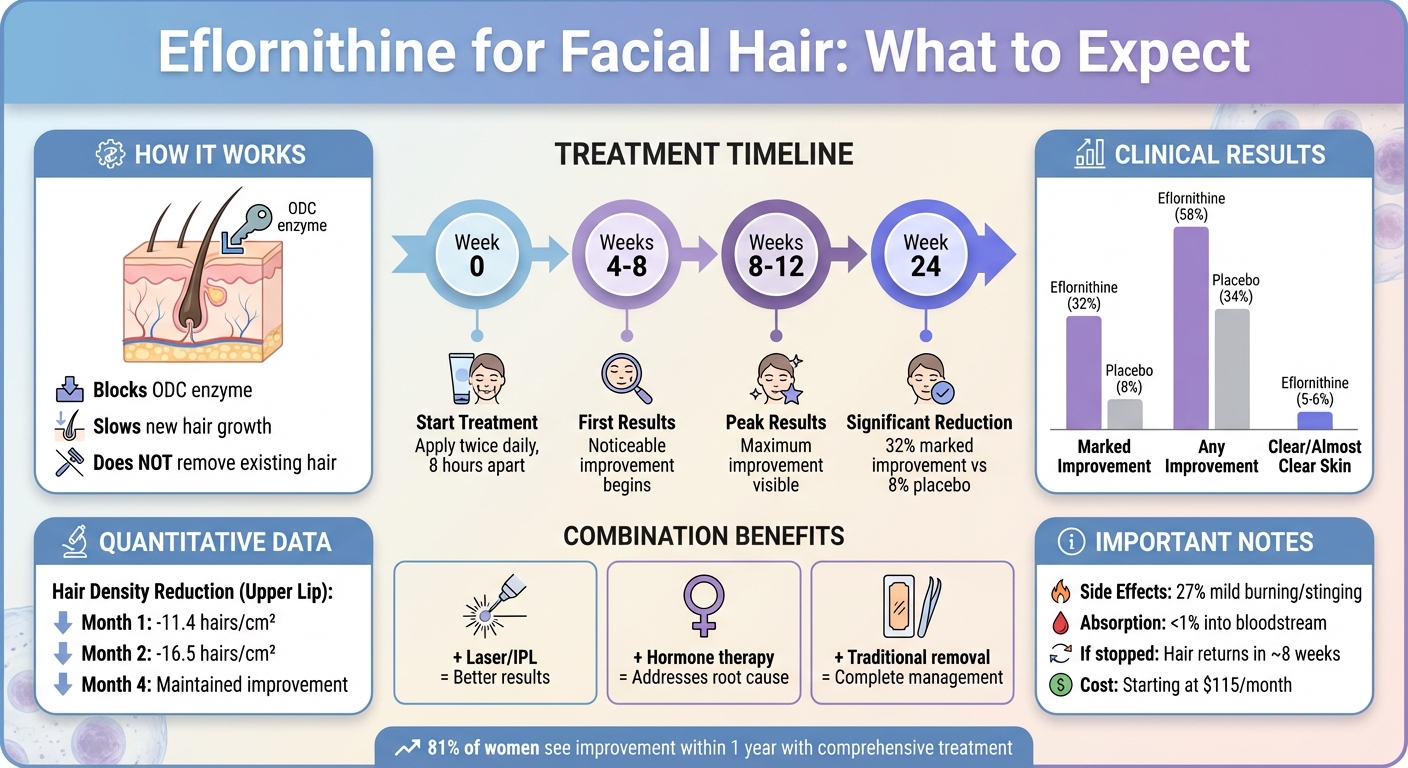
Eflornithine Treatment Timeline and Results for Facial Hair Reduction
How Eflornithine Works
Mechanism of Action
Eflornithine cream works by targeting an enzyme called ornithine decarboxylase (ODC) within hair follicles. This enzyme plays a key role in producing polyamines - compounds like putrescine, spermidine, and spermine - that drive rapid cell growth in the hair matrix. By blocking ODC, eflornithine reduces polyamine production, slowing the development of new hair shafts.
In a four-month study using an 11.5% cream applied twice daily, participants experienced noticeable decreases in both hair density and length. This process highlights how eflornithine impacts hair growth at its source.
What Eflornithine Does and Doesn't Do
Eflornithine doesn’t remove existing hair or permanently damage hair follicles. Instead, it slows the growth of new facial hair. Clinical trials showed that after 24 weeks of use, 27% to 35% of women reported visible improvement, with some seeing results in as little as four weeks. However, since it only affects new hair growth, traditional hair removal methods - like shaving, waxing, threading, or depilatory creams - are still needed during treatment.
Once treatment stops, hair growth typically returns to its normal rate within about eight weeks, as ODC activity gradually resumes. These findings guide how eflornithine is used in treatment plans, which often combine it with other hair removal techniques.
Standard Formulation and Uses
The most common formulation of eflornithine is a 13.9% cream, sold under the brand name Vaniqa. Research has also explored an 11.5% concentration, which showed similar results in reducing hair density and length within one to four months. Because the cream is absorbed minimally - less than 1% - when applied to small facial areas, it primarily works on the surface of the skin. This localized action contributes to its strong safety profile, making it a suitable option for long-term use.
Research on Effectiveness
Randomized Controlled Trials
Randomized, double-blind, placebo-controlled trials involving over 1,300 women have shown that topical eflornithine can significantly slow facial hair growth. In two key 24-week studies, participants applied a 13.9% eflornithine cream twice daily. Results revealed that around 32% of women saw marked improvement compared to just 8% using a placebo, while 58% experienced some level of improvement versus 34% on placebo. Noticeable benefits appeared within 2–8 weeks and peaked between 8–12 weeks. A smaller group - about 5% to 6% - achieved clear or almost clear skin.
Open-Label and Quantitative Studies
Open-label and quantitative studies have added further evidence of eflornithine's effectiveness. In a four-month open-label study, 25 women aged 25 to 63 applied an 11.5% eflornithine cream to their upper lip twice daily. Digital imaging showed a significant reduction in hair density within the first month, with an average decrease of 11.4 hairs per square centimeter (p = 0.014). By the second month, hair density dropped by 16.5 hairs/cm², and the improvement was maintained through the fourth month (p-values ranging from 0.014 to <0.001).
The study also measured cumulative hair length, which decreased by 7.10 mm at one month (p = 0.001), 10.05 mm at two months (p < 0.001), and 8.06 mm at four months (p = 0.001). While the rate of hair growth slowed significantly over the study period, there was no change in the average hair thickness. These findings suggest that eflornithine primarily reduces hair growth and density rather than affecting the thickness of individual hairs.
Safety, Side Effects, and How to Apply
Common Side Effects and Precautions
Topical eflornithine is known for its low absorption into the bloodstream (less than 1%), making it generally well-tolerated. However, like any medication, it can cause mild, localized side effects. The most frequent issue reported is a burning, stinging, or tingling sensation, affecting about 27% of users. This discomfort often decreases with regular use. Other possible reactions include acne or folliculitis (up to 15%), redness, dryness, rashes, and occasionally ingrown hairs. Clinical trials involving over 1,370 women showed that very few discontinued use, highlighting the cream's tolerability.
If irritation occurs, you can reduce applications to once a day and use a gentle, non-comedogenic moisturizer after the cream has dried. Avoid using the cream on broken, sunburned, or inflamed skin, and keep it away from your eyes, mouth, and other sensitive areas. Additionally, due to limited research on its effects during pregnancy and breastfeeding, it’s best to avoid using it in these situations. Proper application is essential to ensure both safety and effectiveness.
Application Process and Timeline
Using eflornithine correctly is key to achieving the best results. Apply a thin layer of the 13.9% cream to the affected facial areas twice daily, ensuring at least 8 hours between applications. Gently rub the cream until it’s absorbed, wash your hands afterward, and allow your skin to dry completely before applying makeup or sunscreen. To maximize its effectiveness, avoid washing the treated area for at least 4 hours after application.
You may start noticing results within 4 to 8 weeks, with some studies showing improvements as early as one month. For example, research documented an average reduction of 11.4 hairs per square centimeter on the upper lip after consistent use. However, keep in mind that eflornithine doesn’t eliminate hair completely - it slows new growth. You’ll still need to use your usual hair removal methods alongside the cream. If you stop applying it, hair growth will return to its original state within about 8 weeks.
sbb-itb-6dba428
Using Eflornithine with Other Treatments
Combining with Other Hair Removal Methods
Eflornithine works well alongside other hair removal techniques, especially for managing PCOS-related facial hair. While the cream slows down hair growth, it doesn’t remove existing hair, so you’ll still need to rely on traditional methods like shaving, plucking, waxing, or threading. The good news? Over time, you may find you need these methods less often.
To avoid irritation, make sure to apply eflornithine cream to clean, dry skin about 5–10 minutes after using any physical hair removal method.
Research has shown that combining eflornithine with laser or IPL treatments can lead to better results than using laser alone. In fact, two randomized controlled trials demonstrated that adding eflornithine to these treatments significantly reduced facial hair growth. Eflornithine slows the regrowth process, while laser and IPL target the hair follicles, delivering faster and longer-lasting results. One study found that women using IPL along with twice-daily eflornithine noticed measurable hair reduction within 8 weeks. For the best outcome, start applying eflornithine 1–2 weeks before your first laser session and continue the treatment between sessions.
For women dealing with PCOS or hormonal imbalances, eflornithine is often part of a broader treatment plan. Studies show that 27–35% of women see significant improvement after 24 weeks, compared to just 8–9% with a placebo. Doctors often pair eflornithine with hormone-focused treatments like combined oral contraceptives or anti-androgens to address the root hormonal issues while the cream improves the visible effects. However, steer clear of using eflornithine with strong retinoids, benzoyl peroxide, or alcohol-based products, as these can increase redness and irritation.
What’s more, these combination treatments are now easy to access through telehealth services.
Getting Eflornithine Through Oana Health
Oana Health makes it simple to get personalized eflornithine treatments for unwanted facial hair, all without leaving your home. After a quick online consultation with licensed professionals who review your health history and symptoms, your prescription can be shipped directly to you with free delivery.
Oana Health’s Hairless Hype treatment, starting at $115/month, blends eflornithine, metformin lotion, and azelaic acid to slow hair growth. Clinical studies report results in as little as 8 weeks, with 81% of women seeing noticeable improvement within a year [1]. For more details about eflornithine treatment options, check out this page.
Here’s what users are saying:
"It's been a little over 5 weeks, and I've noticed a dramatic reduction in my facial hair growth. This has been such a relief for me. You really have to stick with it and be patient to notice results!"
– Allison L., Hairless Hype user [1]
Oana Health also offers additional hormonal support treatments, including oral metformin ER (starting at $22/month) and spironolactone (starting at $14/month). All prescriptions come from FDA-regulated pharmacies, with automatic refills and ongoing support to help you stay consistent with your regimen.
"Oana's telehealth service is fantastic! It's helped manage my insulin levels and reduce excess hair growth I was experiencing due to PCOS. I'm recommending this to all my friends with PCOS."
– Victoria A., Hairless Hype user [1]
Conclusion
Topical eflornithine provides a well-researched option for managing unwanted facial hair, especially for women dealing with hormonal imbalances linked to PCOS. Clinical studies show noticeable results within 4–8 weeks, with significant improvement achieved after 24 weeks of consistent use. This positions eflornithine as an important part of a broader hair management strategy.
While eflornithine effectively slows new hair growth, it works best when combined with other methods like hair removal techniques or hormone therapies. It’s not a standalone fix - you’ll still need to rely on shaving, plucking, or waxing. For optimal results, many experts recommend pairing it with laser or IPL treatments, as research shows this combination can extend the time between regrowth sessions. For women whose excess facial hair stems from hormonal issues - a condition affecting over 20 million women in the U.S. - combining eflornithine with hormone therapies, such as oral contraceptives or anti-androgens, tackles both the symptoms and the root cause. Additionally, eflornithine is generally well-tolerated, with only minor side effects like mild redness or stinging reported by most users.
Access to this comprehensive approach has become easier with telehealth services like Oana Health. These platforms provide personalized prescriptions, free delivery, and ongoing support - all without requiring in-person appointments.
Looking for a science-backed solution to control unwanted facial hair? Oana Health’s Hairless Hype combines eflornithine with metformin lotion and azelaic acid, delivering significant improvements for 81% of women within a year[1]. Starting at $115 per month, it offers a convenient and effective option shipped directly to your door. Learn more about eflornithine treatment options here.
FAQs
How quickly does eflornithine cream work to reduce facial hair growth?
Eflornithine cream generally begins to deliver visible results after about 8 weeks of consistent use. For many, more pronounced changes may take anywhere from 6 to 12 months. Sticking to the application schedule recommended by your healthcare provider is essential to seeing optimal outcomes.
Is it safe to use eflornithine while pregnant or breastfeeding?
The safety of eflornithine during pregnancy or while breastfeeding remains uncertain. If you're pregnant, planning to become pregnant, or nursing, it's crucial to discuss this medication with your healthcare provider first. Following professional medical advice is essential to protect both your health and your baby's well-being.
What side effects can occur when using eflornithine cream?
Using eflornithine cream might result in mild skin irritation, including redness, itching, or a slight burning sensation where it's applied. Though uncommon, some individuals could experience allergic reactions or more serious skin problems, such as infections. If you notice any unusual or lasting symptoms, be sure to reach out to a healthcare professional for advice.