
How Vitamin D Impacts PCOS and Insulin Resistance
Vitamin D plays a key role in managing PCOS and improving insulin resistance. Studies show that 67% to 85% of women with PCOS have a vitamin D deficiency, and this deficiency worsens insulin resistance - a condition affecting up to 70% of women with PCOS. Low vitamin D levels reduce insulin sensitivity, disrupt glucose metabolism, and contribute to hormonal imbalances, leading to symptoms like irregular periods, weight gain, and excess androgen production.
Key takeaways:
- Vitamin D deficiency worsens insulin resistance by impairing pancreatic function and reducing insulin receptor activity.
- Supplementation with 2,000–4,000 IU daily can improve fasting blood glucose, insulin levels, and cholesterol.
- Women with PCOS and a higher BMI may need higher doses or weekly supplementation (e.g., 50,000 IU weekly).
- Testing and tracking vitamin D levels (ideal range: 30–50 ng/mL) are essential for personalized treatment.
Research highlights include improved insulin sensitivity, reduced androgen levels, and better menstrual regularity with consistent vitamin D supplementation over 8–12 weeks. Addressing vitamin D deficiency is a practical and effective step toward managing PCOS and its metabolic challenges.
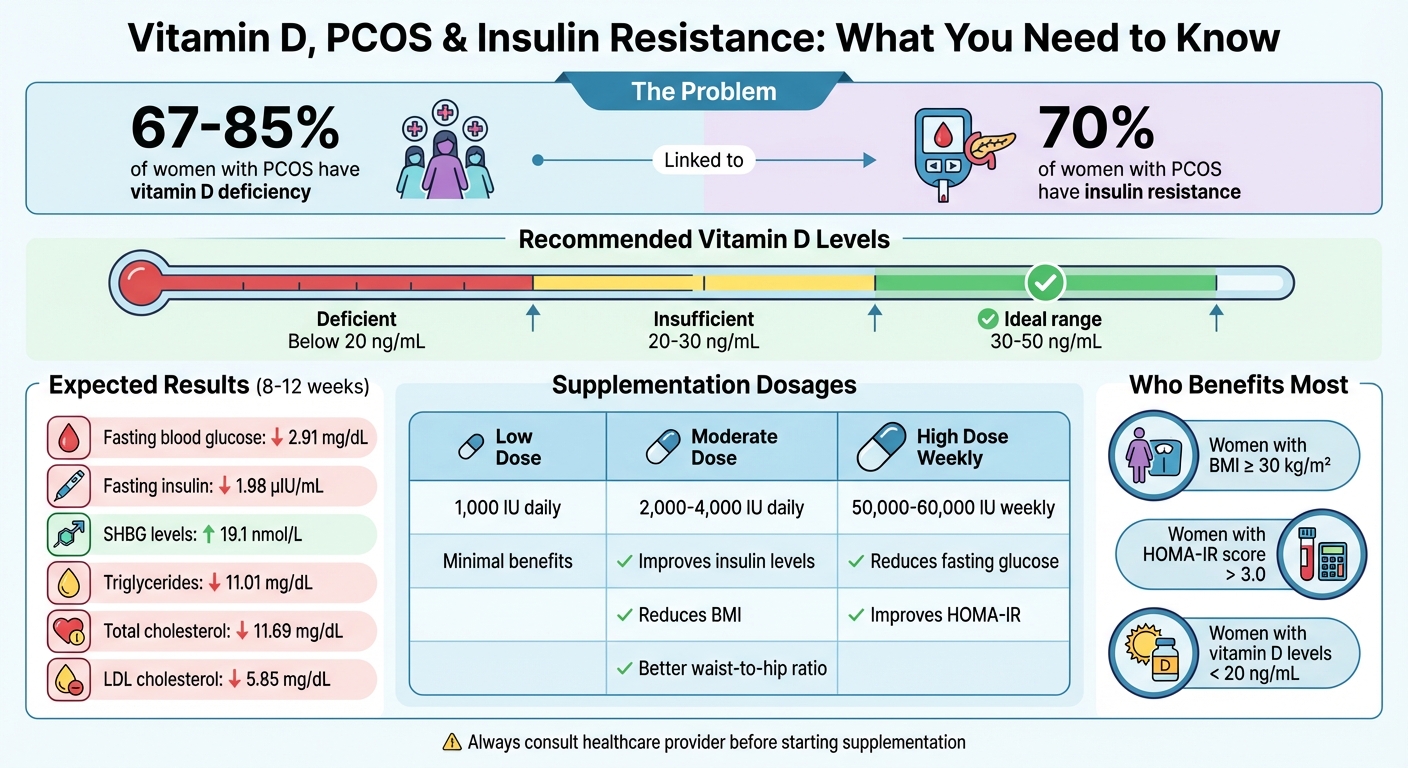
Vitamin D Deficiency and PCOS: Key Statistics and Supplementation Guidelines
What You Need to Know About PCOS and Insulin Resistance
What is PCOS?
Polycystic Ovary Syndrome (PCOS) is a disorder that affects both reproductive and metabolic systems, impacting 4% to 10% of women of reproductive age in the U.S., and as many as 20% of women worldwide. To diagnose PCOS, at least two of the following must be present: elevated androgen levels, irregular menstrual cycles, or polycystic ovaries.
Symptoms often include irregular periods (cycles lasting more than 35 days), acne, thinning hair on the scalp, and weight gain, particularly around the abdomen. About 60% of women with PCOS also experience hirsutism, which is unwanted hair growth on areas like the face, chest, or back. In some cases, women develop acanthosis nigricans - darkened patches of skin on the neck or armpits - indicating severe insulin resistance.
These hormonal and metabolic changes are deeply tied to insulin's role in PCOS.
How PCOS and Insulin Resistance Are Connected
To fully understand PCOS, it’s crucial to grasp how insulin resistance plays into its symptoms.
Insulin resistance is a major factor driving PCOS. When tissues become less responsive to insulin, the pancreas compensates by producing more, leading to hyperinsulinemia. This elevated insulin not only disrupts blood sugar regulation but also directly triggers the ovaries to produce more testosterone.
"Insulin functions as a co-gonadotropin through its cognate receptor to modulate ovarian steroidogenesis." – Evanthia Diamanti-Kandarakis and Andrea Dunaif
Excess insulin fuels androgen production, which then worsens insulin resistance in a cycle. Additionally, high insulin levels reduce sex hormone-binding globulin (SHBG), increasing free testosterone and intensifying symptoms.
Although insulin resistance is often linked to weight, it can occur in women with PCOS regardless of their body weight. However, being overweight can amplify both the metabolic and reproductive challenges of PCOS. This hormonal imbalance disrupts ovulation, leading to irregular periods and making PCOS one of the most common causes of infertility in women.
How Vitamin D Affects PCOS and Insulin Resistance
Vitamin D's Effect on Insulin Sensitivity
Vitamin D plays a key role in improving insulin sensitivity by increasing the expression of insulin receptors, which helps cells absorb glucose more efficiently. This happens because vitamin D activates the Vitamin D Response Element in the insulin gene promoter, directly influencing how the body processes glucose. Beyond this, it also regulates calcium levels, a critical factor for insulin secretion and glucose uptake in skeletal muscle and fat tissue.
Pancreatic β-cells - responsible for producing insulin - are equipped with Vitamin D receptors and the enzyme needed to convert vitamin D into its active form. Adequate levels of vitamin D not only support these cells' function but also help extend their lifespan. Additionally, vitamin D reduces inflammation by suppressing pro-inflammatory cytokines, which are known to contribute to insulin resistance. With Vitamin D receptors present in over 30 tissues, it also influences genes involved in insulin signaling and glucose metabolism.
"Vitamin D may have a beneficial effect on insulin action by stimulating the expression of insulin receptor and thereby enhancing insulin responsiveness for glucose transport." – Middle East Fertility Society Journal
This improved receptor activity highlights why low vitamin D levels can pose significant challenges to metabolic health.
What Happens When Vitamin D Levels Are Too Low
When vitamin D levels drop, the processes that support insulin sensitivity begin to falter. A deficiency reduces the production of insulin receptors, making the body less effective at responding to glucose. Calcium signaling also becomes impaired, disrupting insulin secretion from the pancreas, which can lead to elevated blood sugar levels.
Since vitamin D is fat-soluble, it can get stored in fat tissue, reducing its availability in the bloodstream. This is particularly relevant for obese women with PCOS, who tend to have much lower vitamin D levels (around 8.9 nmol/L) compared to lean women (26.5 nmol/L). Low vitamin D is also linked to higher BMI, increased waist circumference (over 31 inches), and higher waist-to-hip ratios.
The effects of vitamin D deficiency extend to fertility and menstrual health. Low levels interfere with enzymes involved in sex hormone production, leading to increased androgens and reduced Sex Hormone-Binding Globulin (SHBG). This imbalance can worsen symptoms like acne and excess facial hair. Additionally, vitamin D deficiency affects ovarian cells' response to anti-müllerian hormone (AMH) and follicle-stimulating hormone (FSH), which can disrupt ovulation and cause irregular menstrual cycles.
"Vitamin D prevents epigenetic alterations associated with IR, and vitamin D deficiency is one of the factors accelerating IR formation." – Journal of Ovarian Research
What Research Shows About Vitamin D Supplementation
Research Findings on Vitamin D and PCOS
Vitamin D supplementation has been shown to improve metabolic health for women with PCOS, especially those who are obese or insulin-resistant. Recent studies back up earlier findings, highlighting consistent metabolic improvements. For instance, researchers at the First Affiliated Hospital of Xi'an Jiaotong University examined 60 women with PCOS between January 2021 and June 2023. Participants took 2,000 IU of vitamin D daily for 12 weeks, resulting in lower BMI, waist-to-hip ratios, and HOMA-IR scores. The most noticeable changes were observed in women who were either obese or already insulin-resistant.
"Vitamin D supplementation had beneficial effects on metabolic parameters in PCOS women, especially in women with obesity or insulin resistance." – Journal of Ovarian Research
Vitamin D also plays a role in hormone regulation. A study led by Dr. Mehri Jamilian at the Kosar Clinic in Arak, Iran, focused on 90 insulin-resistant women with PCOS. Those who took 4,000 IU daily saw a 0.2 ng/mL decrease in total testosterone and a 19.1 nmol/L increase in SHBG, outperforming both the 1,000 IU and placebo groups. Additionally, the higher dose led to a 1.1-point reduction in hirsutism scores over 12 weeks, compared to just a 0.1-point reduction in the placebo group.
Beyond its effects on glycemic control, vitamin D improves lipid profiles. Studies show that supplementation can lower triglycerides by 11.01 mg/dL, total cholesterol by 11.69 mg/dL, and LDL cholesterol by 5.85 mg/dL. One study from New Delhi found that 50 women taking 60,000 IU weekly experienced a drop in HOMA-IR from 2.38 to 1.00 over 12 weeks, alongside enhanced insulin sensitivity as measured by QUICKI.
These findings highlight the importance of proper supplementation strategies, which are explored in the next section.
Recommended Vitamin D Dosages
Based on research, specific dosages are recommended to target different metabolic benefits. Daily doses ranging from 1,000 to 4,000 IU improve insulin sensitivity, with 4,000 IU showing the most pronounced effects. According to the Food and Nutrition Board of the National Academy of Sciences, 4,000 IU daily is the highest safe dose for the general population without adverse effects.
For women with severe vitamin D deficiency, high-dose weekly supplementation is another effective option. Studies using 50,000 IU to 60,000 IU weekly over 12 weeks have consistently shown reductions in fasting blood glucose and improved insulin resistance. This method may be particularly beneficial for those who find daily supplementation challenging.
The table below summarizes the key benefits of various dosage strategies:
| Dosage Type | Amount | Key Benefits |
|---|---|---|
| Low Dose | 1,000 IU daily | Minimal hormonal and insulin benefits |
| Moderate Dose | 2,000–4,000 IU daily | Improvements in insulin levels, BMI, and waist-to-hip ratio |
| High Dose Weekly | 50,000–60,000 IU weekly | Reductions in fasting glucose and HOMA-IR |
Women with a BMI of 30 kg/m² or higher often see the greatest metabolic improvements from vitamin D supplementation. Since 67% to 85% of women with PCOS are estimated to be vitamin D deficient, it’s a good idea to test your vitamin D levels before starting supplementation to determine the most suitable dosage for your needs.
How to Improve Your Vitamin D Levels
Getting Your Vitamin D Levels Tested
Before diving into supplementation, it’s essential to know where your vitamin D levels stand. This can be determined through a blood test measuring serum 25(OH)D levels.
Ask your healthcare provider for this test to establish your baseline. For women with PCOS, the ideal range is between 30 and 50 ng/mL. If your levels are below 20 ng/mL, you’re considered deficient, while levels between 20 and 30 ng/mL are classified as insufficient. Since 67% to 85% of women with PCOS experience vitamin D deficiency, testing is especially important if you’re dealing with insulin resistance or other metabolic challenges.
Additionally, consider requesting a HOMA-IR test to assess insulin resistance. A score above 3.0 suggests insulin resistance. Keeping track of these markers is crucial for managing PCOS-related metabolic issues. With consistent supplementation, you can expect to see measurable changes within 8–12 weeks.
Choosing and Taking Vitamin D Supplements
Your dosage should align with your current vitamin D levels and BMI. Studies suggest that daily doses under 4,000 IU may improve insulin resistance more effectively than larger weekly doses, likely because of better absorption.
For women with PCOS and insulin resistance, starting with 2,000 to 4,000 IU daily is a good approach. If you have a higher BMI, you may need larger doses since vitamin D’s bioavailability can decrease by as much as 57% in individuals with obesity. In cases of severe deficiency, some women may require 50,000 IU weekly for 12 weeks, but only under medical supervision.
Pairing vitamin D with 1,000 mg of calcium daily can further support menstrual regularity and ovulation. While it’s possible to get vitamin D from food - like cod liver oil (1,360 IU per tablespoon), salmon (447 IU per 3 ounces), or fortified milk (115–124 IU per cup) - supplements are often necessary to reach therapeutic levels.
For a more personalized approach, consider telehealth services.
Getting Treatment Through Oana Health

In addition to supplementation, professional guidance can significantly improve outcomes. Oana Health specializes in telehealth services tailored for women with PCOS and insulin resistance. Their licensed medical professionals review your health history and create a customized treatment plan to address vitamin D deficiency and related metabolic issues.
Oana Health doesn’t stop at vitamin D optimization. They also provide access to prescription medications that complement supplementation. For example, Metformin ($22/month) is an insulin sensitizer that, when combined with vitamin D and calcium, can help improve menstrual cycles and ovulation. For hormonal symptoms like unwanted hair growth or hair loss, Oana Health offers Spironolactone ($14/month) or combination treatments such as Metformin & Spironolactone ($32/month).
All treatments are shipped directly to your home for free, and the platform makes it easy to track your progress over time. This integrated approach - combining supplementation, prescription medications, and ongoing monitoring - tackles the root causes of PCOS and insulin resistance, rather than just managing the symptoms.
sbb-itb-6dba428
Tracking Your Progress and What to Expect
Health Metrics to Monitor
Once you begin taking vitamin D supplements, keeping an eye on specific health markers can help you measure how well the treatment is working. One key metric is your HOMA-IR score, which is calculated using your fasting glucose and insulin levels. If your score is above 3.0, it usually indicates insulin resistance. Over an 8–12 week period, you may see this score improve.
Another important area to watch is your lipid profile, focusing on triglycerides, total cholesterol, and LDL levels. Additionally, track menstrual cycle regularity and symptoms of hirsutism using tools like the modified Ferriman-Gallwey score.
For body composition, consider monitoring your Waist-to-Hip Ratio (WHR) rather than solely relying on changes in scale weight. Vitamin D can influence fat distribution even if your overall weight remains steady. You might also want to check inflammatory markers, such as hs-CRP, and Sex Hormone-Binding Globulin (SHBG) levels. Research suggests SHBG levels can increase significantly - by about 19.1 nmol/L compared to just 0.7 nmol/L in placebo groups.
These specific health markers provide a clear way to track your progress and understand how your body is responding to vitamin D supplementation.
What Results to Expect Over Time
Vitamin D plays a role in improving insulin sensitivity and stabilizing metabolic markers, and many women notice measurable changes within 8 to 12 weeks of consistent supplementation. During this time, serum 25(OH)D levels gradually increase, fasting blood glucose levels tend to drop by around 2.91 mg/dL, and fasting insulin levels decrease by approximately 1.98 µIU/mL.
Physical symptoms often improve along with these metabolic shifts. For instance, a study conducted at King Abdullah University Hospital in Jordan observed significant benefits among 60 overweight women with PCOS who took 50,000 IU of vitamin D weekly for 12 weeks. These women experienced notable reductions in hirsutism scores (P < 0.001), smaller ovarian volumes, and more regular menstrual cycles. Another study highlighted that about 30% of women with previously irregular periods reported improved menstrual frequency after 12 weeks of treatment. However, individual results can vary, partly due to differences in Vitamin D Receptor gene variations.
Vitamin D Benefits During PCOS | Dr. Nupur Gupta
Conclusion
Vitamin D plays a key role in managing PCOS and insulin resistance by improving insulin sensitivity, reducing inflammation, and supporting hormonal balance. Its effects on insulin processing and reproductive hormones are well-documented, offering a path to better metabolic and hormonal health.
Research shows that consistent vitamin D supplementation can lead to noticeable improvements in metabolic markers and symptoms, such as irregular periods and excess hair growth, often within 8 to 12 weeks of starting supplementation.
The first step is to check your vitamin D levels with a simple blood test. From there, a personalized approach is essential, as factors like your metabolic profile, BMI, and baseline vitamin D levels can influence how you respond to supplementation.
If you're ready to address a potential vitamin D deficiency, Oana Health provides tailored, prescription-based treatments delivered to your door. With plans starting at $22 per month, their licensed medical professionals can help you find the right dosage and track your progress using precise health metrics.
Taking control of your vitamin D levels is a practical step toward managing PCOS and insulin resistance. Start today by assessing your vitamin D status and creating a focused plan to support your long-term metabolic health.
FAQs
How does a lack of vitamin D impact insulin resistance in women with PCOS?
Vitamin D plays an important role in tackling insulin resistance, a common issue for women with PCOS. Studies have found that low vitamin D levels are associated with increased insulin resistance, making it harder for the body to manage blood sugar effectively. By improving vitamin D levels, there’s potential to enhance insulin sensitivity and promote better metabolic health.
To increase your vitamin D levels, try spending more time in the sun, adding foods like fatty fish or fortified dairy products to your meals, or consulting a healthcare provider about supplements. Taking steps to address vitamin D deficiency can make a meaningful difference in managing PCOS and supporting overall health.
What is the recommended daily dose of vitamin D for women with PCOS?
For women dealing with PCOS, taking vitamin D supplements is often suggested in doses ranging from 2,000 to 4,000 IU per day, tailored to individual requirements and deficiency levels. In more severe cases, a healthcare provider might recommend 50,000 IU weekly, but this should always be done under medical supervision.
Speaking with a healthcare professional is crucial to figure out the right dosage for your unique health needs and current vitamin D levels. Keeping vitamin D levels within the optimal range can help improve insulin sensitivity and promote better hormonal balance - both essential for managing PCOS symptoms effectively.
How long does it take for vitamin D to improve PCOS symptoms like insulin resistance?
Women dealing with PCOS might start to see positive changes in insulin resistance and metabolic health after roughly 12 weeks of regularly taking vitamin D. Research indicates that a daily dose of about 2,000 IU of vitamin D can help lower insulin levels, BMI, and HOMA-IR - key indicators of metabolic health.
To achieve the best outcomes, it’s essential to consult a healthcare provider. They can help determine the right dosage for your specific needs and monitor your vitamin D levels. Correcting a vitamin D deficiency can play an important role in managing PCOS symptoms and boosting overall health.