
Advanced Imaging for PCOS and Insulin Resistance
PCOS affects up to 21% of women of reproductive age in the U.S., with insulin resistance at its core. This condition disrupts hormonal balance, leading to irregular periods, excessive hair growth, and fertility challenges. Imaging and diagnostic tools like ultrasounds, AMH testing, and advanced techniques such as MRI now play a key role in diagnosing PCOS and guiding treatment.
Key takeaways include:
- Insulin resistance impacts up to 80% of women with PCOS, regardless of weight.
- Ultrasound is the primary diagnostic tool for identifying polycystic ovary morphology (PCOM).
- AMH testing offers a non-invasive alternative to follicle counts.
- Wrist circumference is emerging as a simple marker for insulin resistance, especially for lean women.
- Advanced imaging methods like 3D ultrasound and MRI allow for more precise diagnosis and monitoring.
These tools, combined with metabolic tests, help tailor treatments such as metformin, GLP-1 medications, and lifestyle changes, improving both reproductive and metabolic health.
Main Imaging Techniques for PCOS and Insulin Resistance
Ultrasound for Detecting Polycystic Ovaries
Transvaginal ultrasound is the go-to method for identifying polycystic ovary morphology (PCOM). It provides detailed images that allow for accurate follicle counts and measurements of ovarian volume. According to the Rotterdam criteria, a polycystic ovary is defined as having 12 or more follicles (2–9 mm) or an ovarian volume greater than 10 cm³. However, with advancements in ultrasound technology, updated guidelines now recommend a threshold of 20 or more follicles per ovary when using high-frequency transducers, with some experts suggesting 25 to minimize overdiagnosis.
The connection between ultrasound findings and insulin resistance lies in how elevated insulin levels affect hormone production. High insulin stimulates ovarian theca cells to produce more androgens while amplifying the effects of luteinizing hormone (LH). This disrupts normal egg development, leading to follicular arrest and the classic "string of pearls" appearance on ultrasound. Other indicators, such as increased ovarian stromal echogenicity and altered blood flow patterns on Doppler imaging, may also be present.
"Evidence suggests that the underlying disorder of polycystic ovary disease is insulin resistance, with the elevated insulin levels stimulating excess ovarian androgen production." – Medscape
Timing plays a crucial role in obtaining accurate ultrasound results. The exam should ideally be done when dominant follicles or corpora lutea are absent to ensure precise volume measurements. In adolescents within eight years of menarche, ultrasound is generally avoided, as multi-follicular ovaries are a normal finding during this period. Imaging reports should document ovarian volumes and antral follicle counts clearly, avoiding vague terms like "polycystic appearance".
Ultrasound findings work hand-in-hand with biochemical tests, such as Anti-Müllerian Hormone (AMH) measurements, to provide a full picture of ovarian health.
Anti-Müllerian Hormone (AMH) Testing
AMH testing is a simple blood test that offers a non-invasive way to assess PCOM. This hormone, secreted by small ovarian follicles, directly correlates with antral follicle count. The 2023 International Evidence-Based Guidelines for PCOS now recognize elevated AMH levels as a diagnostic criterion, either alongside or as an alternative to ultrasound follicle counts.
Machine learning models that combine clinical data, ultrasound results, and AMH levels have shown impressive diagnostic accuracy, achieving an Area Under the Curve (AUC) of 0.9947 and an accuracy of 95.53% for identifying PCOS. This makes AMH testing especially valuable for adolescents, where transvaginal imaging may not be suitable due to normal pubertal changes.
"The number of ovarian antral follicles is closely correlated with AMH levels, making a high level of AMH a potential PCOS biomarker." – Anagha Joshi, Computational Biology Unit, University of Bergen
While AMH reflects ovarian function rather than insulin resistance, it plays a key role in identifying the reproductive symptoms of PCOS, such as irregular menstrual cycles and elevated LH. However, a challenge remains in standardizing AMH cut-off values globally, as these can differ by laboratory and manufacturer.
When paired with ultrasound, AMH testing provides a well-rounded approach to evaluating ovarian function in PCOS.
Hyperinsulinemic Euglycemic Clamp Testing
Although not an imaging technique, the hyperinsulinemic euglycemic clamp (EHC) test is the gold standard for assessing insulin resistance. It offers essential metabolic insights to complement imaging findings.
The EHC involves infusing insulin at a steady rate (usually 40 mU/min·m²) to suppress liver glucose production and stimulate muscle glucose uptake. Simultaneously, glucose is infused at a variable rate to maintain blood sugar around 100 mg/dL. The test measures insulin sensitivity using the "M-value", which reflects the amount of glucose required to maintain stable blood sugar levels. A lower M-value indicates greater insulin resistance, with a common cutoff being less than 5 mg/min·kg of fat-free mass.
"The hyperinsulinemic euglycemic clamp technique is the gold standard method for assessing beta-cell sensitivity in humans, quantifying the amount of glucose metabolized by the body following a controlled hyperglycemic stimulus." – Chantal Anifa Amisi, Senior Researcher, Universita Campus Bio-medico di Rome
Despite its accuracy, the clamp test is complex and time-intensive, making it impractical for routine clinical use. The procedure lasts 2–5 hours, requires specialized equipment, and includes 30–120 minutes of monitoring afterward to prevent hypoglycemia. Patients are typically advised to eat a carbohydrate-rich meal post-test. As a result, the clamp test is mainly reserved for research, such as evaluating treatments like metformin or lifestyle interventions in women with PCOS. For everyday clinical practice, simpler markers like HOMA-IR, derived from a single fasting blood sample, are more commonly used.
sbb-itb-6dba428
New Imaging Markers and Methods
Wrist Circumference as an Insulin Resistance Marker
Wrist circumference (WrC) is gaining attention as a practical indicator for detecting insulin resistance in women with PCOS. Unlike traditional metrics like BMI or waist circumference, which focus on fat distribution, WrC acts as a bone-based marker, reflecting the connection between skeletal health and glucose metabolism. Elevated insulin levels, a hallmark of insulin resistance, can stimulate bone mass growth, with bone tissue producing osteocalcin - a hormone that regulates blood sugar and boosts insulin sensitivity. This makes WrC particularly useful for identifying metabolic issues in lean women with PCOS, where fat-based measures might fall short.
"Non-dominant wrist circumference is, to date, the best anthropometrical marker of IR in Sub-Saharan African women with PCOS. It could be suggested as an easy-to-detect marker for assessing IR." – Chantal Anifa Amisi, Endocrinology and Diabetes Unit, Universita Campus Bio-medico di Rome
Research involving Sub-Saharan African and Iranian women has shown that a non-dominant wrist circumference of 15.7–16.3 cm can predict insulin resistance with an accuracy of up to 72%, correlating significantly with HOMA-IR scores. This method is cost-effective and straightforward, making it ideal for primary care settings. Additionally, integrating WrC measurements with advanced imaging techniques could further improve diagnostic precision.
What's Next in PCOS Imaging
Advancements in imaging technology are pushing PCOS diagnostics beyond basic anthropometric tools, offering insights into both ovarian structure and function. One innovative technique, Intravoxel Incoherent Motion (IVIM) imaging, uses MRI to distinguish water molecule diffusion from blood flow. Research conducted at Jinshan Hospital demonstrated that combining IVIM imaging with follicle counts increased diagnostic accuracy, achieving an AUC of 0.94. According to lead researcher Jinwei Qiang, this integrated approach can help differentiate PCOS from other conditions with similar ultrasound features and limitations.
Other emerging imaging methods are also contributing to more precise diagnostics. For instance:
- 3D Ultrasound: Provides more accurate ovarian volume measurements compared to traditional 2D techniques.
- Elastography: Evaluates tissue stiffness, helping distinguish polycystic ovaries from other abnormalities.
- Contrast-Enhanced Ultrasound: Detects subtle vascular changes often missed in standard scans.
Artificial intelligence is stepping into this space as well. Machine learning algorithms are beginning to merge clinical data, lab results, and imaging findings into unified diagnostic profiles. This could lead to earlier detection and help minimize inconsistencies tied to operator-dependent techniques.
In addition to imaging, composite markers like the Visceral Adiposity Index (VAI), Dysfunctional Adiposity Index (DAI), and the waist-to-height ratio are proving effective for assessing metabolic risks. Studies report AUCs of 0.86–0.87 for these markers, along with specific thresholds for risk evaluation. Together, these advancements are enhancing early detection and personalized management of PCOS-related insulin resistance.
Ovary Ultrasound Normal Vs Polycystic Ovarian Syndrome (PCOS) Images | String Of Pearls Sign Ovaries
Comparing Imaging Techniques for PCOS and Insulin Resistance
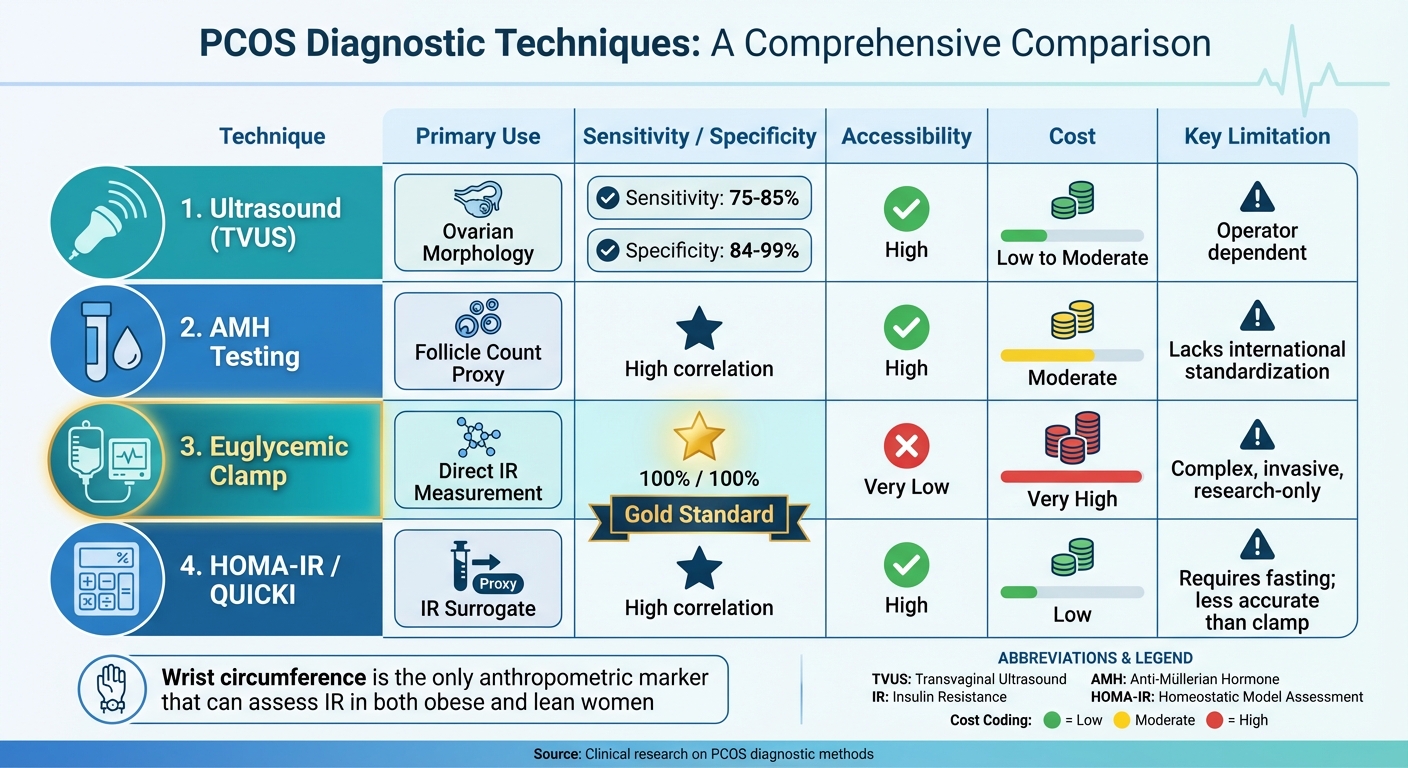
PCOS Diagnostic Techniques Comparison: Ultrasound, AMH Testing, and Clamp Testing
Pros and Cons of Ultrasound, AMH, and Clamp Testing
Diagnosing PCOS and insulin resistance requires a careful balance between precision, practicality, and accessibility.
Transvaginal ultrasound (TVUS) is the go-to method for identifying polycystic ovarian morphology. When a threshold of ≥12 follicles (2–9 mm in diameter) is used, it achieves around 75% sensitivity and 99% specificity. If ovarian volume exceeds 10 cm³, sensitivity increases to 81%, though specificity drops slightly to 84%. Using high-frequency probes (≥8 MHz) with a threshold of 26 follicles further boosts sensitivity to 85% and specificity to 94%. However, about 30% of patients diagnosed biochemically with PCOS may not exhibit increased ovarian volume on ultrasound.
Anti-Müllerian Hormone (AMH) testing offers a biochemical alternative to follicle counting, showing a strong correlation with antral follicle numbers. Unlike ultrasound, it doesn’t rely on operator expertise and only requires a simple blood draw, making it more accessible. The main drawback is the inconsistency caused by the lack of global standardization in hormone assays, which can lead to variable results between labs. While AMH testing is convenient, it doesn’t replace the precision of direct insulin sensitivity measures.
The hyperinsulinemic euglycemic clamp is considered the gold standard for assessing insulin sensitivity, providing unmatched accuracy.
"The hyperinsulinemic euglycemic clamp technique is the gold standard method for assessing beta-cell sensitivity in humans, quantifying the amount of glucose metabolized by the body"
Despite its precision, this method is complex, expensive, and time-consuming, making it impractical for routine use. It’s primarily reserved for research purposes. Instead, clinical settings often rely on surrogate markers like HOMA-IR and QUICKI, which are more accessible and still correlate strongly with clamp results.
Here’s a quick comparison of these techniques:
| Technique | Primary Use | Sensitivity/Specificity | Accessibility | Cost | Key Limitation |
|---|---|---|---|---|---|
| Ultrasound (TVUS) | Ovarian Morphology | 75–85% / 84–99% | High | Low to Moderate | Operator dependent |
| AMH Testing | Follicle Count Proxy | High correlation | High | Moderate | Lacks international standardization |
| Euglycemic Clamp | Direct IR Measurement | 100% / 100% | Very Low | Very High | Complex, invasive, research-only |
| HOMA-IR/QUICKI | IR Surrogate | High correlation | High | Low | Requires fasting; less accurate than clamp |
For lean PCOS patients, where traditional fat-based markers might not be as effective, wrist circumference has emerged as a reliable indicator.
"Wrist circumference is, to date, the only anthropometric marker that can assess IR in both obese and lean women"
This simple, no-cost measurement often outperforms BMI and waist circumference in detecting insulin resistance, making it especially useful in primary care. Choosing the right diagnostic method based on a patient’s unique needs can enhance imaging assessments and help tailor treatment strategies effectively.
Oana Health: Supporting Insulin Resistance Management

Personalized Treatments for PCOS and Insulin Resistance
After an advanced imaging assessment and precise diagnosis, effective treatment for PCOS and insulin resistance requires a personalized approach. Oana Health simplifies this process by connecting women with PCOS to licensed physicians through its telehealth platform. These physicians provide evidence-based prescriptions, delivered straight to patients' homes. Considering that 35% to 80% of women with PCOS experience insulin resistance regardless of their body mass index, customized interventions are critical for addressing both metabolic and reproductive challenges.
Metformin is a key player in managing insulin resistance. It works by reducing glucose production in the liver and enhancing insulin sensitivity in muscle and fat cells. Oana Health offers Oral Metformin ER at $22/month, or as a combination with Spironolactone for $32/month, targeting both insulin resistance and hormonal imbalances. For advanced care, Oral Semaglutide, a GLP-1 medication, is available at $199/month. This treatment addresses the compensatory hyperinsulinemia linked to PCOS, helping regulate menstrual cycles and lower androgen levels. These therapies are carefully aligned with diagnostic insights from clinical markers and imaging.
To address hair loss and excessive facial hair, Oana Health provides Topical Spironolactone ($43/month), Oral Minoxidil ($25/month), and Eflornithine 12% ($69/month). These options ensure a comprehensive treatment plan that incorporates findings from diagnostic tools such as ultrasounds, AMH testing, or measurements like wrist circumference.
Accessible Telehealth Services
Oana Health's telehealth platform makes this personalized care even more accessible. Traditional PCOS treatment often involves numerous visits and extensive lab work. By contrast, Oana Health offers a streamlined, fully online process that includes a quick consultation, physician review, and free prescription delivery. This approach is especially beneficial for patients who face challenges accessing specialized endocrine care.
Using Imaging in Clinical Practice
When to Use Imaging for PCOS
Imaging should be used thoughtfully when evaluating polycystic ovary syndrome (PCOS). A transvaginal ultrasound isn't necessary if a patient already meets two of the three Rotterdam criteria - specifically, irregular menstrual cycles combined with clinical or biochemical signs of hyperandrogenism. In these cases, imaging adds no value to the diagnosis.
However, ultrasound becomes essential when only one diagnostic criterion is present. For instance, if a woman has irregular periods but no clear signs of hyperandrogenism, imaging can confirm the presence of polycystic ovarian morphology (PCOM) to complete the diagnosis using established thresholds.
Imaging also helps rule out other conditions. For symptoms like sudden onset or severe virilization, an ultrasound can check for androgen-secreting tumors. Additionally, women experiencing amenorrhea for over 90 days should have their endometrial thickness evaluated, as PCOS patients face a 2–6 times higher risk of endometrial cancer. In adolescents within 8 years of menarche, avoid using ultrasound to prevent misdiagnosis.
Once imaging confirms structural findings, these results should be paired with metabolic tests to guide treatment decisions.
Pairing Imaging Results with Treatment Plans
After confirming structural abnormalities with imaging, the next step involves metabolic assessments to tailor treatment. For women diagnosed with PCOS, a 2-hour Oral Glucose Tolerance Test (OGTT) is recommended for all, regardless of body mass index (BMI). This is crucial because insulin resistance affects about 75% of lean women and 95% of overweight women with PCOS. Combining imaging results with metabolic testing helps identify the patient’s specific PCOS phenotype and insulin resistance profile.
For lean patients, wrist circumference is a more reliable indicator of insulin resistance than traditional measures like waist circumference or BMI. This measurement reflects bone-related insulin signaling rather than fat distribution, making it a practical tool across different body types. Incorporating wrist circumference measurements alongside imaging findings during routine visits can help refine treatment strategies effectively.
Conclusion
Advancements in imaging techniques are reshaping how we diagnose and manage PCOS and insulin resistance. Transvaginal ultrasound remains the go-to method for identifying polycystic ovarian morphology, while MRI and CT scans provide detailed insights into visceral fat distribution - a critical marker of metabolic risk. When combined with metabolic tests like the 2-hour Oral Glucose Tolerance Test, these tools help clinicians accurately identify phenotypes and tailor treatment plans.
Emerging markers are also enhancing our understanding of PCOS. For instance, wrist circumference is gaining recognition as a practical and effective measure, particularly for lean women. As Chantal Anifa Amisi highlights:
"Wrist circumference is, to date, the only anthropometric marker that can assess IR in both obese and lean women".
This bone-based measurement fills an important gap, especially since insulin resistance affects between 35% and 80% of women with PCOS, regardless of their body mass index.
Additionally, research shows that structural changes detected through imaging are often linked to hormonal imbalances, offering a more complete picture of PCOS. This comprehensive approach not only helps track treatment progress but also aids in assessing long-term health risks.
For women managing PCOS and insulin resistance, Oana Health provides telehealth solutions that combine diagnostic tools with personalized treatments. Their offerings include Oral Metformin ER for improving insulin sensitivity and Oral Semaglutide GLP-1 for more advanced metabolic care. These medications are conveniently delivered to patients' homes with free shipping.
FAQs
Can wrist circumference help identify insulin resistance in lean women with PCOS?
Wrist circumference might serve as a helpful indicator of insulin resistance in women with PCOS, even those who are lean. Studies suggest that wrist size could be linked to underlying metabolic challenges, making it a simple and non-invasive way to evaluate insulin resistance.
Although it shouldn't replace other diagnostic tools, measuring wrist circumference could work alongside other assessments to give a more complete view of metabolic health in women with PCOS.
How does AMH testing compare to ultrasound for diagnosing PCOS?
AMH (Anti-Müllerian Hormone) testing plays a key role in diagnosing PCOS because it aligns closely with the presence of polycystic ovarian morphology. In situations where ultrasound results are inconclusive or not accessible, this test can act as a dependable alternative.
Beyond its diagnostic value, AMH testing is particularly effective in identifying hormonal imbalances associated with PCOS. It also offers additional details about ovarian function, making it a helpful complement to traditional imaging methods.
Why isn’t the hyperinsulinemic euglycemic clamp test widely used in clinical settings?
The hyperinsulinemic euglycemic clamp test is often regarded as the gold standard for measuring insulin sensitivity. However, it’s not commonly used in everyday clinical settings because of its complexity and the significant resources it demands. This test requires specialized equipment, skilled personnel, and several hours to conduct, making it unsuitable for routine patient care.
In practice, simpler methods are typically preferred. Blood tests measuring fasting insulin and glucose levels or calculations like HOMA-IR are more practical alternatives. These approaches offer useful insights into insulin resistance without the logistical hurdles of the clamp test.