
Advances in Hormonal Delivery for Hair Loss
Hair loss affects millions, with nearly 50% of women experiencing it by age 70. Female pattern hair loss (FPHL), driven by hormonal changes like increased DHT levels and declining estrogen and progestin, is the most common cause. New hormonal delivery methods are now improving treatment effectiveness while reducing side effects.
Key Takeaways:
- DHT's Role: DHT shrinks hair follicles, shortening the growth phase.
- Challenges with Current Treatments: Oral medications risk systemic side effects, while topicals often struggle with poor skin penetration.
- New Delivery Systems:
- Transdermal solutions like nanocarriers and ionic liquids improve absorption.
- Microspheres provide controlled, long-term hormone release.
- Microneedles deliver drugs directly to hair follicles with minimal discomfort.
- Cost Overview: Traditional options like minoxidil cost ~$375/year, while advanced methods like microneedles and liposomal systems range from $1,428 to $1,800 annually.
Telehealth services now make these treatments more accessible, offering personalized care plans and direct delivery options. If you suspect an imbalance, a female hormone symptom analyzer can help identify patterns. These innovations address the challenges of female hair loss more effectively than ever before.
How to Stop and Reverse Hormonal Hair Loss
sbb-itb-6dba428
New Hormonal Delivery Systems for Hair Loss
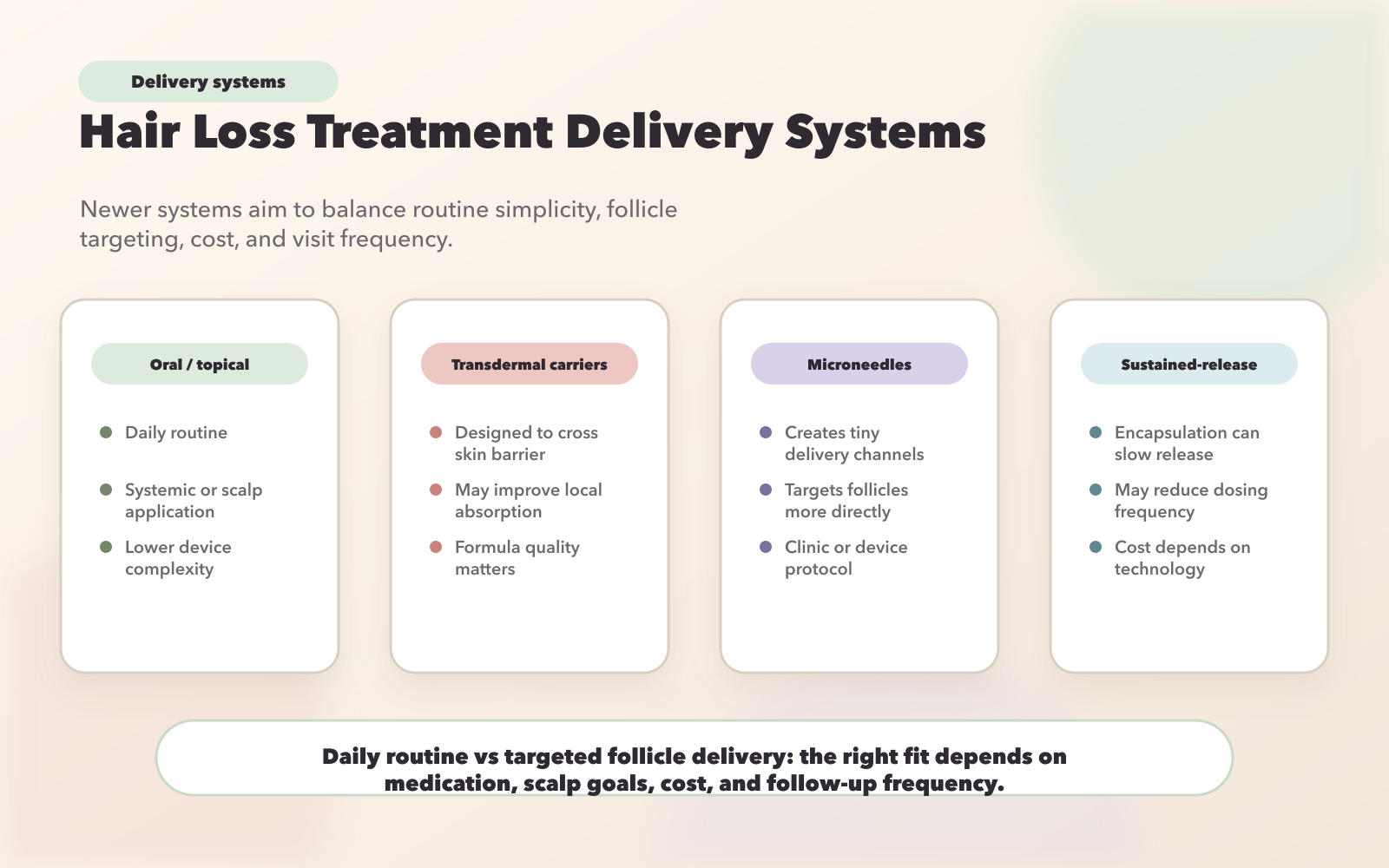
Hair Loss Treatment Delivery Systems Comparison: Frequency, Duration & Cost
Researchers are exploring innovative androgen management and hair loss treatment options, aiming to improve how effectively these treatments reach hair follicles while reducing the risk of side effects. These new methods go beyond traditional oral and topical options, offering more precise and controlled delivery.
Transdermal Delivery Systems
Transdermal patches and advanced topical solutions are now using cutting-edge carriers to penetrate the skin more effectively. Technologies like Nanostructured Lipid Carriers (NLCs) and liposomes are designed to encapsulate medications such as finasteride and dutasteride. These carriers protect the drugs from breaking down and guide them directly to hair follicles, improving their effectiveness. Similarly, Ionic Liquids (ILs), made from organic compounds, enhance the absorption of treatments like minoxidil while being safe for the skin. These systems are particularly effective in targeting the limited pathways available to reach hair follicles.
To build on this precision, researchers have developed encapsulation techniques that allow for sustained hormone release over time.
Encapsulation and Sustained-Release Formulations
PLGA-based microspheres have revolutionized how hormonal treatments are delivered. For example, finasteride-loaded microspheres (FIN-MS) provide a two-phase release: an initial rapid suppression of scalp DHT levels, followed by a steady release over 28 days. This method reduces DHT levels by 60–70% without requiring daily applications.
"This 'rapid intervention – sustained control' therapeutic strategy not only rapidly inhibits the accumulation of a large amount of DHT in AGA but also continuously suppresses DHT production in the subsequent stages." – Yu Zhang, International Journal of Pharmaceutics
Another innovation involves hydrogel-forming patches that use Schiff base cross-linking for controlled medication release. These hyaluronic acid-based patches can deliver minoxidil evenly over several weeks, offering precise dosing and reducing the need for frequent application.
While encapsulation methods are highly effective, microneedle technology offers a different, minimally invasive way to deliver hormones directly to hair follicles.
Microneedle Technology for Hormone Delivery
Microneedles are designed to bypass the skin's outer layer (stratum corneum) and improve drug delivery by stimulating blood vessel growth (angiogenesis). These tiny needles can increase drug absorption by nearly 10,000 times compared to traditional topical treatments.
Researchers at Yonsei University have developed Candlelit Microneedles (CMNs) with a unique curved structure. This design helps the needles penetrate the scalp more effectively, even in areas with existing hair, eliminating the need for patients to shave their heads.
"The reduced application frequency may result in better patient compliance." – Hyungil Jung, Professor, Yonsei University
Another advancement comes from Chengdu Medical College, where researchers introduced dissolving microneedle patches made from hyaluronic acid and PVP K30. These patches are loaded with dutasteride-containing PLGA microspheres (DUT-MS-MNs). When applied, the needles dissolve, releasing microspheres that provide a steady dose of dutasteride. Weekly use in a testosterone-induced hair loss model showed results comparable to daily treatments. Dutasteride is particularly effective, being three times more potent against type 1 5α-reductase and 100 times more potent against type 2 compared to finasteride.
| Delivery System | Application Frequency | Duration of Release | Key Advantage |
|---|---|---|---|
| Traditional Topical (Spray/Foam) | Twice daily | N/A | Simple to use |
| PLGA Microspheres (FIN‑MS) | Once every 28 days | 28 days | Combines rapid and sustained release |
| Dissolving Microneedles (DUT‑MS‑MNs) | Once weekly | 7+ days | Targets follicles directly; fewer side effects |
| Candlelit Microneedles (MP‑CMNs) | Once every 28 days | 29 days | Penetrates scalp without shaving |
These advancements allow for effective treatment with much smaller doses than oral medications. For instance, hyaluronic acid microneedles loaded with minoxidil achieve results using just 10% of the standard topical dosage. By bypassing the liver's first-pass metabolism, these technologies improve bioavailability, reduce systemic side effects, and ensure the medication reaches the hair follicles more efficiently.
Cost and Access to New Delivery Systems
Cost Comparison: Traditional vs. New Delivery Methods
When it comes to hair loss treatments, understanding the costs can help patients make informed decisions. Traditional treatments, like topical minoxidil, are among the most affordable, costing around $375 annually - just over a dollar per day. Generic oral minoxidil is similarly priced at about $365 per year. These options serve as a baseline for comparing newer, more advanced methods.
Advanced delivery systems, however, come with a wider price range. Compounded topicals that mix hormones like minoxidil, finasteride, and spironolactone cost between $119 and $149 monthly, while liposomal delivery systems range from $127 to $150 per month[23, 25]. These systems are designed to improve how medications reach hair follicles, potentially requiring less frequent application, but at a higher cost.
On the high end, JAK inhibitors like Ritlecitinib cost approximately $49.67 daily, adding up to over $18,000 per year. Another JAK inhibitor, Baricitinib, ranges between $20,894 and $41,789 annually. Surgical options, like hair transplants, remain the most expensive, with a single procedure costing $4,000 to $20,000. Full results from these surgeries typically take 12 to 18 months to materialize.
| Treatment Method | Estimated Annual Cost | Application Frequency |
|---|---|---|
| Generic Topical Minoxidil | ~$375 | Twice daily |
| Oral Minoxidil (Generic) | ~$365 | Once daily |
| Custom Compounded Topicals | $1,428 – $1,788 | Once or twice daily |
| Liposomal Delivery Systems | $1,524 – $1,800 | Once or twice daily |
| Ritlecitinib (JAK Inhibitor) | ~$18,142 | Once daily |
| Hair Transplant Surgery | $4,000 – $20,000 | N/A |
While these costs give a general idea, factors like insurance coverage and subscription models also influence what patients ultimately pay.
Insurance Coverage and Patient Costs
Insurance coverage for hair loss treatments is limited since these treatments are typically deemed cosmetic[22, 24]. This means patients often bear the full cost of both traditional and advanced options.
Traditional medications, like oral minoxidil or spironolactone, may be partially covered if prescribed for unrelated conditions, but hair loss itself rarely qualifies. Even when insurance applies, prior authorization is often required. Additionally, consultation fees - ranging from $5 to $80 - can add to the overall expense[22, 24].
Subscription-based models can help reduce costs. Opting for a 6- or 12-month supply often lowers the per-bottle price compared to buying monthly. Many platforms also offer free shipping, though some may charge a small fee of around $5 per shipment[24, 25]. These models not only save money but also streamline access to treatments.
How Telehealth Makes Treatments More Accessible
Telehealth platforms have made hair loss treatments more accessible and affordable, especially for those in underserved areas. By eliminating the need for in-person visits, telehealth allows patients to consult with professionals entirely online. This is particularly beneficial for individuals in rural regions or for those who find in-person discussions about hair loss uncomfortable.
Platforms like Oana Health highlight how telehealth simplifies access. They offer treatments such as oral minoxidil starting at $25 per month and topical spironolactone at $43 per month. Licensed professionals create personalized treatment plans based on patient history, with medications delivered directly through FDA-regulated pharmacies. Free shipping is often included, further reducing costs.
Telehealth also expands access to low-dose oral minoxidil, a practical option for the 60% of patients who don't respond to topical treatments due to low follicular enzyme activity. While only about 1.4% of topical minoxidil is absorbed by a healthy scalp, oral formulations bypass this limitation, improving bioavailability. This allows for lower doses, which can reduce side effects and long-term costs. A survey of 2,846 telehealth patients revealed that 92% experienced improvement or stabilization in hair loss within 12 months.
Personalized Hormonal Hair Loss Treatments
Customizing Hormone Therapy for Each Patient
Personalized treatments address the unique factors behind each patient’s hair loss. For some, the issue stems from excessive DHT binding and hair health, while others may struggle with reduced blood flow or chronic inflammation. Treatment plans are tailored based on gender, age, and the specific hair loss patterns observed. For example, men often face receding hairlines or thinning at the crown, while women typically experience more diffuse thinning. A patient’s medical history - such as oral contraceptive use, past acne, or menopausal status - also plays a role in determining the most appropriate treatment, whether estrogen- or progesterone-based. The method of delivery is another key factor in ensuring effective outcomes.
The delivery system itself can significantly influence results. Oral minoxidil is an option for patients who find topical applications challenging - nearly 60% of topical minoxidil users report difficulties with adherence. Advanced technologies, like dual-phase microspheres, offer rapid and sustained hormone control. For those concerned about systemic side effects, localized delivery systems such as microneedles or nanostructured lipid carriers provide a targeted approach. These methods deliver treatment directly to the hair follicles, which make up only about 0.1% of the skin’s surface. By aligning the therapy type and delivery method with the patient’s profile, the treatment becomes more precise and effective.
How Telemedicine Enables Personalized Care
Remote monitoring and consultations have revolutionized how personalized hair loss treatments are delivered. Telemedicine allows healthcare providers to review patient history, hormone levels, and hair loss patterns without the need for in-person visits. This is especially helpful for those in rural areas or anyone uncomfortable discussing their condition face-to-face.
Platforms like Oana Health make customized prescriptions accessible. Options include oral minoxidil starting at $25 per month and topical spironolactone at $43 per month. For patients who don’t respond well to standard topical treatments, alternatives like low-dose oral minoxidil are available. This option bypasses the need for follicular enzyme activation, offering a more direct solution. Understanding genetic markers for minoxidil success can further help predict which patients will benefit most from these personalized formulations.
"Topical minoxidil remains first line, while oral and sublingual formulations expand therapeutic options and support individualized management." – Frontiers in Pharmacology
Telemedicine also plays a crucial role in improving adherence to treatment plans. By offering more tolerable systemic options and advanced delivery systems, these platforms help patients stick to their regimens. This is particularly important given the emotional toll hair loss can take, often affecting self-esteem and causing social anxiety. With the convenience and accessibility of digital consultations, personalized care becomes more manageable and effective for patients.
Conclusion
New approaches in hormonal delivery systems are reshaping how female hair loss is treated. Techniques like candlelit microneedles (often used alongside microneedling with minoxidil for enhanced absorption) and PLGA microspheres ensure hormones are released steadily, reducing the need for daily applications. These methods focus on delivering treatments directly to hair follicles, limiting broader side effects such as hormonal imbalances or gastrointestinal discomfort.
Telehealth is also playing a key role in improving access to care. By eliminating the need for in-person visits, it allows patients - especially those in remote areas or those hesitant to discuss hair loss in person - to access tailored treatment plans. For instance, services like Oana Health provide options such as topical spironolactone for $43 per month and oral minoxidil starting at $25 per month, with medications conveniently delivered to patients’ homes.
These advancements address the unique challenges of female hair loss, where diffuse thinning requires solutions that minimize side effects. With half of women over 70 experiencing this condition, accessible and effective treatments are critical. The move toward long-acting, self-administered therapies not only improves adherence but also ensures more consistent results while reducing systemic risks. Combined with digital health innovations, these developments are paving the way for more effective, patient-focused hair loss care.
FAQs
Which delivery method is best for reducing side effects?
Transdermal delivery systems, such as TransEpidermal Delivery (TED), offer a practical way to cut down on side effects. By delivering active ingredients straight to the scalp, they avoid the need for systemic circulation. This targeted approach limits the rest of the body's exposure, helping to reduce the risk of unwanted reactions.
How soon do microneedles or microspheres show results?
Microneedles and microspheres are designed to deliver results in a matter of days or weeks. Microneedle systems work by dissolving rapidly, ensuring targeted drug delivery right at the application site. On the other hand, sustained-release microspheres extend the effects over several weeks, offering a longer-lasting solution. These methods enhance both the efficiency of delivery and the overall treatment timeframe.
Are these newer delivery systems worth the higher yearly cost?
Emerging options like transdermal patches and gels are changing the game for treating hair loss. These methods focus on delivering hormones directly to the affected area, which can mean fewer side effects compared to traditional treatments that affect the entire body. Plus, they’re designed to improve absorption, potentially speeding up results.
While these advanced solutions often come with a higher price tag due to the technology involved, their precision and reduced risk of side effects might make them a good fit for some individuals. To figure out what’s right for you, it’s best to talk to a healthcare provider. Services like Oana Health can also provide guidance through telehealth consultations.