
Checklist for Androgen Biomarker Discovery
Androgen biomarkers are critical for diagnosing conditions like PCOS, which affects 6%-13% of women of reproductive age, with 70% remaining undiagnosed. Elevated androgen levels and insulin resistance are key drivers of PCOS, leading to symptoms like hirsutism, acne, and metabolic risks. Traditional diagnostic methods often fail due to low androgen levels in women, but advancements in proteomics now enable more accurate detection through specific protein markers.
Key Takeaways:
- PCOS Diagnosis: Focus on elevated testosterone, free testosterone, and androstenedione.
- Proteomics Advantage: Techniques like LC-MS/MS provide nearly 99% diagnostic accuracy.
- Biomarker Discovery Steps:
- Define objectives (e.g., Biological Androgen Activity).
- Prepare samples (plasma, serum, etc.) with precise handling.
- Conduct proteomic analysis to identify androgen-responsive proteins.
- Validate candidates with independent cohorts.
- Combine biomarkers into algorithms for better predictive accuracy.
This structured process enables earlier diagnosis, personalized treatments, and better PCOS management. Tools like multi-biomarker panels and advanced techniques are reshaping how androgen-related conditions are addressed in clinical settings.
Checklist for Biomarker Discovery
When it comes to emerging biomarkers for androgen dysregulation in PCOS, the discovery process requires more than routine hormone tests. It’s a methodical journey involving careful planning, advanced lab techniques, and thorough validation to ensure clinical usefulness. Let’s break down the key steps researchers follow.
Step 1: Define Research Objectives
Start by focusing on Biological Androgen Activity (BAA) rather than just total testosterone levels. Traditional testosterone tests often fall short, as they don’t account for receptor sensitivity or binding protein changes.
Tailor your objectives to the specific condition you're studying. For example:
- PCOS: Examine elevated testosterone, free testosterone, and androstenedione.
- Male hypogonadism: Focus on markers linked to metabolic syndrome and cardiovascular risks.
A recent study by Aleksander Giwercman and colleagues at Lund University (April 2022) highlights this approach. Using a model of 30 healthy men undergoing chemical castration, they identified 4HPPD, IGFBP6, and ALDOB as better indicators of low testosterone and metabolic risks than standard tests.
Control variables like BMI, SHBG levels, and androgen receptor variations to avoid skewed results. Also, define your target population - whether it’s neonates, adolescents, or older adults - since androgen levels vary significantly over a lifetime.
Step 2: Select and Prepare Samples
Choose the right biospecimens for your study. Options include:
- Plasma
- Serum
- Urine
- Seminal plasma
Each sample type offers unique advantages and impacts the proteins you can detect. For preparation, follow a bottom-up approach:
- Digest proteins into peptides (commonly using trypsin) for mass spectrometry analysis.
- Use immunoaffinity enrichment methods like MSIA-SRM for low-abundance proteins in complex samples like plasma.
Proper storage is critical. Protein profiles are highly sensitive to conditions like cryopreservation. Standardize your preparation with techniques like log2 transformation and "Subtract Median" normalization to ensure consistent data. Exclude outliers, such as individuals with genetic conditions like Klinefelter syndrome, to maintain accuracy.
Step 3: Conduct Proteomic Analysis
Utilize liquid chromatography-mass spectrometry (LC-MS/MS) to identify and quantify potential biomarkers. This method separates peptides, reducing complexity and minimizing interference during analysis.
Focus on identifying proteins that respond to androgen activity. Prioritize candidates based on their statistical performance. For instance:
- Biomarkers with an AUC above 0.80 in ROC analysis are strong candidates for further study.
- Those with an AUC between 0.75 and 0.80 may still hold value if they’re highly enriched in relevant tissues, such as the liver.
Step 4: Validate Biomarker Candidates
Validation is where potential biomarkers prove their worth. Test candidates in an independent cohort using targeted methods like ELISA or SRM. Correlate biomarker levels with androgen-related conditions (e.g., metabolic syndrome, type 2 diabetes, or low bone density), while adjusting for confounders like BMI and SHBG.
The Giwercman team validated their findings by demonstrating that 4HPPD and IGFBP6 outperformed testosterone levels in predicting metabolic syndrome and diabetes in a group of 75 infertile men.
To assess androgen dependence, examine marker correlations with AR gene CAG repeat lengths, which influence hormone sensitivity. Standardize blood collection times to account for daily fluctuations in androgen levels.
"As immunoassays have major drawbacks, especially in samples from women and neonates, concentrations measured using these assays should be interpreted with care." - Annemieke C Heijboer and Sabine E Hannema
Step 5: Perform Data Analysis
Combine biomarkers into a Multi-Marker Algorithm (MMA) to enhance predictive accuracy. For example, pairing 4HPPD with IGFBP6 proved more effective than using either marker alone for identifying metabolic risks.
Use multivariate statistical methods to pinpoint true predictors while accounting for confounding factors. ROC analysis helps measure the sensitivity and specificity of biomarkers in distinguishing between low and normal testosterone levels. Ensure reference intervals are tailored to the life stage (neonatal, puberty, or adulthood) and the measurement methods used.
This structured approach transforms biomarker discovery into a precise science. It’s especially critical in cases where traditional methods fall short - like the 30% to 40% of infertility cases classified as idiopathic due to inconclusive semen analysis. Rigorous data analysis can uncover patterns that might otherwise be missed, moving the field closer to precision medicine.
sbb-itb-6dba428
Clinical Applications of Androgen Biomarkers
The discovery of biomarkers has bridged the gap between research and practical patient care. In conditions tied to androgen imbalances, like PCOS, this shift focuses on moving away from generalized hormone testing toward more precise, affordable diagnostic methods that improve patient outcomes.
Using Biomarkers for PCOS Diagnosis and Monitoring
Modern clinical practice favors starting with visible symptoms of hyperandrogenism, such as hirsutism, before turning to expensive biochemical tests. Hirsutism is often assessed using the modified Ferriman–Gallwey scale, which provides a standardized way to evaluate excessive hair growth.
"The presence of hirsutism or clinical hyperandrogenism alone should be considered predictive of biochemical hyperandrogenism and PCOS in adults, alleviating the necessity for assays in all-comers." - 2023 International Evidence-based Guideline
In 2023, an initial lab evaluation for PCOS costs about $1,366.35 per patient. However, not every patient requires such testing. Only 15.4% of women, particularly those with menstrual irregularities but no clear clinical signs, need androgen measurements to confirm a diagnosis. Even among women with irregular cycles but no hirsutism, only 26.8% show biochemical hyperandrogenemia.
When testing is necessary, key androgen biomarkers include total testosterone (TT), free testosterone (FT), androstenedione (A4), and dehydroepiandrosterone sulfate (DHEAS). However, standard immunoassays often fall short in detecting the lower androgen levels typical in women. To address this, liquid chromatography-tandem mass spectrometry (LC-MS/MS) is the preferred method for measuring total testosterone due to its higher accuracy.
These biomarkers do more than diagnose PCOS - they also shed light on related health risks. Elevated androgen levels are linked to insulin resistance and fat tissue dysfunction, which can increase the risk of cardiovascular disease and endometrial cancer. This is especially important for younger patients, as androgen levels associated with PCOS naturally decline with age. By understanding these risks, clinicians can develop more targeted treatment plans.
Personalized Treatment Based on Biomarker Data
Biomarker data allows for more individualized treatment. For women with PCOS, aligning therapies with their specific biomarker profiles is crucial. For instance:
- Patients with androgenic symptoms like acne or excessive facial hair might benefit from anti-androgen medications that block androgen receptors.
- Those showing signs of metabolic issues may respond better to insulin-sensitizing drugs.
- Women experiencing androgen-related hair loss might see improvements with targeted topical treatments.
Since androgen levels fluctuate over time, a single blood test provides only a snapshot. Clinical symptoms often offer a more consistent view of long-term androgen excess. To reduce variability in test results, blood samples should be collected at standardized times, and clinicians should consider factors like hormonal contraceptive or glucocorticoid use.
Before confirming a PCOS diagnosis with androgen biomarkers, it is critical to rule out other conditions that mimic its symptoms. This includes checking TSH levels to exclude thyroid dysfunction, measuring prolactin to rule out hyperprolactinemia, and testing 17-hydroxyprogesterone to screen for non-classic adrenal hyperplasia.
20-Step Checklist Summary
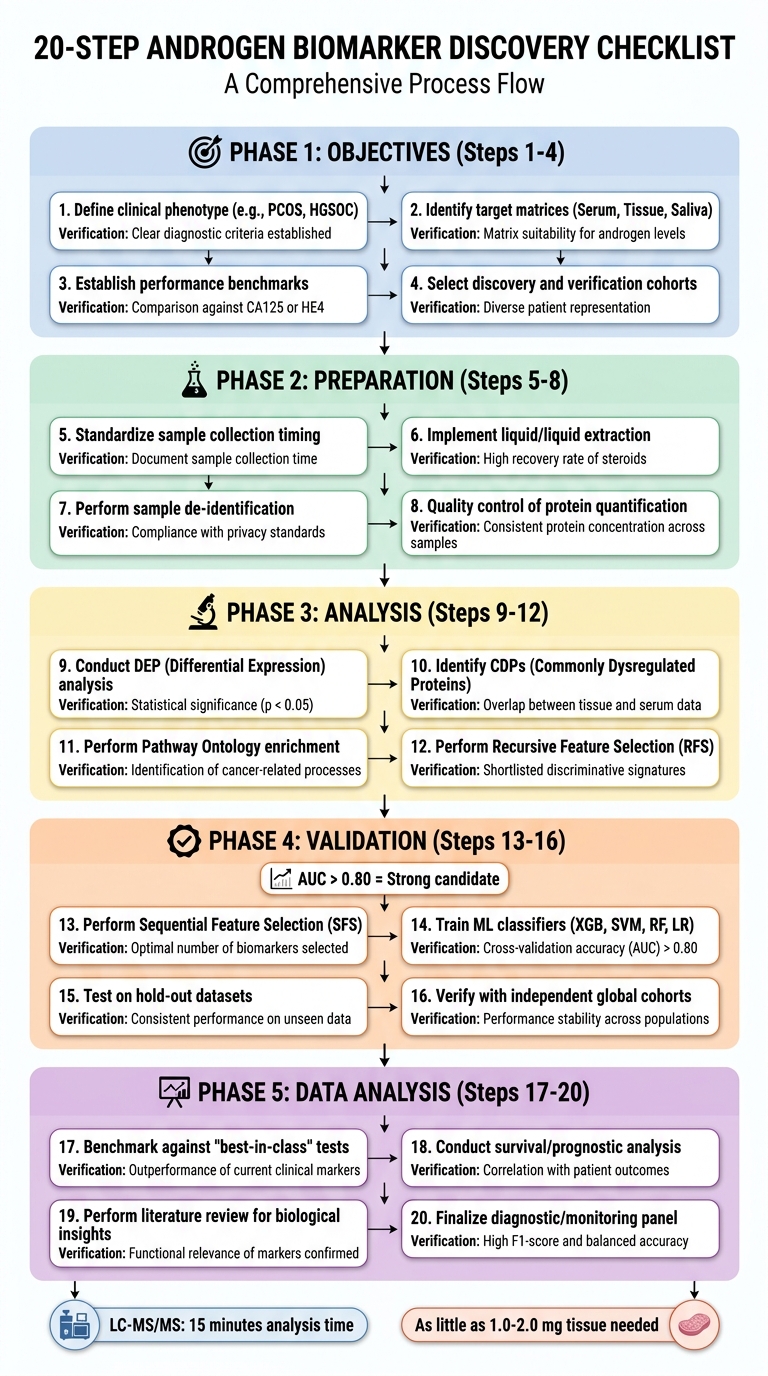
5-Phase Androgen Biomarker Discovery Process: 20-Step Clinical Research Checklist
Here’s a streamlined table outlining the 20 steps involved in androgen biomarker discovery, divided across five key phases. Each step includes the required action and criteria to confirm success.
This framework is grounded in validated clinical research methods, such as the work by Wilton et al. at Roswell Park. They used LC-MS/MS to profile five endogenous androgens in just 15 minutes. Their 2014 study analyzed 188 plasma samples and 129 bone marrow aspirate samples from patients with castration-recurrent prostate cancer. Impressively, they demonstrated that testosterone and DHT concentrations could be reliably measured from as little as 1.0–2.0 mg of prostate tumor tissue.
| Phase | Step # | Action Item | Verification Criteria |
|---|---|---|---|
| 1. Objectives | 1 | Define clinical phenotype (e.g., PCOS, HGSOC) | Clear diagnostic criteria established |
| 2 | Identify target matrices (Serum, Tissue, Saliva) | Matrix suitability for androgen levels | |
| 3 | Establish performance benchmarks | Comparison against CA125 or HE4 | |
| 4 | Select discovery and verification cohorts | Diverse patient representation | |
| 2. Preparation | 5 | Standardize sample collection timing | Document sample collection time |
| 6 | Implement liquid/liquid extraction | High recovery rate of steroids | |
| 7 | Perform sample de-identification | Compliance with privacy standards | |
| 8 | Quality control of protein quantification | Consistent protein concentration across samples | |
| 3. Analysis | 9 | Conduct DEP (Differential Expression) analysis | Statistical significance (p < 0.05) |
| 10 | Identify CDPs (Commonly Dysregulated Proteins) | Overlap between tissue and serum data | |
| 11 | Perform Pathway Ontology enrichment | Identification of cancer-related processes | |
| 12 | Perform Recursive Feature Selection (RFS) | Shortlisted discriminative signatures | |
| 4. Validation | 13 | Perform Sequential Feature Selection (SFS) | Optimal number of biomarkers selected |
| 14 | Train ML classifiers (XGB, SVM, RF, LR) | Cross-validation accuracy (AUC) > 0.80 | |
| 15 | Test on hold-out datasets | Consistent performance on unseen data | |
| 16 | Verify with independent global cohorts | Performance stability across populations | |
| 5. Data Analysis | 17 | Benchmark against "best-in-class" tests | Outperformance of current clinical markers |
| 18 | Conduct survival/prognostic analysis | Correlation with patient outcomes | |
| 19 | Perform literature review for biological insights | Functional relevance of markers confirmed | |
| 20 | Finalize diagnostic/monitoring panel | High F1-score and balanced accuracy |
This checklist serves as the foundation for reliable androgen biomarker discovery, ensuring both data accuracy and clinical relevance at every stage. For instance, a novel 4-protein panel (EEF1G, MSLN, BCAM, TAGLN2) boosted AUC by 59.1% over CA125, while CRISP3 and MMP9 increased AUC by 60.7% for detecting high-grade serous ovarian carcinoma. These examples highlight the critical role of independent validation using multiple datasets to prevent overfitting and confirm clinical applicability.
How Oana Health Uses Biomarker Insights
Oana Health transforms precise biomarker discoveries into practical telehealth solutions designed to address patient needs.
Telehealth Solutions for Androgen-Related Conditions
Oana Health applies insights from androgen biomarkers to create personalized treatments for PCOS and similar conditions. Patients start by completing a quick, 5-minute online medical assessment, which gathers detailed medical histories and hormonal profiles. Licensed medical professionals then review this data to craft evidence-based treatment plans that tackle the root causes of androgen excess.
The platform provides medications specifically designed to address androgenic effects. For instance, Spironolactone helps reduce acne and hirsutism, available for $14/month. Similarly, Eflornithine slows unwanted hair growth, with 81% of women reporting noticeable improvement within a year. For patients dealing with insulin resistance - a common driver of androgen issues in PCOS - topical metformin offers insulin-sensitizing benefits without the gastrointestinal side effects often associated with oral formulations. The 20% lotion is available for $43/month.
"I used to struggle a lot with the side effects for oral metformin and this is a great alternative for me. I get the same benefits but no more upset stomach and nausea." - Carrie S.
These treatments are a direct result of Oana Health's rigorous biomarker research, ensuring that each solution is as targeted as the science behind it.
Personalized Care Backed by Science
Oana Health pairs biomarker insights with FDA-regulated custom compounding. Their "Hairless Hype" treatment, a blend of Eflornithine, Metformin, and Azelaic Acid, delivers noticeable results in as little as 8 weeks. For broader PCOS management, the MetSpiro pack addresses cycle regularity, skin health, and insulin levels, priced at $32/month.
"It's been a little over 5 weeks, and I've noticed a dramatic reduction in my facial hair growth. This has been such a relief for me." - Allison L.
All treatments are shipped directly to patients for free, with ongoing telehealth support included.
FAQs
What is Biological Androgen Activity (BAA)?
Biological Androgen Activity (BAA) describes how androgens, such as testosterone, influence the body. These effects include the development of male traits, enhancing muscle growth, and maintaining reproductive health. BAA works through two main processes: binding to androgen receptors and converting androgens into active metabolites.
Why is LC-MS/MS better than immunoassays for women?
LC-MS/MS is often chosen over immunoassays for women due to its higher specificity and precision in measuring steroid hormones. Unlike immunoassays, it reduces problems such as cross-reactivity, which can compromise accuracy. This makes it a more dependable option, particularly when dealing with complex hormone profiles.
How do you validate a biomarker before clinical use?
To confirm that a biomarker is ready for clinical use, it's crucial to follow well-defined guidelines that guarantee dependable and precise measurements. This involves evaluating key factors like accuracy, precision, sensitivity, specificity, reproducibility, and stability. The validation plan should be customized based on the biomarker's intended clinical application and tested within appropriate biological matrices. By conducting thorough testing, you can ensure the biomarker is reliable for clinical decision-making and aligns with regulatory requirements.