
Top 5 Androgen Blockers in Development for PCOS
Polycystic ovary syndrome (PCOS) affects 8–13% of women of reproductive age globally. A key challenge for many is elevated androgen levels, which cause symptoms like excess hair growth, acne, and hair loss. While older treatments like spironolactone and finasteride have been used off-label, their effectiveness is often limited. Researchers are now working on newer androgen-blocking therapies that target hormonal pathways more precisely.
Here are the top five androgen blockers under development or in use for PCOS:
- Spironolactone Derivatives: Block androgen receptors and reduce DHT production, addressing acne and hirsutism. New formulations aim to improve efficacy and safety.
- Novel AR Antagonists: Advanced therapies like AR PROTACs degrade androgen receptors and show promise for metabolic and skin-related PCOS symptoms.
- 5-Alpha-Reductase Inhibitors: Reduce DHT levels to treat hirsutism, acne, and hair loss. Topical options minimize side effects.
- DRSP/EE Combinations: Common in oral contraceptives, these reduce androgen activity while regulating menstrual cycles.
- AMH-Targeted Modulators: Emerging treatments like NK3 receptor antagonists lower androgen production by stabilizing hormonal signals.
These therapies aim to provide more effective, targeted options for managing PCOS symptoms, offering hope to those who struggle with current treatments.
1. Spironolactone Derivatives
Mechanism of Action
Spironolactone and its derivatives work to reduce androgen activity through several pathways. The primary method involves blocking androgen receptors, which stops testosterone and other male hormones from triggering their usual effects. Additionally, these compounds inhibit the 5-alpha-reductase enzyme, which is responsible for converting testosterone into dihydrotestosterone (DHT) - a more potent form of the hormone that contributes to issues like acne and excess hair growth.
One derivative, drospirenone (DSP), found in fourth-generation birth control pills, achieves similar anti-androgenic effects but at lower doses. It also provides additional benefits by reducing sodium and water retention through aldosterone blockade. When included in combined oral contraceptives, drospirenone also suppresses the hypothalamus-pituitary-ovarian axis, leading to lower levels of LH and FSH. This, in turn, reduces ovarian androgen production, showcasing how these medications have evolved into more advanced androgen blockers.
PCOS Symptom Targets
Spironolactone derivatives are particularly effective in addressing skin-related symptoms of hyperandrogenism, such as moderate-to-severe acne and hirsutism. Clinical studies have shown that drospirenone-containing contraceptives can reduce Ferriman-Gallwey scores (a standard for measuring excess hair growth) by an average of 2.15 to 2.57 points over 6 to 12 months of treatment. Women using these treatments also report improvements in female pattern hair loss and menstrual irregularities, especially when combined with other therapies.
Development Stage
Although spironolactone has long been used off-label by dermatologists and endocrinologists, formal clinical evidence has been sparse. The ongoing SAFA Phase III trial is examining its effectiveness in treating adult female acne over a 24-week period. This trial aims to provide concrete data on its efficacy and cost-effectiveness.
For those seeking treatment now, Oana Health offers spironolactone starting at $14 per month. Licensed medical professionals review each patient’s health history to ensure care is tailored to individual needs.
Potential Side Effect Profiles
Common side effects of spironolactone derivatives include breast tenderness, menstrual irregularities, dizziness, headaches, and increased urination. There is also a potential risk of hyperkalemia (high potassium levels), especially in patients with kidney issues or those taking other potassium-sparing medications. Women of childbearing age need to use reliable contraception during treatment and for at least four weeks after stopping, as these medications can cause feminization of a male fetus. To reduce nighttime bathroom trips, it’s recommended that patients take their entire daily dose in the morning.
This overview of spironolactone derivatives sets the foundation for examining newer androgen blockers in the next section.
2. Novel AR Antagonists
Mechanism of Action
New-generation AR antagonists are designed to go beyond simply blocking androgen receptors. They employ cutting-edge methods to disrupt androgen activity entirely. For example, PROTACs like ARV-110 not only block the receptor but also degrade it, while pure inhibitors such as ADA-308 prevent the receptor from moving into the nucleus, which is critical for its function. Another compound, Seviteronel (INO-464), takes a two-pronged approach: it blocks the androgen receptor and inhibits the enzyme CYP17 lyase, which plays a role in androgen production. These advanced approaches aim to tackle not just androgen receptor activity but also the wide-ranging symptoms of PCOS.
PCOS Symptom Targets
These novel AR antagonists hold promise for addressing both dermatological and metabolic symptoms associated with PCOS. For instance, ADA-308, a topical treatment, targets acne by stopping androgen-driven lipid production in sebocytes. In preclinical studies, it has also shown potential in promoting hair growth, offering hope for those dealing with androgenic alopecia.
On the metabolic front, AR PROTACs like ARV-110 are being studied for their ability to address complications linked to PCOS. Research led by Dr. Olga Astapova demonstrated the following in mouse models:
ARV-110 effectively depletes AR in adipose tissue and results in reduced adiposity and improvements in metabolic complications of DHT-induced PCOS - namely, excess weight, glucose tolerance, and circulating lipids.
This dual focus on both skin and metabolic issues highlights the potential of these therapies to tackle PCOS comprehensively.
Development Stage
Most of these novel AR antagonists are still in the early phases of development. For example, ARV-110, created by Arvinas in collaboration with the University of Mississippi, has shown encouraging results in preclinical studies involving PCOS mouse models. Similarly, ADA-308 is currently undergoing preclinical testing as a topical solution for acne and hair loss. Meanwhile, Seviteronel, initially designed for cancer treatment, has progressed further. Innocrin Pharmaceuticals has identified it as a priority candidate for managing conditions driven by excess sex steroids, including PCOS.
Potential Side Effect Profiles
The safety of these treatments depends on their method of delivery and mechanism of action. Topical options like ADA-308 limit systemic exposure, reducing the risk of widespread side effects. On the other hand, systemic treatments such as ARV-110 require careful dose management. Preclinical studies have noted potential dose-dependent liver toxicity in animal models, underscoring the importance of cautious dosing strategies.
3. 5-Alpha-Reductase Inhibitors like Finasteride Analogs
Mechanism of Action
5-Alpha-Reductase Inhibitors (5ARIs) work by reducing dihydrotestosterone (DHT), a potent androgen linked to many PCOS symptoms. These inhibitors block the conversion of testosterone into DHT, effectively lowering its activity at androgen receptors. By doing so, they reduce serum DHT levels by approximately 70%.
Among the 5ARIs, finasteride specifically targets the Type 2 enzyme, while dutasteride inhibits both Type 1 and Type 2 enzymes. Dutasteride is about three times more effective at targeting Type 2 and 100 times more effective for Type 1. This distinction is important because Type 1 enzymes are prevalent in sebaceous glands (linked to acne), whereas Type 2 enzymes are dominant in hair follicles. This targeted inhibition is key to addressing hallmark PCOS symptoms.
PCOS Symptom Targets
5ARIs are effective in managing several PCOS-related skin and scalp conditions.
- Hirsutism: By curbing DHT production in the skin, these inhibitors reduce the growth of terminal hair in androgen-sensitive areas. Clinical studies indicate that combining anti-androgens with lifestyle changes outperforms metformin and lifestyle changes alone for treating hirsutism, with a weighted mean difference of -1.59.
- Acne: 5ARIs help regulate excessive sebum production by targeting DHT in sebaceous glands.
- Androgenetic Alopecia: They prevent hair follicle miniaturization and encourage hair to shift from the resting phase back to the growth phase. Interestingly, topical finasteride formulations reduce plasma DHT levels by 68-75%, offering results comparable to oral treatments but with reduced systemic exposure.
Development Stage
Currently, finasteride and dutasteride are prescribed off-label as second-line treatments, particularly when oral contraceptives are unsuitable or ineffective. Research is underway to improve delivery methods, especially topical formulations, which aim to enhance local effectiveness while minimizing systemic effects. This is particularly relevant for managing skin-related PCOS symptoms.
"The application of 5ARIs for pharmacological treatment of acne vulgaris, hirsutism, and frontal fibrosing alopecia is promising, but requires further evaluation." – Mariana Escamilla-Cruz, Service of Dermatology, Hospital General de México
A 2023 meta-analysis of 20 randomized controlled trials confirmed the benefits of 5ARIs for treating hirsutism. However, the evidence was labeled as "low certainty", and researchers emphasized the need for more high-quality studies to refine treatment guidelines.
Potential Side Effect Profiles
The primary concern for women of reproductive age using 5ARIs is teratogenicity. These medications can lead to undervirilization in male fetuses, so strict contraception is essential during treatment. Other possible side effects include irregular menstrual cycles, nausea, and mood changes. Despite these risks, 5ARIs generally have a safer profile compared to other anti-androgens like flutamide, with significantly lower risks of liver toxicity.
Topical formulations offer a promising alternative, as they reduce systemic side effects while maintaining skin-level DHT reduction. These formulations achieve similar efficacy to oral treatments but with lower peak plasma concentrations, potentially lessening risks related to mood and sexual health. While serious complications are rare, regular monitoring of liver function is recommended for patients on 5ARIs.
4. DRSP/EE Combinations
Mechanism of Action
DRSP/EE combinations operate through multiple mechanisms to reduce androgen activity in individuals with PCOS. The drospirenone (DRSP) component, a derivative of spironolactone, works as a competitive antagonist at androgen receptors in peripheral tissues. This means it blocks testosterone and dihydrotestosterone (DHT) from binding. Additionally, DRSP inhibits 5-alpha-reductase, the enzyme responsible for converting testosterone into the more potent DHT.
The ethinyl estradiol (EE) component takes a different approach. It suppresses the hypothalamus-pituitary-ovarian axis, resulting in reduced secretion of luteinizing hormone (LH) and follicle-stimulating hormone (FSH). This suppression lowers ovarian androgen production. EE also boosts the liver's production of Sex Hormone-Binding Globulin (SHBG), a protein that binds free testosterone in the bloodstream, reducing its availability. Together, these actions explain the effectiveness of DRSP/EE combinations in addressing a range of PCOS symptoms.
PCOS Symptom Targets
DRSP/EE combinations are considered a first-line treatment for managing hirsutism, acne, and hair loss in PCOS patients. A retrospective study conducted in September 2025 at Fondazione Policlinico Universitario A. Gemelli IRCCS in Rome demonstrated their efficacy. Over six months, drospirenone-only therapy reduced the modified Ferriman-Gallwey (mFG) score for hirsutism from 12.31 to 6.31 (p=0.0053) and improved the CASS score for acne from 2.4 to 1.8 (p=0.02).
Beyond addressing skin and hair concerns, these combinations help regulate menstrual cycles and provide contraceptive benefits. Unlike other progestins, DRSP also blocks aldosterone receptors, which reduces sodium and water retention. This action helps mitigate the bloating often associated with oral contraceptives.
Development Stage
DRSP/EE combinations are already approved and commonly used for managing PCOS in both adults and adolescents. Current research is focused on improving formulations to lower the risks associated with estrogen. For example, researchers are investigating Estetrol (E4)/DRSP combinations as alternatives to traditional EE-based pills. E4 has shown promise due to its more stable lipid profile and lower impact on triglycerides. Additionally, DRSP-only pills are emerging as an option for PCOS patients at higher cardiovascular risk who need to avoid estrogen's metabolic effects.
"First-line treatment in presence of hyperandrogenism (classic phenotype) is based on the prescription of combined oral contraceptive pills (COCP) that are actually recommended in adult and adolescent women with PCOS for management of hyperandrogenism and/or irregular menstrual cycles." – Archives of Gynecology and Obstetrics
Potential Side Effect Profiles
While DRSP/EE combinations offer clear benefits, they come with a unique side effect profile. One key concern is the increased risk of thromboembolism. For context, levonorgestrel-containing pills have a venous thromboembolism (VTE) rate of 9–10 events per 10,000 women-years, whereas drospirenone-containing combinations carry a risk 1.5 to 2.0 times higher. Before starting treatment, patients should be evaluated for cardiovascular and thromboembolic risk factors.
Since DRSP is derived from spironolactone, it has antimineralocorticoid properties that can increase potassium levels. Potassium monitoring is recommended during the first month of treatment, especially for patients taking medications that could lead to hyperkalemia. Other common side effects include headaches, mood changes, nausea, and breast tenderness, primarily due to the ethinyl estradiol component. DRSP is contraindicated in individuals with renal insufficiency, adrenal insufficiency, or liver disease.
sbb-itb-6dba428
5. AMH-Targeted Androgen Modulators
Mechanism of Action
AMH-targeted androgen modulators represent a fresh approach to addressing PCOS by focusing on neuroendocrine pathways. Unlike traditional AR antagonists or enzyme inhibitors, these modulators aim to adjust central hormonal signals influenced by Anti-Müllerian Hormone (AMH). While drugs specifically targeting AMH are still in development, treatments like Neurokinin 3 receptor (NK3R) antagonists, such as fezolinetant, and kisspeptin modulators target the same hypothalamic pathways impacted by AMH in PCOS. Instead of merely blocking androgen effects, these therapies regulate the brain's hormonal control mechanisms.
NK3R antagonists work by stabilizing the abnormal pulsatile release of gonadotropin-releasing hormone (GnRH), which reduces excessive luteinizing hormone (LH) production. This, in turn, lowers ovarian androgen production right at its source. This precise hormonal adjustment offers the potential to not only restore balance but also directly address common PCOS symptoms.
PCOS Symptom Targets
By curbing excessive LH secretion and lowering elevated androgen levels, these modulators may help alleviate symptoms like hirsutism, acne, and hair thinning. They also show promise in promoting more regular menstrual cycles.
Development Stage
Fezolinetant, an NK3R antagonist, has reached Phase 2a clinical trials for PCOS treatment. Early results are promising, showing reductions in testosterone levels and improvements in the LH/FSH ratio. Meanwhile, kisspeptin modulators are still in the early stages of development.
Another area of interest is artemisinins, which interact with the LONP1-CYP11A1 pathway involved in androgen synthesis. However, these therapies are still years away from clinical use, as researchers continue to refine dosing strategies and assess long-term outcomes. Ongoing studies will determine how these modulators fit alongside other advanced androgen-blocking therapies.
Potential Side Effect Profiles
As these treatments are still under investigation, their long-term safety remains uncertain, particularly concerning reproductive health and bone density. Careful monitoring will be essential once these therapies become available to ensure their safety and effectiveness.
Hair FAQ: Treatment Option For PCOS Related Alopecia?, Hair Loss Solution- The Esthetic Clinics
Comparison Table
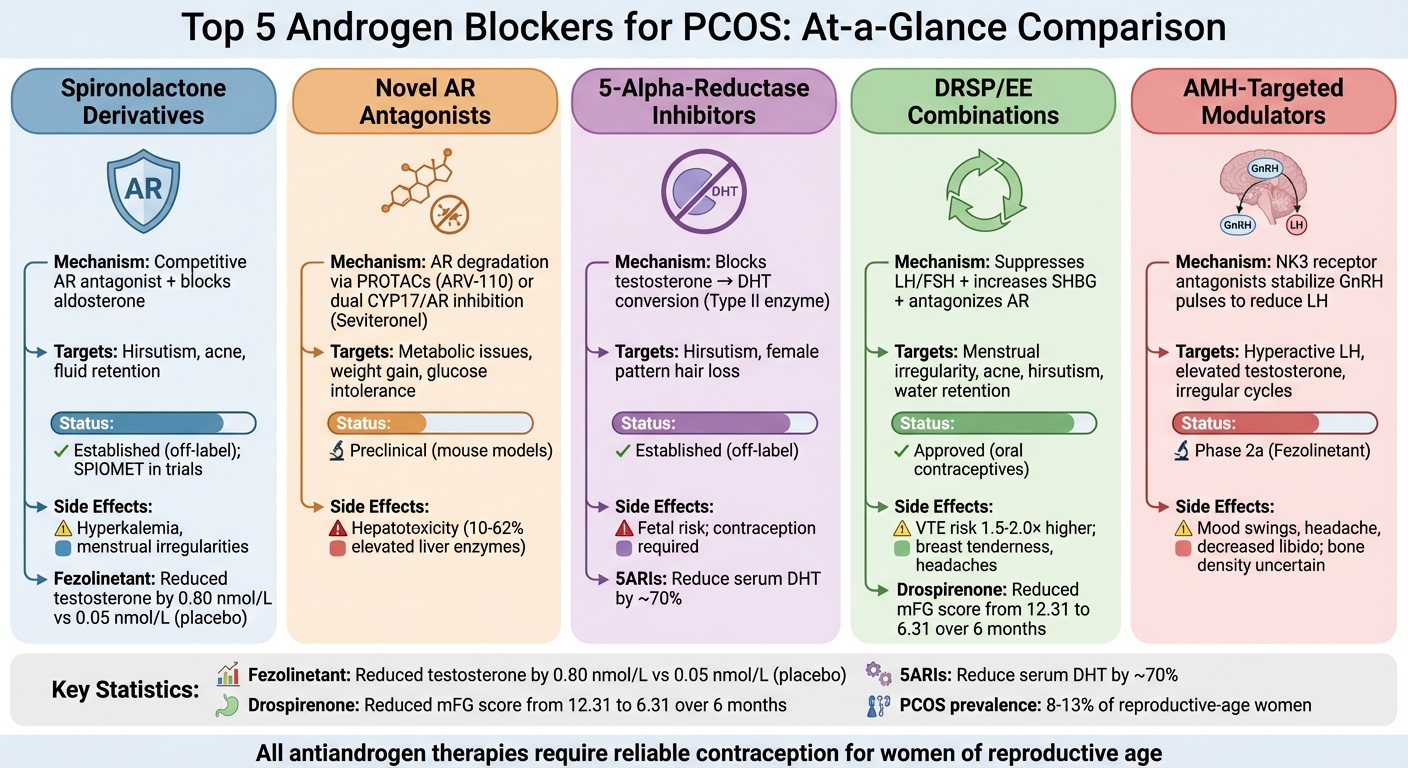
Comparison of 5 Androgen Blockers for PCOS Treatment
Here’s a quick look at five androgen blockers, detailing their mechanisms, targeted PCOS symptoms, development stages, and key side effects.
| Treatment Category | Mechanism of Action | Targeted PCOS Symptoms | Development Stage | Key Side Effects |
|---|---|---|---|---|
| Spironolactone Derivatives | Competitive AR antagonist with antimineralocorticoid activity; blocks aldosterone | Hirsutism, acne, fluid retention | Established (off-label); new combinations like SPIOMET in trials | Hyperkalemia, menstrual irregularities |
| Novel AR Antagonists | AR degradation via proteasome (e.g., PROTACs like ARV‑110) or dual CYP17/AR inhibition (e.g., Seviteronel) | Metabolic issues, weight gain, glucose intolerance, hyperandrogenemia | Preclinical (ARV‑110 tested in mouse models) | Dose-dependent hepatotoxicity; 10–62% may experience elevated liver enzymes |
| 5-Alpha-Reductase Inhibitors | Blocks conversion of testosterone to DHT at the tissue level (Type II enzyme) | Hirsutism, female pattern hair loss (alopecia) | Established (off-label use) | Risk of undervirilization in male fetuses; contraception required |
| DRSP/EE Combinations | Triple action: suppresses LH/FSH, increases SHBG, and directly antagonizes AR | Menstrual irregularity, acne, hirsutism, water retention | Approved (common in oral contraceptives) | VTE risk 1.5–2.0× higher than levonorgestrel-based COCs; breast tenderness, headaches |
| AMH-Targeted Modulators | NK3 receptor antagonists stabilize GnRH pulses to reduce LH; kisspeptin modulators affect hypothalamic pathways | Hyperactive LH secretion, elevated testosterone, irregular cycles | Phase 2a (Fezolinetant); kisspeptin modulators in early development | Mood swings, headache, decreased libido; long-term effects on bone density uncertain |
In Phase 2a trials, Fezolinetant showed encouraging results, reducing total testosterone by 0.80 nmol/L compared to a 0.05 nmol/L change in the placebo group.
Each treatment tackles PCOS in its own way. Traditional options like spironolactone and finasteride block androgen activity or local hormone production. Meanwhile, newer methods, such as AR PROTACs, actively degrade androgen receptors. DRSP/EE combinations reduce ovarian androgen production, while AMH-targeted modulators focus on brain signaling to balance LH secretion. However, it’s crucial for women of reproductive age to use reliable contraception while on antiandrogen therapy, as these medications can impact fetal development.
This range of therapies highlights the many strategies available for managing PCOS, allowing clinicians to customize treatments based on individual needs.
Conclusion
New androgen blockers in development are redefining the way PCOS is treated, shifting the focus from merely managing cosmetic symptoms to addressing the root causes - metabolic and hormonal imbalances. By targeting the cycle where excess androgens fuel insulin resistance and fat accumulation, these treatments tackle PCOS at its core.
Early trial results are promising: licogliflozin reduced hyperinsulinemia by 70% and DHEAS levels by 24%, fezolinetant lowered total testosterone by 0.80 nmol/L compared to 0.05 nmol/L, and AR PROTACs like ARV-110 improved weight and lipid profiles by reducing androgen receptors in fat tissue. These advancements could significantly improve care for the 8–13% of reproductive-age women affected by PCOS. Such progress paves the way for more personalized treatment approaches.
As Yongzhou Wang from Southwest Medical University explains:
A deeper understanding of fat-androgen interactions is crucial for developing precision treatments for PCOS.
Telehealth platforms like Oana Health are already advancing this vision by offering tailored care. From established treatments like spironolactone to emerging therapies, these services customize options based on each patient's symptoms and risk factors.
The combination of cutting-edge medications and accessible telehealth care is transforming PCOS management. Women no longer have to rely on generic treatments or endure medications that don't work for them. With therapies delivered directly to their homes and monitored virtually, this new approach brings us closer to truly personalized and effective care for PCOS.
FAQs
What side effects might occur with new androgen blockers for PCOS treatment?
The side effects of emerging androgen blockers for PCOS, including AR PROTACs like ARV-110, are still under investigation. Preliminary findings indicate that some of these medications may carry risks, such as dose-dependent liver toxicity, which could restrict their application. Similarly, established anti-androgens like spironolactone and finasteride have been linked to side effects, including hormonal imbalances, liver function issues, and other hormone-related complications.
These treatments hold potential for addressing PCOS symptoms like hyperandrogenism, but researchers are actively working to better understand and reduce these risks. It's essential to consult a licensed healthcare provider to weigh the potential benefits and risks based on your individual health needs.
How do new androgen blockers compare to traditional treatments like spironolactone for PCOS?
Emerging treatments like AR PROTACs are being developed to address the hormonal imbalances associated with PCOS in a more precise way than older options like spironolactone. Spironolactone, a common choice for managing symptoms such as acne and excessive hair growth, works by blocking androgen activity and has a long track record of safe use. However, its effectiveness can vary, and some patients experience side effects.
AR PROTACs, on the other hand, take a different approach by directly targeting and degrading androgen receptors. This method could potentially reduce androgen activity more effectively. Early studies suggest these therapies might offer additional benefits for managing both hormonal and metabolic issues. While promising, these treatments are still in the research phase and will need more testing to confirm their safety and effectiveness. For patients who haven’t seen results with traditional methods, these advancements could eventually provide more tailored solutions.
What progress is being made in developing androgen blockers for PCOS treatment?
Several drugs that block androgens are being explored as potential treatments for PCOS. Among them are AR PROTACs, such as ARV-110, which have delivered encouraging results in animal studies. However, concerns about their safety remain a significant hurdle. Meanwhile, Phase II clinical trials are testing other options like GnRH antagonists and neurokinin B receptor antagonists to see how well they can regulate hormone levels.
Researchers are also reviewing the safety and effectiveness of existing anti-androgens, including finasteride and flutamide, which are sometimes prescribed off-label to manage PCOS symptoms. These studies could pave the way for treatments that are more precise and effective.