
How Anti-Androgens Treat Acne: Mechanisms Explained
If you're struggling with persistent acne along your jawline or chin, especially during your menstrual cycle, hormonal imbalances may be the cause. Anti-androgens target these imbalances by reducing androgen activity, which controls excess oil production in the skin. Unlike traditional treatments like antibiotics, anti-androgens address the root hormonal triggers of acne, offering longer-lasting results.
Key options include:
- Spironolactone: An oral treatment that blocks androgen receptors and reduces sebum by 30–50%.
- Clascoterone: A topical cream that directly targets androgen receptors in the skin.
- Birth Control Pills: Combined oral contraceptives that lower free testosterone levels.
These treatments are especially helpful for women with hormonal acne or conditions like PCOS. Improvements are typically noticeable within 8–12 weeks, with full results around six months. Consult a healthcare provider to determine the best approach for your specific needs.
How Androgens Cause Acne
What Are Androgens?
Androgens are C-19 steroid hormones produced by the adrenal glands and, in women, the ovaries (and in men, the testes). While often referred to as "male" sex hormones, both men and women produce androgens, and they play critical roles throughout the body, such as regulating the menstrual cycle.
The androgen family includes testosterone and its more potent derivative, dihydrotestosterone (DHT), as well as weaker precursors like dehydroepiandrosterone (DHEA), DHEA-sulfate (DHEA-S), and androstenedione. Among these, DHT is particularly powerful - 5 to 10 times more potent than testosterone in stimulating oil production.
Interestingly, your skin acts as a hormone-producing organ. Sebaceous glands and hair follicles contain enzymes, especially 5α-reductase, which convert weaker adrenal precursors into stronger androgens like DHT directly in the skin. This localized conversion means that hormonal acne can develop even if blood tests show normal androgen levels, as the activity happens right in the skin tissue.
When these hormones become imbalanced, they set off a chain reaction that leads to acne.
How Hormonal Imbalances Trigger Acne
Androgens stimulate the sebaceous glands to enlarge and produce more sebum, disrupt normal follicular cell turnover (causing clogged pores), and create an environment where Cutibacterium acnes thrives, leading to inflammation.
Several factors can increase androgen levels or make the skin more sensitive to them. For example, Polycystic Ovary Syndrome (PCOS) is responsible for over 90% of hyperandrogenism cases in women, making it the most common hormonal cause of acne. Other triggers include menstrual cycle changes, stress (which releases corticotropin-releasing hormone that amplifies androgen activity), high-glycemic diets that spike insulin, and conditions like congenital adrenal hyperplasia.
Additionally, only about 1% to 2% of testosterone circulates freely in the blood - the rest binds to sex hormone-binding globulin (SHBG). When SHBG levels drop, often due to insulin resistance, more free testosterone becomes available, increasing the likelihood of acne.
How to treat hormonal acne with spironolactone in 2026: dermatologist and acne expert explains
How Anti-Androgens Work to Treat Acne
Anti-androgens tackle acne by reducing androgen levels or blocking their receptors in the skin. Androgens like dihydrotestosterone (DHT) can overstimulate the sebaceous glands, leading to excess oil production, inflammation, and clogged pores. By curbing androgen activity, these treatments help control sebum output and improve acne.
These medications work differently depending on their formulation. Oral anti-androgens, such as spironolactone, act throughout the body, while topical options like clascoterone target androgens directly at the skin level without affecting overall hormone balance. Additionally, certain oral contraceptives reduce free testosterone by increasing sex hormone-binding globulin (SHBG) levels.
What sets anti-androgens apart from traditional acne treatments is their focus on hormonal imbalances rather than just surface symptoms. This makes them particularly effective for women dealing with persistent acne, adult-onset breakouts, or acne related to polycystic ovary syndrome (PCOS). Below are some key anti-androgen treatments and how they work.
Spironolactone: Oral Anti-Androgen Treatment
Spironolactone works by blocking androgen receptors, inhibiting 5α-reductase, and increasing SHBG levels. At doses of 50–100 mg per day, it can cut sebum production by 30% to 50%. In a study of 395 patients, 66% achieved complete clearance, and 85% saw at least a 50% improvement in their acne. The SAFA trial, which included 410 women with persistent acne, reported a mean Acne-QoL symptom score of 21.2 for the spironolactone group versus 17.4 for placebo after 24 weeks.
"Spironolactone has been found to decrease testosterone production, inhibit testosterone and dihydrotestosterone binding to androgen receptors, and block 5α-reductase receptors of the sebaceous glands of skin."
– Sherry Ershadi, BS and John S. Barbieri, MD, MBA
Most women notice improvements within three months, with maximum benefits around five months. The typical starting dose is 100 mg per day, which is both effective and well-tolerated. While retail prices for spironolactone begin at around $4.00 per month, Oana Health offers it for $14 per month, including free shipping and online consultations.
Side effects may include menstrual irregularities and breast tenderness. Although there are concerns about elevated potassium levels, the risk for healthy young women is low - approximately 0.7% to 0.9% - so routine monitoring is generally unnecessary. By addressing the hormonal causes of acne, spironolactone provides a reliable systemic treatment option.
Clascoterone: Topical Anti-Androgen Treatment
Clascoterone is the first topical androgen receptor blocker and is suitable for both males and females. As a 1% cream, it targets DHT receptors locally, reducing sebum production and inflammation without systemic side effects.
"Clascoterone has a novel mechanism in that it is the first topical androgen receptor blocker and the first androgen blocker that can be used in males with acne."
– Clinical Expert, Canadian Agency for Drugs and Technologies in Health
In a trial involving 1,421 participants, clascoterone demonstrated a 19.9% success rate compared to 7.7% for the placebo cream. Since it acts locally, it does not interfere with the hypothalamic-pituitary-gonadal axis, making it a safer choice for those concerned about systemic hormonal effects. Approved for individuals aged 12 and older, clascoterone is applied twice daily as a thin layer across the affected area rather than spot-treating.
Side effects are typically mild and include redness, scaling, or stinging. However, cost can be a barrier - a one-month supply ranges from $300 to $600. Experts suggest combining clascoterone with oral contraceptives or spironolactone for enhanced results in female patients. Women can also explore a topical spironolactone option through Oana Health for $43 per month, offering another way to address hormonal acne directly at the skin level.
Birth Control Pills as Anti-Androgens
Some combined oral contraceptives (COCs) help treat acne by increasing SHBG, which binds free testosterone and reduces its activity. This makes them a complementary option alongside other anti-androgen therapies. FDA-approved formulations like Ortho Tri-Cyclen and Yaz are commonly used for acne treatment. When combined with spironolactone at 100 mg per day, 74% of women with severe acne experienced at least a 75% reduction in lesions. The estrogen component of COCs provides the anti-androgen effect, while the progestin component varies by product.
However, COCs carry a slightly increased risk of venous thromboembolism (VTE), with rates of approximately 8–10 events per 10,000 person-years compared to 5–10 events in non-users. Women with risk factors like smoking, obesity, or a history of blood clots should discuss alternatives with their doctor. Improvements with COCs usually appear within three to six months. Whether used alone or alongside other treatments, their anti-androgen effects offer another route to manage hormonal acne effectively.
sbb-itb-6dba428
Anti-Androgens vs. Antibiotics for Acne
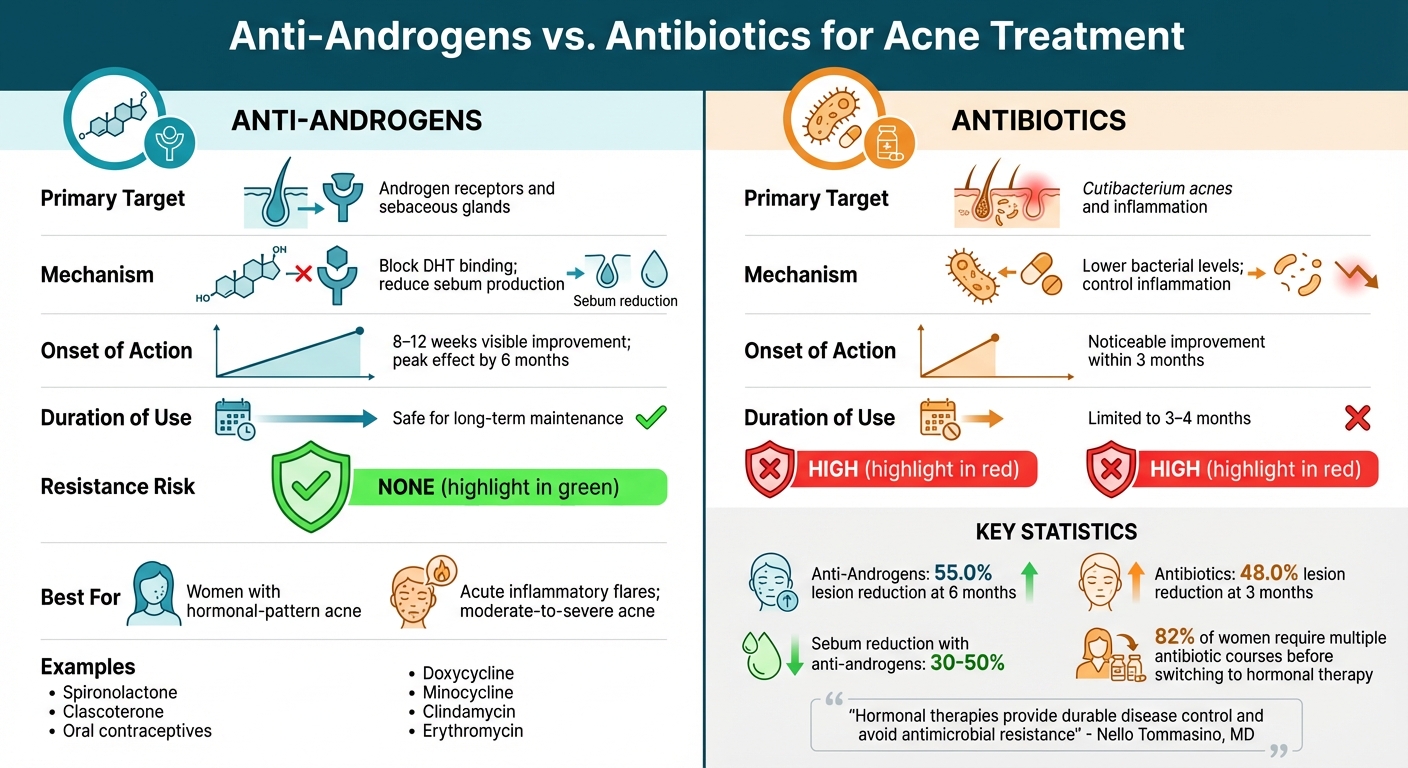
Anti-Androgens vs Antibiotics for Acne Treatment Comparison
Anti-androgens and antibiotics take distinctly different paths when it comes to tackling acne. Antibiotics like doxycycline and minocycline focus on reducing the levels of Cutibacterium acnes on the skin and calming inflammation. On the other hand, anti-androgens such as spironolactone address the hormonal roots of acne by blocking androgen receptors in sebaceous glands, which helps decrease sebum production. Essentially, antibiotics deal with surface symptoms, while anti-androgens go after the hormonal triggers behind the condition - a key theme in understanding their roles.
When comparing results, antibiotics tend to show quicker results, with a 48.0% reduction in acne lesions at the three-month mark, whereas hormonal therapies like anti-androgens achieve greater success over time, with a 55.0% reduction by six months. One study highlighted that spironolactone combined with benzoyl peroxide outperformed doxycycline paired with benzoyl peroxide at both four and six months (p = 0.007).
"Compared with antibiotics, hormonal therapies provide durable disease control and avoid antimicrobial resistance."
– Nello Tommasino, MD, University of Naples Federico II
Antibiotics come with limitations, including a recommended usage of only three to four months due to risks like antimicrobial resistance and complications such as C. difficile infections. In fact, 82% of women undergoing acne treatment often require multiple courses of antibiotics before transitioning to hormonal therapies. Anti-androgens, however, are suitable for long-term use without these resistance concerns.
How Treatment Mechanisms Compare
Here’s a side-by-side look at the key features of these two treatment approaches:
| Feature | Anti-Androgens | Antibiotics |
|---|---|---|
| Primary Target | Androgen receptors and sebaceous glands | Cutibacterium acnes and inflammation |
| Mechanism | Block DHT binding; reduce sebum production | Lower bacterial levels; control inflammation |
| Onset of Action | Visible improvement in 8–12 weeks; peak effect by 6 months | Noticeable improvement within 3 months |
| Duration of Use | Safe for long-term maintenance | Limited to 3–4 months |
| Resistance Risk | None | High risk of antimicrobial resistance |
| Best For | Women with hormonal-pattern acne | Acute inflammatory flares; moderate-to-severe acne |
| Medication Examples | Spironolactone, Clascoterone, oral contraceptives | Doxycycline, Minocycline, Clindamycin, Erythromycin |
For women dealing with hormonal-pattern acne - characterized by breakouts along the jawline, chin, or during premenstrual periods - anti-androgens offer a more precise solution. While antibiotics can quickly address acute inflammatory outbreaks, shifting to hormonal therapies often provides longer-lasting results without the added worry of resistance issues.
Next Steps for Treatment
If you’re dealing with persistent acne along your jawline, chin, or lower face that worsens during your menstrual cycle, anti-androgen therapy might be worth considering. These medications target androgen receptors in your sebaceous glands, helping to reduce sebum production by 30% to 50%.
Start by consulting a healthcare provider to review your symptoms and medical history. Studies show that more than half of adult women with persistent acne have at least one abnormal hormonal level. Your provider may recommend blood tests (ideally done at the start of your menstrual cycle) to measure testosterone, DHEAS, and SHBG levels. These results can help create a treatment plan tailored to your needs.
Improvements typically begin within 8–12 weeks, with full results becoming noticeable around six months. Since these treatments carry teratogenic risks, it’s crucial to use reliable birth control during therapy.
For personalized care, consider telehealth services like Oana Health. They offer consultations with licensed professionals who specialize in hormonal acne and PCOS. Through their platform, you can receive a tailored treatment plan, which may include prescription options like spironolactone or topical spironolactone, delivered straight to your door.
To make the most of your consultation, keep a record of your breakouts and how they align with your menstrual cycle. This data can help your provider determine if hormonal therapy is the right choice for you.
FAQs
How do anti-androgens differ from antibiotics in treating acne?
Anti-androgens and antibiotics work differently when it comes to treating acne, and the choice between them depends on the underlying cause.
Anti-androgens, such as spironolactone, are particularly useful for addressing hormonal acne. They work by lowering androgen levels or blocking androgen receptors, which helps reduce oil (sebum) production and inflammation. This makes them a go-to option for women dealing with hormonal imbalances or conditions like PCOS.
On the other hand, antibiotics focus on combating acne-causing bacteria and easing inflammation. They’re typically used for short-term treatment of inflammatory acne but don’t tackle hormonal issues. Because of concerns about antibiotic resistance, they’re often paired with other treatments and prescribed for limited periods.
For adult women dealing with hormonal acne, anti-androgens tend to be the better choice. Meanwhile, antibiotics are more suitable for acne caused by bacteria or general inflammation.
What side effects can spironolactone cause when used for acne treatment?
Spironolactone is frequently prescribed to manage hormonal acne, but like any medication, it can come with side effects. Some of the more common ones include dizziness, nausea, muscle cramps, and fatigue. These are typically mild, but if they stick around or get worse, it’s a good idea to reach out to your healthcare provider.
Though uncommon, spironolactone can also lead to more serious side effects. That’s why regular check-ins with your doctor are crucial to make sure the treatment remains both safe and effective for you.
Can men use clascoterone to treat acne?
Yes, men can use clascoterone to treat acne effectively. This topical anti-androgen therapy is approved for those 12 and older and works by addressing hormones that play a role in acne development. Its targeted action focuses on the skin, making it a safe option for both men and women without impacting the rest of the body.