
BHRT and Cognitive Decline: What Studies Show
Does BHRT impact cognitive health? Yes, but timing is everything. Starting Bioidentical Hormone Replacement Therapy (BHRT) close to menopause - ideally within 10 years - can lower dementia risk by up to 32%. Delaying treatment past age 65 may increase this risk. BHRT uses hormones like 17β-estradiol, which closely mimic the body’s natural hormones, potentially supporting memory and brain health better than synthetic alternatives.
Key Takeaways:
- Timing Matters: Early use (perimenopause or within 5 years after menopause) shows the best outcomes. Late starts (after 65) may harm cognitive health.
- Brain Benefits: Estradiol helps memory, learning, and reduces Alzheimer’s risk, especially in APOE4 gene carriers.
- Delivery Methods: Transdermal (patches/gels) may be better for memory than oral options.
- Risks: Starting BHRT too late or using synthetic hormones can lead to faster tau protein buildup, linked to Alzheimer’s.
- Research Gaps: Current studies lack diversity and consistency in hormone types, leaving unanswered questions about long-term effects.
If you’re considering BHRT, consult a healthcare provider early to weigh risks and benefits tailored to your health and genetic profile.
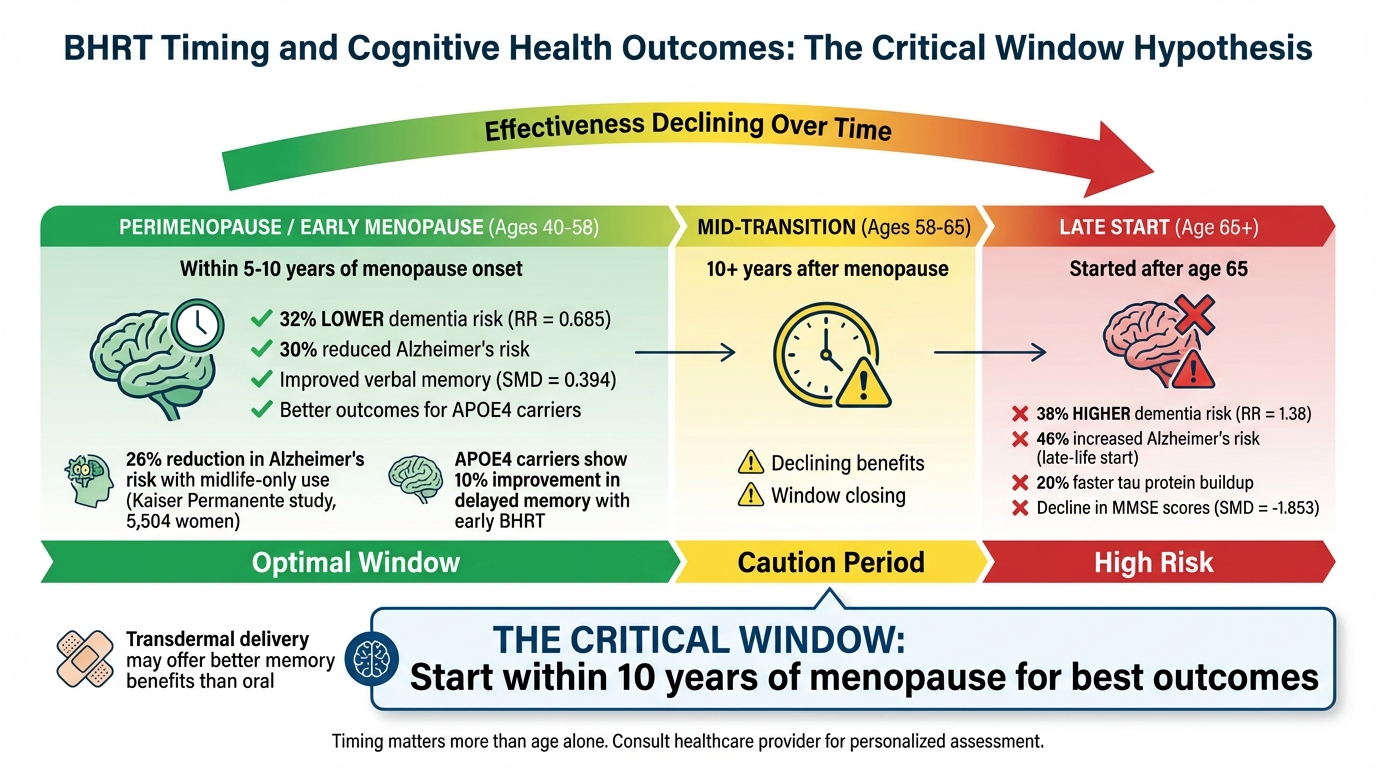
BHRT Timing and Cognitive Health Outcomes: The Critical Window Effect
What Studies Show About BHRT and Cognitive Decline
The 'Window of Opportunity' Hypothesis
Timing plays a crucial role in determining the effectiveness of hormone therapy for brain health. The "window of opportunity" hypothesis suggests that bioidentical hormone replacement therapy (BHRT) is most beneficial when started during perimenopause or the early postmenopausal period - ideally within 10 years of menopause onset or before age 60.
Research supports this idea. For example, women who began estrogen therapy in midlife experienced a 32% lower risk of dementia (RR = 0.685). The Cache County Study, which tracked 1,768 women, found that those who initiated hormone therapy within five years of menopause had a 30% reduced risk of Alzheimer's disease. On the other hand, starting hormone therapy after age 65 was linked to a 38% higher risk of dementia (RR = 1.38).
The Kaiser Permanente study involving 5,504 women confirmed this pattern. Women who used hormone therapy only during midlife saw a 26% reduction in Alzheimer's risk, while those who began treatment later in life faced a 46% higher risk. Dr. Pauline M. Maki from the University of Illinois at Chicago explains:
"Perhaps critical periods occur at menopause, when withdrawal of hormonal influence leads to increased brain susceptibility to pathologic processes... perimenopause or immediately postmenopause might be the appropriate time for intervention."
These timing effects also correlate with changes in biological markers linked to Alzheimer's, such as tau protein accumulation.
BHRT's Effect on Tau Accumulation and Alzheimer's Risk
Recent studies using advanced imaging techniques have provided insights into how hormone therapy influences tau protein buildup in the brain, a key feature of Alzheimer's disease. The Harvard Aging Brain Study, published in March 2025, examined 146 clinically normal women aged 51–89 using PET scans. For women over 70, hormone therapy was associated with a 20% faster tau buildup in the entorhinal cortex compared to non-users. In contrast, younger women showed negligible tau-related effects.
As noted by Tali Sharot in Science Advances:
"In older women (aged >70 years), HT users exhibited faster regional tau accumulation relative to non-users... In younger women (aged <70 years), HT associations with tau accumulation were negligible."
This finding fits with the "Healthy Cell Bias" theory, which suggests that estrogen supports healthy neurons but may worsen damage in already compromised neurons due to age or disease. Genetics also play a role. For instance, the EPAD cohort study of 1,178 women, published in January 2023, reported that APOE4 carriers who started hormone therapy early had larger hippocampal volumes and better delayed memory performance compared to non-users.
While tau accumulation studies highlight biological changes, meta-analyses provide a broader view of cognitive outcomes.
Meta-Analyses and Cognitive Test Results
Meta-analyses of multiple studies reveal clear trends in cognitive outcomes based on the timing and type of hormone therapy. For example, midlife estrogen-only therapy was linked to improved verbal memory, with a standardized mean difference (SMD) of 0.394. Women who underwent surgical menopause and received estrogen therapy also showed moderate improvements in global cognition and verbal working memory.
However, starting hormone therapy later in life tells a different story. Combined estrogen-progestogen therapy (EPT) initiated after age 65 was associated with a decline in MMSE scores (SMD = –1.853) and a 64% increased risk of dementia (RR = 1.64). The KEEPS Continuation Study, which followed 299 women for about 10 years after an initial 4-year trial, reported that short-term hormone therapy started in early menopause caused no long-term cognitive harm. However, it also didn’t offer lasting protection against cognitive decline compared to a placebo.
| Study Type | Age at Start | Hormone Type | Cognitive Outcome |
|---|---|---|---|
| Meta-analysis (RCTs) | Midlife (<65) | Estrogen-only | Improved verbal memory (SMD = 0.394) |
| Meta-analysis (RCTs) | Late-life (≥65) | Estrogen-progestogen | Decline in MMSE scores (SMD = –1.853) |
| Observational | Midlife | Estrogen-only | 32% reduced dementia risk |
| Longitudinal PET | Older (>70) | Any hormone therapy | Faster tau accumulation in entorhinal cortex |
What Affects BHRT's Impact on Cognitive Health
When Menopause Occurs
The timing of menopause plays a crucial role in how BHRT influences cognitive health. Women who experience surgical menopause face a higher risk of cognitive decline but show significant improvements in global cognition when estrogen therapy is introduced early (SMD = 1.575). In comparison, women with spontaneous menopause experience more moderate benefits.
For women entering menopause between the ages of 35 and 48, the risks are even greater. These individuals show a negative relationship (β = -0.044) between cognitive scores and vascular risk factors like high blood pressure and smoking. On the other hand, a later onset of menopause tends to correlate with better cognitive performance, likely because of prolonged exposure to protective estrogen levels throughout life.
"The 'critical window hypothesis' posits that HRT is most effective when initiated near the onset of menopause, during a period when the brain may be more responsive to estrogen"
- Tamlyn J. Watermeyer, Edinburgh Dementia Prevention
This connection between menopause timing and BHRT's effectiveness sets the stage for exploring how different hormone delivery methods impact cognitive outcomes.
Transdermal vs. Oral Delivery Methods
The way BHRT is delivered can influence which cognitive functions benefit most. Transdermal estradiol, which bypasses the liver and avoids first-pass metabolism, has been shown to enhance episodic memory due to its higher bioavailability. In contrast, oral estradiol is metabolized in the liver into estrone, a less potent form, and is more effective at improving prospective memory. In a study of 7,251 cognitively healthy postmenopausal women (mean age 61), 4% used transdermal estradiol, while 2% opted for oral forms.
"Since oral estradiol is metabolized in the liver, estradiol is converted to estrone, which impacts the memory areas of the brain less effectively than transdermal estradiol"
- Dr. Sherry Ross, OB/GYN and women's health expert
A 2025 study involving over 3,800 postmenopausal women also found that transdermal hormone therapy was linked to lower rates of anxiety and depression compared to oral therapy. However, neither delivery method seems to have a major impact on executive function. These findings highlight how the route of hormone administration can uniquely affect specific cognitive domains.
Which Cognitive Functions BHRT Affects Most
Among the various cognitive functions, verbal memory appears to benefit the most from BHRT. Meta-analyses show that midlife estrogen therapy improves verbal memory (SMD = 0.394), with even greater gains in global cognition (SMD = 1.575) for women who have undergone surgical menopause. BHRT also enhances working memory, as demonstrated by improvements in Digit Span forward tests (SMD = 0.747), and boosts delayed memory in women carrying the APOE4 gene.
APOE4 carriers, who are genetically predisposed to Alzheimer's disease, see a 10% improvement in delayed memory scores with BHRT compared to non-users. Data from the European Prevention of Alzheimer's Disease (EPAD) cohort study, which analyzed 1,178 women, revealed that APOE4 carriers using HRT had 6–10% larger entorhinal and amygdala volumes than those not using HRT.
"When initiated specifically in midlife or close to menopause onset, estrogen therapy was associated with improved verbal memory"
- Caroline Andy, Weill Cornell Medicine
However, the effects on executive function are less clear. Some studies suggest a slight negative impact when BHRT begins after age 65. Additionally, longer treatment durations (over one year) have been linked to declines in visual memory compared to shorter courses. These findings underscore the importance of tailoring hormone therapy to individual needs for the best cognitive outcomes.
Research Gaps and Controversies
Large-Scale Trials and Conflicting Results
The Women's Health Initiative Memory Study (WHIMS) stands out as one of the most debated trials in hormone therapy research. WHIMS, which involved 7,429 women aged 65 and older, ended early after finding that combined CEE and MPA doubled dementia risk (hazard ratio = 2.05). Meanwhile, CEE alone showed a 49% increase in risk, though this result wasn’t statistically significant.
Interestingly, these results are at odds with smaller observational studies. These studies have consistently shown a 22% to 46% reduction in Alzheimer's risk among hormone therapy users. For example, a meta-analysis of observational data revealed that midlife estrogen-only therapy was linked to a 32% lower risk of dementia. This stark contrast underscores the importance of when therapy begins.
"The major limitation of the WHIMS is that the trials were conducted on postmenopausal women ages 65 and older, who were likely beyond the therapeutic window of estrogen efficacy." - Lisa Mosconi, PhD, Director of the Women's Brain Initiative
Newer studies, like the Kronos Early Estrogen Prevention Study (KEEPS-Cog), examined 571 recently menopausal women (mean age 53) between 2005 and 2014. It found no significant effects on memory or attention after four years. Similarly, a 2025 study of 146 women revealed that hormone therapy users over age 70 experienced faster tau protein buildup in the inferior temporal gyrus (β = 0.19, P = 0.011), while younger users showed minimal effects.
These conflicting outcomes highlight the need to address limitations in study designs.
Study Design Problems
Many studies face challenges such as small sample sizes, short durations, and biases. For instance, typical sample sizes hover around 65 participants, with studies often lasting just six months - too short to detect subtle cognitive changes.
Observational studies also struggle with healthy user bias. Women who choose BHRT are often healthier, better educated, and have higher socioeconomic status, all of which independently support better cognitive health. Randomized controlled trials, which avoid this bias, often show less favorable outcomes than observational studies.
"The 'healthy user' bias continues to be a critical confound in observational studies." - Anna C. McCarrey, PhD, National Institute on Aging
Another issue is the lack of consistency in hormone formulations. Most large trials have used synthetic conjugated equine estrogens and medroxyprogesterone acetate, whereas modern BHRT typically involves 17β-estradiol and micronized progesterone. These differences in hormone types may lead to varying cognitive effects. Additionally, few studies stratify participants by APOE4 genotype, a genetic factor known to influence hormone therapy responses.
Research also suffers from a lack of diversity, as most data comes from healthy, well-educated, non-Hispanic white women. This limits the generalizability of findings to broader populations.
What Future Research Needs to Address
To better understand BHRT's effects, future studies must address these design flaws. While earlier research hints at potential neuroprotective benefits, methodological inconsistencies demand more rigorous investigation.
Larger, more focused studies should test the "critical window" hypothesis by comparing the effects of hormone therapy initiated in midlife versus later in life. Trials must stratify participants by initiation timing and use standardized cognitive assessments. Additionally, research needs to differentiate between hormone types and delivery methods to determine which combinations work best for brain health.
"Poorer cognitive health at HT initiation may increase vulnerability to adverse effects of estrogens on the postmenopausal brain." - Susan M. Resnick, PhD, National Institute on Aging
Long-term studies spanning 15–20 years post-menopause are crucial for understanding the transition from midlife neuroprotection to potential dementia onset. Incorporating neuroimaging (MRI/PET) and biomarkers will help clarify the structural brain changes linked to BHRT. Finally, future research must include more diverse populations and consider women with comorbidities, such as diabetes, who may have unique risk factors for cardiovascular disease and dementia.
sbb-itb-6dba428
Conclusion
What Current Research Tells Us
Timing plays a key role in the effectiveness of BHRT. Studies show that starting BHRT during perimenopause or within five years after menopause (typically between ages 40 and 58) can reduce dementia risk by 23%–32%. On the other hand, beginning therapy after age 65 or more than 10 years post-menopause may increase dementia risk by as much as 30%.
Genetics also influence outcomes. For instance, women with the APOE4 gene may experience benefits like improved delayed memory and 6%–10% larger volumes in critical brain regions when using BHRT. Dr. Richard Isaacson, Director of Research at the Institute for Neurodegenerative Diseases, emphasizes:
"In the right woman, at the right dose, and for the right duration of time, I believe that hormone replacement therapy can be one of our most powerful tools to reduce a woman's risk for cognitive decline."
This evidence highlights the importance of making informed, timely decisions about BHRT.
What Women Considering BHRT Should Know
If you’re experiencing menopausal symptoms like brain fog or memory issues, it’s worth consulting a healthcare provider to determine if BHRT might be right for you. These symptoms, while different from neurodegenerative decline, often improve with early hormone therapy. However, it’s crucial to focus on symptom relief and quality of life rather than solely aiming for dementia prevention.
Before starting BHRT, ask your provider about screening for other potential causes of cognitive symptoms, such as thyroid issues, vitamin D or B12 deficiencies, or sleep disorders. Genetic testing, such as for the APOE gene, may also help identify whether you could receive specific neuroprotective benefits from BHRT. Additionally, using transdermal delivery methods (like patches or gels) is often recommended. These methods bypass the liver, reduce cardiovascular risks, and may improve episodic memory.
With these factors in mind, individualized care becomes critical.
The Case for Personalized Treatment
The research underscores the value of tailoring BHRT to individual needs. Factors like your age at menopause, genetic profile, history of hysterectomy, and overall health all play a role in how hormone therapy impacts your brain. For example, women who experience surgical menopause often see notable cognitive benefits with estrogen-only therapy.
Oana Health offers telehealth services designed to deliver personalized BHRT solutions. Through online consultations, licensed professionals assess your risk factors, recommend genetic testing if needed, and create a treatment plan tailored to you - all conveniently delivered to your home.
Worried HRT Might Cause Alzheimer’s? Watch THIS First.
FAQs
How do I know if I’m still in the “critical window” to start BHRT?
The best time to consider starting bioidentical hormone replacement therapy (BHRT) is often within the first few years after menopause. Studies indicate that beginning BHRT early might help lower the chances of cognitive decline. However, starting it later in menopause - or after signs of cognitive decline have already appeared - might not provide the same advantages and could even pose potential risks. It's essential to consult a healthcare provider who can assess your health history and timing to determine if BHRT is a good fit for you.
Should I get APOE4 genetic testing before starting BHRT?
Current studies indicate there's no definitive reason to undergo APOE4 genetic testing before beginning BHRT. Research shows that hormone therapy neither dramatically raises nor lowers the risk of dementia. Its impact on cognitive function remains uncertain, leaving no clear conclusions at this time.
Is transdermal estradiol safer or more effective for brain health than oral BHRT?
Transdermal estradiol is often regarded as a safer and more effective option for supporting brain health compared to oral BHRT. Studies have associated it with better memory function and a reduced likelihood of mental health challenges, such as anxiety and depression. Evidence indicates that the method of delivery plays a crucial role in these benefits, particularly after menopause.