
Bicalutamide Safety in Women with PCOS
Bicalutamide, a nonsteroidal anti-androgen originally approved for prostate cancer, is sometimes used off-label to manage PCOS symptoms like hirsutism, acne, and hair loss. Studies show it can reduce hirsutism scores by up to 61.6% within six months and improve hair loss severity. However, its use in women comes with risks, including liver damage and cholesterol increases. It is classified as Pregnancy Category X, meaning it can harm male fetuses, making contraception mandatory during and after treatment. Regular liver function and lipid monitoring are essential for safety during use. While bicalutamide offers an alternative for women who don’t respond to other treatments like spironolactone, its risks require strict medical supervision. Always consult a healthcare provider for personalized advice.
Key Points:
- Effectiveness: Reduces hirsutism and hair loss severity in women with PCOS.
- Risks: Liver damage, cholesterol increases, and severe fetal harm.
- Monitoring: Regular liver function and lipid tests required.
- Contraception: Mandatory during treatment and for 130 days after stopping.
- Not FDA-Approved for Women: Off-label use only under medical supervision.
For PCOS treatment, always discuss options with a licensed healthcare provider to weigh benefits and risks.
Clinical Studies on Bicalutamide Safety and Efficacy
Key Findings from Clinical Trials
In 2018, a multicenter, randomized, double-blind trial looked into the effectiveness of bicalutamide in 70 women with PCOS and severe hirsutism. Participants were divided into two groups: one received an oral contraceptive pill (OCP) combined with 50 mg of bicalutamide daily, while the other received OCP plus a placebo for 12 months. Women in the bicalutamide group showed a significantly greater reduction in hirsutism, as measured by videodermoscopy and modified Ferriman-Gallwey scores. The study concluded:
"The association of OCP + BC is well tolerated and significantly more effective than OCP alone in treating severe hirsutism."
The trial reported only one adverse event - an increase in total cholesterol and LDL levels. While this required monitoring, it did not lead to any participants discontinuing treatment.
Another study from 2020 retrospectively analyzed 316 women with pattern hair loss. It found a reduction of 17% at 6 months and 28.9% at 24 months when using predominantly 10 mg of bicalutamide daily. Low-dose monotherapy also showed promising results. For instance, a study reported that a 25 mg daily dose of bicalutamide reduced hirsutism scores by 41.2% at 3 months and 61.6% at 6 months. Across multiple studies involving 494 women, adverse events were reported in 11.9% of cases, with transient transaminitis (elevated liver enzymes) occurring in about 4.9% of patients.
These findings highlight bicalutamide's potential in managing hirsutism and PCOS symptoms while setting the stage for further safety evaluations.
Short-Term vs. Long-Term Safety Data
Safety data from clinical studies provide a clearer understanding of bicalutamide's risk profile over different treatment durations. Most trials focusing on PCOS and hirsutism have examined short-term use, typically between 6 and 12 months. During this period, the most commonly reported side effects include transient transaminitis, mild gastrointestinal issues, and breast tenderness. To ensure safety, baseline liver function tests are recommended, followed by monthly monitoring for the first four months and then every 3–6 months.
Long-term safety data, though more limited, is reassuring. A 2021 retrospective cohort study followed 7 women treated with 10–20 mg of bicalutamide for fibrosing alopecia over six years, reporting no adverse events. Similarly, a 2020 pilot study tracked 17 women (6 of whom had PCOS) taking 50 mg of bicalutamide for 6 to 18 months. It found that 53% of participants experienced significant improvement, with only two cases of manageable transaminitis.
One notable concern for long-term use, particularly in women with PCOS, is the potential increase in total cholesterol and LDL levels, as observed in the 12-month trial. Regular lipid monitoring, alongside liver function tests, remains essential to manage these risks. While hepatotoxicity has been reported, it is generally mild and reversible, with most cases resolving without stopping treatment. However, there is limited data on the safety of bicalutamide use beyond 24 months in PCOS-specific cases, highlighting the need for more extensive research.
Common Side Effects and Monitoring Guidelines
Reported Side Effects
Expanding on earlier findings about its effectiveness, safety studies provide a clearer picture of bicalutamide's effects in women. Overall, women using bicalutamide report fewer side effects compared to men. For instance, a review of 494 female patients using bicalutamide for hair loss found adverse events in about 11.9% of cases. The most commonly reported issue was temporary increases in liver enzyme levels, observed in 2.8% to 11.4% of patients across various studies.
A 2020 retrospective review by Fernandez-Nieto examined 44 women, many of whom had PCOS, taking daily doses of 25–50 mg of bicalutamide. In this group, 11.4% experienced mild, temporary liver enzyme elevations. Additionally, three patients reported hair shedding, and two experienced short-term menstrual irregularities. Similarly, a larger study involving 316 women noted liver enzyme elevations (transaminitis) in nine patients (2.8%), with only three discontinuing treatment. Other side effects in this study included peripheral edema in eight patients and gastrointestinal complaints in six.
Additional side effects include peripheral edema (around 2.0%), gastrointestinal issues (approximately 1.2%), and temporary menstrual irregularities (about 0.8%). While rare, serious complications like endometrial hyperplasia have been reported in isolated cases. Furthermore, women with PCOS may experience increases in total cholesterol and LDL cholesterol levels, particularly when bicalutamide is used alongside oral contraceptives.
Recommended Monitoring Practices
To ensure patient safety, strict monitoring protocols are crucial when using bicalutamide. Before starting treatment, baseline tests should include a complete blood count (CBC), liver function tests (LFTs), a fasting lipid profile, and a pregnancy test. Establishing these baselines helps track any changes during treatment.
Monitoring liver function is especially important, with regular follow-ups based on established guidelines. Patients should immediately report symptoms of liver issues, such as jaundice (yellowing of the eyes or skin), dark urine, pain in the upper right abdomen, or extreme fatigue. Liver-related side effects often appear within 2 to 3 months of starting treatment but can occur as late as 4 to 6 months.
Lipid profile monitoring is also essential, particularly for women with PCOS who may already face cardiometabolic risks. At each medical visit, blood pressure, body mass index (BMI), and waist circumference should be assessed. Women with diabetes should pay extra attention to their blood glucose levels during treatment.
Because bicalutamide is classified as Pregnancy Category X, effective contraception is mandatory during therapy and for 130 days after the final dose. These monitoring practices are critical to managing the known risks of treatment, ensuring it remains both safe and effective.
For tailored monitoring and management of PCOS, including the use of bicalutamide, patients are encouraged to consult licensed medical professionals through Oana Health's telehealth services. Careful monitoring helps mitigate risks and supports the safe continuation of therapy, as outlined in further detail under contraindications.
Contraindications and Special Considerations
Contraindications
Bicalutamide is strictly contraindicated during pregnancy (classified as Pregnancy Category X). Its antiandrogenic effects can cause severe fetal harm, particularly in male fetuses, leading to issues like masculinization defects. Animal studies have shown that male offspring exposed to bicalutamide may experience reduced anogenital distance, hypospadias, and smaller secondary sex organs, which can result in an inability to mate. As noted in the FDA prescribing information:
"Bicalutamide may cause fetal harm when administered to a pregnant woman. Bicalutamide is contraindicated in women, including those who are or may become pregnant."
The medication is also contraindicated for women who are breastfeeding, as there are no sufficient human studies on this, though it has been identified in rat milk. Additionally, women with hypersensitivity to bicalutamide or its ingredients should avoid the drug due to the risk of severe allergic reactions, such as angioneurotic edema or urticaria.
Severe hepatic impairment is another critical concern. Since bicalutamide undergoes extensive liver metabolism, individuals with liver conditions or PCOS-related NAFLD face a heightened risk of hepatotoxicity. In cases of severe liver disease, the drug's half-life can increase significantly - from 5.9 days to 10.4 days - raising the potential for severe complications. Postmarketing data has reported incidents of hospitalization and even death due to severe liver injury, including hepatic failure.
For women with PCOS, pre-existing cardiometabolic issues are common. Bicalutamide can exacerbate these conditions by increasing total cholesterol and LDL cholesterol levels, particularly when combined with oral contraceptives. It can also impair glucose tolerance, posing additional risks for PCOS patients who often deal with insulin resistance or type 2 diabetes.
These contraindications highlight the importance of strict contraceptive measures during treatment.
Importance of Contraception
Due to the significant fetal risks associated with bicalutamide, rigorous contraceptive practices are non-negotiable. With its teratogenic effects and long half-life (7–10 days), effective contraception is required for all women of reproductive age throughout treatment and for 130 days (approximately 4.5 months) following the final dose. This extended period ensures the drug is fully eliminated from the body before any potential pregnancy.
Healthcare providers should perform a baseline pregnancy test before starting treatment and continue testing monthly for the first four months. Women must commit to using highly effective contraception methods before initiating bicalutamide therapy.
For tailored advice on contraception and safe treatment options for PCOS, women can consult licensed medical professionals through Oana Health's telehealth services at https://oanahealth.com. Adhering to these contraceptive guidelines is critical for managing PCOS symptoms safely while using bicalutamide.
sbb-itb-6dba428
Bicalutamide vs. Other Anti-Androgens: Safety Comparison
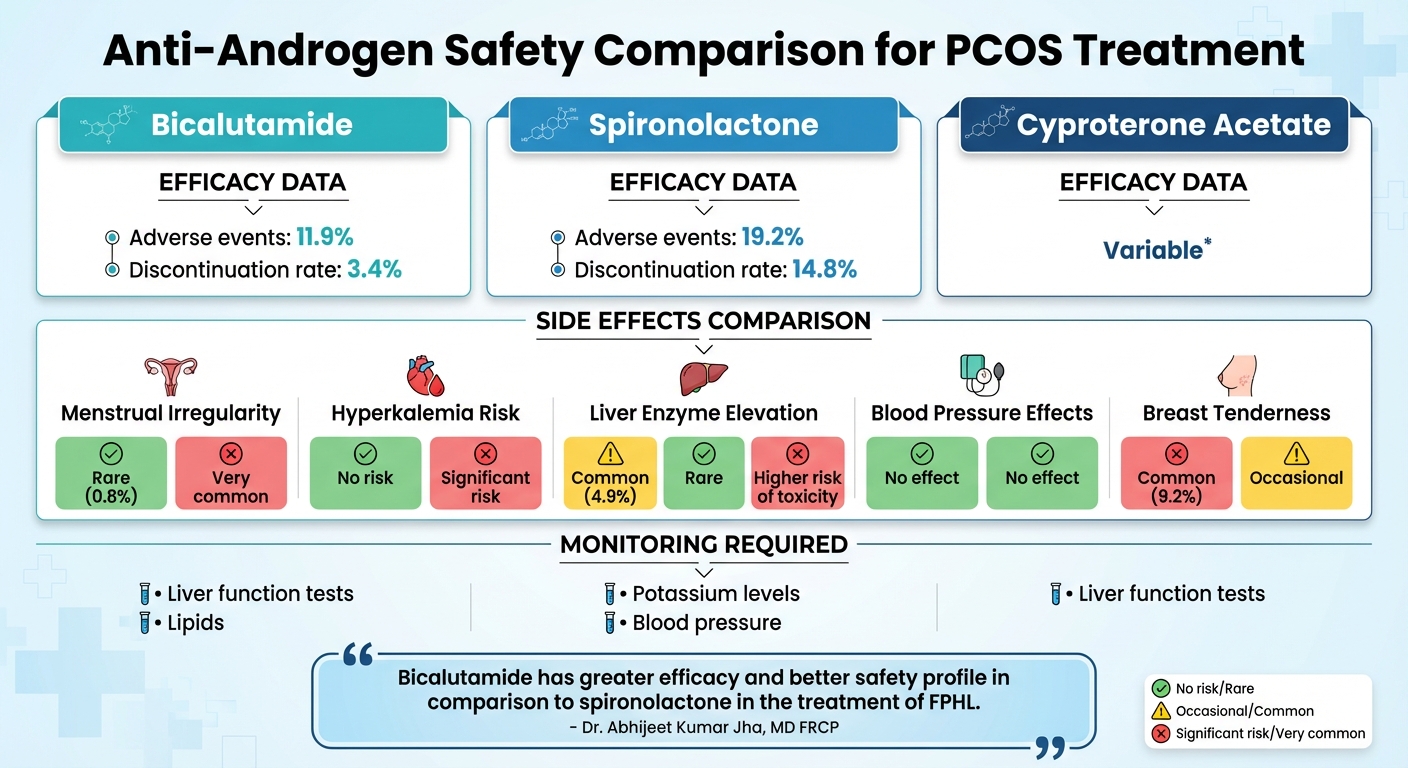
Bicalutamide vs Spironolactone vs Cyproterone Acetate Safety Comparison for PCOS
When comparing anti-androgens, bicalutamide stands out for its specific safety profile, particularly in managing PCOS symptoms. Alongside bicalutamide, spironolactone and cyproterone acetate are also commonly used, but these treatments vary in their systemic effects.
For example, spironolactone’s diuretic properties can lead to low blood pressure and electrolyte imbalances. A study on women with hair loss found adverse events in 11.9% of patients taking bicalutamide, compared to 19.2% of those using spironolactone. Discontinuation rates were also lower for bicalutamide (3.4%) versus spironolactone (14.8%).
"Bicalutamide has greater efficacy and better safety profile in comparison to spironolactone in the treatment of FPHL." – Abhijeet Kumar Jha, MD FRCP, Patna Medical College & Hospital
One key advantage of bicalutamide is its suitability for patients who cannot tolerate spironolactone. Unlike spironolactone, bicalutamide does not interact with mineralocorticoid receptors, eliminating the risk of hyperkalemia. This makes it a safer choice for individuals where regular potassium monitoring is impractical.
Side Effect Comparison
| Side Effect | Bicalutamide | Spironolactone | Cyproterone Acetate |
|---|---|---|---|
| Menstrual Irregularity | Rare (0.8%) | Very common | Low (progestogenic) |
| Hyperkalemia | No risk | Significant risk | No risk |
| Liver Enzyme Elevation | Common (4.9%) | Rare | Higher risk of toxicity |
| Blood Pressure Effects | No effect | Risk of hypotension | No effect |
| Breast Tenderness | Occasional | Common (9.2%) | Occasional |
| Monitoring Required | Liver function tests, lipids | Potassium levels, blood pressure | Liver function tests |
Cyproterone acetate, while effective in regulating menstrual cycles due to its progestogenic effects, carries a higher risk of liver toxicity compared to bicalutamide. However, liver changes linked to bicalutamide are usually temporary, with only about 1% of patients needing to discontinue treatment because of elevated liver enzymes. This balance of efficacy and safety makes bicalutamide a compelling option for many patients.
Conclusion: Weighing Benefits and Risks of Bicalutamide in PCOS
Bicalutamide offers an alternative option for women with PCOS who do not respond to standard treatments. Clinical studies have shown promising results, including a reduction in hair loss severity by around 27.5%–28.9% and a decrease in hirsutism scores by up to 61.6% after six months of treatment. However, these benefits come with notable risks that require careful consideration.
One of the primary concerns is the potential for elevated liver enzymes, affecting approximately 4.9% of patients, with severe liver changes occurring in about 1%. Because of these risks, baseline liver tests and regular monitoring are essential. Additionally, strict adherence to contraception is required due to the drug's Category X classification.
"The heterogeneity of the clinical presentation in PCOS patients suggests the involvement of multiples abnormal physiological pathways... Thereby, the complexity of the PCOS phenotype makes the clinical management of PCOS highly challenging." – Licy L Yanes Cardozo, M.D., University of Mississippi Medical Center
This complexity highlights the importance of tailoring treatment to each individual. Personalized management is not just helpful - it’s crucial.
For those navigating these challenges, platforms like Oana Health provide telehealth services that connect patients with licensed medical professionals. These experts monitor treatment progress, adjust dosages as needed, and ensure safety protocols are followed - all without leaving your home.
Ultimately, your treatment plan should reflect your unique symptoms, medical history, and ability to meet monitoring requirements. Collaborating with knowledgeable healthcare providers is the best way to create an effective, safe, and personalized approach to managing PCOS.
FAQs
What are the potential risks of taking bicalutamide for PCOS treatment?
Bicalutamide is sometimes used off-label for managing PCOS, but it comes with certain risks that need careful evaluation. One of the more serious concerns involves liver-related complications, including severe liver injury or even liver failure. Because of this, regular monitoring of liver function is crucial during its use.
Some individuals may also experience gynecomastia, which is the enlargement of breast tissue, or discomfort in the breast area. Additionally, when bicalutamide is used alongside LHRH agonists, it can lower glucose tolerance, potentially impacting blood sugar levels. This makes blood glucose monitoring another important consideration throughout treatment.
It's essential to consult a licensed healthcare provider to determine whether bicalutamide is a suitable and safe option based on your specific health situation.
Is bicalutamide a safe and effective treatment for PCOS compared to other anti-androgens?
Bicalutamide is an anti-androgen primarily prescribed for prostate cancer treatment. Its application in women with PCOS is less common and hasn’t been extensively researched. While it has shown promise in managing issues like female pattern hair loss in cases linked to high androgen levels, its long-term safety in women is still uncertain. Some adverse effects have been reported, so its use demands close medical supervision.
On the other hand, anti-androgens such as spironolactone and cyproterone acetate are more commonly used for PCOS and come with a more established safety and efficacy record. These medications are often recommended to address symptoms like hormonal acne, excessive hair growth, and hair thinning. If you’re thinking about bicalutamide as a treatment option for PCOS, it’s crucial to discuss it thoroughly with a healthcare provider to evaluate its potential risks and benefits based on your individual needs.
Why do women with PCOS need to use contraception when taking bicalutamide?
Bicalutamide is not safe for use during pregnancy, as it can cause severe harm to a developing fetus. This makes contraception absolutely critical for anyone taking the medication to manage PCOS. Women who are pregnant or planning to conceive should avoid using bicalutamide altogether.
To minimize the risk of unintended pregnancy while on bicalutamide, it’s essential to use dependable birth control. If you're currently taking or considering bicalutamide, speak with your healthcare provider to determine the most effective contraceptive method for your needs.