
Black Cohosh and Hirsutism: What Studies Show
Black cohosh, a plant-based supplement often used for menopausal symptoms, has been explored for its potential to manage hirsutism - a condition causing excessive hair growth in women due to elevated androgen levels. However, current research does not support its effectiveness for reducing unwanted hair growth. While black cohosh may influence hormone regulation in some cases, no clinical studies have specifically measured its impact on hirsutism or androgen-driven symptoms.
Key points:
- No direct evidence: Studies on black cohosh have not assessed its effect on hair growth, focusing instead on fertility and hormonal outcomes in PCOS.
- Limited hormonal impact: Research shows it doesn't significantly alter testosterone or other androgen-related hormones.
- Safety concerns: Mild side effects like gastrointestinal upset and rare cases of liver damage have been reported.
- Proven alternatives exist: Medications like spironolactone and eflornithine cream are backed by research for managing hirsutism.
For now, black cohosh remains unproven for hirsutism, and those seeking effective treatment should consider FDA-approved options.
How Black Cohosh Affects Androgen Levels
Black cohosh operates in a way that sets it apart from other plants like soy or red clover. Unlike these, it doesn’t contain traditional phytoestrogens - plant-based compounds that mimic estrogen in the body. Instead, researchers classify it as a Selective Estrogen Receptor Modulator (SERM). This means it might mimic estrogen in certain tissues, such as the brain and bones, while either staying neutral or blocking estrogen’s effects in others, like the breast and uterus. This unique mechanism raises questions about how it might influence androgen-related conditions, such as hirsutism.
Given its hormonal activity, black cohosh could play a role in balancing estrogen and androgen levels, which might affect hirsutism. Preclinical studies suggest that it inhibits steroid sulfation, a critical step in androgen production. However, clinical studies largely show that black cohosh doesn’t significantly alter levels of testosterone, estradiol, follicle-stimulating hormone (FSH), or luteinizing hormone (LH) in the bloodstream. For example, a 14-day study in animal models found no changes in serum testosterone or sex hormone-binding globulin (SHBG) levels after treatment with black cohosh.
Interestingly, black cohosh’s effects may extend beyond hormones. It interacts with the central nervous system by binding to serotonin receptors (5-HT7 and 5-HT1A) in the hypothalamus, as well as dopamine, norepinephrine, and GABA receptors in the brain. While it doesn’t appear to exert a direct estrogenic effect, its influence on neurotransmitters and inflammatory pathways could explain some of its benefits. These central actions might provide symptom relief, even without measurable changes in hormone levels.
Additionally, black cohosh inhibits aromatase activity in MCF-7 cells, preventing the conversion of androgens into estrogens. Though the significance of this for hirsutism is still uncertain, the extract also shows anti-inflammatory properties that may contribute to its overall effects.
Human Studies on Black Cohosh for Hirsutism
No human research has confirmed that black cohosh reduces hirsutism. While many studies have examined its effects on PCOS, none have specifically evaluated its impact on excessive hair growth.
This lack of evidence stands in contrast to research on fertility and hormonal outcomes. A systematic review of 181 studies identified just two high-quality randomized controlled trials - neither of which measured Ferriman-Gallwey scores, the standard tool for assessing terminal hair growth in nine body areas. Instead, these trials focused on outcomes like ovulation, pregnancy rates, and endometrial thickness in individuals with PCOS.
One trial comparing black cohosh to Clomiphene in PCOS patients found improvements in fertility markers such as FSH/LH ratios. Another review highlighted three randomized controlled trials where combining black cohosh with Clomid led to higher pregnancy rates compared to Clomid alone. However, none of these studies assessed changes in hair growth.
Despite some hormonal improvements noted in fertility-related studies, there is no evidence that black cohosh reduces excessive hair growth. On the other hand, pharmaceutical anti-androgens have shown measurable results. For example, spironolactone (100 mg daily) has been proven to reduce Ferriman-Gallwey scores by an average of –7.69 points. To date, no trials have evaluated black cohosh's effectiveness in addressing hirsutism, which affects approximately 8% of women in the U.S..
Without hirsutism-specific research, any claims about black cohosh's anti-androgenic properties remain theoretical. While some herbalists may recommend it for unwanted hair growth, there is no scientific evidence from human studies to support its use for this purpose. Women seeking treatment for hirsutism should rely on options with proven efficacy.
Study Results Compared
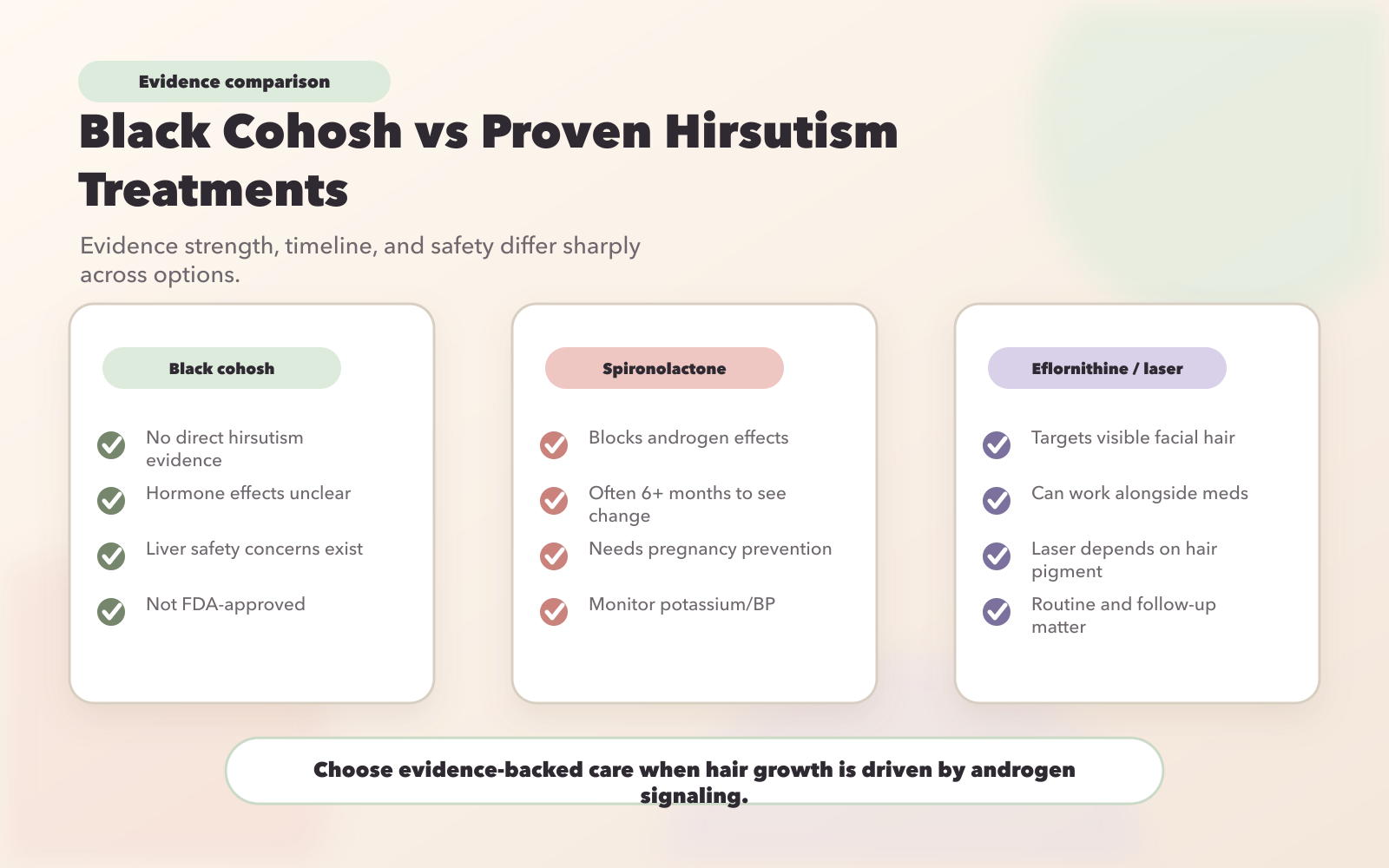
Black Cohosh vs FDA-Approved Hirsutism Treatments Comparison
No clinical trials have specifically evaluated black cohosh's effect on hirsutism, leaving researchers unable to directly compare its impact to medical treatments for hirsutism that have proven results. Instead, studies have primarily focused on fertility outcomes related to PCOS, creating a gap in understanding its role in addressing excessive hair growth.
The research available varies widely in design. Dosages range from 20 mg to 160 mg daily, treatment durations span from short-term trials to 12 months, and extraction methods differ - factors that contribute to inconsistent outcomes. For example, a meta-analysis of nine trials involving over 1,400 participants found a 26% improvement in menopausal symptoms with black cohosh compared to placebo. However, none of these studies assessed hirsutism. These inconsistencies reflect the broader uncertainties about black cohosh's hormonal effects discussed earlier. The table below highlights key study parameters and findings.
Table: Study Results Summary
| Study Year / Author | Sample Size | Dosage / Duration | Hirsutism or Hormone Results | Reported Side Effects | Key Limitations |
|---|---|---|---|---|---|
| 2013 / Kamel | Not specified | Not specified | Not measured; improved FSH/LH ratio | None reported | Focused on ovulation, not hair growth |
| 2014 / Shahin & Mohammed | RCT (size not specified) | Added to Clomiphene cycles | Not measured; improved pregnancy rates | No significant differences vs. control | Small sample size; risk of bias |
| 2021 / Fan et al. (Systematic Review) | 181 records screened; 5–6 analyzed | 20 mg to 120 mg daily; short-term | Not measured; improved hormone regulation | No differences in adverse events | High study heterogeneity; lack of high-quality evidence |
Side effects reported in these studies were generally mild. Gastrointestinal upset occurred in 0.5%–15% of participants, while breast swelling was noted in about 16%. Rarely, liver damage has been associated with black cohosh, with over 30 cases potentially linked to its use according to the US Pharmacopeia. However, most meta-analyses found that the incidence of side effects was comparable to placebo groups.
Although some studies observed hormonal improvements, there is no evidence that these translate into reduced hair growth. Small sample sizes and the potential influence of placebo effects further weaken any conclusions. Without direct measures of hirsutism vs normal hair, current research does not support black cohosh as a solution for unwanted hair.
sbb-itb-6dba428
Research Gaps and Future Studies Needed
The current body of research on black cohosh for addressing hirsutism is sparse. For instance, a systematic review from 2021 found only five studies examining black cohosh in women with PCOS. Most research has centered on fertility outcomes, like pregnancy rates, rather than tackling androgen-driven symptoms such as unwanted hair growth. This leaves a clear need for studies specifically targeting its impact on hirsutism.
Existing trials also highlight several methodological issues. Many studies include small sample sizes - one trial had just 40 participants - and short treatment durations of one to three menstrual cycles. These timeframes are likely too brief to observe meaningful changes in hair growth, which often requires 6 to 12 months of hormonal treatment. Additionally, the lack of proper blinding in many studies raises concerns about potential bias, as both participants and researchers were often aware of treatment assignments.
"Despite these findings, a lack of high-quality evidence and study heterogeneity limited the ability to make definitive conclusions." - Journal of Pharmacy Practice
Inconsistencies across studies further complicate the picture. Different types of black cohosh extracts (e.g., aqueous versus ethanol-based), varying dosages (20 mg to 120 mg daily), and inconsistent methodologies have been used. Moreover, few studies employ validated tools like the Ferriman-Gallwey scale to directly assess hirsutism. These variations make it challenging to determine the herb's true effectiveness for managing unwanted hair growth.
To address these gaps, future research should prioritize the following:
- Standardizing the type and dosage of black cohosh extracts.
- Conducting studies with larger participant groups.
- Extending study durations to 6–12 months to better evaluate hair growth outcomes.
- Using validated scales, such as the Ferriman-Gallwey scale, to measure hirsutism directly.
Safety monitoring is equally critical, particularly for liver function and clotting risks, as black cohosh may pose specific concerns for individuals with liver issues. Without rigorous, well-designed studies, the claim that black cohosh can reduce hirsutism remains speculative compared to prescription vs. natural remedies for hirsutism with established track records. Focused research is essential to clarify its potential role in managing hormonal health and addressing androgen-driven symptoms like hirsutism.
Oana Health: Hirsutism and Hormonal Health Treatment
When it comes to managing hirsutism and hormonal health, Oana Health offers a modern, telehealth-based approach. This platform specializes in personalized treatments for unwanted hair growth, hormonal imbalances, and PCOS-related symptoms, providing tailored care that addresses the root causes of these issues.
Through Oana Health, patients connect with licensed medical professionals who prescribe FDA-approved medications designed to tackle the androgenic hair growth drivers. One option is Spironolactone, an oral anti-androgen medication that starts at just $14 per month. It works by blocking androgen receptors and reducing the production of hormones responsible for triggering unwanted hair. For facial hair, Eflornithine cream, priced at $69 per month, slows hair growth by targeting a specific enzyme in hair follicles.
What sets these treatments apart is their focus on addressing hormonal imbalances rather than offering temporary fixes. Unlike methods like laser hair removal vs. other hirsutism treatments, which only deal with the surface issue, these medications work on the underlying causes of hirsutism. Plus, Oana Health ensures convenience with free home delivery through FDA-regulated pharmacies, making long-term hormonal health management accessible and affordable compared to traditional in-person clinic visits or expensive procedures.
Conclusion
Recent studies suggest that black cohosh offers limited support for managing hirsutism. While it has been used for over 50 years to address menopausal symptoms, research shows little evidence that it significantly impacts hormones like FSH, LH, or estrogen. As noted by MyHirsutism.com, "There is no scientific evidence that suggests such an effect in Hirsutism or PCOS, and more research is needed" —particularly regarding how insulin resistance fuels androgen excess in these conditions.
The evaluation of black cohosh is further complicated by variations in dosing and extract concentrations, as well as safety concerns. Reports include 83 cases of liver damage and 30 instances of hepatotoxicity. These findings highlight the need for rigorous, standardized clinical trials to assess its safety and efficacy.
For women dealing with hirsutism, treatments backed by strong clinical evidence remain the most reliable option. FDA-approved medications, which directly address hormonal imbalances, are far more effective than supplements like black cohosh.
Platforms like Oana Health make these proven treatments accessible through telehealth services. Licensed professionals can prescribe options such as Spironolactone (starting at $14 per month) and Eflornithine cream ($69 per month), which target the underlying causes of hirsutism. This ensures women receive safe, effective care supported by clinical research.
FAQs
Why hasn’t black cohosh been tested directly for hirsutism?
Black cohosh hasn’t been specifically researched in relation to hirsutism. The limited availability of high-quality studies and inconsistent research designs make it challenging to determine whether it could be effective for managing this condition.
How long does it take to see real improvement in hirsutism treatment?
Research shows that treatments for hirsutism, including medications, can take six months or more to produce visible changes in hair growth. Staying patient and sticking to the prescribed plan are essential for the best results.
What should I know about black cohosh and liver safety?
Black cohosh has been associated with reports of liver damage, raising concerns about its overall safety, especially with long-term use. Documented cases of liver injury, known as hepatotoxicity, have prompted the FDA to recommend caution when using this supplement. If you're thinking about trying black cohosh, it's essential to talk to a healthcare provider first to discuss potential risks and ensure it's safe for you.