
Clomiphene Resistance: Combination Therapies That Work
For women with PCOS, clomiphene citrate is often the first choice for ovulation induction. But 20-25% of women face clomiphene resistance, meaning they don’t ovulate even with higher doses. Even for those who ovulate, pregnancy rates remain low (35-40%) due to its side effects, like thinning the uterine lining.
The solution? Combination therapies. These treatments address underlying issues, improve ovulation, and boost pregnancy success. Here's a quick breakdown:
- Clomiphene + Metformin: Tackles insulin resistance with pharmacotherapy; improves ovulation rates (up to 83.3%) and live birth rates (up to 26.8%).
- Clomiphene + Letrozole: Avoids clomiphene's side effects; achieves up to 89% ovulation rates and higher pregnancy success.
- Clomiphene + Gonadotropins: For resistant cases, offering the highest success rates (80% ovulation, doubled live birth rates).
Each therapy has unique pros, costs, and risks, but they all aim to improve outcomes for clomiphene-resistant patients. Treatments should be tailored to individual needs, and telehealth platforms like Oana Health make accessing these therapies easier and more affordable.
Quick Comparison
| Therapy | Ovulation Rate | Pregnancy Success | Cost | Risks |
|---|---|---|---|---|
| Clomiphene + Metformin | Up to 83.3% | 23-34% live birth | ~$50 | GI side effects (5.5-22.2%) |
| Clomiphene + Letrozole | Up to 89% | 42% pregnancy rate | Low (generic) | Minimal multiple pregnancy risk |
| Clomiphene + Gonadotropins | ~80% | Doubled live birth rate | High | OHSS (<1%), multiple pregnancy (<6%) |
Key takeaway: Combination therapies offer hope for clomiphene resistance, with options ranging from affordable oral drugs to more advanced injections. Always consult with a specialist to find the right approach for your situation.
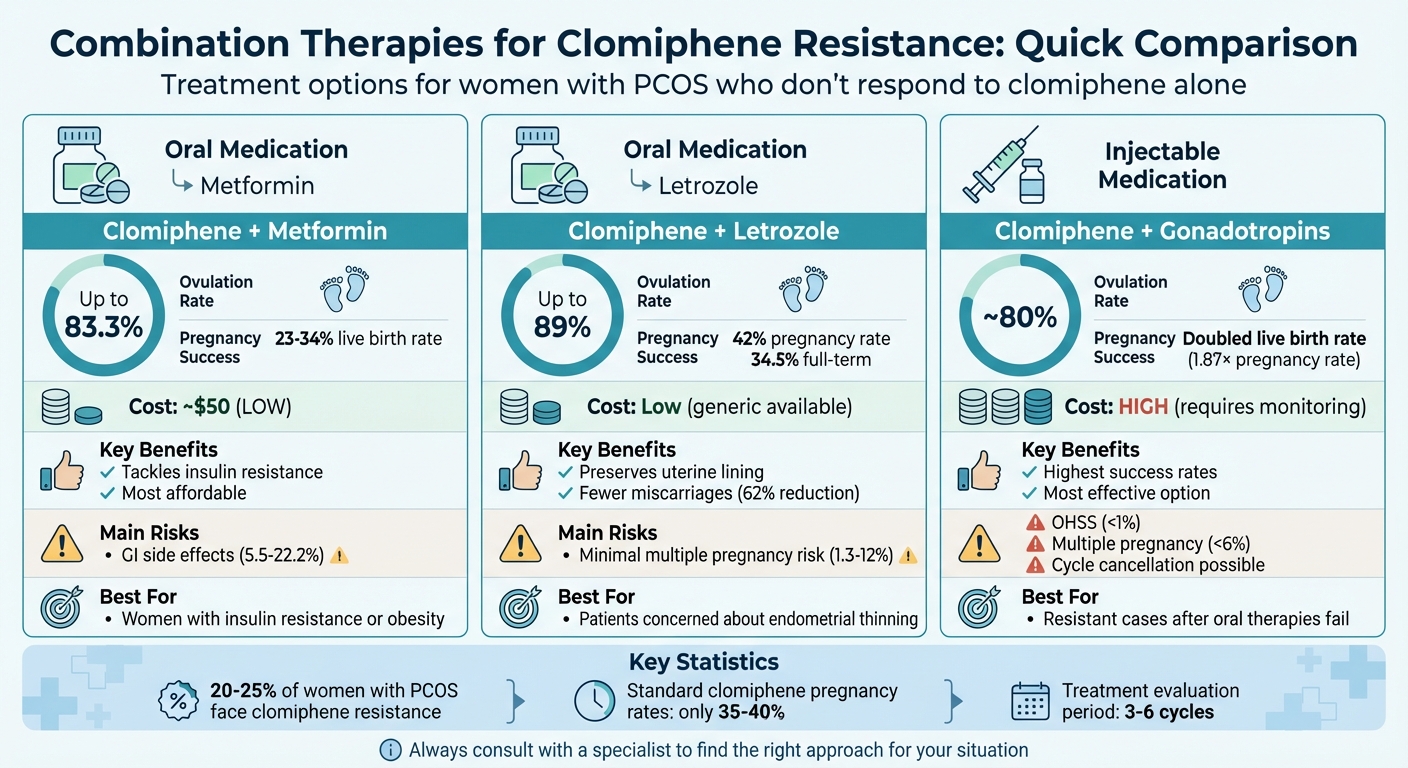
Clomiphene Resistance Combination Therapies Comparison Chart
Ovulation with PCOS: Is Clomid or Letrozole better? What Is Ovulation Induction?
sbb-itb-6dba428
1. Clomiphene with Metformin
Metformin helps reduce insulin resistance and lower androgen levels, which improves the ovarian response to follicle-stimulating hormone (FSH) and boosts the chances of ovulation. This combination is considered a second-line treatment for individuals who don't respond to clomiphene alone. Typically, the regimen includes 500 mg of metformin taken three times daily (totaling 1,500 mg) after a 6–8 week pre-treatment phase. Data supports this approach as effective.
Ovulation Rates
Research shows that combining metformin with clomiphene significantly increases ovulation rates. A 2023 trial reported that 83.3% of women ovulated with the combination, compared to 65.9% with clomiphene alone. Among women with insulin-resistant PCOS, ovulation rates climbed to 76% when both drugs were used together.
Pregnancy Success
The combination therapy also shows promise in improving pregnancy outcomes, although results differ across studies. A 2023 randomized clinical trial found a pregnancy rate of 33.3% for the combination therapy versus 20.5% for clomiphene alone. However, another study focusing on insulin-resistant patients reported similar clinical pregnancy rates - 34.7% with metformin added versus 34.2% without. A larger randomized trial revealed a live birth rate of 26.8% with the combination compared to 22.5% for clomiphene alone and just 7.2% for metformin alone. For women who ovulated successfully, the conception rate was higher in the combination group (46.0%) compared to 21.7% for metformin alone.
Costs
Metformin is an affordable and dependable option for treating infertility. Combining it with clomiphene provides a cost-effective alternative to more expensive treatments like gonadotropins, which are often the next step for patients resistant to clomiphene.
Risks
The main downside to this combination is gastrointestinal side effects. Clinical trials report that 9.3% of women taking metformin with clomiphene experienced symptoms such as nausea, diarrhea, cramping, dizziness, or headaches, compared to just 1.4% in placebo groups. These side effects can lead about 16% of patients to discontinue treatment. To reduce discomfort, doctors suggest starting with one 500 mg tablet and gradually increasing to three tablets over a week. If the full 1,500 mg daily dose is intolerable, lowering it to 1,000 mg or even 500 mg can help patients stick with the treatment. Notably, the combination therapy has a lower multiple pregnancy rate (3.1%) compared to clomiphene alone (6.0%).
2. Clomiphene with Letrozole
The combination of clomiphene and letrozole works to boost ovulation by targeting estrogen feedback mechanisms in the hypothalamus and pituitary gland. Letrozole, an aromatase inhibitor, reduces estrogen production, while clomiphene blocks estrogen receptors. Together, they stimulate a stronger release of follicle-stimulating hormone (FSH). The typical dosage involves 5 mg of letrozole and 100 mg of clomiphene, taken daily for five days starting on the second or third day of the menstrual cycle.
Ovulation Rates
Studies show that 82.9% of patients who didn’t respond to either drug individually developed a dominant follicle when treated with the combination. A meta-analysis of 10 randomized controlled trials, involving 931 participants, revealed that ovulation rates improved by 29% compared to clomiphene alone. For patients resistant to clomiphene, the combination achieved an impressive 89% ovulation rate.
Pregnancy Success
Among clomiphene-resistant patients, 42% achieved pregnancy after three cycles of the combined treatment. Meta-analysis findings also highlight a 50% improvement in pregnancy rates compared to control groups. Additionally, the miscarriage rate dropped by 62% with the combination therapy versus clomiphene alone. Another benefit is the preservation of endometrial thickness, averaging 8.17 mm, which supports successful implantation. This is a notable advantage since clomiphene alone can negatively impact the uterine lining. With favorable outcomes and low costs, this regimen is an attractive option for patients facing resistance to other treatments.
Costs
This approach offers a budget-friendly alternative, especially when compared to more expensive options like injectable gonadotropins or laparoscopic ovarian drilling.
Risks
The safety profile of this combination is similar to that of clomiphene alone. Common side effects include headache, bloating, fatigue, back pain, breast discomfort, and night sweats. The risk of ovarian hyperstimulation syndrome (OHSS) remains minimal. Twin pregnancy rates vary, with one study reporting a rate of 12%, while another observed a much lower rate of 1.3%.
3. Clomiphene with Gonadotropins
When clomiphene alone doesn’t work, adding gonadotropins like FSH or hMG can be a solid next step. This combination is often the second-line treatment for patients who don’t respond to clomiphene citrate. A common method involves using clomiphene on cycle days 5–9, followed by injectable FSH on days 9–12. This sequential approach has shown success in helping clomiphene-resistant patients achieve ovulation.
Ovulation Rates
Using low-dose FSH leads to ovulation in about 80% of patients resistant to clomiphene. Studies reveal that hMG, FSH, and metformin combined with letrozole are the top three therapies for improving reproductive outcomes in such cases.
Pregnancy Success
The data shows that FSH significantly boosts pregnancy chances, with a 1.87 times higher pregnancy rate and twice the live birth rate compared to metformin combined with clomiphene. Additionally, hMG has a 0.71 probability of being the most effective option for achieving pregnancy in women with clomiphene-resistant PCOS.
"In infertile women with polycystic ovary syndrome and clomiphene citrate-resistance, gonadotrophins seem to be the most effective treatment for ovulation induction."
This statement by Dr. Hatem Abu Hashim from Mansoura University's Department of Obstetrics & Gynecology highlights the effectiveness of gonadotropins as a treatment for clomiphene resistance. Among combination therapies, gonadotropins stand out as the strongest option for patients needing more aggressive intervention.
Costs
One downside of gonadotropin treatment is the cost. Unlike more affordable oral medications like metformin or letrozole vs. clomiphene, gonadotropin therapy involves steep medication costs and additional expenses for frequent ultrasound monitoring throughout the cycle.
Risks
While gonadotropins are effective, they come with risks. Ovarian hyperstimulation syndrome (OHSS) occurs in fewer than 1% of cases, and multiple pregnancies happen in under 6%. These risks call for close monitoring with transvaginal ultrasounds. Clinical trials show that OHSS and multiple pregnancy complications are unique to gonadotropin treatments. In some cases, cycles may need to be canceled if too many follicles develop. Ultimately, the decision to use this therapy requires balancing its effectiveness against potential complications.
Pros and Cons
This section breaks down the main benefits and drawbacks of combination therapies, summarizing insights from earlier discussions.
When deciding on the best treatment, it's essential to balance effectiveness, costs, convenience, and the potential for clomiphene resistance. Each therapy comes with its own upsides and challenges.
Oral combinations, like clomiphene paired with metformin or letrozole, are some of the most affordable and accessible options. Generic versions keep costs low - metformin, for instance, is around $50, compared to over $1,000 for surgical alternatives. These treatments are easily managed in standard clinical settings or telehealth visits. However, metformin can cause gastrointestinal issues in 5.5% to 22.2% of patients. Letrozole, on the other hand, offers an added benefit by counteracting the thinning of the uterine lining.
Gonadotropin combinations deliver the highest rates of ovulation and pregnancy but come at a higher cost. These therapies require regular ultrasound monitoring throughout the treatment cycle. Risks include ovarian hyperstimulation syndrome (OHSS), which occurs in less than 1% of cases, and a multiple pregnancy rate of under 6%. If too many follicles develop, the cycle may need to be canceled . Due to these factors, gonadotropins are typically reserved for cases where oral therapies have not been successful.
| Therapy | Ovulation Rate | Pregnancy Success | Cost | Key Risks |
|---|---|---|---|---|
| CC + Metformin | Improved vs. CC alone | Live birth: 23–34% | ~$50 | GI side effects (5.5–22.2%), thin endometrium |
| CC + Letrozole | 1.29× better | 1.50× better pregnancy rate; 34.5% full-term | Low (generics) | Lower multiple pregnancy risk |
| CC + Gonadotropins | ~80% | 1.87× pregnancy rate; 2× live birth vs. CC + Metformin | High | OHSS (<1%), multiple pregnancy (<6%) |
The data highlights that hMG provides the highest pregnancy rates (0.71 probability), while clomiphene combined with letrozole follows closely with a 0.64 probability . Ultimately, the choice of therapy depends on factors like effectiveness, affordability, and how well the patient tolerates the treatment. Doctors will also consider the resources available locally and the patient’s personal preferences. Patients can also use a PCOS symptom severity analyzer to track their progress during treatment. These comparisons help guide the decision-making process for selecting the most suitable treatment.
Conclusion
For women with clomiphene-resistant PCOS, oral combination therapies offer an affordable and non-invasive first-line treatment. Options like metformin with clomiphene or metformin with letrozole come with relatively low risks. Among these, metformin combined with letrozole has shown better full-term pregnancy rates and fewer miscarriages compared to metformin with clomiphene.
For those who don't respond to oral medications, injectable gonadotropins provide a high success rate, with ovulation occurring in about 80% of cases and a pregnancy success ranking probability of approximately 0.71. However, these treatments require close monitoring, come with higher costs, and carry an increased risk of ovarian hyperstimulation syndrome (OHSS). While injectables offer higher ovulation rates, the decision to use them should carefully weigh safety, cost, and individual patient needs. Factors like genetics and ethnicity also play a role in treatment success.
Treatment plans should always be tailored to the patient. As Neil Johnson, Associate Professor, emphasizes:
"The live birth of a baby is the only clinically meaningful primary end point for a couple with infertility".
Metformin-based therapies tend to benefit women with obesity or insulin resistance vs. hyperinsulinemia, while those concerned about safety may prefer oral options to reduce the risk of multiple pregnancies.
For added convenience, Oana Health’s telehealth platform allows PCOS patients to access treatments for clomiphene resistance from home. Through online consultations with licensed medical professionals, patients can receive personalized prescriptions for metformin or combination therapies. These plans are affordable, include free shipping, and avoid the need for invasive procedures. This approach is far more cost-effective than surgical alternatives like laparoscopic ovarian drilling, which typically costs around $1,050.
Ultimately, treatment decisions should consider factors such as BMI, hormone levels, monitoring resources, and patient preferences. Most providers evaluate the effectiveness of a chosen therapy over 3 to 6 cycles before exploring other options.
FAQs
How can I tell if I’m clomiphene-resistant?
If you've been taking 150 mg of clomiphene citrate daily for 5 days over at least three consecutive cycles and still aren't ovulating, you might be clomiphene-resistant. It's important to consult your healthcare provider to discuss further evaluation and explore other possible treatment options.
Which combo is best for me: metformin, letrozole, or injections?
The right combination for treating PCOS varies based on your specific health needs and how your body responds to treatment. Studies indicate that metformin paired with letrozole can boost ovulation and pregnancy success rates in cases where clomiphene alone doesn't work. On the other hand, metformin combined with clomiphene may aid ovulation but could reduce pregnancy chances due to its anti-estrogen effects. If oral medications aren't effective, injections like gonadotropins are another option, though they tend to be more expensive and come with higher risks. Always consult your healthcare provider to determine the best approach for your situation.
What monitoring do I need with these treatments?
When treating clomiphene-resistant PCOS with combination therapies like clomiphene plus metformin or letrozole, regular monitoring is critical. This involves blood tests to check glucose, insulin, and hormone levels such as estrogen, LH, and FSH. Ultrasounds are also used to track follicular development and confirm ovulation.
It's important to stay alert for potential side effects, including nausea, gastrointestinal discomfort, or the risk of ovarian hyperstimulation syndrome (OHSS). Consistent follow-ups with your healthcare provider help ensure the treatment remains safe and adjustments are made as needed for the best outcomes.