
CRP vs. Other Inflammatory Markers in PCOS
PCOS is associated with chronic low-grade inflammation, which contributes to insulin resistance, hormonal imbalances, and increased risks of cardiovascular and metabolic conditions. Among inflammatory markers, CRP (C-reactive protein) is the most reliable for assessing inflammation in PCOS.
Here’s a quick breakdown of the key markers and their relevance:
- CRP: Elevated in PCOS regardless of BMI, correlates with insulin resistance, and predicts cardiovascular risk.
- WBC (White Blood Cell Count): Higher in PCOS but influenced by factors like infections and stress.
- IL-6 (Interleukin-6): Linked to insulin resistance and androgen levels but shows variability across studies.
- TNF-α (Tumor Necrosis Factor-alpha): Affects insulin sensitivity but lacks consistent elevation in PCOS.
- CRP/Albumin Ratio: Combines inflammation and nutritional status, offering a more nuanced risk assessment.
CRP stands out for its stability and predictive value, making it a key tool for identifying and managing inflammatory risks in PCOS patients. Other markers, while informative, are less consistent or specific.
Takeaway: Regular CRP testing, alongside other markers, can guide personalized treatment strategies, including lifestyle changes, metformin, or other therapies.
1. CRP
Elevated Levels in PCOS
Women with PCOS often exhibit higher CRP levels. For instance, one study reported mean hsCRP levels in PCOS patients at 3.86 ± 6.19 mg/L - nearly four times higher than the control group (1.00 ± 1.08 mg/L). Another study found median hsCRP levels of 10,738 ± 7,658 ng/mL in PCOS patients, compared to 1,128 ± 695.92 ng/mL in healthy women. In a study involving 120 women, 32.5% of those with PCOS had hsCRP levels exceeding 3.0 mg/L, compared to just 2.5% of the control group. These findings highlight an increased cardiovascular risk in PCOS patients.
CRP and BMI: An Independent Link
CRP levels remain high in PCOS patients even when BMI is within the normal range. A meta-analysis of 3,648 women demonstrated that CRP elevation persists even after excluding studies with BMI mismatches, showing a 102% relative increase in PCOS patients. Among normal-weight women (BMI < 25 kg/m²), hsCRP levels averaged 0.55 ± 0.08 mg/dL, more than double the 0.27 ± 0.08 mg/dL observed in controls.
"As normal weight women with PCOS are characterized by elevated serum concentrations of hsCRP, they have to be considered as carrying at least one marker of low-grade inflammation." – A Makedos, Unit of Reproductive Endocrinology and Human Reproduction
Links to Hormonal and Metabolic Dysfunction
CRP levels in PCOS patients strongly correlate with hormonal and metabolic imbalances. For example, hsCRP has been shown to positively correlate with fasting blood sugar (r = 0.630), serum insulin (r = 0.700), and HOMA-IR (r = 0.694). Additionally, elevated hsCRP levels are associated with androgens such as total testosterone, DHEA-S, and androstenedione. These connections suggest that CRP plays a role in the broader dysfunction seen in PCOS, potentially offering insights for clinical applications.
Clinical Relevance
CRP testing can help predict complications in PCOS. A specific hsCRP threshold of 1.44 mg/L has been identified to predict metabolic syndrome in PCOS patients with 91.3% sensitivity. Moreover, each unit increase in hsCRP raises the likelihood of metabolic syndrome by 13%. This makes CRP a useful tool for identifying women who may benefit from targeted interventions, such as lifestyle changes or treatments like metformin. However, as discussed below, CRP's limitations must also be considered.
Challenges and Limitations
While CRP is useful, it is a non-specific marker that can be influenced by factors such as subclinical infections, dietary components like glucose, and genetic variations in the CRP gene. Additionally, standard CRP assays may lack the sensitivity needed to detect the low-grade inflammation typical of PCOS, making hsCRP testing a more reliable option.
2. WBC
Elevation in PCOS
Women with PCOS tend to have higher WBC counts compared to women without the condition. For example, a study comparing 200 women with PCOS to 105 controls found that the PCOS group had an average WBC count of 6.30 ± 1.71 (10³ cells/ml), while the control group averaged 5.66 ± 1.12. Although this difference might seem small, it has been associated with an increased risk of cardiovascular issues. A systematic review further supported this, noting that 7 out of 8 studies reported significantly elevated white cell counts in women with PCOS compared to controls.
BMI Independence
Interestingly, WBC elevation in PCOS does not rely entirely on obesity, which often drives other inflammatory markers. A study involving 150 PCOS patients and 150 controls showed that even women with a normal BMI (under 25 kg/m²) had higher leukocyte counts than their non-PCOS counterparts, regardless of age. However, central obesity, measured by the waist-to-height ratio, does play a role. PCOS patients with central obesity exhibited even higher WBC counts.
Correlation with Hormones and Insulin Resistance
The rise in WBC levels in PCOS highlights its sensitivity to hormonal imbalances beyond just weight. For instance, WBC counts show strong correlations with insulin resistance and androgen levels. In a study of 395 women, WBC levels were significantly linked to HOMA-IR (p < 0.001) and fasting insulin (p < 0.001). They also had positive correlations with testosterone (r = 0.130, p = 0.046), androstenedione (r = 0.212, p = 0.001), and DHEAS (r = 0.178, p = 0.006). On the flip side, WBC levels negatively correlated with SHBG (r = -0.308, p < 0.001), progesterone (r = -0.204, p = 0.002), and estradiol (r = -0.140, p = 0.032). Regression analysis showed that PCOS status, HOMA-IR, and BMI independently predict WBC levels, accounting for 6.25%, 12.1%, and 2.5% of the variance, respectively.
"PCOS is associated with increased WBC and CRP concentrations... there is also a relationship between WBC count in PCOS and androgen concentration itself so that inflammation may be mediated not only through adiposity but also through increased androgen concentration." – E. Rudnicka et al.
Clinical Utility
Tracking WBC levels alongside markers like CRP could help identify young women with PCOS who are at higher risk for cardiovascular disease. This early detection could allow for timely lifestyle changes or medical treatments. The presence of androgen receptors in various white blood cells, especially neutrophils, might explain why hyperandrogenism in PCOS is tied to higher WBC counts. WBC measurements offer insights into the inflammatory processes in PCOS that go beyond weight-related factors.
Limitations
Despite its usefulness, WBC count has its drawbacks. It's a non-specific marker influenced by factors like smoking, physical activity, alcohol use, and ethnicity. Medications such as oral contraceptives and metformin can also affect WBC levels. Moreover, SHBG, testosterone, and BMI explain only 16% of the variability in WBC counts, suggesting other unknown factors at play. WBC levels can also fluctuate over time, being affected by subclinical infections or even the menstrual cycle. These limitations make it less reliable as a standalone marker for PCOS-related inflammation.
3. IL-6
Elevation in PCOS
Interleukin-6 (IL-6) is a key proinflammatory cytokine that tends to be elevated in women with PCOS compared to those without the condition. However, its levels show more variability across studies than CRP. A 2025 meta-analysis involving 1,618 participants found a standardized mean difference of 0.78, indicating significantly higher IL-6 levels in PCOS patients. For instance, one study reported IL-6 levels at 4.94 ± 1.97 pg/ml in PCOS patients compared to 3.48 ± 1.77 pg/ml in controls. While IL-6 levels are elevated, CRP shows nearly a 100% increase in PCOS, highlighting CRP's greater sensitivity as an inflammatory marker.
BMI Independence
Interestingly, IL-6 elevation is observed in both lean and obese individuals with PCOS, suggesting that its presence is tied to underlying hormonal and metabolic factors rather than body weight alone. Unlike CRP, which appears to rise in PCOS regardless of weight, IL-6 levels are more closely linked to insulin resistance and hyperandrogenism. This connection underscores the complex interaction between IL-6 and the metabolic and hormonal imbalances seen in PCOS.
Correlation with Hormones and Insulin Resistance
IL-6 levels are strongly associated with insulin resistance and androgen levels. Insulin resistance, as measured by HOMA2-IR, accounts for 43.4% of IL-6 variability. Additionally, IL-6 levels show a positive correlation with total testosterone and a negative correlation with sex hormone-binding globulin (SHBG), particularly in overweight and obese PCOS patients. This makes sense given that IL-6 is produced by both mononuclear cells and adipose tissue and stimulates the liver to produce CRP.
Clinical Utility
IL-6 has potential beyond diagnosis - it can serve as a real-time indicator of treatment response. While CRP is a reliable marker for chronic inflammation and cardiovascular risk, IL-6 provides a dynamic view of how treatments are working. For example, IL-6 levels often decrease with improved insulin sensitivity, making it a useful marker for evaluating insulin-sensitizing therapies like metformin. Its responsiveness to metabolic stress, such as after a high-carb meal, further supports its role in monitoring treatment efficacy.
"A high IL-6 level is not an intrinsic characteristic of PCOS, but may be a useful monitoring biomarker for the treatment of PCOS." – Peng Z, Sun Y, Lv X, Zhang H, Liu C, Dai S
Limitations
Despite its potential, IL-6's variability across studies poses challenges. Measurement inconsistencies can reach up to 91%, largely due to differences in assay techniques and the metabolic diversity of PCOS patients. Older meta-analyses also highlight this variability, which limits cross-laboratory comparability. Unlike the standardized high-sensitivity CRP (hs-CRP) assays, IL-6 tests lack uniformity, making it difficult to compare results across different settings.
4. TNF-α
Elevation in PCOS
Tumor necrosis factor-alpha (TNF-α) is a proinflammatory cytokine linked to insulin resistance and is often overexpressed in adipose tissue. However, unlike CRP, TNF-α shows only a small difference - about 5% - in serum levels between individuals with PCOS and those without. A meta-analysis of nine studies found this 5% difference to be statistically insignificant (p = 0.561). While some individual studies have reported higher TNF-α levels in PCOS patients compared to BMI-matched controls, the broader evidence suggests that circulating TNF-α levels aren't a reliable marker to differentiate between PCOS and non-PCOS individuals.
BMI Independence
The primary factor influencing TNF-α levels seems to be obesity rather than PCOS itself. Obese individuals, regardless of whether they have PCOS, tend to exhibit the highest TNF-α concentrations. In lean women with PCOS, the elevation in TNF-α may stem from increased visceral fat, even when their overall body weight is within a normal range. This sets TNF-α apart from other markers that are less impacted by body fat distribution.
"The source of excess circulating TNF α in PCOS is likely to be adipose tissue in the obese but remains unknown in lean women with the disorder. However, increased visceral obesity could be a source of excess TNF α in lean women with PCOS." – Thozhukat Sathyapalan
Correlation with Hormones and Insulin Resistance
While obesity strongly influences TNF-α levels, its relationship with hormonal and metabolic imbalances in PCOS is less pronounced. TNF-α contributes to insulin resistance by affecting insulin-sensitive tissues through both short-term and long-term mechanisms. Genetic factors, such as the -308A polymorphism of the TNF-α gene, have also been associated with higher androgen levels in PCOS patients. Still, the connection between TNF-α and metabolic dysfunction in PCOS is largely overshadowed by the role of adiposity as the main driver of elevated levels.
Limitations
Despite some links to metabolic factors, TNF-α has limited clinical relevance. Its activity occurs mostly at the tissue level, functioning in an autocrine and paracrine manner, which means serum concentrations don't fully reflect its role in metabolic or inflammatory processes. To better estimate its metabolic impact, researchers often measure the soluble fraction of its type 2 receptor (sTNFR2) instead of the cytokine itself. Additionally, publication bias complicates the interpretation of studies showing minimal differences in TNF-α levels between PCOS patients and controls.
"Meta-analyses involving... 9 studies of TNF-α revealed no statistically significant differences between PCOS and controls." – Héctor F. Escobar-Morreale, M.D., Ph.D.
Given its variability and lack of consistent association with PCOS-specific inflammation, TNF-α is not recommended as a diagnostic or predictive marker for managing PCOS-related metabolic risks. Other markers provide a more reliable reflection of the inflammatory processes linked to the syndrome.
5. CRP/Albumin Ratio
Elevated Levels in PCOS
The CRP/Albumin ratio (CAR) serves as a combined measure of systemic inflammation - indicated by C-reactive protein (CRP) - and nutritional status, as albumin levels tend to drop during inflammation. Women with PCOS show significantly higher CAR values compared to healthy individuals, averaging 2.8 ± 1.2 versus 1.4 ± 0.6 (p < 0.001). Notably, about 74% of women with PCOS have a CAR above 2.0, signaling a heightened inflammatory state.
A study conducted at Navodaya Medical College in Raichur, India, between April 2024 and May 2025, examined 100 women. Researchers Rita D. and Sai Vaishnavi K. found that PCOS patients had much higher CRP levels (4.8 ± 1.4 mg/L vs. 1.9 ± 0.8 mg/L) and lower albumin levels (3.2 ± 0.5 g/dL vs. 4.1 ± 0.4 g/dL), resulting in a significantly elevated CRP/Albumin ratio.
Independent of BMI
Interestingly, the CRP/Albumin ratio is not solely linked to obesity. Even lean women with PCOS exhibit elevated CAR values compared to lean controls (1.12 ± 0.48 vs. 0.65 ± 0.30, p = 0.02). This suggests that inflammation in PCOS is not merely a consequence of excess body fat but may be an underlying feature of the condition itself. Although the ratio correlates positively with BMI (r = 0.41), its elevation in lean individuals highlights its broader relevance.
Links to Hormones and Insulin Resistance
Research from Bahrain highlights the CRP/Albumin ratio's predictive power for PCOS. A ratio of ≥0.097 outperformed both insulin resistance and the Free Androgen Index in identifying PCOS across all BMI groups. Additionally, the ratio correlates with HOMA-IR (r = 0.39), making it a strong marker for inflammation tied to metabolic dysfunction. Compared to other indicators like insulin resistance and androgen levels, the CRP/Albumin ratio provides greater accuracy in reflecting the inflammatory processes associated with PCOS.
Practical Applications
Analysis using ROC curves demonstrated an AUC of 0.89, with 70% sensitivity and 84% specificity at a cut-off above 2.0, surpassing CRP alone (AUC 0.820). This makes the CRP/Albumin ratio a valuable tool for identifying patients with significant inflammatory issues who may benefit from targeted interventions such as metformin or lifestyle changes. It is particularly useful for screening lean PCOS patients, who might otherwise be overlooked for metabolic risks. These findings support its inclusion in tailored management plans for PCOS.
Considerations and Limitations
While the CRP/Albumin ratio demonstrates strong diagnostic potential, it is better suited for monitoring and follow-up rather than initial diagnosis, as other factors beyond PCOS can affect it. Still, its simplicity and affordability make it a practical option for assessing inflammation that standard hormonal tests might miss.
sbb-itb-6dba428
PCOS & Inflammation Explained | IL-6, CRP, TNF-alpha, Leptin | Women’s Health
Advantages and Disadvantages of Each Marker
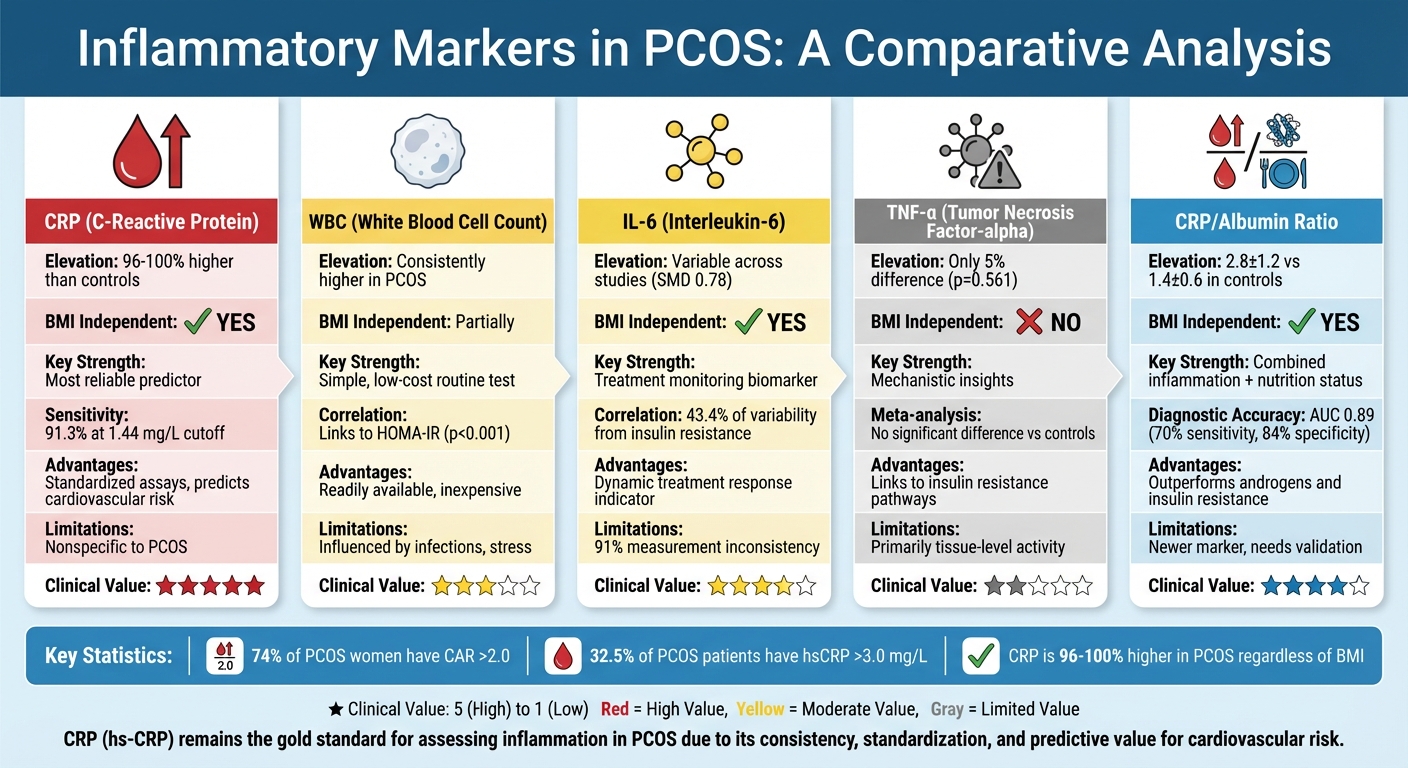
Comparison of Inflammatory Markers in PCOS: CRP, WBC, IL-6, TNF-α, and CRP/Albumin Ratio
Inflammatory markers offer specific insights into the inflammation associated with PCOS. Among these, CRP stands out as the most dependable marker, while cytokines like IL-6 and TNF-α provide mechanistic insights but come with measurement challenges. These comparisons help refine targeted strategies for managing PCOS.
Here’s a summary of the advantages and limitations for each marker:
| Inflammatory Marker | Key Advantages in PCOS Assessment | Key Disadvantages / Limitations |
|---|---|---|
| C-Reactive Protein (CRP) | Consistently elevated (96% higher than controls); independent of BMI; strong predictor of cardiovascular risk; standardized high-sensitivity assays available. | Nonspecific to PCOS; requires high-sensitivity (hs-CRP) assays for accuracy; heavily correlated with BMI in some studies. |
| Interleukin-6 (IL-6) | Directly stimulates CRP synthesis; correlates with insulin resistance and HOMA-IR. | Inconsistent serum levels in meta-analyses; heavily influenced by obesity; short half-life in circulation; variable differences noted between PCOS and controls. |
| TNF-α | Central mediator of insulin resistance; involved in follicular dysfunction. | Circulating levels often show no significant difference between PCOS and controls; functions primarily at the tissue level. |
| White Blood Cell (WBC) | Simple, low-cost routine test; consistently higher in PCOS patients. | Less specific for metabolic/cardiovascular risk than CRP; highly influenced by acute infections, stress, and obesity. |
| CRP/Albumin Ratio | Potentially higher specificity for metabolic dysfunction than androgens or insulin resistance; independent of BMI; cost-effective. | Newer marker requiring more large-scale validation in diverse PCOS phenotypes; some smaller studies show no significant difference. |
Multivariate analysis highlights CRP as the strongest predictor of adverse outcomes in PCOS patients (β = 0.42, p < 0.001). In contrast, meta-analyses of 10 studies on IL-6 and 9 studies on TNF-α found no significant differences between PCOS patients and healthy controls. Research from Hospital Universitario Ramón y Cajal further supports that CRP elevation in PCOS is independent of obesity, reinforcing the link to chronic low-grade inflammation.
CRP stands out for its stability as a downstream marker of systemic inflammation. Unlike IL-6 and TNF-α, which primarily act at the tissue level, CRP serves as a reliable "summary" indicator of low-grade inflammation. This reliability makes CRP especially useful in identifying high-risk patients who may benefit from specific interventions.
How Inflammatory Markers Guide PCOS Treatment
Inflammatory markers are now playing a key role in shaping how clinicians approach PCOS treatment. Instead of relying on a uniform strategy, these markers help tailor care to individual risks and needs. One standout marker, high-sensitivity CRP (hs-CRP), has become crucial for identifying patients who might need more intensive interventions. Elevated hs-CRP levels often indicate a higher cardiovascular risk, prompting more focused management strategies.
For patients with high inflammatory markers, the first step typically involves intensive lifestyle changes. These include supervised weight management programs and adopting low-glycemic diets. However, when these adjustments aren’t enough to reduce inflammation, doctors may turn to medications. As Zeev Blumenfeld from the Technion – Israel Institute of Technology explains:
"A practical compromise may be to concentrate on those PCOS patients with high CRP and other markers of CVD. These patients should be more closely and aggressively monitored for their lifestyle (obesity, exercise, smoking, diet), and when not successful, consider the addition of insulin sensitizers such as metformin, aspirin, and/or statins".
Another useful tool is the CRP/albumin ratio, which provides deeper insights into metabolic health. This ratio helps doctors decide whether a patient’s treatment should focus more on hormonal management or metabolic interventions. When inflammation levels are high, incorporating insulin sensitizers like metformin into the treatment plan becomes a priority.
Telehealth platforms, such as Oana Health, make it easier to manage PCOS care guided by these markers. Through virtual consultations, patients can undergo regular lab testing, allowing for real-time adjustments to their treatment plans. For example, treatments might include oral Semaglutide GLP-1 for insulin resistance, Spironolactone for hormonal balance, or even combination therapies - all without the need for frequent in-person visits. This approach highlights the growing shift toward personalized medicine in PCOS care, ensuring treatments are tailored to each patient’s unique inflammatory profile.
Conclusion
High-sensitivity CRP (hs-CRP) stands out as the most reliable inflammatory marker in evaluating PCOS, consistently showing elevated levels regardless of BMI. Research indicates that hs-CRP levels in women with PCOS are approximately 96%-100% higher than in healthy individuals. Other markers like IL-6, TNF-α, and WBC counts offer some insights into inflammation, but meta-analyses often reveal no significant differences between PCOS patients and controls.
"Women with PCOS exhibit elevation in circulating CRP that is independent of obesity. This finding corroborates existing molecular evidence of the chronic low‐grade inflammation that may underpin the pathogenesis of this disorder" – Dr. Héctor F. Escobar-Morreale, M.D., Ph.D.
The strong inflammatory signal from hs-CRP is directly tied to an increased cardiovascular risk. Among 12 inflammatory markers studied, hs-CRP emerged as the most reliable predictor of cardiovascular disease. It also shows remarkable sensitivity - 91.3% at a cutoff of 1.44 mg/L - for predicting metabolic syndrome in PCOS patients. This makes it an essential tool for identifying young women with PCOS who may face higher risks for future cardiovascular issues.
Incorporating hs-CRP testing into routine care for PCOS patients is crucial. Women with hs-CRP levels above 3.0 mg/L should be classified as high-risk, prompting closer monitoring of blood pressure, lipid levels, and lifestyle habits. For those whose elevated CRP levels persist despite lifestyle changes, treatments such as metformin, statins, or low-dose aspirin should be considered. By integrating hs-CRP testing into standard PCOS management, healthcare providers can offer more personalized care, addressing both the hormonal and metabolic challenges of this condition while reducing long-term health risks.
FAQs
Why is CRP often seen as a key inflammatory marker in understanding PCOS?
CRP, or C-reactive protein, is often considered a key marker when it comes to inflammation in PCOS. This is because it reflects low-grade chronic inflammation, a common problem for many dealing with this condition. Unlike some other markers, CRP offers a dependable way to measure systemic inflammation, which is closely linked to the hormonal imbalances and metabolic challenges typical of PCOS.
What’s more, higher CRP levels have been connected to a greater risk of cardiovascular problems. This connection underscores its role in keeping tabs on overall health as part of PCOS management. Its ability to provide insights into both inflammation and broader health risks makes it an important tool for understanding and addressing PCOS.
What role does CRP testing play in managing PCOS?
CRP testing, or C-reactive protein testing, plays a key role in identifying low-grade chronic inflammation, a condition often seen in women with PCOS. This type of inflammation is closely linked to metabolic challenges, such as insulin resistance and increased cardiovascular risks.
By measuring CRP levels, healthcare providers gain valuable insight that helps them tailor treatment plans. These strategies can target reducing inflammation while also addressing broader metabolic concerns, ultimately supporting better management of PCOS symptoms and hormonal health.
Can lifestyle changes alone lower CRP levels in women with PCOS?
Lifestyle changes, like eating healthier and staying active, can play a big role in managing some PCOS symptoms. These steps can boost insulin sensitivity and aid in weight management. But here's the catch: research shows that high CRP levels - a sign of chronic inflammation - might stick around even with these positive changes. This points to inflammation being a central part of PCOS, not just something tied to factors like obesity.
While adopting healthier habits is crucial for overall well-being, they may not be enough to bring CRP levels back to normal. For many, tackling inflammation and other PCOS symptoms often calls for a well-rounded plan that blends lifestyle improvements with medical treatments.