
Eflornithine and Laser Therapy: A Powerful Combination
Unwanted facial hair is a common concern for many women, often affecting self-esteem and emotional well-being. While treatments like laser therapy and eflornithine cream are effective on their own, combining them delivers faster and longer-lasting results. Here's why:
- Eflornithine slows hair growth by targeting hair follicle cells, making it effective for all hair colors and skin types.
- Laser therapy targets hair follicles with heat, offering long-term reduction but works best on dark hair and light skin.
- Together, they complement each other, addressing different aspects of hair growth for quicker and more effective outcomes.
Clinical studies show that combining laser therapy with eflornithine reduces hair regrowth by 17% after six months, compared to using laser therapy alone. This approach also works well for "salt and pepper" hair, which can be challenging for laser treatments alone. While each method has its limitations, combining them offers a solution that balances effectiveness and safety.
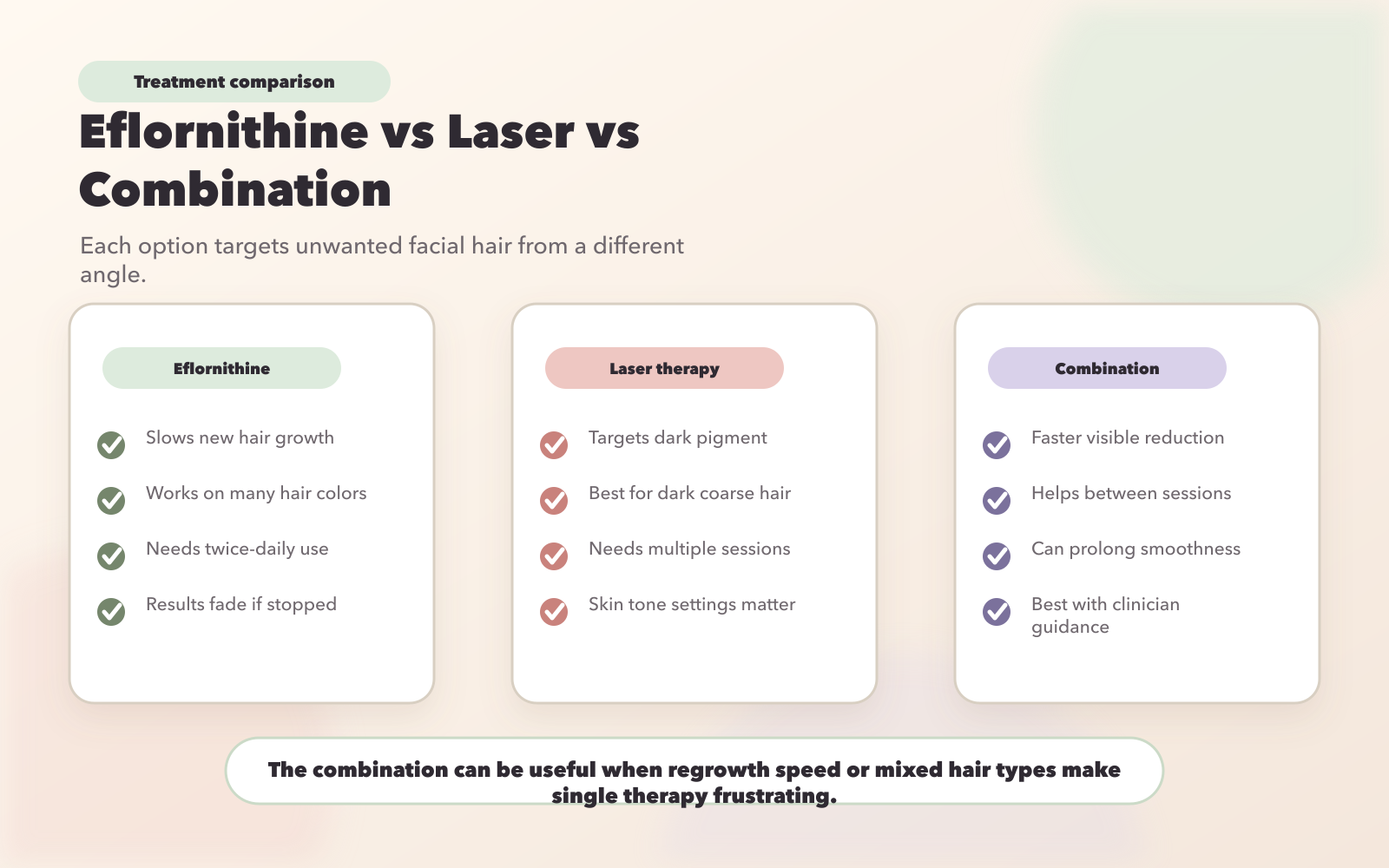
Eflornithine vs Laser Therapy vs Combination Treatment Comparison
1. Eflornithine
How It Works
Eflornithine hydrochloride (13.9% cream) works by irreversibly blocking the enzyme ornithine decarboxylase (ODC). This enzyme is essential for producing polyamines, which play a role in androgen-driven hair growth. By reducing polyamine production, the cream slows down the activity of hair matrix cells, leading to finer and slower-growing hair. The body absorbs less than 1% of the cream, and any small amount absorbed is quickly excreted, making it a highly targeted treatment.
Effectiveness in Reducing Hair Growth
Clinical studies back up the cream's effectiveness. In Phase 3 trials, 73% of participants saw improvement compared to 44% using a placebo. When combined with light-based treatments as part of a maintenance routine, users reported a 14% reduction in hair regrowth after one month and 17% after six months. A separate randomized trial involving 54 women showed noticeable hair reduction from weeks 6 to 22. Patients rated their satisfaction and the cream's effectiveness with median Visual Analog Scale scores of 5–6. Unlike laser treatments, which rely on dark hair pigment to work, eflornithine is effective regardless of hair color, making it a versatile option.
Safety Profile and Side Effects
Eflornithine is generally well-tolerated, with only about 1% of users discontinuing due to side effects. The most common issues include dry skin (7.4%), acne (6.9%), hair thinning (6.5%), headaches (6.0%), and itching (5.1%). Importantly, the cream has been shown to be non-genotoxic, non-carcinogenic, and non-teratogenic, ensuring its safety for long-term use.
Suitable for All Hair and Skin Types
Eflornithine stands out for its ability to work on facial hair of all colors, including "salt and pepper" hair, which can be difficult to manage with laser treatments. It’s also suitable for women of all ethnic backgrounds. To achieve the best results, the cream should be applied twice daily, with usage not exceeding 30 grams per month. However, the effects only last while the treatment is ongoing - hair growth typically returns to its original state if the cream is discontinued.
This makes eflornithine a valuable addition to combination therapy strategies. Women interested in this treatment can access it through telehealth services like Oana Health, which offers convenient prescription-based delivery straight to their homes.
2. Laser Therapy
Mechanism of Action
Laser therapy relies on a process called selective photothermolysis, where melanin in the hair absorbs specific wavelengths of light (ranging from 600–1,200 nm). This light energy transforms into heat, damaging the hair follicle. By targeting the hair matrix and bulge stem cells, this heat disrupts the hair growth cycle. Common laser technologies for facial hair reduction include Nd:YAG and alexandrite lasers, while Intense Pulsed Light (IPL) uses a broader spectrum of light to achieve similar results.
"Laser photoepilation heats hair and adjacent tissues to suspend growth." - Stacy R. Smith, MD, Lead Researcher
This precise energy delivery not only halts hair growth but also delivers better results when paired with eflornithine.
Effectiveness for Hair Reduction
Laser therapy offers long-term hair reduction, typically requiring 4–6 sessions to target the anagen (active growth) phase, with annual maintenance sessions to sustain results. When combined with eflornithine, the effectiveness improves significantly. A study published in Dermatologic Surgery (October 2006) by Stacy R. Smith and Daniel J. Piacquadio examined 54 women undergoing Nd:YAG or alexandrite laser treatments at weeks 2 and 10. Participants applied eflornithine on one side of their face and a placebo cream on the other for 34 weeks. Results showed the eflornithine-treated side experienced faster hair reduction, particularly between weeks 6 and 22.
Safety and Side Effects
While laser therapy is effective, it comes with potential side effects. Common issues include redness, swelling, pain, and a burning sensation. Rare complications, such as blistering, scarring, or permanent pigment changes, can occur. Combining laser therapy with eflornithine has a safety profile similar to using eflornithine alone, though some individuals may notice acne flare-ups during treatment. Both the patient and operator must wear protective eyewear during sessions to avoid eye injuries. These considerations reinforce the value of combining laser therapy with eflornithine for enhanced results while maintaining safety.
Suitability for Different Hair and Skin Types
The success and safety of laser therapy largely depend on selecting the right laser for your skin type and hair color. It’s most effective for people with light skin and dark hair, but certain lasers are designed to work safely on darker skin tones.
| Laser Type | Wavelength | Best Skin Types (Fitzpatrick) | Key Characteristics |
|---|---|---|---|
| Ruby | 694 nm | I–III | Ideal for light skin/dark hair; high melanin absorption |
| Alexandrite | 755 nm | I–III | Greater penetration; suitable for lighter hair |
| Diode | 810 nm | I–V | Deeper penetration; minimizes epidermal damage |
| Nd:YAG | 1,064 nm | I–VI | Safest for darker skin; lower melanin absorption |
Proper preparation is key for optimal results. Avoid plucking or waxing for at least six weeks before treatment, as these methods remove the hair root. Use sunscreen for 4–6 weeks prior to minimize pigmentation risks, and shave before sessions to leave slight stubble. This helps focus the laser energy on the follicles without unnecessary absorption by surrounding skin.
Advantages and Disadvantages
Eflornithine offers a practical, at-home solution to slow hair growth. It’s easy to use with a strong safety profile, requiring twice-daily application to maintain its effects. However, its effectiveness can fade over time. For instance, one study noted that by Week 34, the difference in hair growth between eflornithine-treated and untreated areas was no longer noticeable. Some users may also experience mild skin irritation or even acne flare-ups.
On the other hand, laser therapy provides immediate and long-lasting results. However, it comes with its own set of challenges: multiple sessions are needed, and there’s a risk of side effects like redness, swelling, or, in rare cases, scarring. Additionally, its effectiveness can depend on factors like skin tone and hair color.
Interestingly, combining these two approaches seems to deliver the best results. A February 2016 study published in the Journal of the European Academy of Dermatology & Venereology examined 22 women with facial hirsutism. They underwent 5–6 IPL sessions and applied eflornithine twice daily to one side of the face for six months. The eflornithine-treated side showed 17% less hair regrowth after six months compared to the untreated side. Another trial involving 54 women found that combining eflornithine with Nd:YAG or alexandrite laser therapy led to significant hair reduction between Weeks 6 and 22. Patients also expressed a clear preference for the combination treatment.
These findings highlight how blending eflornithine with laser therapy offers a more effective and satisfying approach to hair reduction.
| Treatment Method | Key Advantages | Limitations |
|---|---|---|
| Eflornithine Alone | Easy to use, non-invasive, self-administered at home | Effectiveness may decrease over time; requires frequent use; potential for skin irritation |
| Laser Therapy Alone | Immediate and long-lasting results | Requires multiple sessions; can be costly; effectiveness varies by skin and hair type |
| Combination Therapy | Faster results (visible by Week 6), better long-term maintenance, higher patient satisfaction | Requires commitment to both treatments for optimal results |
sbb-itb-6dba428
Why Combining Treatments Works Better
The strength of combining eflornithine and laser therapy lies in how they work together to target hair growth in different ways. Laser photoepilation heats the hair and surrounding tissue, temporarily halting follicle activity. Meanwhile, eflornithine slows the growth of follicular cells by inhibiting ornithine decarboxylase. By addressing hair growth from two angles, this combination reduces the need to rely on just one method. The result? Faster hair reduction and fewer limitations compared to using each treatment on its own.
A multicenter trial highlighted the benefits of this approach, showing that pairing laser therapy with daily eflornithine use speeds up hair reduction. Patients reported noticeable improvements as early as Week 6. For those eager to see results quickly, this combined method is a game-changer.
One of the standout advantages of this combination is its ability to address a limitation of laser therapy: difficulty treating fine or light-colored hairs that lack enough melanin for effective targeting. A June 2006 case study by L.K. Ganger and I.H. Hamzavi, published in the Journal of Drugs in Dermatology, demonstrated that "salt and pepper" hair - a mix of dark and light hairs - can be managed effectively with this dual approach. The laser targets the darker hairs, while eflornithine slows the growth of lighter ones.
Another key benefit? The combined treatment maintains a safety profile similar to eflornithine cream alone. This means patients can achieve better results without adding extra risks.
For women looking for a reliable solution to unwanted facial hair, Oana Health offers eflornithine 12%. Licensed medical professionals prescribe the treatment, which is then delivered straight to your door.
Conclusion
Eflornithine works by slowing follicular cell growth, while laser therapy targets hair follicles with heat. Together, they provide faster and longer-lasting hair reduction. Clinical studies show that this combination achieves 93.5% near-complete hair removal at treatment sites, compared to 67.9% with laser therapy alone.
Even after laser sessions end, eflornithine helps maintain results by reducing hair regrowth by 17% at six months post-treatment. These extended benefits highlight the importance of expert guidance to ensure the best outcomes.
It's essential to address any underlying conditions, such as PCOS or hormonal imbalances, before starting treatment. A licensed medical professional can diagnose these issues and design a plan tailored to your needs.
For personalized care, Oana Health offers telehealth consultations with licensed providers who can create customized treatment plans for facial hair. They also provide eflornithine 12% and other proven treatments, delivering prescriptions straight to your door with free shipping. Professional guidance ensures you’re combining treatments safely and effectively.
FAQs
When should I start eflornithine if I’m getting laser hair removal?
Start applying eflornithine cream 4 to 8 weeks before beginning your laser hair removal sessions. This timeframe gives the cream enough time to show initial results, making it easier to get the most out of your combined treatment.
Can this combo help with light, gray, or “salt and pepper” facial hair?
Yes, using a combination of eflornithine and laser therapy can help reduce light, gray, or “salt and pepper” facial hair. This method works by slowing down hair regrowth and increasing the interval between treatments, especially for fine hair influenced by hormonal changes.
How do I maintain results after my laser sessions end?
To keep your results after laser sessions, it’s important to stick with topical treatments, like eflornithine cream, which can help slow down hair regrowth and make the effects of laser therapy last longer. Using this approach may reduce the need for maintenance sessions to just once every 8–12 months. If your hair growth is influenced by hormones, your doctor might recommend hormonal therapies to address the issue. Regular check-ins with your healthcare provider and following your customized treatment plan closely are key to maintaining long-term results.