
Eflornithine Research: High vs. Low-Quality Studies
Eflornithine, marketed as Vaniqa, is a prescription cream used to slow facial hair growth, particularly for women with PCOS. Its effectiveness depends heavily on the quality of research supporting it. High-quality studies, such as randomized, double-blind trials, are more reliable due to better design and larger sample sizes. These studies show that 58% of users see improvement in hair growth reduction, compared to 34% using a placebo. In contrast, low-quality studies often lack proper controls, use small sample sizes, and produce less trustworthy results.
Key Points:
- High-Quality Studies: Use rigorous designs (e.g., split-face trials), larger sample sizes, and objective tools like imaging systems. Results show clear benefits of eflornithine.
- Low-Quality Studies: Often open-label with small participant groups, leading to biased and less reliable outcomes.
- Efficacy: High-quality research shows 32% of users achieve "marked improvement", but effects reverse within 8 weeks of stopping use.
For women managing hirsutism, relying on evidence from robust studies ensures better treatment decisions. Combining eflornithine with other methods, like photoepilation, can enhance results. Always consult a healthcare provider for personalized advice.
1. High-Quality Eflornithine Studies
Study Design
Research into eflornithine's effects is built around randomized, double-blind, vehicle-controlled trials, often considered the gold standard in clinical research for reducing bias. In these trials, neither participants nor researchers know who is using the active cream versus a placebo (vehicle). A common approach is the bilateral split-face design, where participants apply eflornithine to one side of the face and a placebo to the other. This method ensures each participant acts as their own control, removing variables like hormonal or genetic differences that could influence the results. These studies usually span 24 weeks (6 months), allowing researchers to evaluate both the safety of the treatment and its long-term effectiveness. The credibility of these trials is further enhanced by their use of large and diverse participant groups.
Sample Size
While smaller studies with around 25 participants are sometimes used for specialized methods, the most impactful findings come from larger, multi-center trials conducted by research groups like the Eflornithine HCl Study Group. These trials include participants from various clinical sites, ensuring the results are applicable to a wide range of individuals. Larger sample sizes help confirm that the findings are not due to random chance, providing more reliable conclusions about the treatment's effectiveness.
Efficacy Outcomes
After 24 weeks of treatment, 58% of participants using eflornithine showed some level of improvement in facial hirsutism, compared to 34% of placebo users. Moreover, 32% of eflornithine users experienced "marked improvement", while only 8% in the placebo group reached this level. Researchers used a mix of objective tools, such as TrichoScan imaging systems to measure hair density and thickness, and subjective feedback from participants. Women using eflornithine also reported a 33% reduction in discomfort and annoyance caused by their facial hair, compared to just 15% among placebo users.
"Eflornithine 15% cream was superior to placebo in reducing hair growth, as demonstrated by objective and subjective methods, after 2 to 8 weeks' treatment." - Adis New Drug Profile
Bias and Reliability
The reliability of these studies is reinforced by their rigorous design and follow-up phases. One key finding is the rebound effect: hair growth typically returns to pretreatment levels within 8 weeks of stopping eflornithine use. This demonstrates that the treatment’s effects are truly drug-dependent, not just a placebo response. Post-treatment monitoring helps document these changes. Another factor adding to the reliability is eflornithine's minimal systemic absorption - less than 1% enters the bloodstream when applied twice daily. This low absorption rate ensures a strong safety profile, confirmed through precise testing.
2. Low-Quality Eflornithine Studies
Study Design
Studies on eflornithine of lower quality often rely on open-label, single-center, or non-comparative designs without proper control groups. This makes it challenging to distinguish the actual effects of the drug from placebo responses. Many of these studies use the subjective Ferriman-Gallwey score, which is less reliable than imaging methods employed in higher-quality research. Additionally, short follow-up periods - ranging from just 2 to 8 weeks - limit the ability to assess long-term outcomes. These design flaws highlight the need for more rigorous and controlled investigations, as they also impact sample size and the reliability of reported outcomes.
Sample Size
The issue of small participant groups further compounds the challenges posed by flawed study designs. For instance, one single-center study included only 33 women, making its six-month findings difficult to generalize. Similarly, when the FDA approved eflornithine (Iwilfin) for neuroblastoma in December 2023, the decision was based on Study 3b, which involved just 105 patients. To support their conclusions, researchers matched 90 of these patients with 270 historical controls from a separate study. However, the FDA noted that this externally controlled design introduced "associated uncertainty in treatment effect estimation".
Efficacy Outcomes
Small sample sizes also lead to uncertainties regarding the drug's effectiveness. For example, an open-label study involving 25 women reported a reduction in hair density by 11.4 hairs/cm² after one month (P = 0.014) and 12.05 hairs/cm² after four months (P = 0.05). Additionally, cumulative hair length decreased by approximately 7 mm and 8 mm at the same time points (P = 0.001). However, without a control group, interpreting these results becomes problematic. Critics, including Van Neste D, have raised concerns about the reliability of the TrichoScan method used for assessing facial hair growth. Reliance on manufacturer data or abstracts further limits the ability to verify these findings.
Bias and Reliability
"The certainty in comparisons with placebo was moderate and for head-to-head comparisons was low." – Swiglo BA, et al.
Unlike high-quality trials with robust controls, open-label designs in these studies introduce significant bias. Knowing they are receiving the active treatment can lead participants to over-report improvements, while observers may unconsciously overestimate results. Additionally, many of these studies fail to track outcomes after stopping treatment - a critical gap, as higher-quality research shows that hair growth often returns to baseline levels within 8 weeks of discontinuing eflornithine. A meta-analysis of 43 randomized controlled trials for hirsutism treatments found moderate evidence when comparing eflornithine to placebo. However, certainty in head-to-head comparisons with other active treatments remained low due to small sample sizes and weak study designs.
sbb-itb-6dba428
Pros and Cons
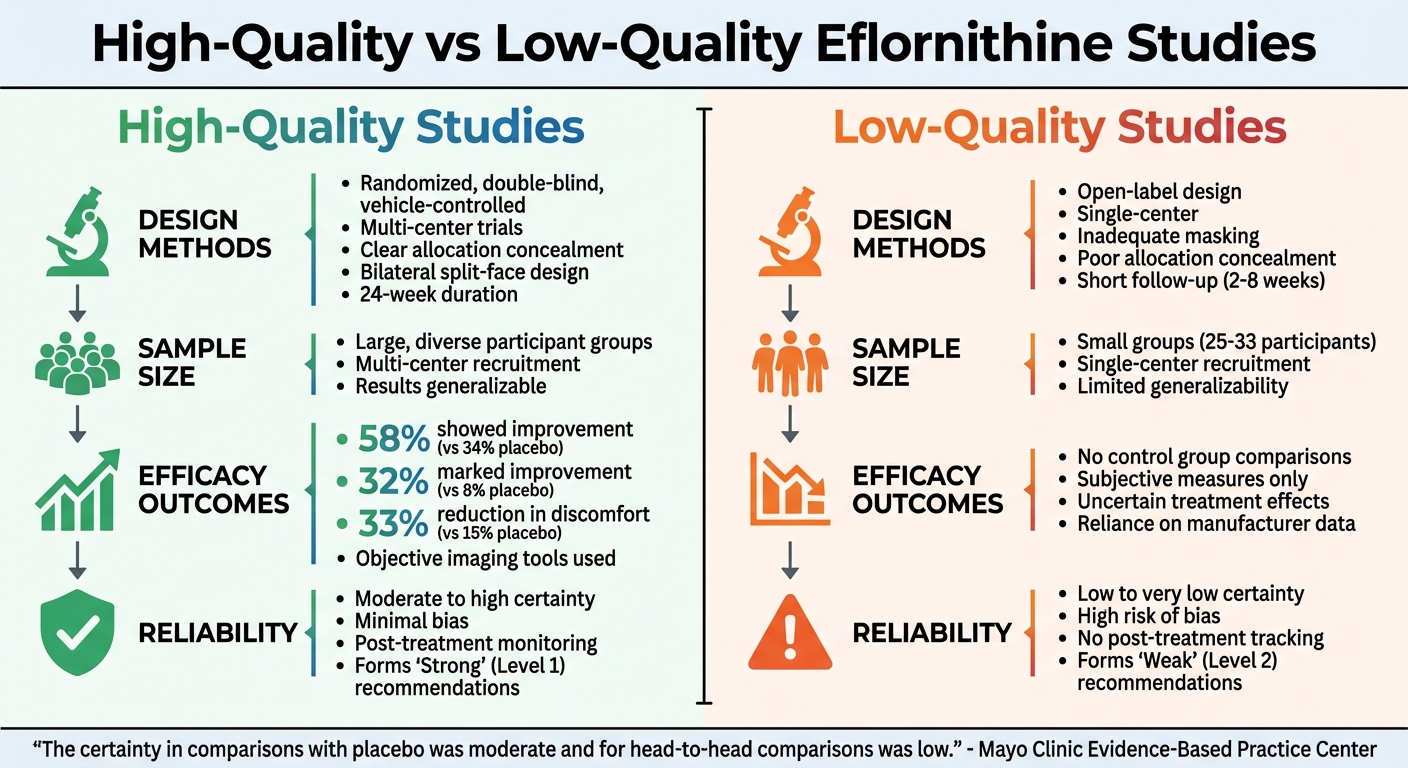
High-Quality vs Low-Quality Eflornithine Studies Comparison
The design of a study plays a huge role in shaping its outcomes, especially when it comes to research on eflornithine. The quality of study design directly affects how much trust clinicians can place in the results. Top-tier trials often use randomized, double-blind, vehicle-controlled methods conducted across multiple centers. This approach reduces bias and ensures the findings apply to a broad range of patients. On the flip side, studies with weaker designs - like open-label, single-center trials with small sample sizes - are more prone to observer bias and produce results that are harder to generalize.
One of the clearest distinctions between high- and low-quality studies is how reliable their outcomes are. In well-designed trials, 32% of patients using eflornithine showed marked improvement, compared to just 8% in the placebo group. However, when eflornithine is compared directly to other treatments, the confidence in the results drops significantly due to weaker methodology.
"The certainty in comparisons with placebo was moderate and for head-to-head comparisons was low." – Barrionuevo P, et al., Mayo Clinic Evidence-Based Practice Center
Clinical recommendations are heavily influenced by the strength of the evidence. For instance, the Endocrine Society bases its guidelines on high-quality research, advising women to combine eflornithine with photoepilation for quicker results. But there’s a cautionary note: a 2024 analysis revealed that 94.4% of systematic reviews from 2019 were rated as having "critically low" methodological quality. This highlights the danger of relying on poorly designed studies, which can lead to conflicting recommendations that confuse both doctors and patients.
| Feature | High-Quality Studies | Low-Quality Studies |
|---|---|---|
| Design Methods | Randomized, double-blind, vehicle-controlled; clear allocation concealment | Inadequate masking; poor allocation concealment; financial conflicts |
| Reliability | Moderate to high certainty in outcomes, especially versus placebo | Low to very low certainty; high risk of bias |
| Assessment Tools | Uses both objective (imaging) and subjective (quality of life) measures | Often relies on a single assessment method, increasing potential errors |
| Clinical Impact | Forms the basis for "Strong" (Level 1) clinical recommendations | Leads to "Weak" (Level 2) suggestions or recommendations against use |
For patients, understanding these differences in study quality is key to making sense of why some research shows dramatic benefits while professional guidelines remain cautious. Open-label studies, for example, often overstate eflornithine’s effectiveness. This underscores the importance of rigorous trials to guide clinical decisions and ensure accurate expectations.
Conclusion
The most reliable research on eflornithine relies on randomized, double-blind, controlled studies, while less reliable studies often use open-label methods that can introduce bias. This highlights the importance of study design in ensuring treatment reliability.
For patients considering eflornithine, high-quality evidence is key to making informed decisions. To use the cream effectively, apply it twice daily, ensuring at least an 8-hour gap between applications and waiting 5 minutes after hair removal before applying. Initial results typically appear within 4–8 weeks, but a full 6-month trial is recommended for optimal outcomes. The Endocrine Society also advises combining eflornithine cream with photoepilation treatments for quicker results.
Women with PCOS-related hirsutism, a condition affecting 70% to 80% of those with PCOS, can benefit significantly from treatments backed by strong evidence. Services like Oana Health simplify access to care by connecting patients with licensed medical professionals who can prescribe eflornithine and create personalized treatment plans. With the cream priced at $69 per month, including free shipping, patients can conveniently access prescription-based care from home. This approach ensures evidence-based and accessible treatment options.
Ultimately, high-quality studies that minimize bias and use validated tools are essential for reliable treatment choices. When addressing unwanted facial hair, focus on therapies supported by rigorous research and consult healthcare providers knowledgeable about the latest evidence.
FAQs
What defines a high-quality study on eflornithine?
High-quality research on eflornithine stands out due to its strict methodology, aimed at reducing bias and ensuring dependable results. The most reliable studies are randomized, double-blind, and placebo-controlled. This means neither the participants nor the researchers know who is receiving the actual treatment, while a placebo is used to clearly identify the drug's effects. These studies also rely on a sufficient sample size and carefully defined inclusion and exclusion criteria, ensuring the results are relevant to the target population.
To measure outcomes like hair density and growth rate, researchers often use validated tools such as the TrichoScan system, which adds precision to the findings. Ethical practices, including obtaining informed consent and securing approval from an institutional review board, further underscore the integrity of the research. Publishing in peer-reviewed journals and applying robust statistical analysis are additional hallmarks of trustworthy studies, providing clinicians and patients with results they can rely on.
Why is the rebound effect important in eflornithine studies?
Eflornithine's short half-life and the rapid regeneration of its target enzyme, ornithine decarboxylase, make the rebound effect a key consideration. Once treatment stops, hair growth can quickly resume, highlighting the importance of consistent and continuous use to achieve dependable results.
Recognizing this rebound effect is essential for researchers to design studies that effectively assess eflornithine's long-term performance and ensure the findings align with how it would be used in everyday scenarios.
How does combining eflornithine with laser or IPL hair removal improve results?
Using eflornithine alongside laser or intense pulsed light (IPL) hair removal offers a powerful one-two punch for tackling unwanted hair. Eflornithine works by slowing down hair growth at the source - blocking the enzyme that drives hair follicle activity. Meanwhile, laser or IPL treatments target and remove existing hair, providing immediate results. Together, these methods not only reduce visible hair but also help delay its return.
Clinical research supports the effectiveness of this combination. For instance, studies show that patients who applied eflornithine after IPL treatments experienced noticeably less hair regrowth over several months compared to those using IPL alone. This dual approach not only enhances hair reduction but also provides longer-lasting results, making it a game-changer for people dealing with unwanted facial hair.