
Metformin and Hormone-Related Cancers: Key Insights
Metformin, a widely used diabetes drug since 1957, has shown potential in reducing risks and aiding treatment for hormone-related cancers like breast, prostate, and pancreatic neuroendocrine tumors. Studies suggest that it lowers cancer rates in diabetic patients, improves survival outcomes, and disrupts tumor growth through mechanisms like AMPK activation and mTOR pathway suppression. While clinical trials show mixed results, combining metformin with other therapies or lifestyle changes may enhance its effects, particularly for cancer prevention and hormone regulation.
Key Takeaways:
- Cancer Risk Reduction: Associated with 30%-50% lower cancer risk, including a 47% decrease in mortality for diabetic breast cancer patients.
- Mechanisms: Activates AMPK, suppresses mTOR pathway, reduces insulin and IGF-1 levels, and inhibits inflammation and tumor blood vessel formation.
- Clinical Trials: Mixed results for survival benefits; some studies show improved responses in specific cancer subtypes.
- Prevention: Effective in reducing cancer risk, especially for those with obesity, insulin resistance, or PCOS.
- Combination Therapies: Pairing with GLP-1 agonists or other treatments may improve outcomes.
Metformin’s affordability and safety make it a promising option for cancer prevention and treatment when tailored to individual needs.
Recent Advances in Cancer Treatment with Metformin
sbb-itb-6dba428
How Metformin Works Against Hormone-Related Tumors
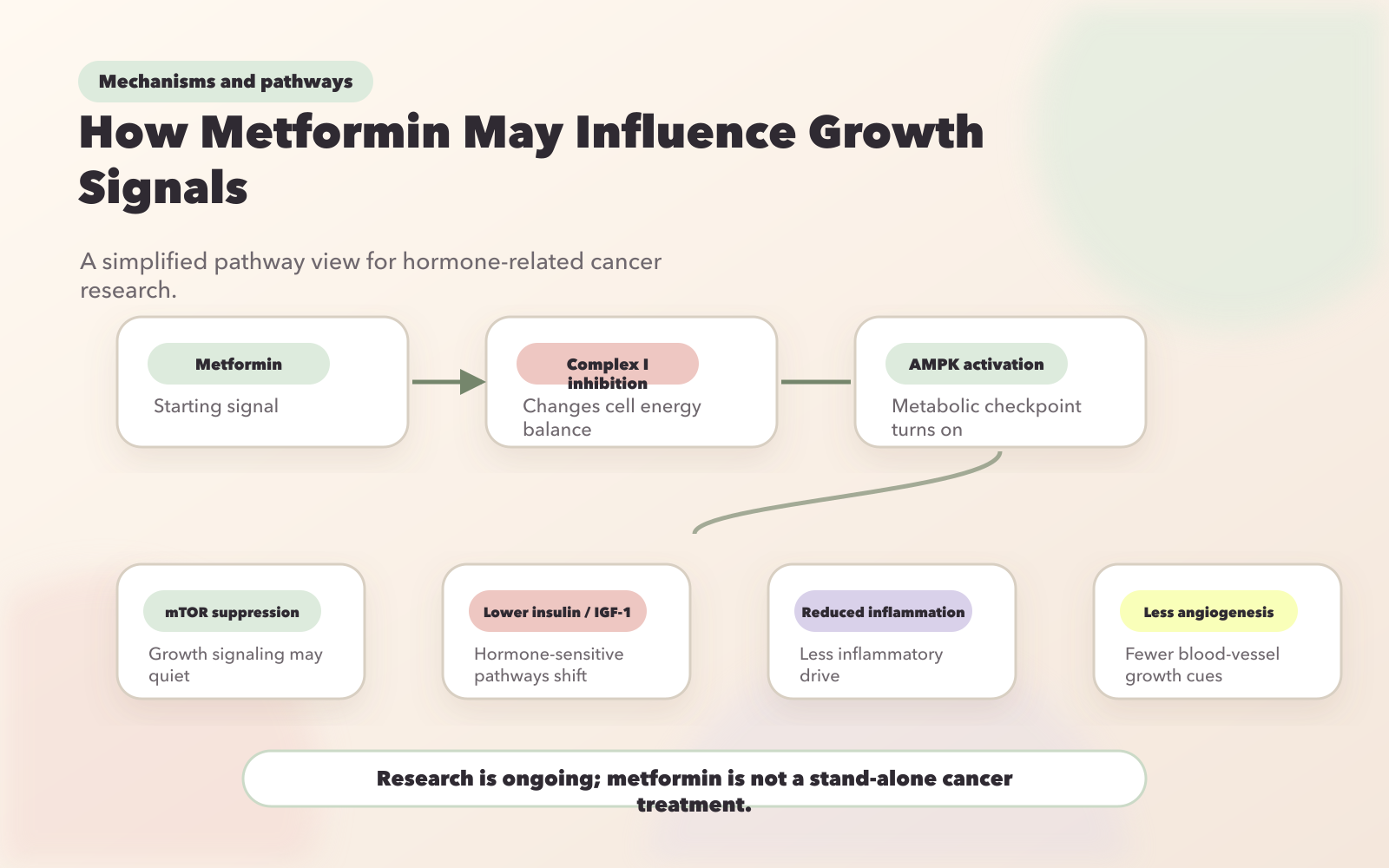
How Metformin Works Against Hormone-Related Cancers: Mechanisms and Pathways
Metformin disrupts the way cancer cells produce energy. Once inside a cell, it inhibits Complex I of the mitochondrial electron transport chain, creating an energy crisis. This leads to a drop in ATP levels and a rise in AMP levels.
This shift in energy balance sets off a series of protective mechanisms. The increased AMP/ATP ratio activates AMPK (AMP-activated protein kinase), which acts like a cellular circuit breaker. As Yeon Kyung Choi from Kyungpook National University explains, "AMPK is a master sensor and regulator of energy homeostasis at both the cellular and whole-body levels, especially under condition of energy stress". Once activated, AMPK halts energy-draining processes like protein and fat synthesis while boosting energy production.
On a broader scale, metformin lowers insulin and IGF-1 levels, hormones that fuel the PI3K/Akt/mTOR signaling pathway - a pathway often overactive in hormone-sensitive tumors.
This combination of cellular and systemic effects works to slow tumor growth.
mTOR Pathway Suppression
The mTOR (mammalian target of rapamycin) pathway is like a growth accelerator for cells, promoting protein production and cell division. In cancers like breast and prostate, this pathway often operates in overdrive. Metformin applies the brakes by phosphorylating the TSC2 tumor suppressor, enhancing its ability to suppress mTOR, and by phosphorylating Raptor, a critical mTORC1 component.
When mTOR activity is reduced, it leads to lower protein production, cell cycle arrest at the G0/G1 or G2/M phases, and apoptosis (programmed cell death). For example, a retrospective analysis found that diabetic breast cancer patients taking metformin during neoadjuvant chemotherapy had a pathological complete response rate of 24%, compared to just 8% for those not on the drug.
Interestingly, metformin can also inhibit mTOR through AMPK-independent pathways, such as influencing Rag GTPases and inducing REDD1 (Regulated in Development and DNA Damage Response 1), which blocks mTORC1 activity even without AMPK.
AMPK Activation
Alongside mTOR suppression, AMPK activation disrupts tumor cell metabolism on multiple fronts.
When AMPK is activated, it forces cancer cells to rewire their energy use. It reduces reliance on the Warburg effect - a process where cancer cells prioritize glucose consumption through aerobic glycolysis - by downregulating HIF-1α, which normally drives glycolytic enzyme production and blood vessel formation.
AMPK also disrupts cancer cells' ability to form new membranes. It phosphorylates and inactivates enzymes like Acetyl-CoA Carboxylase (ACC) and Fatty Acid Synthase (FASN), cutting off the fatty acids needed for rapid cell growth. In hormone-sensitive breast cancer cells, AMPK activation suppresses cyclin D1, releasing CDK inhibitors (p27Kip1 and p21Cip1) that halt the cell cycle.
"AMPK activation reprograms cellular metabolism and enforces metabolic checkpoints by acting on mTORC1, p53, fatty acid synthase and other molecules for regulating cell growth." - Zhijun Luo, MD, PhD, Boston University School of Medicine
Additionally, AMPK stabilizes the tumor suppressor p53 by phosphorylating it at Ser15, preventing stressed cells from dividing and enforcing metabolic checkpoints. These mechanisms contribute to metformin's association with a 30% to 50% reduction in overall cancer risk, as shown in various meta-analyses.
### Reducing Inflammation and Blood Vessel Formation
Chronic inflammation plays a major role in tumor growth, and metformin counters this by blocking the IL-6/JAK2/STAT3 signaling pathway, which is often implicated in breast cancer progression. It also shifts the immune environment by encouraging macrophages to adopt the anti-inflammatory M2 phenotype instead of the pro-inflammatory M1 type.
In a 2018 study led by Erin D. Giles, female Wistar rats with ER+ mammary tumors on a high-fat diet received metformin in their drinking water (2 mg/mL) for eight weeks. The treatment significantly reduced tumor size by lowering aromatase-positive, CD68+ macrophages in the tumor microenvironment. This, in turn, reduced local estrogen production near the tumor, directly slowing its growth.
Metformin also inhibits angiogenesis, the process of forming new blood vessels that tumors rely on for growth. It targets the HER2/HIF-1α axis, blocking the release of Vascular Endothelial Growth Factor (VEGF), which effectively starves tumors of their blood supply. Additionally, by inhibiting stress kinases like JNK and increasing IκBα levels, metformin creates an environment that's hostile to hormone-sensitive cancer cells.
Together, these mechanisms highlight how metformin disrupts multiple pathways to slow the progression of hormone-related cancers.
Clinical Studies on Metformin and Hormone-Related Cancers
Building on metformin's known effects on the mTOR and AMPK pathways, researchers have explored its role in hormone-related cancers through clinical trials. The results, however, vary depending on the type of cancer, patient characteristics, and treatment combinations.
Breast Cancer Studies
The MA.32 trial, conducted from August 2010 to March 2013, included 3,649 patients with high-risk, nonmetastatic breast cancer across multiple countries, including the United States and Canada. Participants were given 850 mg of metformin or a placebo twice daily for five years. The findings showed no significant improvement in invasive disease-free survival (HR 1.01), with event rates nearly identical between the metformin (2.78 per 100 patient-years) and placebo groups (2.74 per 100 patient-years).
Despite the lack of survival benefits, metformin demonstrated metabolic advantages. Over six months, patients on metformin lost a median of 1.4 kg, while the placebo group gained 0.5 kg. Additionally, insulin levels dropped by 15%, insulin resistance (HOMA-IR) decreased by 17%, and hsCRP levels were 16% lower (p < 0.0001).
Another trial at Beni-Suef University Hospital in Egypt, conducted between June 2019 and November 2020, involved 80 non-diabetic patients with locally advanced breast cancer. Participants received 1,000 mg of metformin twice daily alongside anthracycline/taxane-based neoadjuvant chemotherapy. While the pathological complete response rate was higher in the metformin group (22.2%) compared to the control group (10.5%), the difference was not statistically significant (p = 0.181). However, metformin appeared to reduce the incidence of grade I chemotherapy-induced peripheral neuropathy (30.56% vs. 44.74%).
Some studies suggest that pairing metformin with lifestyle changes could enhance its effects. For example, breast cancer survivors who combined metformin with structured diet and exercise programs experienced reductions in circulating sex hormones, including estradiol (down by 4 pmol/L) and estrone (down by 8 pmol/L) in those not on aromatase inhibitors. This combination also improved levels of adipokines, sex hormone-binding globulin (SHBG), and C-reactive protein (CRP).
"Supportive healthy lifestyle programs combined with metformin to achieve maximal risk reduction among BC cancer survivors are recommended, especially for those with obesity in menopause and perimenopause." - Harriet Johansson et al.
Metformin’s activity appears to vary by breast cancer subtype, with triple-negative and HER2-positive cancers showing the most sensitivity in preclinical and early-phase studies. Additionally, the drug has been shown to significantly lower circulating sex hormones, such as estradiol, estrone, and testosterone, in postmenopausal women.
While breast cancer research provides valuable insights into metformin's potential, its impact on other hormone-sensitive cancers tells a more complex story.
Prostate Cancer and Androgen Deprivation Therapy
In prostate cancer, meta-analyses indicate an 18% reduction in cancer incidence (RR: 0.82). However, for advanced prostate cancer, the benefits are less clear. A target trial emulation using SEER-Medicare data, involving 7,361 patients, revealed that starting metformin was not linked to lower all-cause mortality (HR 1.38; 95% CI, 0.98–1.95) or prostate cancer–specific mortality (HR 0.99; 95% CI, 0.63–1.55). These findings suggest that while metformin may help reduce the risk of developing prostate cancer, it does not improve survival outcomes in advanced cases.
Pancreatic Neuroendocrine Tumors
Interest in metformin's effects extends to other hormone-sensitive tumors, such as pancreatic neuroendocrine tumors, due to its ability to suppress mTOR and activate AMPK. However, there is currently limited survival data for these tumors, highlighting the need for further research.
Side Effects and Tolerability
Treatment tolerability remains a key consideration. In the MA.32 trial, grade 3 nonhematological toxic events were more common in the metformin group (21.5%) compared to the placebo group (17.5%). Notable side effects included diarrhea (7.0% in the metformin group vs. 1.9% in placebo) and hypertension (2.4% vs. 1.9%).
While the data highlights metformin's promise in certain areas, its role in hormone-related cancers remains nuanced and requires further investigation.
Prevention and Combination Treatment Options
Using Metformin for Cancer Prevention
Metformin isn't just a treatment for diabetes - it also shows promise in preventing cancer, particularly in individuals with obesity, insulin resistance, or Type 2 diabetes. Research has linked metformin use to a 28% reduction in overall cancer risk (RR 0.72). Specific reductions include 32% for breast cancer (RR 0.68) and 38% for colorectal cancer (RR 0.62). In Taiwanese patients with Type 2 diabetes, the numbers are even more striking, with a 63% lower risk of colorectal cancer (RR 0.37).
Metformin works by targeting metabolic pathways that fuel tumor growth. It activates AMP-activated protein kinase (AMPK), a key player in suppressing cancer cell proliferation, and even targets cancer stem cells, which are often responsible for recurrence. For women with PCOS, metformin offers additional benefits by lowering androgen levels and normalizing menstrual cycles - factors that directly influence hormone-driven cancers.
Clinical studies further highlight its potential. For example, low-dose metformin (250 mg/day) reduced colorectal aberrant crypt foci - early markers for colorectal cancer - by 40% in non-diabetic patients. In non-diabetic breast cancer survivors, a higher dose (1,500 mg/day) reduced fasting insulin levels by 22%. To minimize gastrointestinal side effects, starting with a low dose and gradually increasing is recommended.
These findings pave the way for combination therapies that build on metformin's preventive capabilities.
Combining Metformin with GLP-1 Agonists
Pairing metformin with GLP-1 receptor agonists takes treatment to the next level by enhancing both metabolic and hormonal control. A January 2025 meta-analysis of eight randomized controlled trials involving 337 participants with PCOS showed this combination outperformed metformin alone. The results? Improved fasting glucose levels (mean difference = -0.30), better insulin sensitivity (mean difference = -1.58), weight loss of 1.37 kg, and a BMI reduction of 0.88 kg/m². Additionally, the combination significantly increased Sex Hormone-Binding Globulin (SHBG) levels (mean difference = 10.04).
The synergy here is clear: metformin improves insulin sensitivity, while GLP-1 agonists promote weight loss. Together, they tackle hormone-related cancer risks more effectively. For women managing PCOS, this dual approach offers better hormonal regulation and reduced cancer risks tied to hormonal imbalances.
Oana Health has developed Oral GLP-1 & Metformin formulations tailored for hormonal health, offering a convenient way to support both metabolic and hormonal balance.
The benefits of combining metformin go beyond prevention. For example, in breast cancer patients undergoing chemotherapy with paclitaxel, metformin helped reduce treatment-related side effects like peripheral neuropathy. Additionally, pairing metformin with letrozole has shown promising clinical responses in ER-positive breast cancer cases.
Conclusion
Metformin’s potential in managing hormone-related cancers goes well beyond its original purpose as a diabetes medication. By activating AMPK and suppressing the mTOR pathway, while also lowering systemic insulin and IGF-1 levels, it tackles the metabolic weaknesses that drive tumor growth. The data speaks volumes: diabetic breast cancer patients on metformin experienced a 47% reduction in all-cause mortality and a 24% pathologic complete response rate during neoadjuvant therapy, compared to just 8% for those not using the drug.
"Metformin and its derivatives exert dual anticancer effects by modulating systemic insulin signaling and targeting tumor-intrinsic pathways."
– Breast Cancer Research
Clinical research continues to highlight metformin’s preventive benefits. Meta-analyses suggest it can reduce the risk of various cancers by as much as 50%. For women dealing with PCOS and metabolic issues, metformin addresses the root causes of hormonal imbalances and insulin resistance that elevate cancer risk. The MetBreCS trial further underscores its potential, showing lowered estradiol levels and down-regulation of tumor-promoting genes in non-diabetic breast cancer survivors after a year of treatment.
The future of metformin likely lies in combination therapies. Pairing it with GLP-1 agonists can improve both metabolic and hormonal regulation, while studies combining metformin with treatments like everolimus and letrozole have shown clinical benefit rates of 50% in endometrial cancer patients. Oana Health now offers tailored Oral GLP-1 & Metformin formulations to support hormonal health through this combined approach.
What sets metformin apart is its affordability and proven safety record. For those managing conditions like PCOS, insulin resistance, or hormone-sensitive cancer risks, metformin presents a scientifically supported option for prevention and treatment. Collaborating with healthcare providers to customize dosing and explore combination therapies is essential for addressing individual metabolic and hormonal health needs effectively.
FAQs
Can I take metformin to lower my cancer risk if I’m not diabetic?
Metformin has shown potential in lowering the risk of some hormone-related cancers, like breast cancer, particularly in individuals with diabetes. However, the evidence supporting its effectiveness in those without diabetes remains limited. Using metformin strictly for cancer prevention is not a common practice and should only be considered under the guidance of a healthcare professional.
Which hormone-related cancers respond best to metformin?
Metformin shows the greatest impact on hormone-related cancers like breast, ovarian, and endometrial cancers, especially when these are associated with metabolic syndrome, high insulin levels, or elevated blood sugar. These conditions can affect the body’s response to treatments, positioning metformin as a helpful tool in managing these types of cancers.
What side effects should I watch for when starting metformin?
Common side effects when starting metformin can include nausea, diarrhea, bloating, stomach pain, and sometimes a metallic taste. These issues are most common during the first few weeks and tend to ease as your body adjusts. If these symptoms continue or get worse, it’s important to reach out to your healthcare provider.