
Metformin and Vitamin B12: Testing Guidelines
If you’re taking metformin for diabetes, PCOS, or insulin resistance, you should know it can interfere with your body’s ability to absorb vitamin B12. This can lead to a deficiency that’s often mistaken for diabetic complications like nerve pain or fatigue. Left unchecked, it may cause permanent nerve damage.
Key takeaways:
- Up to 10% of metformin users develop B12 deficiency.
- Risk increases with higher doses and longer use (13% per year).
- Older adults, vegetarians, and those with gut issues are more vulnerable.
- Symptoms include numbness, tingling, and fatigue but may go unnoticed.
What to do:
- Test B12 levels annually if you’ve been on metformin long-term.
- Look for levels below 180 pg/mL; additional tests like MMA may help.
- Treat deficiencies with supplements (oral or injections) and follow up regularly.
Monitoring your B12 levels ensures metformin’s benefits without compromising your health.
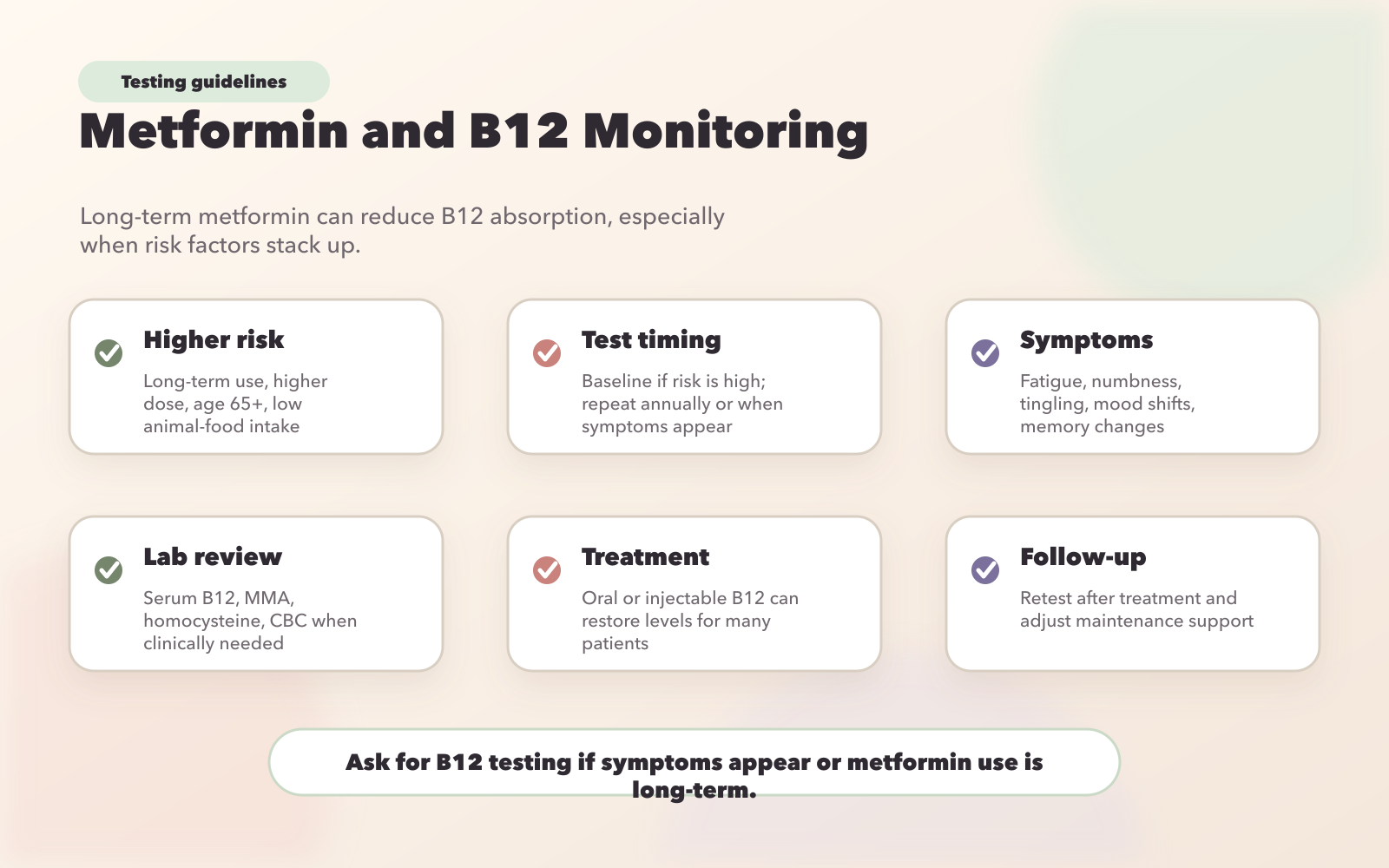
Metformin and Vitamin B12 Deficiency: Risk Factors and Testing Guidelines
Metformin and Vitamin B12 Deficiency
sbb-itb-6dba428
Who Gets B12 Deficiency on Metformin
Metformin is widely regarded as safe, but its effect on B12 absorption isn't uniform across all users. Research highlights that certain groups are more prone to B12 deficiency. For instance, about 5.8% of adults with type 2 diabetes taking metformin show biochemical B12 deficiency, compared to only 2.4% of non-users. When subclinical cases are included, this figure jumps to 16.2%.
The Diabetes Prevention Program Outcomes Study (DPPOS) offers a closer look. It tracked 1,073 participants who took 850 mg of metformin twice daily from 2002 to 2015. After five years, 19.1% of metformin users had low or borderline B12 levels, compared to 9.5% in the placebo group. This trend persisted, with 20.3% still affected after 13 years.
Risk Factors for B12 Deficiency
Several factors determine whether someone on metformin might develop a B12 deficiency. Dosage and treatment duration are key drivers. For every additional 100 mg of daily metformin, the odds of deficiency rise by 8%, while each additional year of use increases the risk by 13%. Using metformin for more than four years correlates with a 41% higher risk.
Age also plays a role. Older adults are more vulnerable, with those over 65 experiencing deficiency rates of 4.2%, compared to 2.5% in younger patients. The risk accelerates further for individuals over 80, who develop deficiency faster - on average, in 1,491 days, compared to 1,926 days in the general population.
Diet and other health conditions can compound the issue. People following strict vegan or vegetarian diets, which lack sufficient B12 from animal sources, are at higher risk. Similarly, gastrointestinal conditions like Crohn's disease, inflammatory bowel disorders, or a history of stomach surgery can impair B12 absorption. Additionally, medications such as proton pump inhibitors (PPIs), H2-receptor antagonists, or colchicine further reduce B12 absorption.
"The risk of low vitamin B12 levels increases with higher metformin dose, longer treatment duration, and in patients with risk factors for vitamin B12 deficiency." - Medicines and Healthcare products Regulatory Agency
Individuals starting metformin therapy with B12 levels already on the lower end of the normal range are particularly susceptible. Interestingly, studies suggest that African-American individuals may have a 27% lower incidence of B12 deficiency compared to other racial groups.
What Research Shows
Research consistently backs these findings. Data from NHANES and the DPPOS study highlight how deficiency rates increase with longer metformin use:
| Duration of Metformin Use | Prevalence of B12 Deficiency |
|---|---|
| < 1 year | 4.1% |
| 1–3 years | 6.3% |
| 3–10 years | 4.1% |
| > 10 years | 8.1% |
The DPPOS study also found that after five years, 4.3% of metformin users had low B12 levels (≤203 pg/mL), increasing to 7.4% after 13 years. The study concluded: "Long-term use of metformin in DPPOS was associated with biochemical B12 deficiency and anemia. Routine testing of vitamin B12 levels in metformin-treated patients should be considered".
One concerning aspect is that clinical symptoms, such as anemia or neuropathy, often remain absent even when a biochemical deficiency is present. Moreover, standard multivitamins with 6 μg of B12 - typically effective for preventing deficiency in the general population - don’t seem to work as well for metformin users. This emphasizes the need for regular B12 screenings, particularly for those with multiple risk factors.
When and How to Test for B12 Deficiency
Testing Schedule Recommendations
Long-term metformin use increases the risk of B12 deficiency, making regular testing a must. Experts recommend annual testing for individuals using metformin over extended periods, with baseline levels taken before starting the medication to monitor future changes. If you experience short-term side effects like tingling, numbness, or signs of anemia, testing should be done immediately.
Certain groups may need more frequent testing. This includes people over 65, those taking proton pump inhibitors (like omeprazole), using medications such as colchicine, or those with gastrointestinal conditions like Crohn's disease. If you've been on metformin for 4 to 5 years or more, your doctor might suggest closer monitoring.
Understanding B12 Test Results
Once you’ve established a testing routine, understanding your results is key. The serum B12 test is the standard. Levels below 180 pg/mL (133 pmol/L) typically indicate deficiency, while levels above 350 pg/mL make deficiency unlikely. However, the range between 180 and 350 pg/mL is less clear-cut. Even within this "grey zone", some people may show symptoms of deficiency.
If your levels fall into this ambiguous range, additional tests like methylmalonic acid (MMA) or homocysteine may be needed. These tests can detect early signs of deficiency, even when serum B12 appears normal.
"Vitamin B12 deficiency is now considered to be a common side effect in patients on metformin treatment, especially in those receiving a higher dose or longer treatment duration." Understanding the benefits and dosage of metformin is essential for managing these risks.
– Medicines and Healthcare products Regulatory Agency (MHRA)
If you're taking B12 supplements, let your doctor know, as they can mask a deficiency. Also, don’t rely solely on an annual blood count to spot problems. While a high Mean Corpuscular Volume (MCV) can hint at B12 issues, it might appear normal if iron deficiency is also present.
Treating B12 Deficiency
B12 Supplement Types
Once a B12 deficiency is diagnosed, choosing the right treatment becomes essential. High-dose oral vitamin B12 (1,000–2,000 mcg daily) works just as well as intramuscular (IM) injections for many people. IM injections are generally reserved for more severe cases or for quickly boosting levels during an initial loading phase. For metformin users, targeted supplementation is particularly important to address absorption issues caused by the medication.
Most metformin users find oral or sublingual methylcobalamin to be a practical and effective option. This form of B12 is easy to take at home, cost-effective, and stays in the body longer. It's also been specifically studied for helping with nerve-related symptoms.
Intramuscular injections are often used for severe deficiencies or when a rapid response is needed. A typical protocol involves weekly 1,000 mcg injections for eight weeks, followed by monthly doses of the same amount for ongoing maintenance.
"Oral or sublingual methylcobalamin is recommended as the most effective, cost-effective and convenient method for supplementation in those requiring treatment."
– Pam Brown, Editor, Diabetes & Primary Care
Food Sources of Vitamin B12
Although supplements are crucial for those on metformin, dietary sources of B12 can still play a supportive role. B12 is naturally found in animal-based foods like beef, chicken, liver, fish (salmon, trout, tuna), shellfish, eggs, milk, cheese, and yogurt. For vegetarians and vegans, fortified options such as plant-based milks, breakfast cereals, and nutritional yeast are good alternatives.
It's worth noting that standard multivitamins typically provide only 6 μg of B12, which is often insufficient for metformin users. To maintain healthy levels, patients usually need at least 25 μg daily or more in oral form.
Interestingly, calcium supplements may help counteract metformin’s interference with B12 absorption. This is because metformin disrupts a calcium-dependent process in the terminal ileum that's critical for absorbing B12. Talk to your healthcare provider to see if this option might work for you.
Follow-Up Testing
Starting treatment is just the first step - follow-up testing ensures your levels are improving and staying within a healthy range. After beginning therapy, it's recommended to check serum B12 or methylmalonic acid (MMA) levels at 2–3 months. Beyond that, annual monitoring of hematologic parameters and B12 levels is standard, though some guidelines suggest testing every 2–3 years.
Regular monitoring allows for timely adjustments to your treatment plan, ensuring optimal recovery. Early detection and consistent follow-up are especially important because advanced neurological symptoms may not fully resolve if treatment is delayed.
Conclusion
For those using metformin long-term, keeping an eye on your vitamin B12 levels is crucial. Studies show that up to 10% of long-term users may develop a deficiency, with the risk climbing by 13% each year. Symptoms like numbness and fatigue can often be mistaken for other issues, delaying proper treatment.
Vitamin B12 deficiency can appear suddenly, which is why early detection is so important. Regular testing - typically every one to three years, or annually for individuals at higher risk - can catch a deficiency before it leads to irreversible nerve damage.
"I think that [metformin] can be safely prescribed as long as the potential for B12 deficiency is recognized and monitored."
– Dr. Jill Crandall, Professor of Medicine at Albert Einstein College of Medicine
It's worth noting that standard blood tests may not always detect a B12 deficiency. Many individuals with biochemical deficiencies still show normal hemoglobin and hematocrit levels. For a more accurate assessment, specific B12 tests - and sometimes methylmalonic acid (MMA) tests - are recommended.
This highlights the importance of tailoring monitoring protocols to individual needs.
By staying proactive about B12 testing, you can ensure that metformin continues to deliver its benefits without compromising your health. Routine testing and timely supplementation are simple yet effective steps to safeguard your well-being. Work with your healthcare provider to set up a testing schedule that fits your needs.
If you're looking for expert, personalized support in managing your metformin therapy, check out the telehealth services provided by Oana Health. They offer science-backed advice to help you stay on top of your health.
FAQs
Can metformin-related B12 deficiency mimic diabetic neuropathy?
Vitamin B12 deficiency caused by metformin use can sometimes mimic the symptoms of diabetic neuropathy. For instance, peripheral neuropathy - a common symptom - might be mistakenly attributed to diabetes alone. However, B12 deficiency itself can lead to or worsen neuropathy, even if blood sugar levels are well-managed. This makes it crucial for long-term metformin users to have their B12 levels checked regularly to avoid potential complications.
Should I request MMA testing if my B12 is “low-normal”?
If your B12 levels fall into the "low-normal" range, an MMA (methylmalonic acid) test might provide more clarity - especially if you're experiencing symptoms or have certain risk factors. Generally, a normal MMA level suggests a lower chance of B12 deficiency. However, it doesn't completely eliminate the possibility, particularly if kidney function is compromised or certain medications are involved. Always seek advice from your healthcare provider for guidance tailored to your situation.
Do I need B12 injections, or will high-dose oral B12 work?
High doses of oral vitamin B12, ranging from 1,000 to 2,000 mcg daily, are often effective in treating deficiencies. This approach can be a solid alternative to injections, particularly for people dealing with absorption issues or those taking metformin over an extended period. That said, it's essential to consult your healthcare provider to find the option that works best for your situation.