
Minoxidil Shedding: Science Behind the Process
Minoxidil shedding happens when starting the treatment, causing a temporary increase in hair loss. This process is normal and indicates the medication is working by pushing out weaker hairs to make way for stronger ones. Shedding typically begins 2–4 weeks after starting minoxidil, peaks around the second month, and resolves within 6–8 weeks. New hair growth usually becomes noticeable after 4–6 months of consistent use.
Key points:
- What it is: Temporary hair loss caused by minoxidil.
- Why it happens: Old hairs are shed as follicles enter the growth phase.
- When it starts: 2–4 weeks after starting treatment.
- How long it lasts: 3–6 weeks on average, sometimes up to 8 weeks.
- When results appear: Noticeable regrowth in 4–6 months, best results in 12–18 months.
Consistency is critical - stopping treatment can reverse progress. If shedding persists beyond 4–6 months, consult a doctor.
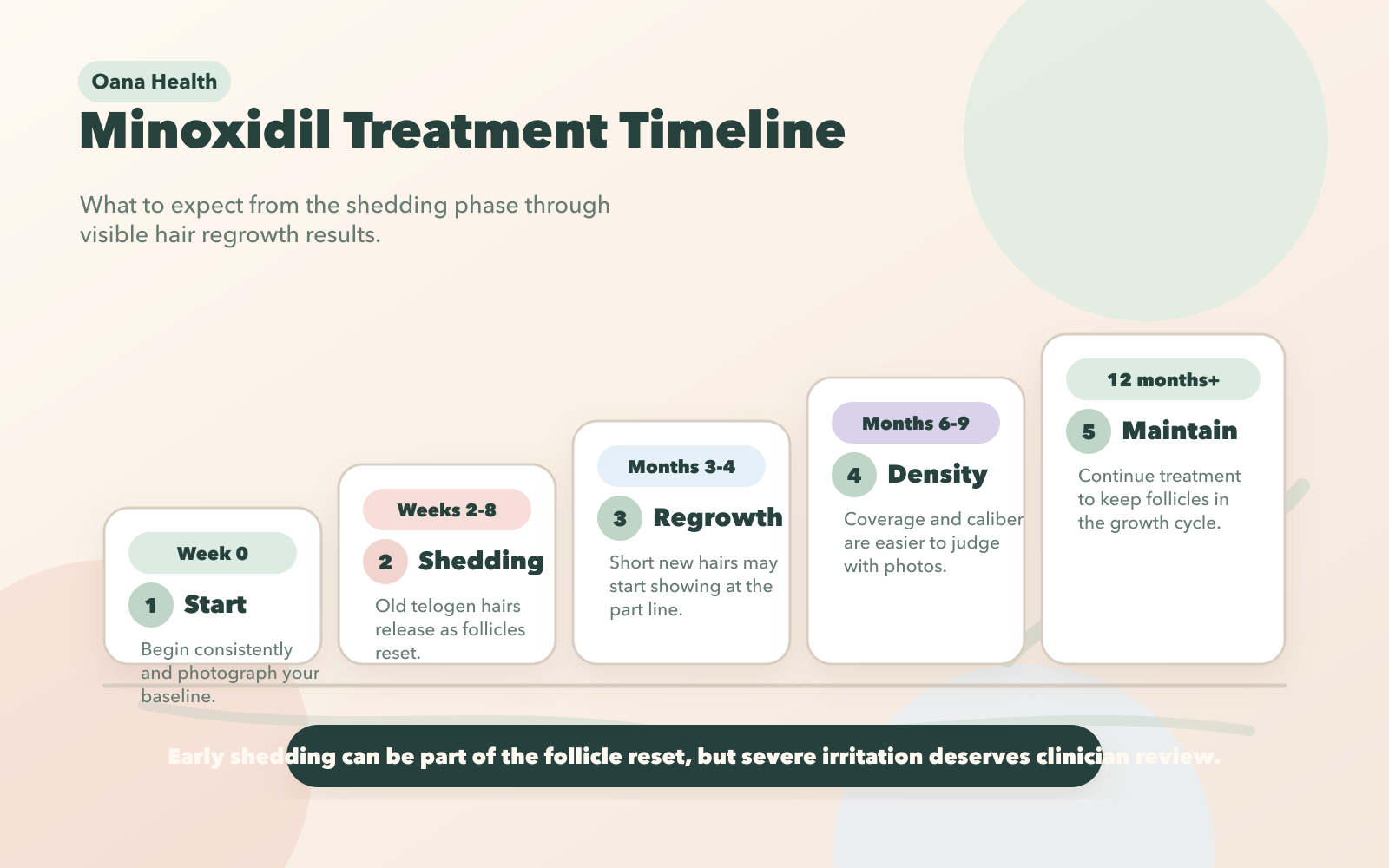
Minoxidil Treatment Timeline: Shedding Phase to Hair Regrowth Results
The Science Behind Hair Growth and Shedding
The Hair Growth Cycle
Hair grows in a continuous cycle with four distinct phases: anagen (active growth lasting 2–7 years), catagen (a brief 2–3 week transition), telogen (a resting period of 2–4 months), and exogen (shedding as new hair pushes through). On average, people lose around 100 hairs daily. This natural cycle is the foundation for how treatments like minoxidil work on dormant hair follicles.
How Minoxidil Affects the Hair Growth Cycle
Minoxidil works by speeding up the hair growth cycle. Once applied, it converts into its active form, minoxidil sulfate, through the sulfotransferase enzyme. This active form stimulates dormant follicles to quickly enter the anagen phase, cutting the telogen phase from about 20 days to just 1–2 days. Acting as a vasodilator and potassium channel opener, minoxidil extends the duration of the anagen phase and increases follicle size, resulting in thicker and longer hair strands.
"Minoxidil shortens the telogen phase to prompt the dormant hair follicles for premature transition into the anagen phase."
- Preeti Patel, StatPearls
Why Shedding Can Be a Positive Sign
When starting minoxidil, some initial shedding, known as minoxidil-induced telogen effluvium, is common. This process clears out weaker hairs to make room for stronger, healthier strands. While it might seem alarming, this shedding phase signals that the treatment is working to reset hair follicles, paving the way for better hair density over time. Knowing this can help manage expectations and maintain confidence during the early stages of treatment.
How Long Minoxidil Shedding Lasts
Typical Shedding Timeline
When starting minoxidil, shedding usually kicks in around the 2–4 week mark, often peaking by the second month. This phase typically lasts 3 to 6 weeks, though in some cases, it can stretch to about 8 weeks. Noticeable new hair growth generally appears after 4 to 6 months of consistent use.
"Increased hair shedding typically occurs between weeks 2 to 4 of treatment and resolves at approximately 6 weeks."
- Lilian White, MD
If shedding continues beyond 4–6 months, it’s a good idea to consult a doctor. Now, let’s explore how the concentration of minoxidil can influence this process.
How Minoxidil Concentration Affects Shedding
About 12.5% of people using the 5% minoxidil solution report increased shedding. Interestingly, some studies suggest the 2% formulation might have a slightly higher shedding rate, with overall rates ranging from 2.4% to 22%. While the 5% solution often delivers better cosmetic results, it can also come with a higher chance of side effects like scalp irritation.
Individual Differences in Shedding
Shedding patterns aren’t just about the concentration of minoxidil - individual biological factors play a big role too. Responses to minoxidil can vary widely. For instance, a 2024 study involving 115 patients found that only 5.2% experienced new shedding after starting low-dose oral minoxidil.
Factors like variations in sulfotransferase enzyme activity, hormonal imbalances (such as those seen in PCOS), thyroid issues, nutritional deficiencies, stress, and even certain medications can influence shedding. Medications like aspirin, for example, may reduce minoxidil's effectiveness by blocking the enzyme required for its activation.
Clinical Evidence on Minoxidil Shedding
What Clinical Studies Show
Research has shown that early shedding when starting minoxidil is actually a positive indicator of its effectiveness. A 2025 retrospective study highlighted that this temporary shedding phase signals dormant hair follicles are being activated.
"Minoxidil shedding is a temporary increase in hair fall that happens when you first start the medication. It's actually a sign that it's working - older hairs are being pushed out to make room for new, thicker ones."
- Hannah Kopelman, DO
Shedding typically peaks between weeks 6 and 12. By weeks 12 to 16, new hair growth begins to emerge, and noticeable improvements in hair density are often seen by week 24. For example, a Phase III study demonstrated that using 5% minoxidil foam led to an increase of 23.9 hairs per square centimeter at 24 weeks. During this process, thinner, resting hairs are replaced by visibly thicker strands in about a month, marking a clear clinical improvement.
Further research supports the superior efficacy of higher concentrations of minoxidil. A 48-week trial revealed that 5% topical minoxidil resulted in 45% more hair regrowth compared to the 2% formulation. Dr. Elise A. Olsen from Duke University Medical Center also noted, "hair count data indicate that response to treatment occurred earlier with 5% compared with 2% topical minoxidil".
These findings underline minoxidil’s effectiveness, not just in the short term but also over extended periods.
Long-Term Results with Minoxidil
Long-term studies reinforce the benefits of consistent minoxidil use. Hair regrowth often peaks around the one-year mark and remains stable with continued application. A 5-year follow-up study found that men using 2% and 3% minoxidil maintained their terminal hair counts over this period.
However, stopping treatment reverses these gains, with noticeable hair loss resuming within 12 to 24 weeks. This is why dermatologists stress the importance of ongoing use - minoxidil’s benefits are sustained only as long as the treatment continues.
sbb-itb-6dba428
Managing Expectations During Treatment
Why Patience Matters
Using minoxidil effectively requires commitment and patience. The initial shedding phase often starts between the second and eighth weeks of treatment, peaking around the second month. By the eighth week, this shedding usually subsides as hair follicles transition into the growth phase.
One common mistake is giving up too soon. A 2023 study conducted in Jeddah, Saudi Arabia, by researcher Zari Shadi, examined 400 patients and found that individuals who stuck with minoxidil for over a year were 78% less likely to stop treatment. Interestingly, 68% of users who quit did so because they thought the treatment wasn’t working, while 32% were worried about the need for lifelong use. Peak results often take up to a year to become noticeable, so evaluating progress too early can lead to unnecessary frustration.
Here’s how to manage the shedding phase and stay on track with your treatment.
Tips for Handling Shedding
Start by marking your treatment date. If shedding continues beyond four months, it’s time to consult a dermatologist to rule out other potential issues. Shedding is typically a sign of progress, as it indicates hair follicles are entering a new growth cycle. However, if you notice patchy hair loss, severe scalp redness, scaling, or any unusual discharge (yellow, green, or gray), these could point to irritation rather than normal shedding.
To support your scalp during this period, focus on maintaining overall scalp health:
- Eat a nutrient-rich diet with antioxidants, folic acid, biotin, vitamin E, and omega-3s.
- Use gentle shampoos and avoid tight hairstyles that pull on your hair.
- Stick to the recommended dosage - typically 1 mL or half a capful. Using more won’t speed up results but may increase side effects.
If the liquid version irritates your scalp, consider switching to the foam formulation. The foam often causes less irritation since it doesn’t contain propylene glycol.
Why You Shouldn't Stop Treatment
Consistency is non-negotiable when it comes to minoxidil. Shedding is a normal part of the process and signals that the treatment is taking effect. Stopping treatment can cause all newly grown hair to fall out within three to four months, and your hair loss will likely return to its untreated state.
"It is important to let patients know that with discontinuation of minoxidil, gains in hair loss will recede to a level that would be expected without treatment"
- Dr. Lilian White
Minoxidil works by shortening the resting phase of hair from about 20 days to just one or two days. Skipping applications disrupts this process and can prolong the shedding phase. For the best results, stick to daily use for at least 12 months before assessing the treatment’s effectiveness.
Conclusion
Key Takeaways
Minoxidil shedding is a sign that the treatment is working. About 18% of people experience this temporary phase, where older, weaker hairs are shed to make way for new growth. This process typically starts between weeks 2 and 8, peaks around the second month, and gradually tapers off as hair follicles enter the active growth phase.
Patience is key when it comes to seeing results. Visible regrowth usually begins to appear after 4 to 8 months, with the best results showing around 12 to 18 months. However, stopping treatment prematurely can undo all progress. Dr. Lilian White puts it plainly:
"It is important to let patients know that with discontinuation of minoxidil, gains in hair loss will recede to a level that would be expected without treatment"
- Dr. Lilian White
Stick with your regimen, nourish your scalp, and don’t let the shedding phase discourage you. It’s a necessary step toward healthier, thicker hair.
Next Steps
For a treatment plan tailored to your needs, consult a licensed professional. Expert guidance is crucial for addressing hair loss effectively. Oana Health provides telehealth services with licensed medical professionals who specialize in hair loss solutions. Their science-backed, prescription-based treatments are delivered straight to your door with free shipping, making it easier to stay on track.
Ready to take the next step? Schedule a consultation and get personalized advice for your minoxidil treatment. Visit Oana Health to begin your journey.
Dermatologist Explains How Minoxidil Works for Hair Loss (How to Use, Results, & More)
FAQs
What should I do if Minoxidil shedding lasts longer than normal?
If you notice that Minoxidil shedding lasts for several months rather than the usual few weeks, it's a good idea to pause using the product and reach out to a healthcare provider. A professional can assess your situation, identify the reason behind the extended shedding, and recommend any necessary changes to your treatment plan.
While shedding is a normal step in the hair regrowth journey, prolonged or excessive hair loss might indicate the need for tailored advice to support your hair health effectively.
Is it safe to use minoxidil if I have a sensitive scalp?
Yes, you can use minoxidil even if you have a sensitive scalp, but it’s wise to approach it carefully. Start with a patch test to see if your skin reacts negatively, like showing signs of irritation or an allergic response. For those with sensitive skin, opting for a lower-strength formula or consulting a healthcare professional can help you find the safest option.
Be aware that minoxidil may sometimes lead to mild irritation, such as redness or dryness, particularly for individuals with sensitive skin. If you notice discomfort or your symptoms worsen, stop using it immediately and reach out to a licensed medical provider for advice.
How can I get the best results from using minoxidil?
To get the most out of minoxidil, staying consistent and following the application instructions is crucial. Typically, women use the 2% solution, while men often start with the 5% foam or solution. Apply about 1 mL of solution or half a capful of foam directly to a dry scalp twice a day, focusing on the thinning areas. Gently massage the product into your scalp and remember to wash your hands thoroughly afterward.
Patience is essential - visible regrowth often takes 4–6 months of regular use. Don’t be alarmed if you notice some shedding during the first few weeks; this is normal and happens as older hairs fall out to make room for new growth. For optimal results, avoid using styling products, wearing hats, or lying down for at least 2–4 hours after applying minoxidil to allow proper absorption.
If you experience any irritation, such as redness or itching, consider reducing how often you apply the product or consult a healthcare provider. For a more tailored approach to managing hair loss, you might want to explore a telehealth consultation with Oana Health, where licensed professionals can develop a science-backed plan that works for you.