
Research on Minoxidil Timing for Hair Growth
Timing matters when using minoxidil for hair growth. The drug must stay on the scalp for at least four hours to ensure proper absorption. Studies show that minoxidil works by shortening the resting phase of hair growth and extending the active growth phase, helping follicles produce thicker hair. Here’s what you need to know:
- Twice-daily application is the standard method for maintaining consistent drug levels. Reducing applications to once daily may decrease effectiveness.
- Morning vs. evening use doesn’t change results, but personal preference and convenience often determine the best time to apply.
- Avoid blow-drying immediately after use, as it can reduce absorption by up to 50%.
- For women with PCOS-related hair loss, combining minoxidil with hormonal treatments like spironolactone improves outcomes.
Consistency in application is more important than timing it with hair growth phases. Whether you choose topical or oral minoxidil, sticking to a routine ensures better results.
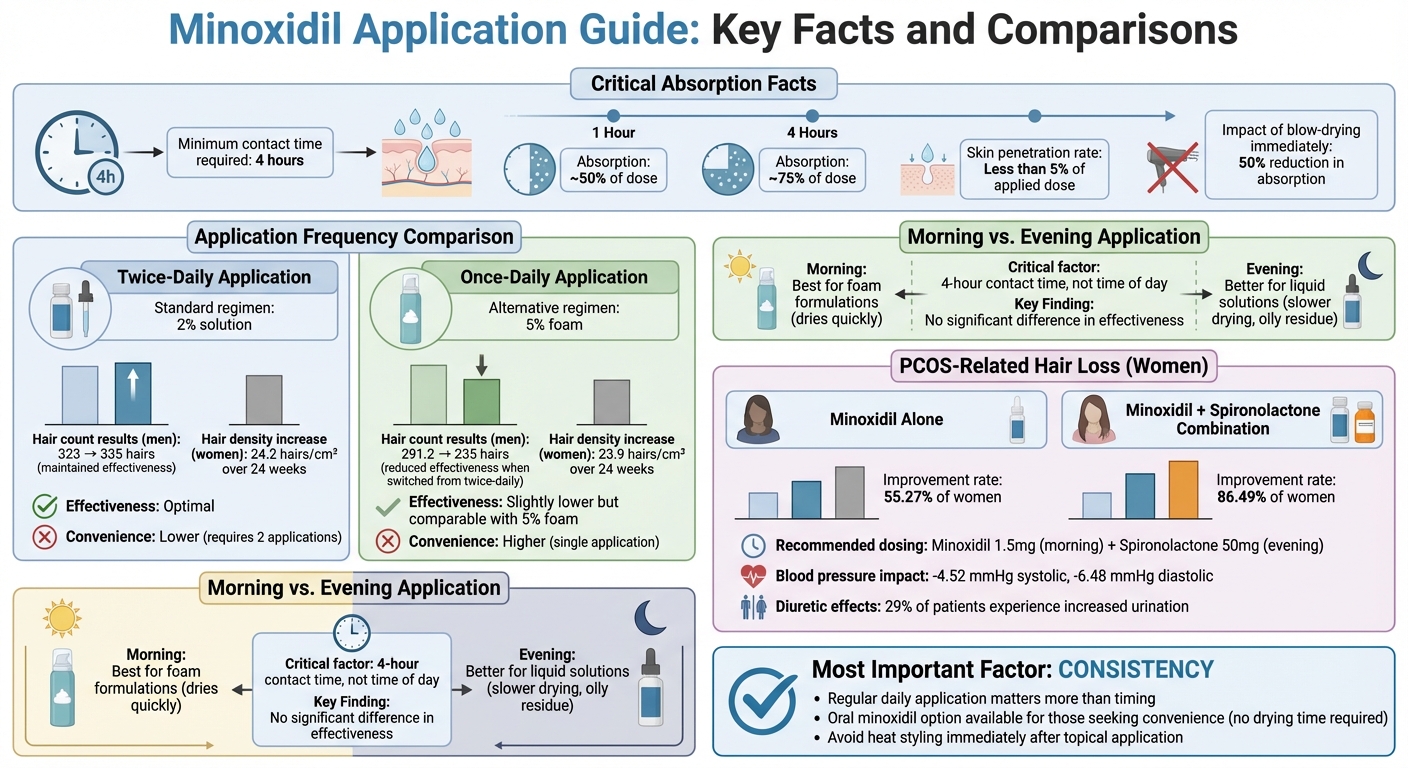
Minoxidil Application Methods: Effectiveness and Absorption Rates Compared
Dermatologist's Guide to MINOXIDIL for Hair Growth
The Standard Twice-Daily Application Method
Minoxidil received FDA approval in 1988, with a twice-daily 2% application regimen becoming the foundation for clinical research. This dosing schedule was developed based on how minoxidil is absorbed through the skin and delivered to hair follicles. While effective, this approach also presents some challenges for users.
Why Twice-Daily Applications Are Recommended
Minoxidil is absorbed slowly, and maintaining steady levels in the skin is key to ensuring it works as intended. The skin acts as a reservoir, gradually releasing the medication over time. However, less than 5% of the applied dose actually penetrates the skin. Studies confirm that applying more than the recommended amount doesn’t improve results. Dr. Olsen noted that increasing the frequency of applications doesn’t boost minoxidil levels either.
Adhering to the twice-daily regimen has proven benefits. Research shows that switching to a once-daily application can reduce effectiveness. For example, one study found that men who reduced their applications from twice daily to once daily experienced a drop in hair count - from 291.2 to 235 hairs. In contrast, those who stuck to twice-daily use saw their hair count rise from 323 to 335 hairs. Among women with pattern hair loss, a twice-daily 2% solution led to an average increase of 24.2 hairs/cm² over 24 weeks, slightly outperforming a once-daily 5% foam, which resulted in a 23.9 hairs/cm² increase.
Common Barriers to Twice-Daily Use
Despite its advantages, sticking to a twice-daily schedule isn’t always easy. For minoxidil to work effectively, it needs to remain on the scalp for at least four hours, which can interrupt daily routines. The liquid formulation can also leave hair looking greasy or flat, and it’s more likely to cause irritation, such as itching or dandruff, compared to foam options. Additionally, using a blow dryer right after applying minoxidil can cut absorption by half, making it even harder to incorporate into a busy lifestyle. These hurdles have inspired researchers to explore ways to make application more convenient for users.
How Application Timing Affects Minoxidil Results
Morning vs. Evening Application: Research Findings
Studies indicate that whether you apply minoxidil in the morning or evening doesn’t significantly impact its effectiveness. The key factor is giving the medication enough time - at least four hours - to be absorbed into the scalp. This ensures optimal results.
Choosing between morning and evening often boils down to personal preference and the type of formulation you’re using. Foam formulations, which dry quickly, fit seamlessly into a morning routine. On the other hand, liquid solutions tend to dry slower and can leave hair looking oily, making them more convenient for nighttime use. Regardless of timing, the absorption process remains consistent.
How Time of Day Affects Scalp Absorption
Research confirms that the scalp absorbs minoxidil in a steady, predictable manner, no matter when it’s applied. The scalp acts as a reservoir, gradually releasing the medication over time.
While some speculate that circadian rhythms might influence absorption, clinical evidence points to two major factors: contact time and the scalp’s reservoir effect. However, external conditions can interfere. For instance, applying minoxidil right before exercising could lead to sweat diluting the medication, potentially reducing its effectiveness.
sbb-itb-6dba428
Hair Growth Cycles and Application Timing
The 3 Phases of Hair Growth
Hair grows in three main stages: the anagen phase, which is the active growth period lasting several years; the catagen phase, a short transitional stage of about two to three weeks when follicles begin to shrink; and the telogen phase, a resting period lasting roughly three months before the hair sheds and the cycle restarts.
Minoxidil works by prolonging the anagen phase, delaying the catagen phase by increasing VEGF mRNA expression sixfold, and significantly shortening the telogen phase. Animal studies have demonstrated that minoxidil can reduce the telogen phase from about 20 days to just 1–2 days.
"Minoxidil shortened the telogen phase to 1 to 2 days in treated rats compared to approximately 20 days in untreated rats... suggesting that minoxidil stimulated secondary hair germ cells of telogen follicles and caused a rapid shift to the anagen phase."
– Poonkiat Suchonwanit, Division of Dermatology, Faculty of Medicine, Ramathibodi Hospital
With hair follicles operating on different schedules, it's impossible to synchronize application timing with specific phases.
Matching Application Times to Growth Phases
Because the hair follicles on your scalp are always in various stages of growth, timing your minoxidil application to align with specific phases isn’t practical. This asynchronous growth pattern means some follicles are growing actively, while others are resting. A consistent application routine ensures that some follicles, regardless of their phase, are continually exposed to minoxidil’s benefits. The real secret lies in sticking to a regular schedule, not in trying to time it perfectly.
Minoxidil Timing for Women with PCOS and Hair Loss
Using Minoxidil for Hormonal Hair Loss
Hair loss tied to PCOS presents a distinct challenge because it’s driven by hormonal imbalances, especially elevated androgens. A 24-week clinical trial revealed that 86.49% of women using a combination of minoxidil and spironolactone experienced hair improvement, compared to 55.27% of those using minoxidil alone. This highlights the need to address hormonal factors while also focusing on follicle stimulation.
To optimize results, separating doses of oral minoxidil (1.5 mg in the morning) and spironolactone (50 mg at night) is recommended. This approach reduces potential side effects, such as blood pressure drops, and keeps spironolactone's diuretic effects (which cause increased urination in 29% of patients) confined to daytime hours. Specifically, this regimen lowers systolic pressure by about 4.52 mmHg and diastolic pressure by 6.48 mmHg. For those using topical minoxidil, applying it to a dry scalp ensures proper absorption. These strategies help women with PCOS tackle hair loss while accommodating their daily routines.
Application Tips for Busy Schedules
Timed dosing is crucial, but it’s just as important to make the process manageable for busy lifestyles. Women juggling PCOS treatments and daily responsibilities can benefit from routines that fit seamlessly into their schedules. Oral minoxidil, for instance, skips the 2–4 hour drying time required for topical versions and avoids residue that might interfere with hair styling. This convenience is often referred to as having better "cosmetic appeal".
For those who prefer topical minoxidil, applying it to a dry scalp and gently massaging it in is key. Avoid using blow-dryers immediately afterward, as heat can reduce absorption by up to 50%. If mornings are hectic, applying topical minoxidil at night - at least 2 to 4 hours before bed - can allow for sufficient absorption without disrupting daytime activities.
For oral minoxidil, taking it at bedtime may help minimize side effects like lightheadedness. Regardless of the formulation - whether it’s once-daily 5% foam, twice-daily 2% solution, or oral tablets - the most important factor is consistency. Women managing PCOS-related hair loss and other symptoms can achieve noticeable results with regular, daily use.
Conclusion
Research indicates that the duration of scalp contact is more critical than how often minoxidil is applied. Around 50% of a topical minoxidil dose is absorbed within the first hour, and this increases to about 75% after four hours of contact time. Applying the product more than twice daily doesn’t enhance its effectiveness, and using a blow dryer immediately after application can cut absorption by nearly 50%.
This underscores the importance of a straightforward, consistent routine. For women dealing with hormonal hair loss, maintaining consistency is key. A once-daily application of 5% foam has been shown to be as effective as using a 2% solution twice daily, making it easier to stick to in the long run. To maximize results, ensure the product stays on for at least four hours before washing and avoid heat styling right after application.
For those who find topical treatments inconvenient or disruptive, low-dose oral minoxidil offers a practical alternative. It eliminates the need for drying time, providing a simpler option for those with busy lifestyles. Women with PCOS-related hair loss may also benefit from combining minoxidil with therapies aimed at addressing hormonal imbalances for potentially better results.
FAQs
When can I wash my hair after applying minoxidil?
You should wait at least 4 hours after applying minoxidil before washing your hair. This waiting period gives the solution enough time to absorb into your scalp properly, which can help it work more effectively. Washing your hair too soon might wash away some of the product, reducing its potential impact.
Is once-daily minoxidil enough, or do I need twice daily?
Using minoxidil once a day is usually enough. Studies indicate that applying it once daily can deliver results comparable to using it twice a day, provided the total daily amount stays the same. This approach offers a more convenient routine without sacrificing its effectiveness.
How should I time minoxidil if I also take spironolactone for PCOS?
For the best outcomes, it's recommended to take oral minoxidil (1.5 mg) in the morning and spironolactone (50 mg) at night. This timing helps reduce potential side effects, such as dizziness or nausea from spironolactone, and makes it easier to monitor how minoxidil works throughout the day. Taking spironolactone in the evening also helps avoid sleep disturbances caused by its diuretic properties. Be sure to consult your healthcare provider to tailor this schedule to your specific needs.