
PCOS Treatments: Adverse Event Patterns in Women
Polycystic Ovary Syndrome (PCOS) affects millions of women, yet 70% remain undiagnosed. Treatments like Metformin, Spironolactone, oral contraceptives, and GLP-1 therapies help manage symptoms but come with side effects. Here's a quick breakdown:
- Metformin: Commonly causes nausea, diarrhea, and appetite suppression. Extended-release forms may ease discomfort. Rare risk: lactic acidosis.
- Spironolactone: Helps with acne and hair growth but may disrupt menstrual cycles or raise potassium levels, especially in older women.
- Oral Contraceptives: Regulate cycles but increase blood clot risks. Low-dose options may reduce side effects.
- GLP-1 Therapies: Aid weight loss but can cause nausea and rare risks like pancreatitis.
Each treatment has pros and cons, and personal health factors should guide choices. Regular monitoring can help manage risks effectively.
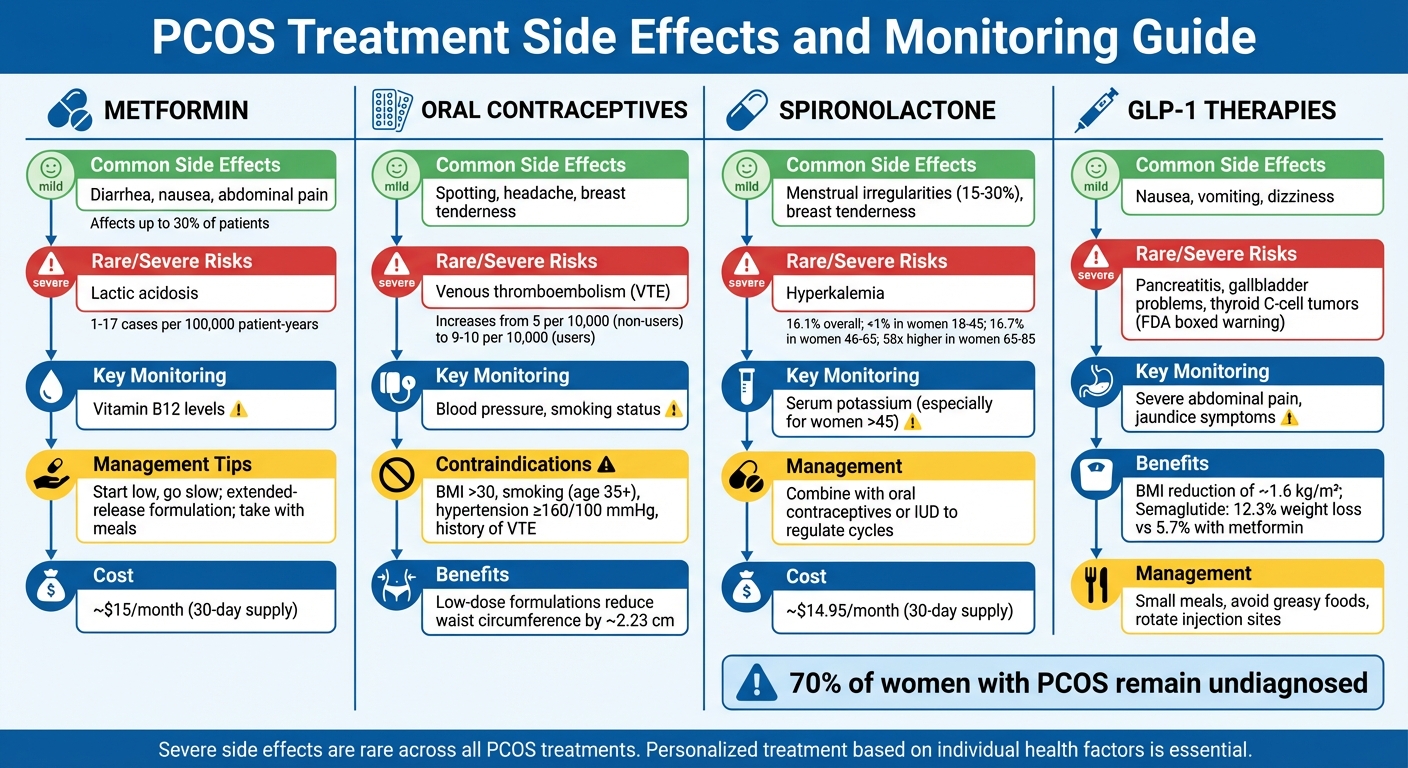
PCOS Treatment Side Effects and Monitoring Guide
Birth Control Pills in PCOS Treatment – Benefits, Risks & All You Need to Know
Metformin Adverse Events in PCOS Treatment
Metformin is often the first choice for addressing insulin resistance in women with PCOS, but it’s not without its challenges. Gastrointestinal issues are the most common side effects, affecting up to 30% of patients and frequently leading to early discontinuation of the medication. These symptoms tend to appear within the first few weeks of treatment but usually improve after 2 to 4 weeks for those who stick with the regimen.
Gastrointestinal Side Effects
The most frequently reported gastrointestinal problems include nausea, diarrhea, vomiting, abdominal discomfort, gas, bloating, and a metallic taste. A randomized pilot study conducted at the Third Affiliated Hospital of Guangzhou Medical University between January 2014 and January 2016 highlighted these trends. Among 54 PCOS patients taking Metformin alone, 11.1% experienced nausea, 1.85% reported vomiting, and 1.67% had diarrhea. Notably, 5.5% of participants stopped treatment due to intolerable side effects.
To help patients better tolerate the medication, doctors often recommend a "start low and go slow" approach - beginning with 500 mg once daily and gradually increasing the dose by 500 mg or 850 mg weekly. Taking Metformin with meals can reduce stomach upset by slowing absorption. Extended-release formulations, taken once daily with an evening meal, are generally easier on the stomach compared to immediate-release versions.
Although rare, lactic acidosis is a serious potential side effect of Metformin, occurring at an estimated rate of 1 to 17 cases per 100,000 patient-years. The risk increases when Metformin accumulates in the body, particularly in individuals with kidney problems. Plasma levels exceeding 5 mcg/mL are considered dangerous, and Metformin is contraindicated for patients with an eGFR below 30 mL/min/1.73m².
Interestingly, these gastrointestinal side effects can also impact weight management by reducing appetite and altering food tolerance.
Effects on Weight Management
While gastrointestinal issues dominate the conversation, Metformin’s role in weight management is also worth noting. The medication is often described as weight-neutral, though it may lead to modest weight loss in women with insulin resistance. Findings from the COMET-PCOS trial, a multicenter study conducted from January 2018 to June 2023, support this perspective. The trial involved 240 women with hyperandrogenic PCOS and a BMI between 25 and 48 kg/m². Participants took 2,000 mg of extended-release Metformin daily for 24 weeks. The results? No significant reductions in BMI or waist circumference compared to baseline.
"Metformin is recognized as weight-neutral, with the potential to induce modest weight loss." - StatPearls
When weight loss does occur, it’s often a secondary result of gastrointestinal side effects like nausea and appetite suppression rather than a direct metabolic effect. Up to 30% of patients report reduced appetite, which can contribute to minor weight changes - though this is not the medication’s primary purpose.
Oral vs. Topical Metformin: Side Effect Comparison
The way Metformin is administered plays a big role in the side effects patients experience. Oral Metformin, available in both immediate-release and extended-release forms, is absorbed systemically, which often leads to gastrointestinal issues. Extended-release formulations reduce the severity of these symptoms by slowing absorption, but they don’t eliminate them entirely.
On the other hand, topical Metformin formulations - like Metformin HCL Lotion 20% - are designed to target specific symptoms, such as unwanted facial hair caused by hyperandrogenism. Since topical applications minimize systemic absorption, they largely avoid the gastrointestinal side effects common with oral forms. However, they can cause localized skin reactions, including irritation, redness, or dryness.
| Formulation | Primary Adverse Events | Systemic Absorption | GI Side Effects |
|---|---|---|---|
| Oral Metformin ER | Nausea (11.1%), diarrhea (1.67%), vomiting (1.85%) | High | Common (up to 30%) |
| Metformin HCL Lotion 20% | Localized skin irritation, redness, dryness | Minimal | Rare |
Choosing between oral and topical formulations depends on the treatment goals. Oral Metformin is better suited for addressing systemic issues like insulin resistance, but it requires careful dose adjustments and strategies to manage gastrointestinal symptoms. Topical options, meanwhile, are ideal for treating skin-related symptoms without the systemic side effects.
Spironolactone and Anti-Androgen Adverse Events
Spironolactone is widely used to treat hirsutism and acne in women with PCOS, but its side effects can vary depending on the dosage, age, and overall health of the patient. Unlike Metformin, which primarily causes gastrointestinal issues, Spironolactone's side effects tend to be hormonal - such as menstrual cycle disruptions and breast tenderness - or metabolic, particularly hyperkalemia (elevated potassium levels). In rare cases, it may also lead to liver-related complications. Understanding these risks helps patients and healthcare providers make informed decisions about treatment options and how to combine Spironolactone with other therapies for PCOS.
Menstrual Cycle and Hormonal Changes
Menstrual irregularities are a common side effect of Spironolactone, affecting about 15% to 30% of women, and the likelihood increases with higher doses. The drug works by blocking androgen and progesterone receptors, which lowers testosterone levels and increases its metabolic clearance. While this mechanism helps reduce symptoms like acne and unwanted facial hair, it can also interfere with the regularity of menstrual cycles. Other hormonal side effects include breast tenderness and enlargement.
These issues are often manageable by pairing Spironolactone with oral contraceptives or an intrauterine device (IUD), which can help regulate hormonal fluctuations.
"The medication is generally well tolerated, with the most common adverse event being irregular menstruation (15%-30%), which is dose dependent and mitigated by oral contraceptives or an intrauterine device." – Yu Wang, BA
For women considering this treatment, discussing potential hormonal side effects with a healthcare provider is essential. Adjusting the dosage or combining Spironolactone with contraceptives can significantly improve its tolerability.
Hyperkalemia and Liver-Related Risks
Hyperkalemia, or elevated potassium levels, is one of the most reported side effects of Spironolactone, occurring in about 16.1% of cases according to the FDA Adverse Event Reporting System. However, the risk varies significantly depending on age and kidney function. For healthy women aged 18–45, the risk is less than 1%, while it rises to about 16.7% in women aged 46–65 and becomes 58 times more likely in women aged 65–85 due to declining kidney function.
Liver-related complications are rare but can occur within 4 to 8 weeks of starting treatment. These issues typically resolve within 1–3 months after discontinuing the medication. Symptoms might include mild increases in liver enzymes, fatigue, or itching.
Given these potential risks, monitoring guidelines differ based on age and overall health. Women under 45 with normal kidney function generally don’t require routine potassium monitoring. However, women over 45 should have their potassium levels and kidney function checked regularly - ideally within one week of starting or adjusting the dose, and then monthly for the first three months. It’s also crucial to avoid combining Spironolactone with medications that can further increase potassium levels, such as trimethoprim-sulfamethoxazole (Bactrim), which has been associated with a higher risk of sudden death.
"Women taking spironolactone should be counseled that hyperkalemia is the most common adverse event but is uncommon in those age ≤45 years." – Yu Wang, BA
Spironolactone, Topical Spironolactone, and Flutamide: Adverse Event Comparison
When choosing an anti-androgen therapy, it’s important to weigh the effectiveness of the treatment against its potential side effects. Oral Spironolactone is a popular choice, not only because of its effectiveness but also because it’s affordable - a 30-day supply of 100 mg tablets costs around $14.95. For those who want to avoid systemic side effects, topical Spironolactone offers a good alternative. By limiting absorption into the bloodstream, the topical version reduces the risk of menstrual irregularities and hyperkalemia, though it may cause localized skin irritation, such as redness or dryness.
Flutamide is another anti-androgen option, but it’s less commonly used due to concerns about liver toxicity. In a study involving 40 women with hirsutism, Spironolactone, Flutamide, and Finasteride were all effective over six months. However, Spironolactone was preferred for its safety, availability, and lower cost. Flutamide’s higher risk of liver damage makes it a less desirable choice.
| Medication | Primary Adverse Events | Monitoring Requirements | Cost (30-Day Supply) |
|---|---|---|---|
| Oral Spironolactone | Menstrual irregularities (15–30%), hyperkalemia | Potassium monitoring recommended for women over 45 | ~$14.95 |
| Topical Spironolactone | Localized skin irritation (redness, dryness) | None required | ~$43 |
| Flutamide | Higher risk of liver toxicity | Regular liver function tests | Varies |
For younger women with no kidney issues, oral Spironolactone is a safe and affordable option that typically doesn’t require intensive monitoring. In older women or those with kidney problems, careful potassium monitoring is essential. Topical formulations may be a better choice for those seeking to reduce systemic risks. These comparisons highlight the importance of tailoring treatment plans to individual needs and health profiles.
sbb-itb-6dba428
Oral Contraceptives and GLP-1 Therapies in PCOS
After reviewing the side effects of Metformin and Spironolactone, let’s shift focus to other treatments that address the hormonal and metabolic challenges of PCOS. Combined oral contraceptive pills (COCPs) help regulate menstrual cycles and reduce symptoms of hyperandrogenism, while GLP-1 receptor agonists target weight management and insulin resistance.
Blood Clot Risks with Oral Contraceptives
Using COCPs increases the risk of venous thromboembolism (VTE) by 3 to 6 times compared to non-users. However, the absolute risk is still relatively low - around 9–10 cases per 10,000 women-years for users, compared to 5 per 10,000 for non-users. This translates to an annual risk of about 0.1%.
Some women on COCPs may experience metabolic changes, such as higher triglyceride levels. However, low-dose formulations (20 μg ethinyl estradiol) have shown benefits like reduced waist circumference (by approximately 2.23 cm) and slight improvements in BMI (around 0.49 kg/m²) in women with PCOS and obesity.
It’s essential to screen for contraindications before prescribing COCPs. These include obesity (BMI over 30 kg/m²), smoking in women over 35 (especially those smoking 15 or more cigarettes daily), hypertension (≥160/100 mmHg), a history of VTE, and focal migraines. Additionally, COCPs containing drospirenone may carry a higher risk of elevated potassium levels.
"Drugs commonly used to treat PCOS appear to be associated with very low risk of severe adverse effects although data are extrapolated from other populations." – Mohammad Hassan Murad, MD, MPH, Mayo Clinic
While COCPs primarily address hormonal issues, GLP-1 therapies focus on managing metabolic dysfunction.
GLP-1 Therapies: Side Effects and Benefits
GLP-1 receptor agonists, such as semaglutide and liraglutide, offer significant benefits for women with PCOS, particularly in managing weight and improving metabolic health. Studies show that GLP-1 agonists can reduce BMI by about 1.6 kg/m². A 48-week study revealed that semaglutide (2.4 mg) led to a 12.3% weight loss compared to 5.7% with metformin. Beyond weight loss, these therapies also enhance insulin sensitivity and lower androgen levels.
However, GLP-1 agonists are not without side effects. Common issues include nausea, vomiting, and dizziness, especially during dose adjustments. These symptoms can often be managed with practical strategies like eating smaller meals, avoiding greasy or spicy foods, staying hydrated, and rotating injection sites (abdomen, thigh, or upper arm) to reduce local irritation.
Serious but rare complications include pancreatitis and gallbladder problems. Patients should seek immediate care if they experience persistent severe abdominal pain or notice yellowing of the skin or eyes. Additionally, all GLP-1 therapies carry an FDA boxed warning about the potential risk of thyroid C-cell tumors, making them unsuitable for individuals with a personal or family history of medullary thyroid cancer or Multiple Endocrine Neoplasia type 2. Rapid weight loss from these treatments may also lead to temporary hair thinning and facial changes due to fat loss.
Combining GLP-1 therapies with metformin has shown enhanced benefits, including greater weight loss and improved insulin sensitivity compared to metformin alone. However, access remains a significant hurdle. In a U.S.-based study, about 83% of patients faced at least one insurance denial before successfully obtaining GLP-1 therapy.
Drug-Induced PCOS and Related Adverse Events
This section dives into how certain medications, prescribed for conditions unrelated to PCOS, can sometimes trigger or worsen PCOS-like symptoms. Understanding these drug-induced effects is crucial for managing the broader spectrum of adverse events women may face.
Some medications, particularly those used for epilepsy or psychiatric disorders, have been linked to PCOS-like symptoms, complicating treatment for women already managing these conditions. Here's a closer look at the risks associated with specific drugs.
Valproic acid, commonly prescribed for epilepsy and bipolar disorder, has been strongly associated with drug-induced PCOS. A pharmacovigilance study analyzing 1,516 cases between 2014 and 2024 reported a Reporting Odds Ratio (ROR) of 20.78, with symptoms typically appearing after about 905 days (roughly 2.5 years). The drug impacts the hypothalamic–pituitary–ovarian (HPO) axis by disrupting the secretion of gonadotropin-releasing hormone (GnRH), leading to an imbalance between luteinizing hormone (LH) and follicle-stimulating hormone (FSH).
Olanzapine, an antipsychotic, also shows a notable connection to PCOS-like symptoms, with a ROR of 10.27 and a median onset time of 155.5 days (about 5 months). These effects are primarily linked to metabolic changes, including significant weight gain and insulin resistance. These disturbances may be driven by pathways such as IGF1/p-AKT/FOXO1 and NF-KB/IL-1β/TNF-α.
| Drug Name | Drug Class | Risk Signal (ROR) | Median Onset Time |
|---|---|---|---|
| Valproic acid | Anticonvulsant | 20.78 | 905 days (~2.5 years) |
| Olanzapine | Antipsychotic | 10.27 | 155.5 days (~5 months) |
| Lamotrigine | Anticonvulsant | 5.25 | Not specified |
| Quetiapine | Antipsychotic | 3.52 | 335 days (~11 months) |
For women taking these medications, regular endocrine monitoring is essential. Symptoms like irregular periods, rapid weight gain, or signs of hyperandrogenism should be closely watched. When feasible, healthcare providers might explore lower-risk alternatives - such as substituting Valproic acid with Lamotrigine. However, it's worth noting that some of these associations may be influenced by indication bias, where the underlying condition (e.g., bipolar disorder) itself contributes to endocrine disruptions.
Summary and Clinical Implications
Severe side effects are rare across commonly used PCOS treatments. For example, lactic acidosis linked to Metformin occurs in just 1 to 17 cases per 100,000 patient-years. Similarly, the absolute risk of venous thromboembolism (VTE) increases slightly with oral contraceptive use, rising from 5 per 10,000 women in non-users to 9–10 per 10,000 in users.
Metformin-related gastrointestinal discomfort can often be reduced by gradual dose increases or by using extended-release formulations. For Spironolactone users, regular potassium checks help mitigate the rare risk of hyperkalemia. These strategies highlight the importance of tailoring treatments to individual needs.
Personalized treatment is essential. The choice of therapy should align with a patient’s specific goals, whether that’s managing hirsutism, regulating menstrual cycles, or addressing fertility concerns. For instance, women with liver issues should avoid anti-androgens like Flutamide, while those at higher metabolic risk might benefit from low-dose oral contraceptives. Additionally, long-term Metformin users should have their Vitamin B12 levels checked periodically.
Here’s a quick overview of the side effects, risks, and necessary monitoring for common PCOS treatments:
| Treatment Type | Common Side Effects | Rare/Severe Risks | Key Monitoring |
|---|---|---|---|
| Metformin | Diarrhea, nausea, abdominal pain | Lactic acidosis (1–17 per 100,000) | Vitamin B12 levels |
| Oral Contraceptives | Spotting, headache, breast tenderness | VTE (9–10 per 10,000 users) | Blood pressure, smoking status |
| Spironolactone | Menstrual changes, breast tenderness | Hyperkalemia | Serum potassium |
| Flutamide | Hot flashes, fatigue | Hepatotoxicity | Liver function tests |
Even modest lifestyle changes, like achieving a 5% weight loss, can help restore regular menstrual cycles and enhance the effectiveness of medications. With the right combination of medical treatments, regular monitoring, and lifestyle adjustments, most women can effectively manage PCOS symptoms while keeping risks low.
FAQs
What are the typical side effects of taking Metformin for PCOS?
Metformin is a widely used medication for managing PCOS, but it’s not without its challenges. Common side effects include nausea, vomiting, diarrhea, stomach discomfort, and loss of appetite. In fact, these issues can affect more than 1 in 10 people taking the drug.
The good news? These side effects are often temporary and tend to ease as your body adapts to the medication. However, if the symptoms stick around or become too difficult to manage, it’s important to reach out to your healthcare provider for advice and possible adjustments.
Can Spironolactone affect menstrual cycles in women with PCOS?
Yes, Spironolactone can impact menstrual cycles in women with PCOS. Studies indicate that 13% to 33% of women may experience changes in their menstrual patterns while using this medication, and in some instances, this number can climb above 70%. These disruptions are tied to the way Spironolactone alters hormone levels, which can interfere with the regularity of the menstrual cycle.
If you experience noticeable changes in your cycle while taking Spironolactone, it's a good idea to reach out to your healthcare provider. They can work with you to adjust your treatment plan as needed.
What are the potential risks of using oral contraceptives to manage PCOS?
Using oral contraceptives for managing PCOS symptoms comes with potential risks. While they are often prescribed to help regulate menstrual cycles and address issues like acne and excess hair growth, they may lead to side effects such as blood clots, cardiovascular complications, and hormonal imbalances. These risks can differ based on your personal health profile, making it essential to review your medical history with a healthcare provider.
When considering PCOS treatments, it’s important to focus on care tailored to your specific needs. Working with a licensed medical professional can help you find a balanced approach that minimizes risks while effectively managing your symptoms.