
5α-Reductase Inhibitors: Role in PCOS Treatment
5α-Reductase inhibitors, like finasteride and dutasteride, are medications that reduce dihydrotestosterone (DHT), a hormone linked to many symptoms of PCOS, including excessive hair growth, acne, and hair loss. Though not FDA-approved for PCOS, these drugs are used off-label to manage androgen-related symptoms. Here's what you need to know:
- PCOS Symptoms Addressed: Hirsutism, acne, and androgenic alopecia.
- How They Work: Block the enzyme that converts testosterone into DHT, reducing androgen activity.
- Key Medications:
- Finasteride: Lowers DHT by ~70%; commonly used for hirsutism and hair loss.
- Dutasteride: Reduces DHT by up to 99%; more effective for severe cases.
- Treatment Timeline: Results take 6–12 months for hirsutism, up to 18 months for hair regrowth.
- Safety: Strictly contraindicated during pregnancy; reliable contraception is essential.
These medications are often combined with other treatments like birth control pills or metformin for better results. While effective, they require consistent use and careful monitoring to manage side effects and ensure safety.
Main 5α-Reductase Inhibitors for PCOS
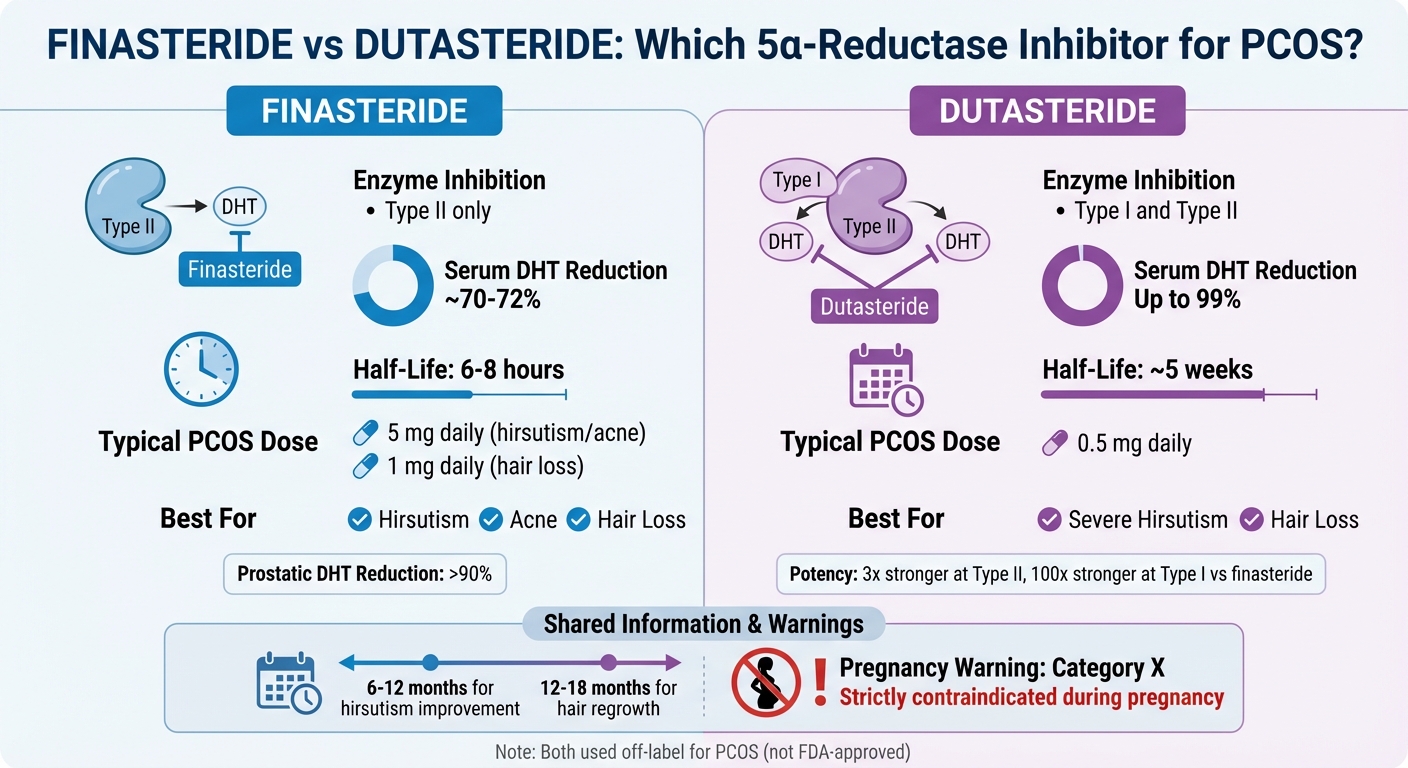
Finasteride vs Dutasteride for PCOS: Comparison of Effectiveness and Dosing
Finasteride and dutasteride are the two main 5α-reductase inhibitors used off-label to address symptoms of PCOS. While neither is FDA-approved specifically for PCOS, both are effective at managing androgen-related issues like hirsutism, acne, and hair loss. The primary difference between these medications lies in how extensively they block dihydrotestosterone (DHT) production. Here’s a closer look at each.
Finasteride: Standard Treatment Option
Finasteride works by selectively inhibiting the Type II 5α-reductase enzyme, which is most active in hair follicles and the prostate. This selective action decreases serum DHT levels by around 70–72% and reduces prostatic DHT by more than 90%. For PCOS-related symptoms, a daily dose of 5 mg is typically prescribed for hirsutism and acne, while a lower 1 mg dose is used to treat hair loss.
With a half-life of 6 to 8 hours, finasteride doesn’t stay in the body for long. However, visible improvements in hirsutism may take 6–12 months, and hair regrowth can require 12–18 months. As a Category X medication, it is strictly contraindicated during pregnancy, necessitating reliable birth control throughout the treatment period.
Dutasteride: Broader-Acting Alternative
Dutasteride, while less commonly used, offers broader inhibition by targeting both Type I and Type II 5α-reductase enzymes. Type I enzymes are mainly found in the skin and sebaceous glands, while Type II enzymes are concentrated in hair follicles. This dual action makes dutasteride more potent, reducing serum DHT levels by as much as 99%, compared to finasteride’s ~70% reduction.
For PCOS-related symptoms, a daily dose of 0.5 mg is recommended. Dutasteride’s long half-life - around 5 weeks - means it lingers in the body far longer than finasteride, which requires users to adhere to strict contraception measures. Like finasteride, it is also contraindicated during pregnancy.
| Feature | Finasteride | Dutasteride |
|---|---|---|
| Enzyme Inhibition | Type II only | Type I and II |
| Serum DHT Reduction | ~70–72% | Up to 99% |
| Half-Life | 6–8 hours | ~5 weeks |
| Typical PCOS Dose | 5 mg daily | 0.5 mg daily |
| Best For | Hirsutism, acne | Severe hirsutism, hair loss |
The next sections will delve into their mechanisms in clinical research and provide guidance for ensuring safe and effective use in PCOS management.
How They Work and Clinical Research
Mechanism of Action in PCOS
5α-reductase inhibitors work by blocking the enzyme responsible for converting testosterone into dihydrotestosterone (DHT). DHT is a key player in driving androgen effects, particularly in hair follicles and sebaceous glands, which can lead to symptoms like unwanted facial hair, acne, and hair loss.
By reducing DHT levels through selective or dual enzyme inhibition, these inhibitors effectively lower androgen activity at the tissue level. The body has two types of 5α-reductase enzymes: Type 1, found mostly in the liver and skin, and Type 2, concentrated in the prostate and skin. Finasteride targets the Type 2 enzyme specifically, while dutasteride inhibits both types. Dutasteride is especially potent, being about three times stronger at blocking Type 2 and over 100 times more effective at inhibiting Type 1 compared to finasteride.
"DHT has a stronger impact on the androgen–androgen receptor complex than testosterone. 5α-Reductase inhibitors (5ARIs) act by blocking DHT production from adrenal and gonadal sources." - Dermatology and Therapy
Interestingly, research has uncovered an enhanced "backdoor pathway" for DHT synthesis in PCOS patients. This discovery highlights the importance of 5α-reductase inhibitors in addressing multiple androgen synthesis pathways in PCOS. Clinical studies have explored how these biological effects translate into symptom relief.
Research Supporting Their Effectiveness
The mechanisms of 5α-reductase inhibitors are backed by clinical research showing their impact on PCOS symptoms. For instance, a 12-week study found that 88.6% of women with moderate acne experienced near-complete clearance when treated with 2.5 mg of finasteride. Finasteride also reduced hirsutism scores, as measured by the Ferriman-Gallwey scale, by an average of 1.48 points.
A systematic review and meta-analysis published in September 2023 in eClinicalMedicine examined 20 randomized controlled trials involving 961 women with PCOS. The findings showed that anti-androgens, including finasteride, combined with lifestyle changes, were more effective than metformin for treating hirsutism, with a weighted mean difference of -1.59 (p = 0.03). The study also noted that taking anti-androgens daily was significantly more effective than taking them every three days, with a weighted mean difference of -3.48.
Another notable study, published in the Journal of Clinical Endocrinology & Metabolism, compared spironolactone, flutamide, and finasteride in a 12-month trial involving women with hirsutism. All three treatments significantly reduced hirsutism scores, but finasteride stood out by also reducing hair shaft diameter. It’s worth noting that results from pharmacotherapy typically take at least six months to become noticeable, and long-term treatment may be needed for sustained improvement.
Safety Profile and Treatment Guidelines
Pregnancy Risks and Birth Control Requirements
5α-reductase inhibitors should never be used during pregnancy, as they interfere with dihydrotestosterone (DHT), which is critical for the development of male fetuses. Animal studies have shown that even small doses of finasteride - just 0.02 times the recommended human dose - can shorten the anogenital distance in male offspring. If a pregnant individual is exposed to these drugs, the fetus could face issues like hypospadias or even feminization.
"Finasteride use is contraindicated in women when they are or may potentially be pregnant. Because of the ability of Type II 5α-reductase inhibitors to inhibit the conversion of testosterone to 5α-dihydrotestosterone (DHT), finasteride may cause abnormalities of the external genitalia of a male fetus." - Hetero Labs Limited
For women of childbearing age, effective contraception is a must while using these medications. Combined oral contraceptives are often prescribed alongside 5α-reductase inhibitors, not only to prevent pregnancy but also to manage symptoms of PCOS. Pregnant individuals should avoid any contact with crushed tablets, as the medication can be absorbed through the skin. If accidental contact occurs, washing the area immediately with soap and water is essential. Additionally, patients taking dutasteride should refrain from donating blood for at least six months after their last dose to minimize the risk of exposing a pregnant woman to the drug.
Beyond pregnancy precautions, clinicians must remain alert to potential side effects throughout treatment.
Side Effects and Ongoing Monitoring
Ensuring patient safety is critical for the long-term use of 5α-reductase inhibitors in managing PCOS. A large-scale analysis involving 62,827 patients reported low rates of side effects, such as decreased libido (1.5%), erectile dysfunction (1.6%), ejaculatory dysfunction (3.4%), and gynecomastia (1.3%). In PCOS-specific studies, severe adverse effects were rare, with no notable changes in weight or BMI.
Mental health monitoring is equally important. Healthcare professionals should check for any signs of depression, anxiety, or suicidal thoughts at each follow-up visit. A rare but serious concern is post-finasteride syndrome (PFS), where sexual, physical, and cognitive symptoms persist even after stopping the medication.
"Since this class of medication is generally thought of as being benign, it can be overlooked as a potential cause of new clinical symptoms patients might experience." - Dr. Senthil R. Meenrajan, University of Florida
Routine monitoring should include baseline liver function tests before starting treatment, especially when these inhibitors are combined with other anti-androgens. For patients using 5α-reductase inhibitors with spironolactone or drospirenone-containing birth control, potassium levels should be checked during the first month to watch for hyperkalemia. Additionally, periodic lipid profiles are advised, as combining these medications with oral contraceptives can impact cholesterol levels. To evaluate the effectiveness of hirsutism treatment, a clinical assessment is typically needed over a span of 6 to 9 months.
sbb-itb-6dba428
Combining 5α-Reductase Inhibitors with Other PCOS Treatments
Using with Birth Control Pills
Combination oral contraceptive pills (OCPs) are a common first-line treatment for managing irregular periods and hirsutism in PCOS. When OCPs alone don't yield enough improvement after six months, adding 5α-reductase inhibitors like finasteride can provide a second-line option. These treatments work well together: OCPs reduce ovarian androgen production and boost sex hormone-binding globulin (SHBG), which lowers free testosterone levels. Meanwhile, 5α-reductase inhibitors block the conversion of testosterone into the more potent dihydrotestosterone (DHT) in the body.
OCPs are essential when using 5α-reductase inhibitors, not only for their role in reducing ovarian androgen production but also because they provide contraception, protecting against the teratogenic effects of these drugs. When choosing an OCP for this combination, doctors often select ones with progestins that have low androgenic activity, such as norgestimate, desogestrel, or drospirenone. Beyond managing symptoms, OCPs also offer long-term health benefits, including a 50% lower risk of endometrial cancer and a 27% reduced risk of ovarian cancer.
These combined therapies can also address metabolic issues, which are discussed in the next section.
Pairing with Metformin and Spironolactone
For a more comprehensive approach to PCOS, combining hormonal and metabolic treatments tackles both hyperandrogenism and insulin resistance. Pairing 5α-reductase inhibitors with metformin targets these separate but related issues: metformin helps manage metabolic dysfunction, and 5α-reductase inhibitors focus on hyperandrogenic symptoms like hirsutism and hair loss. This combination is particularly beneficial for PCOS patients with obesity, who may face higher risks of thromboembolic events from estrogen-based therapies. Research indicates that adding anti-androgens to metformin and lifestyle changes can reduce testosterone levels by 0.29 nmol/l compared to using metformin and lifestyle changes alone.
Spironolactone, which has some 5α-reductase inhibitory properties of its own, can be paired with other 5α-reductase inhibitors to enhance DHT suppression. Noticeable improvements in symptoms like hair growth or reduced hirsutism generally require consistent treatment for at least 6 to 12 months.
Oana Health's PCOS Treatment Options

Oana Health integrates these combination strategies into personalized care plans for PCOS management. Their telehealth services offer direct-to-home delivery of treatments, making it easier for patients to access comprehensive care. Options include metformin for $22 per month and spironolactone for $14 per month, both of which can be combined with 5α-reductase inhibitors under medical supervision. For those needing multi-faceted therapy, Oana Health provides a Metformin & Spironolactone pack at $32 per month, targeting both insulin resistance and hyperandrogenism. Each patient's health history is reviewed by licensed medical professionals to create evidence-based, personalized treatment plans, all delivered with free shipping. This approach allows patients to manage PCOS effectively without the need for in-person visits.
Conclusion
Medications like finasteride and dutasteride provide a focused way to address some of the most noticeable symptoms of PCOS, such as hirsutism, acne, and hair loss. These drugs work by blocking the conversion of testosterone into dihydrotestosterone (DHT), a more potent androgen responsible for many of these effects. Finasteride can lower DHT levels in the blood by about 70%, while dutasteride can achieve reductions of up to 99% due to its broader action. It’s important to note that visible improvements often take time, with most patients seeing results in 6–12 months of consistent use, while hair regrowth may take 12–18 months.
The benefits of these treatments are best realized when tailored to individual needs. Clinical guidelines emphasize the importance of personalized care to improve both health outcomes and quality of life. Combining these medications with other therapies can further enhance their effectiveness while maintaining safety.
Oana Health offers a convenient way to access these personalized treatment plans through its telehealth services. With options like metformin for $22 per month, spironolactone for $14 per month, and combination packs starting at $32 per month, patients can receive care plans designed by licensed medical professionals. Plus, free shipping ensures that comprehensive PCOS care is delivered right to your door.
FAQs
What role do 5α-reductase inhibitors play in managing PCOS symptoms?
5α-Reductase inhibitors work to manage PCOS symptoms by targeting the enzyme that converts testosterone into dihydrotestosterone (DHT), a stronger androgen. Lowering DHT levels can help reduce symptoms tied to excess androgens, like unwanted facial hair (hirsutism) and acne.
This approach directly addresses the hormonal imbalance common in PCOS, offering relief from some of the condition's most frequent and challenging symptoms.
What’s the difference between finasteride and dutasteride in treating PCOS symptoms?
Finasteride and dutasteride are both 5α-reductase inhibitors used to manage androgen excess in PCOS, but they function in distinct ways. Finasteride mainly targets the type 2 isoform of 5α-reductase, which is associated with areas like hair follicles. This makes it a common choice for addressing hair loss and hirsutism. Dutasteride, however, inhibits both type 1 and type 2 isoforms, giving it a stronger ability to lower overall androgen levels.
When it comes to PCOS symptoms, finasteride is often selected for localized concerns, such as unwanted facial hair. Dutasteride, with its broader suppression of androgens, may be better suited for more widespread issues. The right choice depends on your specific needs and goals, so working with a healthcare provider is crucial to find the most suitable treatment.
What should I know about using 5α-reductase inhibitors for PCOS treatment?
When using 5α-reductase inhibitors (5ARIs) to manage PCOS symptoms, there are a few essential precautions to consider. These medications can influence androgen levels, which may result in side effects like hormonal imbalances, reduced libido, or other noticeable changes. That’s why regular check-ins with a healthcare provider are crucial to ensure both safety and effectiveness.
Another important factor is liver health. Some anti-androgens can impact liver function, so periodic liver function tests might be necessary. Since 5ARIs are often prescribed off-label for PCOS, they’re usually combined with other treatments, such as oral contraceptives or lifestyle modifications. Always stick to your provider’s recommendations and report any side effects or concerns during treatment. Tailored care plays a central role in achieving the best possible outcomes.