
Latest Research on Androgen Blockers for PCOS
Androgen blockers are gaining attention as effective treatments for managing Polycystic Ovary Syndrome (PCOS) symptoms like hirsutism, acne, and hair thinning. These medications work by either blocking androgen receptors or reducing androgen production, directly addressing the hormonal imbalance that drives many PCOS symptoms. Common treatments include spironolactone and finasteride, while new therapies like enzyme inhibitors (CYP17A1, CYP11A1) and investigational drugs (e.g., artemisinin) show promise in targeting androgen production at its source.
Key takeaways:
- Spironolactone: Reduces androgen effects, often combined with hormonal contraceptives. Side effects include dizziness and rare risks like hyperkalemia.
- Finasteride: Lowers DHT levels, effective for hair loss but strictly contraindicated in pregnancy.
- Emerging treatments: CYP17A1 inhibitors (e.g., orteronel) and artemisinin derivatives target androgen synthesis, with early trials showing positive results.
Combination therapies, such as pairing androgen blockers with metabolic agents like metformin or GLP-1 receptor agonists, improve outcomes by addressing both hormonal and metabolic factors. Personalized treatment plans, including telehealth options, make these therapies more accessible and tailored to individual needs.
How to Stop PCOS Hair Loss
How Androgen Blockers Work
Androgen blockers tackle PCOS by addressing hormonal imbalances through two main methods: blocking androgen receptors and reducing androgen production. These approaches either stop androgens from binding to their target receptors or lower the body’s overall androgen levels.
In PCOS, hormonal imbalances - often marked by a higher LH-to-FSH ratio and elevated insulin - drive the ovaries to produce excess androgens. These hormones circulate in the bloodstream and bind to receptors in tissues like the skin and hair follicles, causing issues like acne, excessive hair growth (hirsutism), and hair thinning on the scalp. Androgen blockers combat these effects by targeting receptor activity and hormone synthesis.
Blocking Androgen Receptors
Receptor antagonists work by attaching to androgen receptors, preventing hormones like testosterone and dihydrotestosterone (DHT) from activating these cells.
"As an anti-androgen, spironolactone can help block the hormonal effects of androgens (male sex steroid hormones) on tissues that are sensitive to these hormones. It does this by attaching to androgen receptors located on cells and preventing hormones from binding and taking effect."
– Dr. Christina Han, MD FRCPC
In tissues such as skin and hair follicles, blocking these receptors helps reduce oil (sebum) production, manage hirsutism, and slow down the miniaturization of hair follicles. Studies have shown that using receptor antagonists daily is far more effective than intermittent use, with a weighted mean difference of –3.48 in hirsutism scores.
On the other hand, some treatments focus on reducing androgen levels directly.
Reducing Androgen Production
Another approach involves limiting the body’s production of androgens. For instance, 5-alpha-reductase inhibitors like finasteride block the enzyme responsible for converting testosterone into DHT, a more potent androgen.
Certain anti-androgens, such as those in combined oral contraceptives, also work by lowering gonadotropin-releasing hormone (GnRH) pulse frequency. This reduces the secretion of LH and FSH, which in turn decreases ovarian androgen production. Research has shown that spironolactone, at doses of 100 mg and 200 mg, can significantly lower serum testosterone and DHT levels in women with hirsutism.
Some medications offer a dual-action benefit. For example, spironolactone and cyproterone acetate not only block androgen receptors but also inhibit enzymes involved in androgen production, making them highly effective for managing hyperandrogenism.
Current Androgen Blockers in Use
Androgen blockers are often prescribed off-label for managing PCOS symptoms, even though they were originally developed to treat conditions like high blood pressure or prostate issues. Two of the most commonly used medications are spironolactone and finasteride, each addressing hyperandrogenic symptoms like unwanted hair growth and acne through different mechanisms. Here's how these medications are utilized in clinical practice.
Spironolactone: A Popular Choice
Spironolactone is the most frequently prescribed anti-androgen for PCOS in the United States. When combined with hormonal contraceptives - such as a regimen of 100 mg spironolactone paired with norgestimate and ethinyl estradiol - it has been shown to significantly reduce hirsutism scores (p < 0.001) and lower serum androgen levels. Most patients notice improvements within 6 to 12 months.
However, spironolactone isn't without its side effects. Common issues include menstrual irregularities, breast tenderness, dizziness, and gastrointestinal discomforts like nausea or diarrhea. A rare but serious risk is hyperkalemia (elevated potassium levels), which can result in irregular heartbeat or muscle weakness. To mitigate this, periodic blood tests are often recommended to monitor potassium levels and kidney function. Patients experiencing dizziness are advised to stand up slowly from sitting or lying positions and avoid driving until the symptoms resolve.
Important safety consideration: Women of childbearing age must use reliable contraception while on spironolactone, as it poses a risk of feminizing a male fetus if pregnancy occurs.
Finasteride: Addressing Hair Growth Concerns
Finasteride works differently, reducing serum DHT levels by about 70%, making it effective for treating pattern hair loss. Like spironolactone, it typically takes 6 to 12 months for noticeable results.
Despite its effectiveness, finasteride has strict limitations for women. It is classified as Category X for pregnancy, meaning it is strictly contraindicated due to the risk of causing external genital abnormalities in male fetuses. Pregnant women should avoid even handling broken or crushed tablets. Additionally, individuals taking finasteride are advised not to donate blood during treatment and for six months afterward to prevent accidental exposure to pregnant recipients.
Side effects of finasteride can include orthostatic hypotension (reported in 9% of cases when used alone and 18% when combined with other therapies), dizziness, weakness, skin rashes, and rhinitis. Emerging studies also suggest potential long-term concerns, such as increased insulin resistance and the development of non-alcoholic fatty liver disease.
"Current evidence does not support the use of anti-androgens preferentially to COCPs to treat hyperandrogenism in PCOS. Anti-androgens could be considered to treat hirsutism in PCOS, where COCPs are contraindicated, poorly tolerated, or present a sub-optimal response after a minimum 6-month period."
– eClinicalMedicine
New Androgen Blocking Treatments Under Study
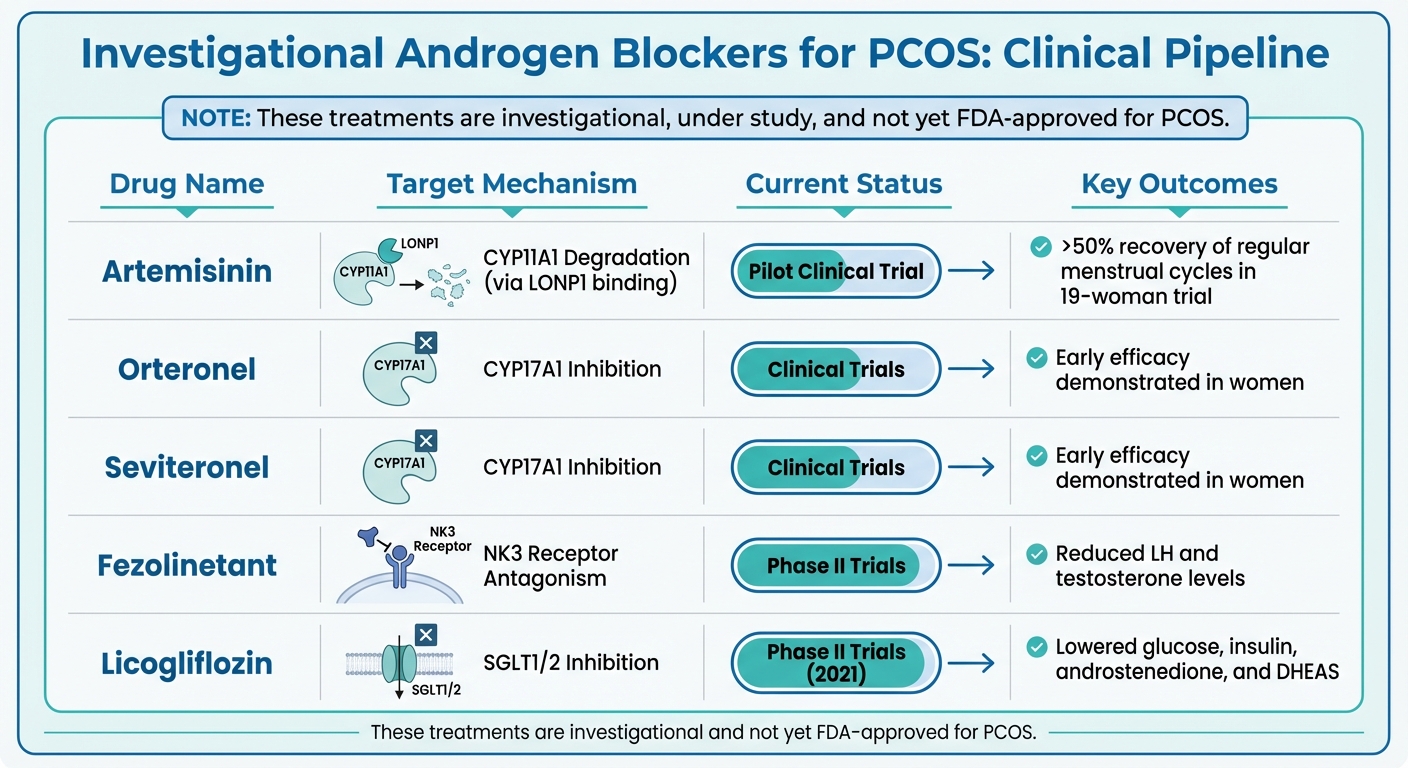
Comparison of Current and Emerging Androgen Blockers for PCOS Treatment
Researchers are exploring new ways to manage androgen excess by targeting its production at the source. While treatments like spironolactone and finasteride remain standard options for addressing PCOS symptoms, these emerging therapies aim to tackle the root cause of androgen excess rather than just blocking its effects after production.
CYP17A1 and CYP11A1 Inhibitors
Two enzymes, CYP11A1 and CYP17A1, play a central role in androgen production in women with PCOS. CYP17A1, in particular, is involved in the later stages of androgen synthesis. To curb excessive testosterone production, scientists are developing drugs that inhibit these enzymes.
CYP17A1 inhibitors, such as orteronel and seviteronel, have already progressed to clinical trials, showing early signs of effectiveness and tolerability in women. In laboratory settings, even more potent compounds are being identified. For instance, "Compound 11" has demonstrated an IC50 of 4 nM, indicating strong potential for reducing androgen synthesis. Additionally, plant-based inhibitors like 6-(1,1-dimethylallyl) genistein are being studied as potentially safer alternatives to synthetic drugs.
Focusing on CYP17A1 offers a distinct advantage over targeting CYP11A1. Since CYP17A1 acts downstream of progesterone production, its inhibition may reduce androgen levels without significantly affecting progesterone - a concern with earlier-stage enzyme blockers.
"Developing specific inhibitors for CYP11A1/CYP17A1 enzymes may thus be a more effective option for treating PCOS."
– Kathryn R. Brewer, Ph.D. candidate in biochemistry, Vanderbilt University
Other innovative approaches are also being explored alongside enzyme-targeting therapies.
Artemisinin Derivatives and Other Investigational Drugs
Artemisinin, a compound traditionally used to treat malaria, has shown promise in reducing ovarian androgen production. It achieves this by binding to mitochondrial protease LONP1, which enhances the degradation of CYP11A1, effectively targeting androgen synthesis at its earliest stage.
In a small clinical trial involving 19 women with PCOS, 12 weeks of artemisinin treatment led to normalized menstrual cycles in over half of the participants and significantly reduced serum testosterone levels. However, researchers caution that inhibiting CYP11A1 could also lower progesterone levels. Long-term safety studies will need to monitor this closely.
Other investigational drugs are also making strides. Fezolinetant, originally developed to address menopause symptoms, works as an NK3 receptor antagonist. It has shown the ability to lower luteinizing hormone (LH) and testosterone levels in Phase II trials. Meanwhile, Licogliflozin, an SGLT1/2 inhibitor from Novartis, demonstrated its ability to reduce glucose, insulin, androstenedione, and DHEAS levels during a 2021 randomized Phase II trial.
Here’s a quick overview of these investigational treatments and their mechanisms:
| Investigational Drug | Target Mechanism | Current Status | Key Outcome |
|---|---|---|---|
| Artemisinin | CYP11A1 Degradation | Pilot Clinical Trial | Over 50% recovery of regular cycles |
| Orteronel | CYP17A1 Inhibition | Clinical Trials | Early efficacy in women |
| Seviteronel | CYP17A1 Inhibition | Clinical Trials | Early efficacy in women |
| Fezolinetant | NK3 Receptor Antagonism | Phase II Trials | Reduced LH and testosterone levels |
| Licogliflozin | SGLT1/2 Inhibition | Phase II Trials | Lowered insulin and DHEAS levels |
sbb-itb-6dba428
Personalized Treatment Approaches
PCOS affects a broad spectrum of women - anywhere from 6% to 20% - with symptoms that range from unwanted hair and acne to more complex metabolic issues like insulin resistance and weight gain. Because of this wide variation, treatment strategies need to go beyond addressing surface-level symptoms. Instead, they should focus on the unique hormonal and metabolic factors driving each individual’s condition.
One effective approach combines androgen blockers with metabolic agents. For example, pairing spironolactone with metformin targets both excess testosterone and insulin resistance at the same time. This combination is particularly helpful for patients who cannot take combined oral contraceptives due to blood clot risks or for those who haven’t seen improvements with standard treatments after six months.
"The enhanced efficacy of combination therapy suggests a potential paradigm shift in PCOS treatment strategies, moving beyond traditional monotherapy approaches." – Diabetology & Metabolic Syndrome
This shift toward individualized care also includes advanced metabolic treatments and innovative hormonal therapies.
Metabolic Treatments
Improving insulin sensitivity plays a key role in reducing testosterone levels, as it lowers insulin levels and increases SHBG (sex hormone-binding globulin).
GLP-1 receptor agonists are emerging as effective weight management medications for PCOS. A 2025 meta-analysis revealed that combining GLP-1 RAs with metformin led to a 1.37 kg reduction in body weight and a 0.88 kg/m² drop in BMI compared to using metformin alone. These medications work by stimulating insulin release, curbing appetite, and slowing digestion. Even modest weight loss - around 5% to 10% of body weight - can make a big difference in improving hormonal balance and reducing PCOS symptoms.
SGLT2 inhibitors, which prevent glucose reabsorption in the kidneys, also show promise. These drugs help lower blood sugar and insulin levels. Studies suggest that SGLT2 inhibitors may even outperform GLP-1 RAs in improving hormonal profiles, particularly by reducing the Free Androgen Index (FAI) and total testosterone levels. One investigational drug, licoglinetant, combines SGLT1 and SGLT2 inhibition. A 2021 Phase II trial demonstrated its ability to lower glucose, insulin, androstenedione, and DHEAS levels.
While addressing metabolic imbalances is crucial, therapies that directly regulate hormonal pathways add another layer of precision to treatment.
Hormonal Pathway Modulators
New therapies are being developed to target the hormonal imbalances that drive androgen overproduction. In PCOS, the hypothalamic-pituitary-ovarian axis often malfunctions, leading to excessive luteinizing hormone (LH) secretion and elevated testosterone levels.
NK3 receptor antagonists are a promising solution. One such drug, fezolinetant, was initially designed for menopause symptoms but has shown potential in PCOS treatment. By targeting NK3 receptors in the brain, fezolinetant helps normalize the pulsatile release of gonadotropin-releasing hormone (GnRH). Phase II trials have demonstrated its ability to lower both LH and testosterone levels.
The combined use of metabolic and hormonal therapies often produces enhanced results. For instance, adding GLP-1 RAs to standard therapy reduced waist circumference by 4.39 cm more than standard therapy alone. Similarly, combining GLP-1 RAs with metformin increased SHBG levels by 10.04 nmol/L compared to metformin alone.
"Combining standard therapy with GLP-1 receptor agonists offers superior efficacy in improving metabolic and hormonal outcomes in women with PCOS." – BMC Women's Health
These strategies highlight the potential for a more tailored and multi-faceted approach to managing PCOS, addressing both metabolic and hormonal factors for comprehensive care.
Accessing Research-Based PCOS Treatments
Advancements in research are now making PCOS care more accessible than ever. Telehealth platforms have emerged as a vital connection between the latest studies and practical treatments, removing obstacles like limited access to specialists and the inconvenience of in-person visits.
These digital services provide personalized, prescription-based treatments after a thorough online consultation and review of the patient’s medical history. Once prescribed, medications are shipped directly to the patient’s home with free delivery, making specialized care both easier to access and more budget-friendly. This shift has opened the door to advanced, patient-centered telehealth solutions.
Telehealth Access to Androgen Blockers
One example of these advancements is platforms like Oana Health, which focus on turning research into actionable treatment plans. For women dealing with issues like hirsutism or hormonal acne, Oana Health offers access to androgen blockers such as spironolactone (starting at $14/month) and eflornithine cream ($69/month). These treatments are especially valuable for patients who cannot use combined oral contraceptive pills or who haven’t seen results from them after six months - situations highlighted in recent clinical guidelines.
"Anti-androgen pharmacological agents could be considered to treat clinical hyperandrogenism (hirsutism), in situations where the [combined oral contraceptive pills] and/or cosmetic therapies... are contraindicated, poorly tolerated, or present a suboptimal response after a minimum period of six months." – Aya Mousa, PhD, Monash University
The telehealth approach ensures patients receive proper dosing instructions, reducing the need for a trial-and-error process. This evidence-based prescribing method helps patients achieve better outcomes while avoiding unnecessary complications.
Complete PCOS Care Plans
Modern telehealth solutions now offer comprehensive care plans that tackle PCOS from multiple angles, following evidence-based guidelines. These plans go beyond androgen blockers to include treatments for hormonal imbalances, metabolic issues, and mental health. For example, Oana Health provides options like oral metformin ($22/month) to improve insulin sensitivity, GLP-1 receptor agonists for weight management ($199/month), and mental health medications such as bupropion ($25/month) to support emotional well-being.
Research shows that combining anti-androgens with lifestyle modifications leads to better results than using metformin alone. By integrating hormonal treatments with metabolic and mental health interventions, telehealth platforms simplify the process of achieving well-rounded care, eliminating the need to coordinate with multiple specialists. This approach ensures patients receive the comprehensive support they need to manage PCOS effectively.
Conclusion
Research highlights that androgen blockers can effectively address PCOS symptoms like hirsutism and acne, especially when first-line treatments fall short. Studies also show that combining these medications with lifestyle adjustments leads to better results, and consistent use yields more reliable outcomes compared to intermittent dosing. This reinforces the importance of sticking to evidence-based, steady treatment methods.
However, personalization is critical. Alarmingly, up to 70% of women with PCOS remain undiagnosed. Since PCOS symptoms and metabolic challenges vary widely, standard treatments often miss the mark. Tailored approaches that tackle both hormonal imbalances and metabolic issues tend to provide the most effective results.
"Anti-androgens could be considered to treat hirsutism in PCOS... with consideration of clinical context and individual risk factors and characteristics." – Alesi et al., Monash Centre for Health Research and Implementation
Emerging research also supports combining androgen blockers with other treatments like insulin sensitizers or GLP-1 receptor agonists. These combination therapies have shown better results in managing weight, reducing testosterone levels, and improving overall symptoms compared to single-drug options. By addressing multiple aspects of PCOS simultaneously, these strategies offer a more comprehensive approach to care.
For women navigating PCOS, platforms like Oana Health make research-backed care accessible and convenient. With personalized treatment plans crafted by licensed professionals and delivered directly to your home, managing PCOS has become more practical than ever. The key lies in finding a provider who recognizes your unique experience with PCOS and tailors care to meet your specific needs. This individualized, research-informed care represents a promising direction for PCOS management.
FAQs
How do medications like spironolactone and finasteride help manage PCOS symptoms?
Androgen blockers like spironolactone and finasteride are often used to help manage symptoms of PCOS by targeting the effects of excess androgens (male hormones) in the body. These medications either block androgen receptors or inhibit enzymes like 5-alpha reductase, which is involved in hormone production.
By reducing androgen activity, these treatments can help alleviate symptoms such as unwanted facial or body hair (hirsutism) and acne. Healthcare providers typically include these medications as part of a personalized treatment plan designed to address hormonal imbalances and improve overall well-being.
What side effects can occur when using androgen blockers to treat PCOS?
Androgen blockers are commonly prescribed to address PCOS symptoms such as acne and excessive hair growth. However, they can come with a range of side effects. These might include irregular menstrual cycles, fatigue, mood changes, and reduced libido. In rare situations, there’s a risk of liver complications or electrolyte imbalances. A crucial point to keep in mind is that androgen blockers can lead to serious birth defects if taken during pregnancy.
If you're thinking about this treatment, it's essential to consult a healthcare provider. They can help you weigh the risks and determine if this approach aligns with your health needs.
Are there new advancements in treatments for PCOS beyond traditional androgen blockers?
Researchers are investigating new treatments for PCOS that move beyond the usual androgen blockers. One potential breakthrough involves AR PROTACs, like ARV-110, which work by targeting and dismantling androgen receptors. Early research shows promise, indicating these treatments might help manage PCOS-related challenges such as hormone imbalances and metabolic issues. Although still in the experimental stage, these developments hold the potential to offer more effective solutions down the line.