
Anti-Androgens vs. Other Acne Medications
Hormonal acne often resists traditional treatments like antibiotics or retinoids. Anti-androgens target the root cause - excess androgens like testosterone and DHT - making them effective for persistent acne, especially in women with hormonal imbalances or conditions like PCOS.
Key options include:
- Spironolactone: Blocks androgen receptors, reducing oil production. Studies show a 62% reduction in acne scores over 6 months.
- Clascoterone (Winlevi): A topical anti-androgen with minimal systemic effects, reducing lesions by 50% faster than tretinoin.
- Combined Oral Contraceptives (COCs): Regulate hormones, with a 55% reduction in acne lesions after 6 months.
- Antibiotics: Address inflammation and bacteria but don’t target hormones. Limited to short-term use due to resistance risks.
Quick Comparison:
| Treatment | Time to Results | Effectiveness (6 months) | Long-Term Use | Key Limitation |
|---|---|---|---|---|
| Spironolactone | ~3 months | 62% reduction | Yes | Slower onset; female-only |
| Clascoterone (topical) | ~2 weeks | 50% lesion reduction | Yes | High cost ($300–$600/month) |
| COCs | 3–6 months | 55% reduction | Yes | Not for smokers or women >35 |
| Antibiotics | 1–3 months | 48% reduction | No | Resistance risk; short-term only |
Anti-androgens are ideal for hormonal acne, while antibiotics provide faster, short-term relief. Tailoring treatment to your needs ensures better results.
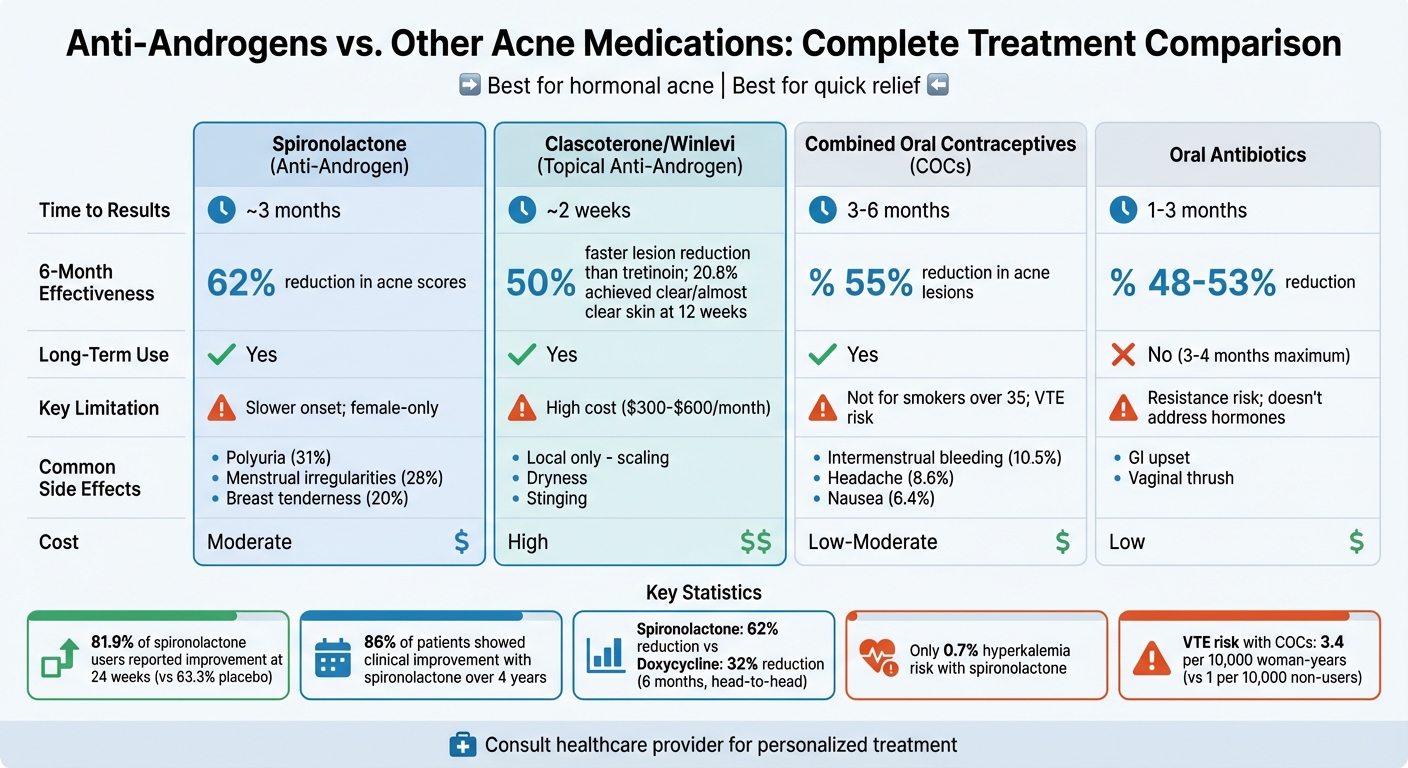
Anti-Androgen vs Other Acne Treatments Comparison Chart
How to manage Hormonal Acne | Dr Davin Lim
How Anti-Androgens Work for Acne
Anti-androgens tackle hormonal acne by targeting the root cause: androgens like testosterone and DHT. These hormones overstimulate sebaceous glands, leading to excessive oil production, clogged pores, and inflammation. By blocking androgen receptors or reducing androgen levels, these medications help rebalance the hormonal activity driving acne.
They work in several ways: competing with DHT for receptor sites, inhibiting the enzyme 5α-reductase (which converts testosterone to DHT), and increasing SHBG levels to reduce free testosterone. Interestingly, sebaceous glands don’t just respond to circulating hormones - they can also produce active androgens locally from precursors like DHEA. Below, we’ll explore some common anti-androgen treatments and their proven results.
Spironolactone for Hormonal Acne
Spironolactone is a well-established option for women dealing with hormonal acne. It works by blocking androgen receptors, inhibiting androgen production, and boosting SHBG levels. Typical doses range from 50 mg to 200 mg daily, with noticeable improvements often appearing within three to six months.
The SAFA trial, conducted in September 2024, found that 81.9% of participants using spironolactone reported acne improvement after 24 weeks, compared to 63.3% in the placebo group. At 12 weeks, 18.5% of spironolactone users achieved treatment success based on the Investigator's Global Assessment, compared to just 5.6% of placebo users. A separate four-year retrospective study showed that 86% of patients experienced clinical improvements with this treatment. In a direct comparison, spironolactone at 150 mg/day reduced global acne scores by 62%, outperforming doxycycline (100 mg/day), which achieved a 32% reduction over six months.
"Spironolactone is an effective acne treatment with clinical trial data to support its use as a first-line acne treatment for women with acne." – Howa Yeung, MD
In healthy young women, routine potassium monitoring isn’t needed, as the risk of hyperkalemia is just 0.7%. However, due to potential side effects like gynecomastia, spironolactone is generally reserved for female patients.
Clascoterone: A Topical Anti-Androgen
Clascoterone, marketed as Winlevi, offers a topical solution for acne with minimal systemic effects. Approved by the FDA, it’s suitable for males and females aged 12 and older. Clascoterone works by blocking DHT from binding to androgen receptors in sebocytes, the cells responsible for oil production. Its localized action and rapid metabolism into an inactive form (cortexolone) contribute to its favorable safety profile. The cream is applied twice daily in a thin layer over the affected area, not as a spot treatment.
In two Phase 3 trials (CB-03-01/25 and CB-03-01/26) involving 1,440 participants, 20.8% achieved "clear" or "almost clear" skin at week 12, compared to 6.5% in the placebo group. Clascoterone also showed quicker results than tretinoin, with a 50% reduction in lesion count achieved in a median of 43.5 days versus 57.0 days for tretinoin 0.05% cream.
"Clascoterone is a safe and effective topical anti-androgen for the treatment of acne in men and women with limited systemic effects on reproductive hormones." – Howa Yeung, MD
The main downside? Cost. A one-month supply typically costs between $300 and $600.
Topical Spironolactone Research
Topical spironolactone is emerging as a promising alternative to oral forms, potentially offering fewer systemic side effects. Early studies have tested formulations ranging from 2% to 5%. In pilot trials, a 5% topical spironolactone cream reduced inflammatory lesions by up to 71% compared to placebo, with no significant side effects. A 2% solution also outperformed topical clindamycin 1.5% in reducing comedones and papules over 12 weeks. While these results are encouraging, more research is needed before topical spironolactone becomes a mainstream treatment option. It could be a great choice for patients looking to minimize systemic exposure while still addressing hormonal acne.
Anti-Androgens vs. Other Acne Medications
Acne treatments work in different ways, and understanding these mechanisms is essential. Anti-androgens specifically target hormonal factors, setting them apart from options like combined oral contraceptives (COCs) and antibiotics.
Combined Oral Contraceptives (COCs)
COCs are a go-to for managing hormonal acne. They work by increasing SHBG levels, which bind free testosterone, reducing ovarian androgen production, and blocking 5α-reductase, the enzyme that converts testosterone into DHT. Typically, it takes 3 to 6 months to see noticeable improvements, with studies showing a 55% reduction in acne lesions after six months. However, only four brands - Ortho Tri-Cyclen, Yaz, Estrostep FE, and Beyaz - have FDA approval for acne treatment. Among these, drospirenone-containing options like Yaz may perform better than those with norgestimate.
COCs are particularly helpful for women who want contraception along with acne control. Still, they aren’t suitable for everyone. For example, women over 35 who smoke or those with a history of migraines with aura should avoid COCs due to a higher risk of blood clots. The risk of deep vein thrombosis for COC users is about 3.4 per 10,000 woman-years, compared to 1 per 10,000 for non-users.
A key point to note: Progestin-only contraceptives, like the mini-pill, hormonal IUDs (e.g., Mirena), and implants (e.g., Nexplanon), do not help with acne and might even worsen it by increasing androgen activity.
Unlike COCs, which regulate hormones, antibiotics offer quicker results but come with their own set of challenges.
Topical and Oral Antibiotics
Antibiotics primarily tackle acne by reducing inflammation and targeting Cutibacterium acnes on the skin. Oral antibiotics can reduce acne lesions by 48% within three months, compared to 37.3% for COCs.
However, antibiotics don’t address the hormonal roots of acne, and concerns about antibiotic resistance have led dermatologists to limit their use to 3–4 months.
"Antibiotics are often over-prescribed in acne, drive antimicrobial resistance in targeted and non-targeted bacteria, and have no effect on sebum synthesis." – American Journal of Clinical Dermatology
After finishing a course of antibiotics, patients are usually transitioned to maintenance treatments like benzoyl peroxide or retinoids. On the other hand, anti-androgens can often sustain clearance as a primary therapy.
"Topical or oral antibiotics should not be used as monotherapy because of the risk of developing resistance." – American Academy of Family Physicians
Effectiveness and Long-Term Results Comparison
Each treatment has its trade-offs, particularly when balancing quick results with lasting control. Antibiotics may work faster initially, but hormonal treatments often deliver better long-term outcomes. For example, antibiotics can reduce lesions by 48% in three months, while COCs achieve about a 55% reduction at six months. Spironolactone, an anti-androgen, outperforms doxycycline (an antibiotic) in direct comparisons, reducing global acne scores by 62% versus 32% over six months at respective doses of 150 mg/day and 100 mg/day.
| Treatment Type | Time to Results | 6-Month Effectiveness | Long-Term Suitability | Primary Limitation |
|---|---|---|---|---|
| Spironolactone | ~3 months for response | 62% reduction | Suitable for long-term use | Slower onset; only for female patients |
| Combined Oral Contraceptives (COCs) | 3–6 months | 55% reduction | Suitable for long-term use | Not recommended for smokers over 35 |
| Oral Antibiotics | 1–3 months | 52.8% reduction | Limited to 3–4 months | Resistance risk; doesn’t address hormones |
| Clascoterone (topical) | As early as 2 weeks | 19.9% success at 12 weeks | Suitable for long-term use | High cost ($300–$600/month) |
"Hormonal therapies provide durable disease control and avoid antimicrobial resistance." – Nello Tommasino, Section of Dermatology, University of Naples Federico II
For lasting acne control, anti-androgens and COCs stand out. They offer sustained improvements without the resistance issues linked to antibiotics. That said, relapse rates after stopping spironolactone range from 17.9% to 35.7%.
"Hormonal therapy to treat acne may take longer to show results compared with other acne treatments and often requires 3 months to 6 months of treatment for efficacy." – MK Trivedi, University of California San Francisco
Side Effects: Anti-Androgens vs. Other Acne Medications
When choosing an acne treatment, side effects play a big role in the decision-making process. Each treatment option comes with its own set of potential side effects, which can influence patient preferences and compliance.
Spironolactone, for instance, is associated with some notable side effects, including polyuria (31%), irregular menstrual bleeding (28%), and breast tenderness (20%). However, the risk of hyperkalemia - a condition involving elevated potassium levels - is extremely low at only 0.7%, which is comparable to the baseline risk in the general population. For this reason, potassium monitoring is generally unnecessary for young, healthy women unless they have kidney issues or are using other potassium-sparing medications.
"Potassium monitoring is of low value for patients on spironolactone unless patients have specific risk factors for hyperkalemia." – Howa Yeung, MD
Combined oral contraceptives (COCs) have their own profile of side effects, such as intermenstrual bleeding (10.5%), headaches (8.6%), and nausea (6.4%). A more serious concern is the increased risk of venous thromboembolism (VTE). COCs raise the risk of VTE approximately threefold, with 8–10 events per 10,000 person-years compared to 5–10 events in non-users. Additionally, formulations containing drospirenone (like Yaz) are linked to a 1.5–2.0 times higher risk of VTE compared to those containing levonorgestrel. Because of these risks, regular blood pressure monitoring is recommended both before starting and during treatment.
Oral antibiotics, while effective, can cause gastrointestinal upset and vaginal thrush. To minimize the risk of antimicrobial resistance, their use is usually limited to a 3–4 month period. On the other hand, topical antibiotics primarily cause mild local irritation, such as redness, and are less likely to have systemic effects.
Clascoterone, a topical anti-androgen, stands out due to its minimal systemic absorption. Its side effects are limited to local issues like skin scaling, dryness, and stinging, making it an appealing option for those looking to avoid broader systemic effects.
Here’s a quick comparison of the side effect profiles for these treatments:
Side Effect Comparison Table
| Treatment Type | Common Side Effects | Monitoring Requirements | Key Contraindications |
|---|---|---|---|
| Spironolactone | Polyuria (31%), menstrual irregularities (28%), breast tenderness (20%), dizziness | Potassium/creatinine checks for high-risk patients | Pregnancy, kidney disease, Addison's disease |
| Clascoterone (topical) | Skin scaling, dryness, stinging, burning | None – minimal systemic absorption | Hypersensitivity |
| COCs | Intermenstrual bleeding (10.5%), headache (8.6%), nausea (6.4%) | Regular blood pressure monitoring | Smokers over 35, migraine with aura, VTE history |
| Oral Antibiotics | Gastrointestinal upset, vaginal thrush | Limit duration to 3–4 months | Contraindicated in pregnancy (e.g., tetracyclines) |
| Topical Antibiotics | Local irritation, redness | Avoid monotherapy to reduce resistance risk | Hypersensitivity |
Each treatment has its pros and cons, and understanding the side effect profiles can help guide more informed decisions tailored to individual needs and health considerations.
sbb-itb-6dba428
Choosing the Right Acne Treatment
Finding the right acne treatment depends on several personal factors. Your hormone levels, the areas where your acne tends to appear, and your history with previous treatments all play a role in determining what works best. While anti-androgens are ideal in certain situations, other medications might be better suited for different types of acne.
When Anti-Androgens Are the Best Option
Anti-androgens are particularly effective for acne with a hormonal pattern. This type of acne often shows up along the jawline, chin, or lower face, especially during menstrual cycles or in individuals with PCOS. In fact, more than 90% of hyperandrogenism cases are linked to PCOS. Anti-androgens are also a strong choice for women experiencing "acne tarda", which is acne that appears after age 25.
If you've already tried treatments like topical retinoids or oral antibiotics without success, anti-androgens provide a different approach by addressing the hormonal root of the problem. They’re also a better long-term option compared to antibiotics, which should only be used for a few months (3–4 months) to avoid resistance. For men or those who prefer to avoid systemic hormonal effects, topical clascoterone offers a localized solution that doesn't interfere with reproductive hormones.
Hormone tests (like total testosterone, free testosterone, and DHEAS) can confirm androgen excess and help guide treatment decisions.
Combining Treatments for Better Results
Anti-androgens can deliver even better results when paired with other treatments. For example, combining spironolactone with a combined oral contraceptive (COC) has proven highly effective. In one study, 74% of women with severe acne experienced at least a 75% reduction in lesions when taking 100 mg/day of spironolactone with a drospirenone-containing COC. This combination also significantly reduces menstrual irregularities, dropping the rate from 50% to just 15%.
Adding 20% azelaic acid to a COC regimen can further improve outcomes, particularly for scarring and pigmentation. In one study, 58% of patients using this combination achieved near-clear skin, compared to 45% who used the COC alone. Pairing spironolactone with oral antibiotics can also provide multi-targeted relief, though antibiotic use should still be limited to 3–4 months.
Even topical anti-androgens can be combined effectively. For instance, clascoterone works well alongside retinoids, delivering faster results. Studies show it can reduce lesion counts by 50% about 13 days sooner than tretinoin (43.5 days versus 57.0 days).
Getting Spironolactone Through Oana Health
Oana Health offers an easy way to access topical and oral spironolactone online. Through their platform, you'll connect with licensed physicians who design personalized treatment plans tailored to your hormonal acne needs. Once your plan is finalized, your medication is shipped directly to your home with free delivery. This streamlined process ensures your treatment matches the severity of your acne.
The platform provides two main options: "skincare-first" topical treatments or "internal support" oral medications, depending on what suits you best.
- Topical spironolactone is applied 1-2 times daily and works well for mild to moderate acne or sensitive skin. It doesn’t require lab monitoring and is supported by research showing that a 5% concentration can reduce total lesion counts by 71%, compared to 36% with a placebo. Clinical improvements are often noticeable by week 2 of treatment.
- Oral spironolactone, typically prescribed at 50-150 mg daily, is ideal for deeper, cystic acne or breakouts linked to PCOS. It provides systemic benefits, with about 86% of patients reporting clinical improvement. While monitoring may be necessary in some cases, this option addresses hormonal acne from within.
To find the right treatment, start with a quick online consultation through Oana Health's spironolactone program or their topical spironolactone option. Whether you need localized care with minimal absorption or a more robust systemic solution, the physician will recommend the best approach for you.
With Oana Health, there’s no need for in-person appointments - everything is handled online, and your medications are delivered straight to your door at no extra cost.
Conclusion
Deciding between anti-androgens and other acne treatments comes down to understanding your specific acne triggers and long-term goals. Anti-androgens like spironolactone and combined oral contraceptives focus on reducing androgen activity, addressing the hormonal roots of acne. On the other hand, antibiotics primarily target bacteria and inflammation. This makes anti-androgens especially effective for adult women dealing with persistent acne, premenstrual flare-ups, or symptoms tied to hormonal imbalances like hyperandrogenism.
When it comes to results, antibiotics can reduce acne lesions by 48% within three months. However, by six months, both antibiotics and oral contraceptives show similar success, with a 53–55% reduction in lesions. What sets anti-androgens apart is their suitability for long-term use. Unlike antibiotics, which are typically limited to 3–4 months due to concerns about resistance, spironolactone offers a safe, long-term option without contributing to antimicrobial resistance.
Treatment choice also depends on how well you tolerate the medication and its potential side effects. For example, spironolactone may cause menstrual irregularities or breast tenderness, while antibiotics can lead to issues like gastrointestinal discomfort or yeast infections. The risk of hyperkalemia with spironolactone is low, occurring in only about 0.7% of cases. For severe or scarring acne that doesn’t respond to other treatments, oral isotretinoin remains an option, though it requires close monitoring.
Ultimately, the best treatment plan depends on your unique health needs and priorities. Factors like gender, age, contraceptive requirements, and the severity of your acne should all play a role. Working closely with your healthcare provider ensures a personalized approach - whether that involves topical clascoterone for targeted relief, oral spironolactone for hormonal balance, or a combination of treatments for the best results.
FAQs
What’s the difference between anti-androgens and antibiotics for treating hormonal acne?
Anti-androgens and antibiotics take very different approaches when it comes to addressing hormonal acne. Anti-androgens, like spironolactone or certain hormonal birth control pills, tackle the root cause - hormonal imbalances. This makes them a stronger choice for managing acne over the long term, especially for women. Plus, they sidestep the issue of antibiotic resistance, a potential problem with extended antibiotic use.
Antibiotics, meanwhile, are more about short-term relief. They work by reducing inflammation and bacteria, which often leads to faster results in the early stages of treatment. But their effectiveness tends to wane over time, and they aren’t a practical long-term fix for hormonal acne.
For women aiming for a solution that targets the underlying issue and offers lasting results, anti-androgens are often seen as the more effective option compared to systemic antibiotics.
What side effects can spironolactone cause when used for acne treatment?
Spironolactone, often used to treat hormonal acne, can come with a few side effects, particularly when you first begin taking it. These may include dizziness, nausea, muscle cramps, fatigue, or a general sense of low energy. The good news? Most of these symptoms are mild and usually subside as your body gets used to the medication. If anything feels off or symptoms stick around, it’s a smart move to check in with your healthcare provider.
Can anti-androgens be combined with other acne treatments for better results?
Yes, anti-androgens are often used alongside other acne treatments to boost their effectiveness. Treatment plans frequently combine anti-androgens with options like topical retinoids, benzoyl peroxide, or antibiotics to tackle multiple factors that contribute to acne, such as excess oil production and bacterial growth.
For instance, pairing anti-androgens with topical or oral antibiotics can be particularly helpful for managing hormonal or persistent acne. This multi-faceted approach addresses acne from several angles, often leading to improved results for many individuals.