
Top 5 Anti-Androgen Combos for PCOS Management
Managing PCOS often requires more than one type of treatment to address its wide-ranging symptoms, from hormonal imbalances to metabolic issues. Here are five effective anti-androgen combinations that target specific symptoms like hirsutism, acne, and insulin resistance:
- Spironolactone + Metformin: Reduces testosterone levels and improves insulin sensitivity. Ideal for PCOS patients with weight concerns or insulin resistance.
- Spironolactone + Combined Oral Contraceptives (COCs): Combines hormone regulation with androgen receptor blocking for issues like hirsutism and acne.
- Spironolactone + Eflornithine: Targets facial hirsutism with systemic and topical treatments.
- Cyproterone Acetate + COCs: A strong option for severe hirsutism and acne but carries a higher risk of blood clots.
- Flutamide + Metformin: Focuses on androgen-related symptoms and metabolic health but requires close monitoring due to potential liver risks.
Each combination has its strengths and side effects, so choosing the right one depends on individual symptoms and health factors. Always consult a healthcare provider to create a tailored treatment plan.
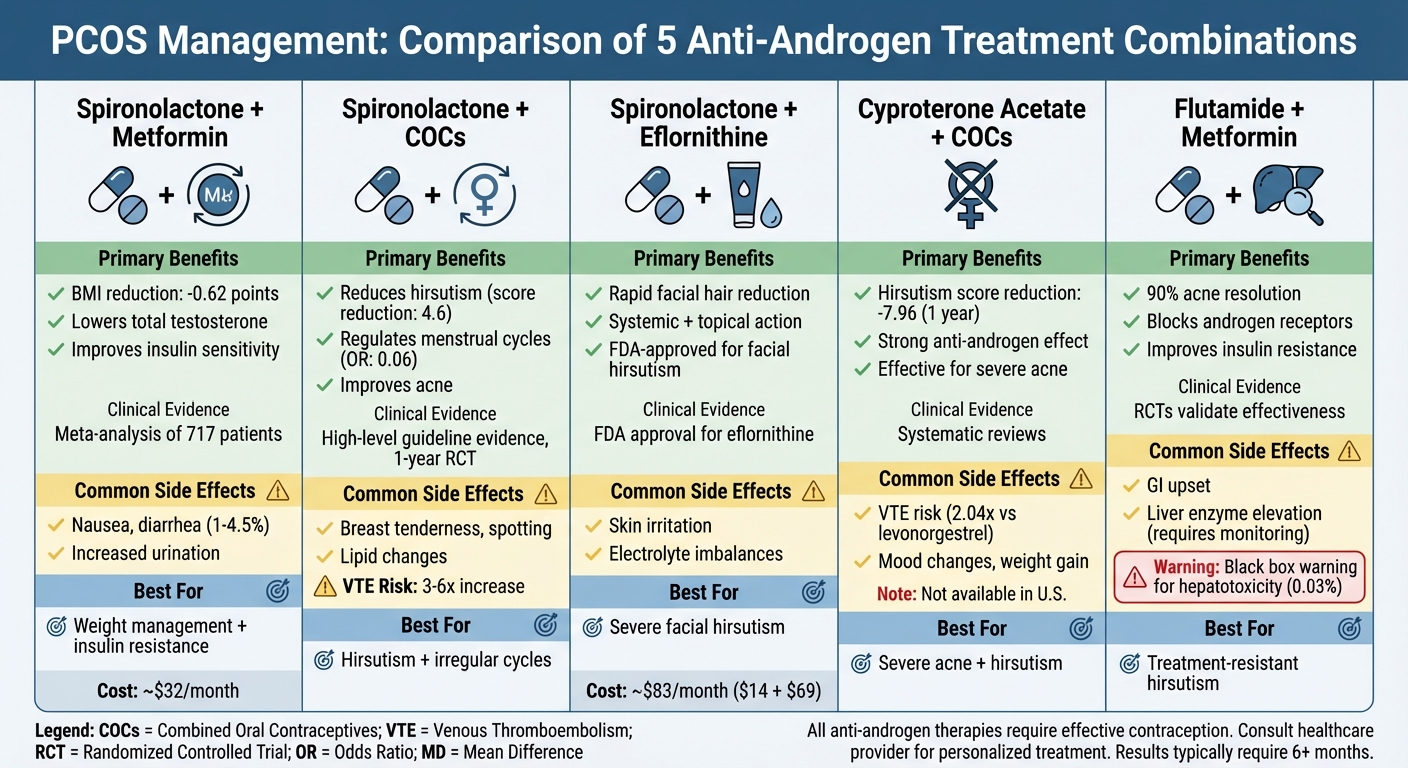
PCOS Anti-Androgen Treatment Combinations: Benefits, Side Effects, and Best Uses
1. Spironolactone with Metformin
Effectiveness in Reducing Hyperandrogenism Symptoms
When combined, spironolactone and metformin tackle PCOS symptoms from two angles. Metformin works to lower insulin resistance, which in turn reduces androgen production, while spironolactone blocks androgen receptors directly. Studies show that this pairing has a complementary effect.
A meta-analysis of six randomized controlled trials, involving 717 patients, demonstrated that this combination significantly lowered total testosterone levels more effectively than metformin alone. However, while biochemical improvements occur earlier, visible changes in hirsutism may take more time.
This dual approach also paves the way for improvements in overall metabolic health.
Impact on Insulin Resistance and Metabolic Health
In clinical trials lasting six months or more, patients experienced notable reductions in fasting blood glucose and insulin resistance, with statistical significance (P = 0.01 and P = 0.0003, respectively). The combination also proved more effective than metformin alone in weight management, with an average BMI reduction of 0.62 points.
Spironolactone may amplify metformin’s benefits by blocking mineralocorticoid receptors in fat tissue. This action reduces inflammatory markers like TNF-α and IL-6, while also improving glucose uptake. This makes the combination especially helpful for PCOS patients dealing with obesity or those who cannot use estrogen-based contraceptives due to thromboembolic risks.
Safety Profile and Side Effects
The combination effectively addresses both hormonal and metabolic challenges without increasing the frequency of side effects compared to metformin alone. The most common side effects - nausea, vomiting, and diarrhea - are typically linked to metformin. Notably, no serious adverse events, such as hyperkalemia (high potassium) or elevated creatinine levels, have been reported in clinical trials.
In terms of cost, generic metformin is approximately $73 per month, while spironolactone costs around $61 per month.
2. Spironolactone with Combined Oral Contraceptives
Effectiveness in Reducing Hyperandrogenism Symptoms
Spironolactone and combined oral contraceptives (COCs) work together to tackle hyperandrogenism symptoms through complementary actions. COCs lower ovarian androgen production and boost levels of sex hormone-binding globulin (SHBG), while spironolactone blocks androgen receptors and reduces androgen production [9, 17]. This combination is widely seen as the most effective option for managing symptoms like excessive facial or body hair (hirsutism) and acne.
A one-year randomized clinical trial highlighted the effectiveness of this pairing. It outperformed metformin in regulating menstrual cycles (odds ratio: 0.06) and significantly reduced hirsutism scores (mean difference: 4.6). Clinical guidelines suggest adding spironolactone to COC therapy if symptoms persist after six months, as spironolactone enhances the effect, leading to greater reductions in hirsutism [11, 17]. This combination not only delivers strong results but also maintains a reassuring safety profile.
Safety Profile and Side Effects
The safety and tolerability of this combination make it a standout choice. Clinical evidence underscores not only its effectiveness but also its manageable side effect profile.
"Oral contraceptives plus spironolactone is a much more effective treatment than metformin, proving both safe and well-tolerated." - Professor Héctor F. Escobar-Morreale, Hospital Universitario Ramón y Cajal
Over a one-year period, the combination has demonstrated excellent tolerability without increasing metabolic risks. Common side effects include breast tenderness, bloating, nausea, and vomiting [16, 17, 18]. However, it is essential to note that COCs are linked to a 3- to 6-fold increase in the relative risk of venous thromboembolism (VTE). On the other hand, spironolactone may provide cardiovascular benefits, such as increasing HDL ("good") cholesterol levels.
An important precaution: spironolactone must be paired with effective contraception, like COCs, to prevent pregnancy. If pregnancy occurs, its anti-androgenic effects could lead to feminization of a male fetus.
3. Spironolactone with Eflornithine
Effectiveness in Reducing Hyperandrogenism Symptoms
Spironolactone and eflornithine work together to tackle hirsutism by targeting the issue from different angles. Spironolactone acts systemically, blocking androgen receptors and reducing androgen production. On the other hand, eflornithine, applied as a 13.9% cream, works locally by inhibiting ornithine decarboxylase, an enzyme that plays a role in hair growth. This combination makes them go-to options for managing facial hirsutism in individuals with PCOS.
Eflornithine holds the distinction of being the only FDA-approved treatment specifically for facial hirsutism. It’s applied directly to the affected areas twice a day. However, patience is key - consistent application for up to six months may be necessary to see its full effects, especially when paired with systemic treatments like spironolactone or laser therapies.
Now, let’s examine the safety aspects of this combination.
Safety Profile and Side Effects
Spironolactone comes with some potential side effects, including hyperkalemia, nausea, and breast tenderness. Regular monitoring of potassium levels and kidney function is essential, though severe hyperkalemia is rare, occurring in only 2% of users compared to 1% in those taking a placebo. It’s also important to steer clear of potassium supplements or salt substitutes while on this medication.
Eflornithine is generally well tolerated, though some users might notice mild skin reactions such as stinging, burning, or redness where the cream is applied. Both medications are classified as FDA Pregnancy Category C, so effective contraception is strongly advised during spironolactone use.
4. Cyproterone Acetate with Combined Oral Contraceptives
Effectiveness in Reducing Hyperandrogenism Symptoms
Cyproterone acetate (CPA) stands out as one of the strongest anti-androgens among progestins used in combined oral contraceptives. When combined with ethinyl estradiol (EE), it’s particularly effective for managing moderate-to-severe cases of hirsutism and acne. Its mechanism includes blocking androgen receptors, reducing ovarian androgen production, and preventing testosterone from converting into dihydrotestosterone.
Clinical studies reveal that the EE/CPA combination can significantly lower Ferriman-Gallwey scores, which measure hirsutism severity. On average, scores drop by about 1.22 points after three months and nearly 7.96 points after a year. For a clearer picture of its effectiveness, six months of consistent use is recommended.
Impact on Insulin Resistance and Metabolic Health
Besides tackling hyperandrogenism, the combination of EE and CPA also affects metabolic health. While it doesn’t significantly alter glucose levels or body weight, it may slightly increase triglycerides (by about 25.1 mg/dL) and HDL cholesterol (by approximately 6.09 mg/dL). These changes are generally mild, but healthcare providers often monitor them, especially for patients with cardiovascular concerns.
Safety Profile and Side Effects
When considering EE/CPA, safety is a key factor. CPA-containing contraceptives carry a higher risk of venous thromboembolism (VTE), with a relative risk roughly 2.04 times that of contraceptives containing levonorgestrel. For this reason, EE/CPA is typically prescribed for women with moderate-to-severe symptoms rather than milder cases.
CPA is contraindicated for women with meningioma, and the European Medicines Agency (EMA) recommends using doses of 10 mg or higher only when no alternative treatments are effective. Before starting EE/CPA, it’s crucial to assess individual risk factors such as age, smoking habits, BMI, and any history of blood clots.
A common clinical formulation includes 35 μg of EE and 2 mg of CPA. Like other combined oral contraceptives, it may cause side effects such as headaches, nausea, mood changes, or breast tenderness, which often improve after a few months. However, the anti-androgen effects tend to fade within months of stopping treatment, making long-term use necessary for sustained benefits.
sbb-itb-6dba428
5. Flutamide with Metformin
Effectiveness in Reducing Hyperandrogenism Symptoms
Combining flutamide with metformin offers a dual approach to managing PCOS: metformin addresses insulin resistance, while flutamide blocks androgen activity. Specifically, flutamide works by inhibiting androgen receptors and preventing testosterone from converting to DHT, making it a valuable option when oral contraceptives aren't effective or well-tolerated.
When it comes to reducing hirsutism, flutamide outperforms metformin on its own. Studies suggest that adding an anti-androgen like flutamide to metformin and lifestyle adjustments results in significantly lower testosterone levels compared to relying solely on metformin and lifestyle changes. Its effects on acne are particularly striking, with up to 90% acne resolution compared to 40% achieved with spironolactone.
This combination doesn't just target androgen-related symptoms - it also has implications for metabolic health.
Impact on Insulin Resistance and Metabolic Health
While flutamide helps balance hormones by lowering androgen levels, metformin improves metabolic health by reducing liver glucose production and enhancing insulin sensitivity. Since elevated androgens can exacerbate insulin resistance, the combined treatment indirectly supports better metabolic outcomes. However, research shows that achieving weight-related benefits with this combination requires longer treatment durations compared to using metformin alone.
Safety Profile and Side Effects
Flutamide comes with a black box warning for hepatotoxicity, with rare cases of hepatic failure occurring in about 0.03% of patients. To mitigate risks, liver function tests are crucial - baseline testing before starting treatment and regular monitoring during the first three months are essential. If jaundice appears or ALT levels rise to twice the normal limit, treatment must be stopped immediately.
Common side effects of flutamide include hot flashes (affecting over 50% of patients), decreased libido (36%), and gastrointestinal symptoms like diarrhea, nausea, or vomiting in about 10% of cases. Metformin can also cause gastrointestinal discomfort, though starting with a low dose can help reduce these effects.
Comparison Table
Here's a breakdown of five anti-androgen combinations, focusing on their primary benefits, supporting clinical evidence, common side effects, and ideal use cases:
| Anti-Androgen Combination | Primary Benefits | Clinical Evidence | Common Side Effects | Best For |
|---|---|---|---|---|
| Spironolactone + Metformin | Helps reduce BMI, lowers total testosterone, and enhances insulin sensitivity. | A meta-analysis involving 717 patients found notable BMI reduction (MD -0.62) and decreased testosterone levels. | Nausea, diarrhea (1–4.5% may experience severe gastrointestinal issues), and increased urination [9, 26]. | Ideal for weight management and addressing insulin resistance with elevated testosterone levels. |
| Spironolactone + COCs | Combines to reduce hirsutism, regulate menstrual cycles, and improve acne. | Supported by high-level evidence from guidelines, showing greater effectiveness than monotherapy. | Breast tenderness, spotting, and a less favorable lipid profile. | Best for managing hirsutism and irregular menstrual cycles. |
| Spironolactone + Eflornithine | Provides rapid reduction in facial hair through both systemic and topical effects. | Eflornithine is FDA-approved for treating facial hirsutism. | May cause skin irritation (topical) and electrolyte imbalances. | Most effective for severe facial hirsutism. |
| Cyproterone Acetate + COCs | Offers strong anti-androgen effects, particularly for skin and hair concerns. | Systematic reviews confirm its use for severe acne and hirsutism. | Side effects include increased risk of VTE, mood changes, and possible weight gain. | Best suited for severe acne and hirsutism. Note: This combination is not available in the U.S. |
| Flutamide + Metformin | Targets androgen receptors while improving insulin resistance. | RCTs validate its effectiveness, though safety concerns limit its widespread use. | Gastrointestinal upset and potential liver enzyme elevation. | Recommended for hirsutism unresponsive to other treatments. |
When choosing a therapy, it's essential to weigh individual symptoms and treatment goals. Metabolic improvements often require at least six months of consistent use, and all anti-androgen therapies necessitate effective contraception to prevent fetal exposure risks.
Managing PCOS with Personalized Anti-Androgen Therapy at Oana Health
Oana Health simplifies access to tailored, prescription-based treatments for PCOS, building on well-established anti-androgen combinations. With just a 5-minute online consultation, licensed physicians review your medical history and deliver a personalized treatment plan within 24 hours. Whether your goal is to reduce hirsutism, address insulin resistance, or regulate menstrual cycles, Oana Health offers targeted options like Spironolactone paired with Metformin or Eflornithine combined with Spironolactone.
The platform provides access to several effective anti-androgen therapies. Spironolactone starts at $14 per month, while a bundle of Spironolactone and Metformin ER is available for $32 per month. For facial hirsutism, Eflornithine 12% is offered at $69 per month. Another option, the Hairless Hype treatment, also priced at $69 monthly, includes prescription-grade ingredients designed specifically to reduce unwanted hair growth.
All medications are prepared in FDA-regulated compounding pharmacies and come with free shipping, automatic refills, and continuous support via online or phone communication.
This personalized approach aligns with clinical guidelines, which stress the importance of tailoring treatments to individual needs by addressing specific symptoms and considering related health factors like cardiovascular risks. Oana Health ensures that treatments are adjusted based on your unique response, offering a truly individualized experience.
Conclusion
Combining anti-androgens tackles PCOS by addressing two major challenges: reducing androgen activity to help with issues like acne and excessive hair growth, while also improving insulin sensitivity. The approaches discussed above highlight how specific treatments can target both the hormonal and metabolic sides of PCOS.
Since PCOS symptoms and responses to treatment vary widely, a one-size-fits-all approach simply doesn’t work. As the American Academy of Family Physicians explains, "PCOS is not a simple pathophysiologic process for which one treatment addresses all manifestations... physicians must individualize treatment goals". It’s also worth noting that combination therapies often take at least six months to fully deliver metabolic benefits.
With this in mind, personalized care is key to achieving the best results. Talk with a healthcare provider who understands PCOS to create a treatment plan tailored to your needs. For convenient, prescription-based care, Oana Health offers targeted treatments delivered straight to your door with free shipping.
FAQs
What side effects should I watch out for when combining anti-androgen medications with other PCOS treatments?
Combining anti-androgens with other treatments for PCOS can sometimes lead to side effects, making close monitoring essential. For instance, spironolactone might raise potassium levels, which can pose risks for individuals with kidney, liver, or heart issues. To mitigate this, regular blood tests are often recommended to keep potassium levels in check and avoid complications. Similarly, medications like flutamide come with concerns such as liver toxicity, while cyproterone acetate may increase the likelihood of blood clots.
When used alongside drugs like metformin, there can also be side effects like nausea, diarrhea, or fluctuations in blood sugar levels. These potential interactions underline the importance of collaborating with a healthcare provider to develop a treatment plan that suits your specific needs. Ongoing medical supervision not only ensures safety but also helps manage PCOS symptoms more effectively.
How do anti-androgen treatments help with symptoms like excess hair growth and acne?
Anti-androgen treatments are often used to address symptoms like excess hair growth (hirsutism) and acne by reducing the impact of androgens - hormones that can overstimulate hair follicles and oil glands. Medications such as spironolactone work by blocking androgen receptors, which helps reduce the hormonal signals responsible for unwanted facial or body hair and acne. It's important to note that these treatments take time, with noticeable results usually appearing after 6 to 12 months.
For a more targeted approach, topical treatments like eflornithine can help slow down facial hair growth. This works by reducing the enzyme activity involved in hair production, offering a localized solution with fewer overall side effects. When combined with other therapies, such as oral contraceptives, these treatments can help regulate hormone levels more effectively, creating a well-rounded strategy for managing these symptoms.
Why is it essential to personalize PCOS treatment based on individual symptoms and health needs?
PCOS (Polycystic Ovary Syndrome) doesn’t look the same for everyone. Symptoms like acne, unwanted hair growth, hair thinning, irregular periods, and insulin resistance can vary a lot from one woman to another. That’s why a one-size-fits-all treatment plan often falls short. Instead, tailored approaches - like combining anti-androgens such as spironolactone with insulin-sensitizing medications like metformin - can target specific symptoms more effectively while addressing the hormonal imbalances at the root of the condition.
It’s also important to consider factors like pregnancy goals, potential side effects, and any pre-existing health conditions when crafting a treatment plan. For instance, some medications may not be safe for women trying to conceive or those with certain medical risks. A personalized approach ensures that treatments are not only safe but also aligned with individual health goals, leading to better symptom management and overall well-being.