
CBT for PCOS Depression: What Studies Show
Cognitive Behavioral Therapy (CBT) is a proven method to help women with Polycystic Ovary Syndrome (PCOS) manage depression and anxiety. Women with PCOS are up to 5 times more likely to experience depression and 7 times more likely to have suicidal thoughts compared to those without the condition. This is due to a combination of hormonal imbalances, body image issues, infertility struggles, and metabolic challenges like insulin resistance.
CBT helps by targeting negative thought patterns and improving emotional responses. Research highlights its effectiveness:
- Depression scores dropped significantly in studies, such as a trial where scores fell from 24.4 to 6.7 after 8 weeks of group CBT.
- Combining CBT with lifestyle changes (e.g., diet and exercise) leads to better weight loss and improved mental health.
- Group-based CBT and online programs offer accessible and effective options, with added social support.
While studies show promising results, larger trials and longer follow-ups are needed to confirm long-term benefits. Adding CBT to your PCOS care plan could address both emotional and physical challenges.
Research Findings on CBT for PCOS-Related Depression
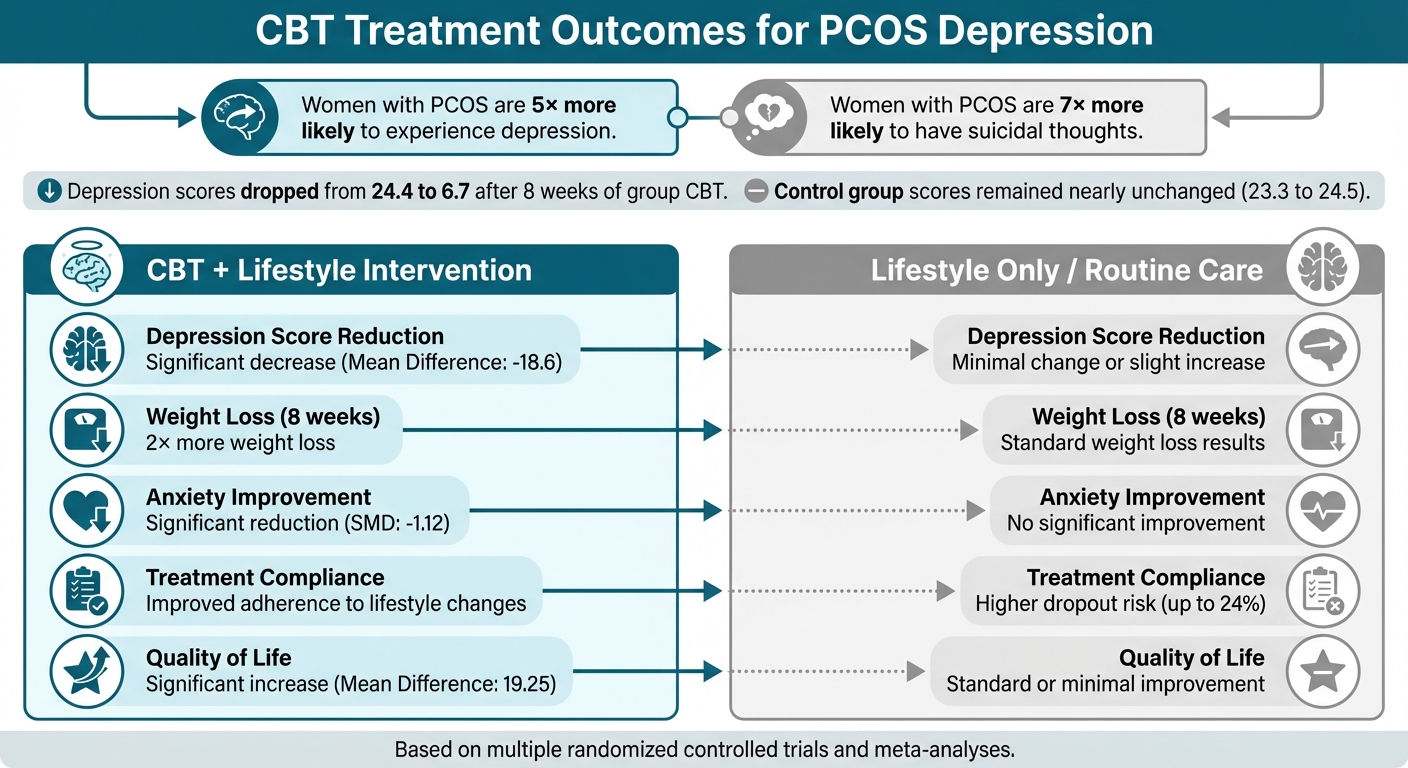
CBT Plus Lifestyle vs Lifestyle Only for PCOS Depression Treatment Outcomes
What Studies Show About CBT for Depression in PCOS
Research strongly supports the use of CBT (Cognitive Behavioral Therapy) for addressing depression in women with PCOS. A randomized controlled trial conducted in Iran involved 84 women with PCOS who participated in eight weekly group CBT sessions lasting 60–90 minutes. Results showed a dramatic drop in depression scores for the CBT group - from 24.4 to 6.7 - compared to the control group, whose scores remained nearly unchanged (23.3 to 24.5). The mean difference was –18.6 (95% CI: –19.4 to –17.8; P < 0.001).
A network meta-analysis from 2025, which reviewed 25 randomized controlled trials, also highlighted CBT's ability to significantly reduce depression, with a standardized mean difference (SMD) of –1.27. While some studies, such as a 2022 meta-analysis, found no major differences in depression levels, the majority of trials report positive outcomes.
CBT has additional benefits beyond mood improvement. It increases adherence to treatment plans, reducing dropout rates from lifestyle-only interventions (which can reach up to 24%). There’s also evidence suggesting CBT may improve clinical pregnancy rates for women with PCOS who are trying to conceive. These findings emphasize CBT’s potential, particularly in group settings where shared experiences can enhance results.
Group-Based CBT Interventions
A significant portion of the research on CBT for PCOS-related depression focuses on group-based approaches. A 2022 meta-analysis covering eight major trials revealed that all studies relied on group formats. These groups typically included 5 to 7 participants meeting weekly for 8 to 18 sessions.
Group CBT offers a dual benefit: addressing common challenges like infertility and body image concerns while also fostering social support. Sessions often include techniques such as progressive muscle relaxation, imagery exercises, and thought record sheets to challenge negative thinking patterns related to appearance and fertility struggles.
"CBT significantly reduced anxiety, improved quality of life related to hirsutism, and increased treatment compliance and pregnancy rates in patients with PCOS." – Rong Tang, Center for Reproductive Medicine, Shandong University
Group-based CBT is not only effective but also cost-efficient, making it a practical option for healthcare providers aiming to improve the well-being of women with PCOS. Importantly, the benefits of these interventions tend to last. Follow-up assessments conducted three months after therapy showed no significant decline in outcomes. When combined with lifestyle modifications, the positive effects of CBT can be even greater.
CBT Combined with Lifestyle Changes
Pairing CBT with lifestyle changes results in better outcomes than either approach on its own. For example, a 2018 pilot trial divided obese women with PCOS and depression into two groups: one received eight weekly 30-minute CBT sessions alongside lifestyle changes, while the other focused solely on lifestyle modifications. The CBT group achieved double the weight loss in just eight weeks and reported a higher quality of life.
Supporting these findings, a study conducted by Erasmus MC in Rotterdam (2010–2016) followed 155 women with PCOS (BMI > 25 kg/m²) who participated in a one-year intervention. This program combined 20 group CBT sessions (2.5 hours each) with diet and physical therapy. Results showed significant reductions in depression (p = 0.045) and improvements in self-esteem (p = 0.027) compared to a control group receiving standard weight-loss advice. Interestingly, while weight loss contributed to better self-esteem, the lifestyle intervention improved depression and body image independently of weight changes.
This integrated approach - combining metformin, lifestyle changes, and CBT - delivers superior emotional and physical outcomes. CBT plays a crucial role in helping patients stick to and sustain healthy lifestyle changes, which are often the first-line treatment for PCOS. International guidelines now recommend CBT as part of comprehensive care for PCOS, as it addresses both the metabolic and psychological aspects of the condition.
| Outcome Measure | CBT + Lifestyle Intervention | Lifestyle Only / Routine Care |
|---|---|---|
| Depression Score Reduction | Significant decrease (MD: –18.6) | Minimal change or slight increase |
| Weight Loss (8 weeks) | Approximately 2× more weight loss | Standard weight loss results |
| Anxiety Improvement | Significant reduction (SMD: –1.12) | No significant improvement |
| Treatment Compliance | Improved adherence to lifestyle changes | Higher dropout risk (up to 24%) |
| Quality of Life | Significant increase (MD: 19.25) | Standard or minimal improvement |
sbb-itb-6dba428
Online and Adolescent-Focused CBT for PCOS
Online CBT Programs for PCOS Mental Health
Digital CBT platforms are making mental health support more accessible for women managing PCOS. A 2025 network meta-analysis found that digital interventions can significantly reduce depression symptoms in women with PCOS, showing a standardized mean difference of -0.77. These platforms, which include mobile apps and online therapy services, provide a practical alternative to traditional, in-person therapy - especially for women who face challenges like transportation issues, busy schedules, or limited access to specialized care.
"Digital interventions, such as mobile applications and online psychological therapy platforms, are emerging as effective approaches. Their convenience and affordability make them a favored option." – PeerJ
Online CBT has been particularly helpful during times when face-to-face therapy isn't possible. For example, during public health crises, weekly 45-minute online counseling sessions were just as effective as group therapy in reducing depression symptoms. This flexibility is especially beneficial for women balancing PCOS management with daily life. However, while digital platforms are effective for addressing depression, researchers have noted they may be less effective in managing anxiety symptoms compared to in-person therapy.
Telehealth services, such as those provided by Oana Health, offer personalized CBT programs that make care more accessible for women with PCOS. Although these digital solutions are helping adults, it’s equally important to focus on tailored CBT interventions for adolescents.
CBT for Adolescents with PCOS
Adolescence is already a challenging time, and for girls with PCOS, the mental health risks are even higher. Studies show that adolescents with PCOS are 2.21 times more likely to experience depression. With depression rates in this group reaching as high as 50%–60%, early intervention through CBT can reduce the risk by around 19%, addressing key issues like body image and weight management before they worsen.
"Our research indicated that adolescents with PCOS experienced more severe depressive symptoms than those without PCOS. This highlights the importance of evaluation and early treatment of mental health in PCOS." – Frontiers in Endocrinology
CBT programs for adolescents often incorporate Social Support Theory, which focuses on providing medical guidance, emotional encouragement, and affirming coping strategies. These programs also involve parents and peer mentors to help ensure treatment adherence and build emotional resilience. Many of these interventions are delivered through mobile platforms like WeChat, making them accessible and affordable. By meeting adolescents where they already spend much of their time, these programs offer flexibility and reduce barriers to traditional therapy.
Strengths and Limitations of Current CBT Research
What Current Research Gets Right
Research into CBT's role in managing PCOS-related depression has shown some encouraging outcomes. Studies consistently report reductions in depression and anxiety scores, along with noticeable improvements in overall quality of life. CBT also seems to play a key role in helping women stick to lifestyle changes and medical treatments, which can be notoriously difficult to maintain over time. On top of that, some studies even suggest a link between CBT interventions and higher clinical pregnancy rates. These findings highlight CBT's potential as a tool for addressing both the mental health and physical challenges associated with PCOS.
Research Gaps and Challenges
Despite the positive results, several challenges limit the current research on CBT for PCOS. For starters, many studies rely on relatively small sample sizes, typically involving just 40–84 participants. This makes it tough to draw broad conclusions. Adding to the complexity, the way CBT is delivered varies widely - from group sessions to one-on-one therapy - with no clear consensus on the ideal format or duration of treatment.
One major issue is the lack of long-term follow-up. Most studies only track participants for 8 to 12 weeks, which isn't enough time to fully understand whether the benefits of CBT stick around. Sustained behavioral changes often take much longer - possibly six months or more - to truly take root. Without extended observation, it's hard to say how durable these improvements really are.
Another gap lies in participant selection. Many trials exclude women with pre-existing mental health conditions, even though this group might stand to gain the most from focused psychological support. Geographic and cultural factors also play a role. A significant portion of high-quality studies comes from countries like Iran and China, raising questions about how well these findings translate to women in other parts of the world.
"Larger and higher-quality randomized controlled trials are needed to clarify the role of CBT in PCOS." – Frontiers in Psychology
These limitations point to the need for more robust studies, particularly those with larger sample sizes and longer follow-up periods, to better understand CBT's full potential in addressing PCOS-related challenges.
How to Use CBT for PCOS Treatment
Adding CBT to Your PCOS Treatment Plan
CBT works best when combined with other treatments for PCOS. Typically, it involves eight weekly sessions focused on mood assessment, identifying negative thought patterns, and practicing relaxation techniques like progressive muscle relaxation. These sessions also help you recognize and challenge "hot thoughts" by using thought records to reframe your thinking patterns.
Pairing CBT with medical treatments and lifestyle adjustments often delivers better outcomes. For instance, one study found that women who combined CBT with diet and exercise lost twice the weight in eight weeks compared to those relying solely on lifestyle changes. CBT can also complement medications like metformin or spironolactone, helping to reduce emotional distress and improve adherence to treatment plans.
Another advantage of CBT is its accessibility. You don't need to visit specialized PCOS clinics to benefit from it. Many therapists trained in CBT protocols can provide effective support since these techniques are broadly applicable. Group-based CBT offers additional benefits by fostering peer support, which can further encourage treatment adherence.
This integration of CBT with other therapies is paving the way for newer, more accessible treatment options, including digital solutions.
Future Research and New CBT Approaches for PCOS
The future of CBT for PCOS lies in digital delivery methods, making therapy more affordable and accessible. These digital CBT programs provide a convenient alternative to traditional in-person sessions. Research has shown that digital interventions can significantly reduce depression symptoms, with some studies reporting a standardized mean difference of -0.77.
"Digital interventions, such as mobile applications and online psychological therapy platforms, are emerging as novel treatment approaches... Due to their convenience and low cost, these interventions are increasingly favored by many patients." – PeerJ
Researchers are also working on personalized approaches to CBT. Using network meta-analyses, clinicians may soon be able to tailor psychological interventions to individual symptoms, whether you're struggling more with anxiety or depression. Emerging technologies like AI tools and self-guided mindfulness programs are also being developed to enhance CBT, addressing psychiatric symptoms and sleep disturbances associated with PCOS.
How Telehealth Supports PCOS Mental Health
Telehealth platforms are expanding access to mental health care for women with PCOS, addressing gaps in traditional treatment options. Weekly video or phone counseling sessions allow you to receive therapy from home, which can be especially helpful if you're dealing with body image concerns or social anxiety. Studies show that online CBT programs are effective in reducing symptoms of depression and anxiety.
Platforms like Oana Health combine mental health support with comprehensive PCOS management. They offer treatments for insulin resistance and weight management, tackling both the physical and emotional challenges of PCOS. This integrated approach makes it easier to stick to a consistent treatment plan. Considering that PCOS affects 6% to 20% of women of reproductive age - and many wait an average of two years for a diagnosis - telehealth ensures that help is more readily available.
"Psychiatric care providers are well suited to be on the front lines of screening for psychiatric symptoms as well as initiating treatment." – Psychiatry Online
FAQs
How do I know if CBT is right for my PCOS depression?
Cognitive Behavioral Therapy (CBT) might be an option if your PCOS-related depression includes ongoing feelings of sadness, anxiety, or hopelessness that interfere with your daily life. Research indicates that CBT can help reduce these symptoms while enhancing overall well-being. Women who are open to a structured, non-medication approach may find it particularly helpful. A licensed mental health professional can evaluate your situation and guide you in deciding if CBT could address the emotional and lifestyle challenges associated with PCOS.
How long does CBT take to start helping with PCOS-related depression?
Research indicates that Cognitive Behavioral Therapy (CBT) can lead to visible improvements in depression symptoms after approximately 8 weekly sessions. Each session typically lasts between 60 and 90 minutes. However, the exact timeline can differ based on individual circumstances and how consistently the treatment is followed.
Is online CBT as effective as in-person CBT for PCOS?
Research indicates that online CBT can work just as well as in-person sessions for managing depression. Studies highlight comparable results, particularly when aspects like session length and the amount of professional support are taken into account. This makes online CBT a practical and effective choice for women with PCOS dealing with depression.