
Cognitive Behavioral Therapy for PCOS Stress
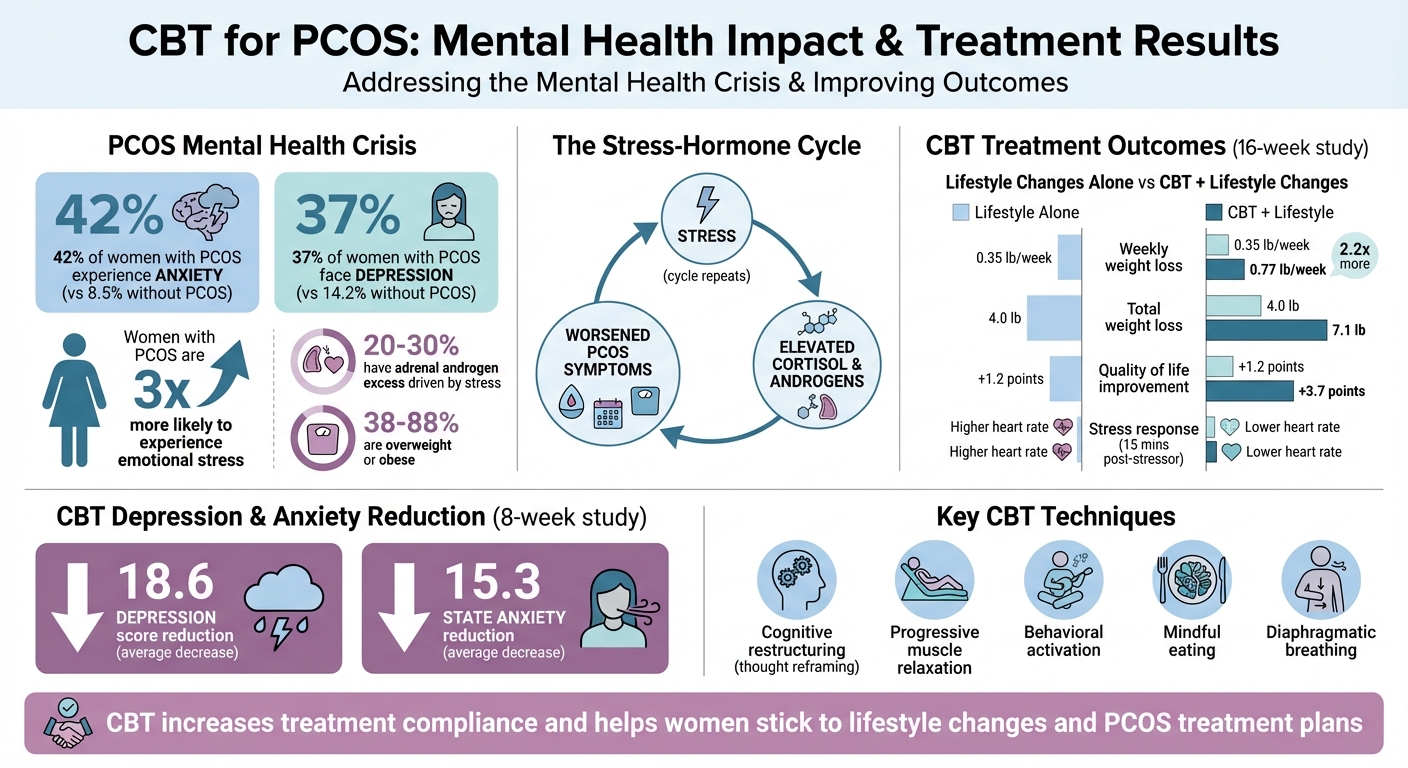
Living with PCOS often means dealing with more than just physical symptoms like irregular periods, acne, or weight gain. It also significantly impacts mental health, with 42% of women experiencing anxiety and 37% facing depression - far higher than rates in women without PCOS. Stress worsens these issues by raising cortisol levels, fueling inflammation, and disrupting hormone balance, which can intensify symptoms like insulin resistance and androgen excess.
The solution? Cognitive Behavioral Therapy (CBT). This therapy helps women manage the emotional toll of PCOS by addressing negative thought patterns, reducing stress, and improving adherence to lifestyle changes. Research shows CBT not only lowers anxiety and depression but also supports better weight management and hormonal balance. For example, women combining CBT with lifestyle changes lost double the weight compared to those making lifestyle changes alone.
Here’s what CBT offers:
- Stress reduction: Techniques like progressive muscle relaxation and deep breathing lower cortisol and improve emotional well-being.
- Behavioral tools: Scheduling positive activities and mindful eating help counteract emotional eating and withdrawal.
- Long-term strategies: Skills like thought reframing and self-monitoring empower women to manage stress and stick to treatment plans.
When paired with medical treatments like Metformin or Spironolactone, CBT enhances results, making it easier to break the cycle of stress and hormonal imbalance. For women with PCOS, addressing both the mental and physical aspects of the condition is key to feeling better and gaining control over symptoms.
PCOS Mental Health Statistics and CBT Treatment Outcomes
Addressing Psychosocial Impacts of Polycystic Ovary Syndrome in Women and Gender Diverse Individuals
sbb-itb-6dba428
The Link Between PCOS and Stress
PCOS and stress often fuel each other in a way that makes both conditions harder to manage. When you're stressed, your body activates the HPA (hypothalamic-pituitary-adrenal) axis. This prompts your pituitary gland to release ACTH, which signals your adrenal glands to produce cortisol and androgens.
Here’s where it gets tricky: while cortisol has a natural mechanism to regulate its own production, adrenal androgens don’t. Once they’re triggered, there’s no feedback loop to stop their production. This means stress can lead to persistently high androgen levels, which in turn make PCOS symptoms worse.
For about 20% to 30% of women with PCOS, stress - not just ovarian dysfunction - is the primary driver of elevated male hormones. This condition is known as "adrenal androgen excess". For these women, managing stress isn’t just helpful - it’s crucial for symptom control. Understanding these hormonal dynamics helps highlight why stress management is such a critical focus for women with PCOS.
Common Stressors for Women with PCOS
Living with PCOS often comes with its own set of stressors. The physical symptoms alone can create emotional strain. Unwanted facial and body hair, adult acne, weight gain (particularly around the abdomen), and thinning scalp hair all impact body image and self-esteem. These aren’t just minor inconveniences; they’re constant reminders of the condition, often leading to emotional distress.
Irregular periods are another major source of anxiety. The unpredictability of menstruation - especially for those concerned about fertility - can create ongoing worry. This uncertainty keeps the HPA axis in overdrive, perpetuating stress.
Weight challenges add another layer of frustration. Between 38% and 88% of women with PCOS are classified as overweight or obese. insulin resistance fuels androgen excess and makes weight loss even more difficult, creating a vicious cycle: stress leads to higher cortisol levels, which can make losing weight feel nearly impossible.
It’s no surprise that women with PCOS are three times more likely to experience emotional stress compared to those without the condition. This stress isn’t just about feeling overwhelmed - it’s tied to the symptoms that affect how women view themselves and how they believe others perceive them. These stressors, in turn, trigger hormonal responses that worsen PCOS symptoms.
How Stress Affects Your Hormones
When stress becomes chronic, it changes how your body handles hormones. Women under prolonged stress often develop a heightened ACTH response, meaning their bodies react more intensely to stress over time. What might have been a minor issue before can now cause a significant hormonal spike.
This creates a feedback loop. Cortisol increases blood sugar and insulin levels, disrupting reproductive hormones by interfering with Gonadotropin-Releasing Hormone (GnRH). This imbalance affects Luteinizing Hormone (LH) and Follicle-Stimulating Hormone (FSH), leading to irregular or absent ovulation. As a result, periods become unpredictable, and fertility challenges arise.
Insulin resistance makes matters worse. High insulin levels, combined with LH, stimulate the ovaries to produce more androgens. At the same time, insulin reduces SHBG (Sex Hormone-Binding Globulin), leaving more active testosterone circulating in the bloodstream instead of being bound and inactive.
"Women who are under chronic stress not only have more opportunities for elevated ACTH and thus elevated androgens, but their hormones may also start to react more severely to stressful situations." - Chris Kresser, M.S., L.Ac
This cycle of stress and hormonal imbalance worsens both physical and emotional symptoms. To break this loop, it’s essential to address both the physical effects of PCOS and the stress response. This is where therapies like Cognitive Behavioral Therapy can play a key role.
What is Cognitive Behavioral Therapy?
Cognitive Behavioral Therapy (CBT) is a type of psychotherapy designed to help people identify and change unhelpful thought patterns and behaviors. By focusing on the present, CBT provides practical tools to tackle current challenges, making it particularly helpful for managing the stress and emotional toll of PCOS.
The basic idea is simple: your thoughts influence your emotions, and your emotions drive your behaviors. For someone dealing with PCOS symptoms like unwanted facial hair or weight gain, negative thoughts can spiral quickly. CBT offers strategies to recognize and reframe these thoughts in a more balanced way. By addressing these patterns head-on, CBT can reduce the emotional stress that often worsens PCOS symptoms.
"The goal of CBT is to improve quality of life by modifying a person's current thought patterns and restructuring their behaviors." – PACMH Team
For women with PCOS, the challenges often go beyond the physical symptoms. Issues like body image struggles and concerns about fertility can weigh heavily. CBT directly addresses these concerns, offering tools to break the cycle of stress and hormonal imbalance. Let’s dive into how CBT achieves this.
How CBT Works
CBT uses a variety of techniques to manage stress and reshape emotional responses. One key method is cognitive restructuring, which involves identifying "hot thoughts" - those automatic, negative reactions triggered by situations like noticing weight gain or facial hair. Using tools like thought record sheets, individuals can document these situations, their automatic thoughts, and the emotions that follow. This process helps challenge and balance those thoughts, leading to healthier perspectives.
Another tool in CBT is behavioral activation, which focuses on scheduling positive activities - like exercise or self-care routines - to counteract the tendency to withdraw when feeling overwhelmed by PCOS-related stress.
CBT also incorporates relaxation techniques, such as progressive muscle relaxation and guided imagery, to address physical symptoms of anxiety. These practices help calm the body’s stress response, easing issues like a racing heartbeat or muscle tension.
Research backs up CBT’s effectiveness. For example, a study conducted at Al-Zahra Hospital in Tabriz, Iran, involved eight weekly group CBT sessions. These 60–90 minute sessions included mood screening, challenging cognitive distortions, and relaxation exercises. By the end of the study, participants in the CBT group saw significant reductions in depression and anxiety - mean reductions of 18.6 and 15.3 points, respectively - compared to the control group.
Why CBT Works for PCOS Patients
CBT is especially effective for PCOS because it targets psychological factors that contribute to distress, such as rumination, overgeneralization, and excessive self-focus.
"CBT is believed to repair processes that maintain depression and anxiety, such as rumination, overgeneralization, and self-focused attention." – Majidzadeh S, et al.
This is crucial, given that women with PCOS face higher rates of anxiety (42%) and depression (37%) compared to women without the condition (8.5% and 14.2%, respectively). Beyond reducing emotional distress, CBT also boosts adherence to lifestyle changes and medical treatment plans, which are vital for managing PCOS.
One study led by Dr. Anuja Dokras at the University of Pennsylvania explored the impact of CBT combined with lifestyle changes. Over a 16-week trial, women in the CBT group lost an average of 0.35 kg per week (about 0.77 lb/week), compared to 0.16 kg per week (roughly 0.35 lb/week) for those making lifestyle changes alone. The CBT group also showed a reduced heart rate response to stress, highlighting its ability to disrupt the stress-hormone cycle.
| Outcome Measure | Lifestyle Changes Alone | CBT + Lifestyle Changes |
|---|---|---|
| Weekly Weight Loss | 0.16 kg/week (≈0.35 lb/week) | 0.35 kg/week (≈0.77 lb/week) |
| Total Weight Loss (16 weeks) | 1.8 kg (≈4.0 lb) | 3.2 kg (≈7.1 lb) |
| Quality of Life Improvement | +1.2 points | +3.7 points |
| Stress Response (Heart Rate) | Higher autonomic response | Lower response 15 mins post-stressor |
These results demonstrate that CBT not only improves mental health but also contributes to better physical outcomes, showing its potential to break the cycle of stress and hormonal imbalance in PCOS.
Using CBT to Manage PCOS Stress
Incorporating CBT techniques into your daily routine can help you tackle the emotional challenges tied to PCOS. Let’s explore some practical strategies that can make a difference.
Changing Negative Thought Patterns
A key part of managing PCOS stress with CBT is identifying and challenging negative thoughts that drive feelings of anxiety and depression. These "hot thoughts" often pop up automatically, like when you see unwanted facial hair in the mirror or step on a scale.
One helpful tool is the seven-column thought record. This worksheet guides you to document stressful situations, pinpoint your automatic thoughts, recognize the emotions they trigger, and challenge those thoughts with evidence. For instance, if you think, "I'll never lose weight with PCOS", the worksheet helps you list evidence supporting and contradicting that belief. You can then reframe it into something more balanced, like, "Weight loss is harder with PCOS, but many women succeed with the right plan".
Be on the lookout for common cognitive distortions. Women with PCOS often struggle with all-or-nothing thinking, such as "I ate one cookie, so my whole day is ruined", or overgeneralization, like "One irregular cycle means I'll never get pregnant". Recognizing these patterns allows you to replace them with more realistic, evidence-based thoughts.
Once you’ve started addressing your thought patterns, it’s time to add behavioral techniques to calm your body’s stress responses.
Behavioral Techniques for Stress Reduction
CBT isn’t just about changing how you think - it also includes physical techniques to ease stress. These methods can help counteract the cortisol spikes and inflammation that worsen PCOS symptoms.
Progressive muscle relaxation (PMR) is a great starting point. This technique involves tensing and relaxing different muscle groups, starting from your toes and moving up to your head. Practicing PMR for 15 minutes twice a day can help reduce tension and cortisol levels.
Diaphragmatic breathing is another effective tool. During moments of acute stress, take slow, deep breaths from your belly instead of shallow chest breaths. This simple shift signals your body to exit fight-or-flight mode and promotes calmness.
For many, mindful eating can be a game-changer. By paying attention to hunger and fullness cues, you can address emotional eating, which is often linked to PCOS stress. This approach is particularly useful for managing weight and insulin resistance.
Research backs up these techniques. In a 16-week study at the University of Pennsylvania, women who combined CBT methods with lifestyle changes lost about 0.77 pounds per week, compared to 0.35 pounds per week for those who only made lifestyle changes. The CBT group also showed better stress regulation, with lower heart rate responses to stress 15 minutes after a lab stressor.
Beyond these immediate benefits, CBT equips you with tools for long-term stress management.
Developing Long-Term Coping Skills
The true strength of CBT lies in its ability to teach lasting skills that help you manage PCOS stress long after therapy ends. It’s not just about quick fixes - it’s about creating sustainable habits.
Self-management training is a key part of this process. Toward the end of CBT sessions, you’ll develop a personalized plan to maintain your progress. This might include identifying potential setbacks, like holiday eating or major life stressors, and creating strategies to address them before they throw you off track.
"CBT increased compliance for women with PCOS, meaning that they were more likely to stick to their lifestyle changes and PCOS treatment when coupled with CBT." – PACMH Team
This improved compliance is crucial for managing PCOS in the long run. With strong coping skills, it’s easier to stick to dietary changes, exercise routines, and medical treatments - even when motivation dips or stress levels rise.
Another practical skill CBT teaches is time management, which helps reduce the overwhelm that often triggers stress. Breaking tasks into smaller, manageable steps and prioritizing them can prevent burnout.
The impact of CBT goes beyond managing stress. Research shows that women who combined CBT with lifestyle changes saw a 3.7-point improvement in quality of life scores, compared to a 1.2-point improvement for those who only made lifestyle changes. This highlights how the skills learned through CBT can enhance your overall experience of living with PCOS, making life feel more manageable and fulfilling.
Pairing CBT with Oana Health PCOS Treatments
Combining Cognitive Behavioral Therapy (CBT) with targeted medical treatments creates a well-rounded plan for managing PCOS. This approach tackles both the mental and physical challenges of the condition, offering a way to address the psychological and physiological aspects together for better results.
Oana Health's PCOS Treatment Options
Oana Health provides prescription-based treatments designed to address common PCOS symptoms:
- Metformin ER ($22/month): Helps manage insulin resistance.
- Spironolactone ($14/month): Blocks androgens that cause hormonal acne and unwanted facial hair.
- Metformin & Spironolactone pack ($32/month): Combines both medications to support hormonal balance.
- Bupropion XL ($25/month): Aids in mental health and weight management.
- Oral GLP-1 & Metformin pack ($199/month): Offers enhanced metabolic management.
By integrating these treatments with CBT, patients can not only work toward hormonal balance but also establish stronger lifestyle habits that support long-term health.
How CBT Improves Treatment Results
CBT plays a key role in improving the outcomes of medical treatments by addressing the mental roadblocks that can hinder progress. A study led by Dr. L.G. Cooney in July 2018 found that women who combined CBT with lifestyle changes lost 3.2 kg over eight weeks - nearly double the 1.8 kg lost by those relying on lifestyle changes alone. Additionally, these women showed significantly lower heart rate responses during stress tests.
CBT helps patients challenge and manage negative thoughts, making it easier to stick to treatment routines like taking Metformin, following dietary recommendations, and maintaining other healthy habits. This consistency leads to better symptom control and hormonal balance. Furthermore, CBT's stress management techniques help reduce cortisol levels, which can otherwise exacerbate insulin resistance and inflammation.
Maintaining Your Progress Over Time
CBT skills aren't just tools for the short term - they require regular practice to truly make a lasting impact. For long-term success, it's essential to consistently apply these techniques and routinely check in on both your mental and physical health. One of the strengths of CBT is its ability to empower you with strategies you can use independently, even after therapy sessions have ended. These habits create a strong foundation for maintaining hormonal balance and overall well-being.
Preventing Stress-Related Setbacks
Keeping stress in check starts with self-monitoring. A study conducted between July and October 2021 at Al-Zahra Hospital in Tabriz, Iran, highlighted the importance of this approach. Involving 84 women with PCOS, the study had an intervention group participate in eight weekly CBT sessions, each lasting 60–90 minutes. The final session focused on prevention and self-management. The results were clear: the CBT group showed significant improvements, with depression scores dropping by an average of 18.6 points and state anxiety decreasing by 15.3 points.
Using tools like the seven-column thought record can help you stay on top of stress. This method encourages you to document situations, thoughts, emotions, counterevidence, and alternative perspectives. It’s particularly useful for addressing "hot thoughts" tied to body image, fertility, or treatment progress.
Incorporating progressive muscle relaxation into your daily routine - ideally twice a day - can also be a game-changer. This practice helps lower cortisol levels and reduce inflammation, both of which are common in PCOS. Set aside time each week for a self-management check-in. During this session, review your progress and stay alert for early warning signs like irregular eating habits or missed medications that could disrupt hormonal balance.
While self-monitoring builds resilience, having professional support can strengthen your efforts even more.
Ongoing Support Through Oana Health
Staying on track requires a mix of self-driven practices and expert guidance. Oana Health’s telehealth services make it easy to adjust your treatment plan as your hormonal needs evolve. Through regular consultations, you can connect with licensed medical professionals who understand the link between stress management and hormonal health. These check-ins not only help fine-tune your care but also encourage consistency with lifestyle changes and medication adherence.
Combining self-management skills with professional support creates a balanced approach to PCOS care. As the PACMH Team explains:
"Skills learned through CBT can aid in the self-management of PCOS symptoms and provide you with direction as you navigate the sometimes overwhelming task of regulating your PCOS".
Whether you’re using Metformin ER ($22/month), Spironolactone ($14/month), or another treatment, having ongoing support ensures you stay motivated and consistent in managing your hormonal health.
Conclusion
Managing PCOS requires addressing both physical and mental health challenges. Women with PCOS are three times more likely to experience depressive symptoms and five times more likely to struggle with anxiety compared to those without the condition. This makes psychological support a key component of effective, long-term care.
Research highlights the benefits of combining cognitive behavioral therapy (CBT) with medical treatments. Clinical trials have shown that this integrated approach not only doubles weekly weight loss but also significantly improves overall quality of life. As the PACMH Team explains:
"CBT increased compliance for women with PCOS, meaning that they were more likely to stick to their lifestyle changes and PCOS treatment when coupled with CBT".
This evidence emphasizes the importance of a comprehensive treatment strategy. Oana Health’s telehealth platform makes this approach accessible by connecting you with licensed medical professionals who recognize the link between stress and hormonal health. Whether you're using Metformin ER ($22/month), Spironolactone ($14/month), or other treatments, incorporating CBT skills supports consistent care and long-term progress. This approach helps break the stress-hormone cycle, reinforcing a key takeaway from this discussion.
FAQs
How soon can CBT reduce PCOS stress symptoms?
Studies indicate that weekly CBT sessions can ease PCOS-related stress in just 8 weeks. During this period, participants frequently report feeling less anxious and depressed. This is because CBT focuses on reshaping negative thought patterns, which not only boosts mental well-being but may also influence hormonal balance in a positive way.
Can CBT improve PCOS hormones and periods?
Yes, cognitive behavioral therapy (CBT) can play a role in regulating hormones and improving menstrual cycles for women with PCOS. By addressing stress and anxiety - two factors closely tied to hormonal imbalances - CBT may also help with weight management, reduce symptoms of anxiety or depression, and improve overall well-being.
Can I do CBT while taking Metformin or Spironolactone?
Yes, it’s perfectly fine to undergo Cognitive Behavioral Therapy (CBT) while taking Metformin or Spironolactone. There’s no evidence suggesting any interactions or contraindications between these medications and CBT. This means CBT remains a safe and effective way to address stress or other mental health challenges associated with PCOS while continuing your prescribed treatments.