
Male vs. Female Hair Transplants: Key Differences
Hair transplants for men and women differ in patterns of hair loss, donor area stability, and surgical goals. Men typically face localized balding, like receding hairlines or thinning crowns, driven by DHT. Women experience diffuse thinning across the scalp, often linked to hormonal shifts such as menopause or PCOS. These differences affect everything from donor hair availability to hairline design and recovery.
Key Points:
- Men: Stable donor zones (back/sides of the scalp), predictable balding patterns, focus on restoring hairlines or covering bald spots. Techniques like FUE are popular for minimal scarring.
- Women: Diffuse thinning, less stable donor areas, focus on increasing overall density without altering hairlines. FUT is often preferred as it doesn’t require shaving.
- Hormonal Factors: Women’s hair loss is influenced by estrogen levels, PCOS, or thyroid issues, requiring detailed pre-surgical evaluations and ongoing medical treatments.
Quick Comparison:
| Feature | Men | Women |
|---|---|---|
| Hair Loss Pattern | Localized (e.g., crown, hairline) | Diffuse thinning |
| Donor Area | Stable, broad | Limited, may also thin |
| Surgical Goal | Restore hairline, cover bald spots | Increase density |
| Popular Technique | FUE | FUT |
| Recovery Focus | Minimal scarring, quick return | Managing hormonal factors |
Understanding these differences ensures realistic expectations and better results for each gender.
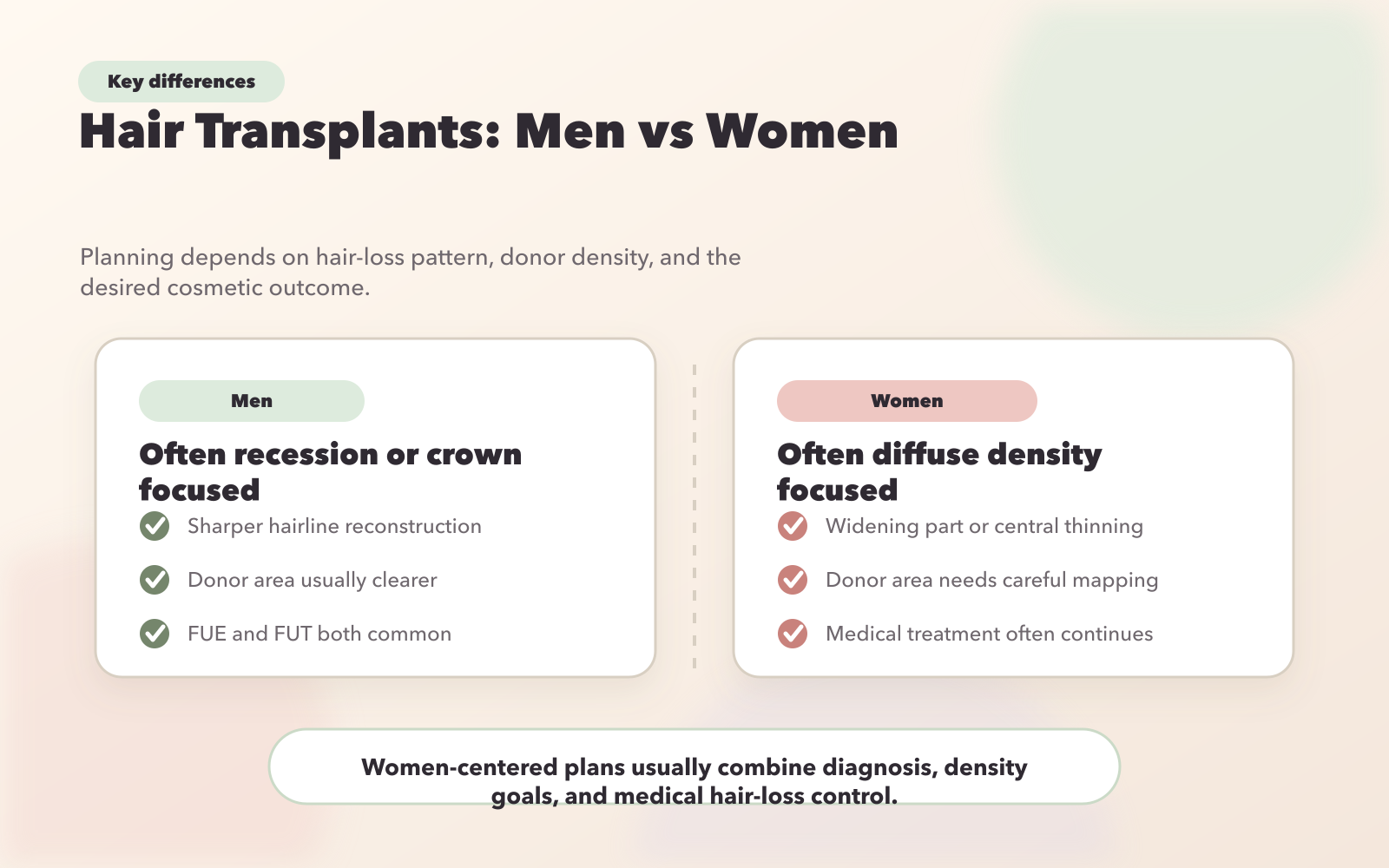
Male vs Female Hair Transplant Differences: Key Comparison Chart
Transgender Male to Female Hair Transplant Q and A
How Hair Loss Differs Between Men and Women
Hair loss shows distinct differences in how it affects men and women, both in appearance and underlying causes. For men, hair loss often follows a recognizable pattern, starting with an "M"-shaped receding hairline and thinning at the crown. This progression is tracked using the 7-stage Hamilton–Norwood scale. By the time men reach 50, about half of them experience some degree of hair loss, and this number increases to 70%–80% by their 70s or 80s. In severe cases, hair loss can result in almost complete baldness in certain areas. Women's hair loss, on the other hand, follows a different trajectory.
In women, thinning is typically more diffuse across the scalp, often creating what’s described as a "Christmas tree" pattern while maintaining the frontal hairline. This type of hair loss is measured using the 3-grade Ludwig scale. By age 30, about 12% of women experience hair loss, and this number rises to 30%–40% between the ages of 60 and 69.
Male Pattern Baldness
When it comes to men, hormonal sensitivity is the primary driver of hair loss. Male pattern baldness is closely linked to dihydrotestosterone (DHT), a powerful androgen. DHT is produced when the enzyme 5-alpha reductase converts testosterone. Once formed, DHT binds to androgen receptors in hair follicles, causing them to shrink - a process known as follicular miniaturization. This leads to the transformation of thick, terminal hairs into fine, nearly invisible vellus hairs and, eventually, the cessation of hair growth altogether.
"Male pattern hair loss can result in complete loss of hair coverage in particular areas, whereas female pattern hair loss rarely advances to baldness." - Nina L. Tamashunas, BS, and Wilma F. Bergfeld, MD, FAAD
Female Pattern Hair Loss
In women, hair loss is influenced by a more complex mix of hormonal factors. While androgens do play a role, many women with female pattern hair loss have normal androgen levels, making the exact mechanism more elusive. Hormonal changes, such as those caused by polycystic ovary syndrome (PCOS) or menopause, can trigger or worsen thinning. The drop in estrogen levels after menopause is another factor that may accelerate hair loss. Unlike men, women’s hair loss is generally spread across the scalp rather than being concentrated in specific areas.
Under normal conditions, about 12 hairs are growing (anagen phase) for every one hair resting (telogen phase). In androgenetic alopecia, this ratio can drop to 5:1, significantly reducing the number of active follicles. This imbalance leads to the thinning patterns characteristic of hair loss in both men and women. Recognizing these differences is crucial for tailoring surgical approaches and setting realistic expectations for treatment outcomes in each gender.
Donor Area Characteristics
The quality and availability of donor hair play a key role in hair transplantation and vary significantly between men and women. The donor area, typically located at the back and sides of the scalp, is where hair follicles are harvested for transplantation. The success of the procedure depends heavily on whether these follicles remain stable and continue to grow after being transplanted to thinning areas. This stability - or lack thereof - shapes the techniques used for men and women.
Stable Donor Zones in Men
Men generally have a reliable "safe donor zone" - a horseshoe-shaped area at the back and sides of the scalp. This zone is resistant to DHT (dihydrotestosterone), the hormone responsible for male pattern baldness. Because of this resistance, hair in this region remains stable and does not thin over time, making it ideal for transplantation. Roughly 90% of balding men are good candidates for hair restoration surgery, thanks to the dependable nature of their donor area.
"In men, the donor area - commonly at the back and sides of the scalp - remains largely unaffected by DHT. This provides a reliable and dense source of hair grafts." - Capilclinic
The stability of this donor zone allows surgeons to harvest a significant number of grafts, ensuring lasting results. Additionally, men typically have greater scalp laxity, meaning the skin at the back of their head is more flexible. This flexibility makes it easier to extract grafts and allows for larger strip harvests when using the FUT (Follicular Unit Transplantation) method.
Donor Area Challenges in Women
Women face unique challenges when it comes to donor hair. Female pattern hair loss often involves diffuse thinning across the scalp, including traditional donor areas. As a result, only about 2% to 5% of women experiencing hair loss are suitable candidates for surgical hair restoration. Unlike men, women’s safe donor zones are limited to a small area along the occipital bone at the back of the head, rather than the broader horseshoe-shaped zone.
"The most challenging aspect for women is the stability of the donor area." - Vinay Rawlani, MD, Northwestern Hair
Women also tend to have tighter scalp tissue, which limits the number of grafts that can be safely harvested. This reduced scalp laxity requires surgeons to be more cautious during the procedure to avoid excessive scarring. Before surgery, doctors must thoroughly evaluate the donor area using tools like densitometry, microscopy, or follicle biopsies. If the donor hair is thinning due to hormonal or systemic factors, transplantation becomes ineffective.
"Transplanting hair from such unstable donor sites would result in the transplanted hair falling out eventually, rendering the procedure ineffective." - American Hair Loss Association
These differences in donor area stability highlight the importance of a detailed pre-surgical evaluation, particularly for women considering hair transplants.
Hairline Design Differences
Hairline restoration is all about creating a design that works harmoniously with a person’s facial structure and gender-specific traits. A hairline that looks natural on a man might seem out of place on a woman, so surgeons carefully tailor the design to match the patient’s unique features and ensure it ages gracefully over time.
For men, hairlines are typically more angular and structured, often forming an "M" or "V" shape with some natural temple recession. Women, on the other hand, usually have hairlines that are rounded, oval, or bell-shaped, sitting lower on the forehead with minimal angularity at the sides.
Here’s a quick breakdown of the key differences between male and female hairline designs:
| Feature | Male Hairline Design | Female Hairline Design |
|---|---|---|
| General Shape | Angular, "M" or "V" shaped | Rounded, oval, or bell-shaped |
| Temple Area | Recessed/Angular | Full/Rounded |
| Height | Higher (mature hairline) | Lower on the forehead |
| Growth Angle | Sharp and forward-facing | Flat and soft |
| Density Focus | Gradual transition front-to-back | High frontal density to avoid see-through |
Angular and Recessed Hairlines for Men
For men, the hairline is usually placed higher on the forehead with a deliberate recession at the temples. This creates a mature and natural look that evolves well with age. Surgeons often use the "4-finger rule" - placing the hairline about four fingers above the eyebrows - as a starting point, adjusting based on the individual’s facial structure and proportions.
"A hairline that is too low might not age well, while a receding hairline that is too high can look unnatural. The right balance ensures long-lasting hair growth." - Dr. Ross Kopelman, Kopelman Hair
To mimic natural male hair growth patterns, hair is implanted at sharper, forward-facing angles. Single-hair grafts are used at the very front to create subtle irregularities and soft transitions. This avoids the artificial look of a straight "wall of hair" and ensures a natural appearance.
Softer and Rounded Hairlines for Women
Women’s hairlines follow a completely different set of rules. They are designed to be lower, softer, and more rounded to complement feminine facial contours. Features like a widow’s peak, present in 81% of women, and lateral mounds, seen in 98% of female hairlines, are carefully considered during the design process.
"Designing a female hairline as if it were male is one of the most common and damaging mistakes in hair restoration." - Haarex Clinic
To maintain a feminine look, hair is implanted at flatter, softer angles along the frontal line. Women also require higher density at the front to ensure the scalp doesn’t show through. On average, the distance from the mid-eyebrow to the frontal midpoint in women is about 5.5 cm (approximately 2.2 in). Surgeons use this measurement as a baseline, customizing the design to enhance both volume and natural curvature. These thoughtful adjustments highlight the importance of a specialized approach for female hair restoration.
Transplant Techniques by Gender
When it comes to hair transplants, gender plays a big role in determining the best approach. Factors like hairline design, donor area characteristics, and personal preferences all influence the choice of method. The two main techniques - Follicular Unit Extraction (FUE) and Follicular Unit Transplantation (FUT) - offer distinct benefits that cater differently to men and women.
In 2021, over 700,000 hair transplants were performed globally, with men making up about 87% of patients. FUE has emerged as the most popular choice, accounting for around 75% of male procedures and over 50% of female ones. The decision between these techniques often hinges on factors like scarring, shaving requirements, and the number of grafts needed.
FUE for Men
FUE involves extracting individual hair follicles with tiny punches, leaving small, scattered scars that are barely noticeable. This method has become the top pick for men, especially those who favor short hairstyles like buzz cuts or fades. Even with hair as short as 0.5 inches, the scars are nearly invisible.
Recovery with FUE is quick - most men can return to desk jobs within 2 to 3 days and resume normal activities in about a week. The minimal downtime makes it a great option for active lifestyles. However, traditional FUE usually requires shaving the donor area. For those who prefer to avoid shaving, "Partial Shave-Free FUE" techniques are available.
"FUE is a popular choice for men who prefer a minimally invasive procedure with minimal scarring. It's also a good option for those who want to keep their hair short." - Concord Hair Restoration
For men who prefer longer hairstyles or want maximum graft yield, another method may be more suitable.
FUT for Women
FUT, on the other hand, involves removing a thin strip of scalp tissue from the back of the head, which is then dissected into individual grafts. This method is often chosen by women because it doesn’t require shaving - the surrounding hair covers the donor area immediately after the procedure.
"FUSS (FUT) is usually the better option since females do not typically wear their hair so short that the donor scar from FUSS becomes visible. Female patients can enjoy the lower cost of FUSS while getting the result they seek." - International Alliance of Hair Restoration Surgeons
FUT is particularly effective for achieving a high graft yield in one session, making it ideal for addressing extensive hair loss. Since women generally have less scalp laxity than men, surgeons take extra care to avoid wide scars during strip harvesting. The resulting linear scar is easily concealed by hair that’s at least 0.5 inches long. In the U.S., FUT is often more cost-effective, with prices ranging between $4,000 and $15,000.
sbb-itb-6dba428
Surgical Goals and Density Requirements
Men and women often have distinct priorities when it comes to hair transplant consultations. For men, the main focus tends to be restoring a defined hairline and addressing bald areas, particularly at the temples and crown. Women, on the other hand, are typically more concerned with improving scalp density and thickness, aiming to minimize the appearance of thinning areas. These differing goals influence how surgeons approach graft placement and overall surgical planning for each gender.
Men's Focus on Hairline and Coverage
For men, hair restoration usually centers on areas with complete hair loss, such as a receding hairline and the crown. These patterns align with the predictable progression of male pattern baldness. Surgeons prioritize crafting a natural, age-appropriate hairline that complements facial features. Since men often have stable donor zones, their procedures typically involve localized graft placement, especially when hair loss is limited to the hairline. This can result in a lower total graft count compared to more widespread hair loss cases.
Women's Focus on Volume and Thickness
Unlike men, women generally experience diffuse thinning across the top of the scalp rather than distinct bald patches. The frontal hairline often remains intact.
"For women, the focus is usually on achieving fuller, denser hair rather than altering the hairline." - Concord Hair Restoration
To address this, surgeons distribute smaller grafts throughout the thinning areas, blending them with existing hair to increase density and reduce scalp visibility. Women’s hair loss patterns and the potential for thinning in donor areas often mean they require a higher graft count. Additional treatments, such as PRP (platelet-rich plasma) therapy or minoxidil, may also be recommended to enhance results. While the changes may appear more subtle compared to men’s procedures, the impact on a woman’s confidence and overall appearance can be profound. Due to the complexity of these cases, women’s procedures also tend to involve more intricate planning and may come with higher costs.
Hormonal Factors and Recovery
Hormones play a pivotal role in the success of hair transplants, and their effects differ significantly between men and women. For men, transplanted hair from areas resistant to DHT (dihydrotestosterone) tends to thrive. However, many men still rely on medications like Finasteride after surgery to preserve their remaining hair.
In women, the situation is far more complex. Hair density is closely tied to estrogen levels, and events such as pregnancy, menopause, or conditions like polycystic ovary syndrome (PCOS) can lead to diffuse thinning even after a transplant . By the age of 50, around 40% of women experience some degree of hair loss, a figure that increases to roughly 50% by age 80 . Unlike men, many women with hair loss have normal testosterone levels, making it harder to pinpoint the root cause. These hormonal intricacies demand customized pre- and post-surgical care.
How Hormones Affect Women's Results
For women dealing with hormonal hair loss, thorough screening is crucial. This involves testing thyroid function, ferritin levels, free testosterone, DHEAS, and serum prolactin - especially if symptoms like irregular periods or acne are present . Conditions such as PCOS, thyroid imbalances, and nutritional deficiencies can significantly impact graft survival and overall transplant outcomes.
A notable trend is the increased prevalence of female pattern hair loss after menopause, which suggests that reduced estrogen levels directly affect hair density and the longevity of transplant results. Because of these factors, women often require ongoing medical support after surgery. Treatments like Oral Minoxidil or Topical Spironolactone, available through Oana Health, can help manage hormonal hair loss and maintain the density of non-transplanted hair . For women experiencing rapid shedding, it’s recommended to stabilize hair loss with medical therapy for 6 to 12 months before proceeding with a transplant. Long-term success often depends on consistent post-surgery management, including therapies from providers like Oana Health.
Recovery Times and Shock Loss Risks
Recovery after a hair transplant introduces additional challenges, particularly for women. Both men and women may experience "shock loss", a temporary shedding of existing hair. However, women are generally more sensitive to this phenomenon. This sensitivity arises because women often have a higher proportion of miniaturized hair in the recipient area, making these follicles more susceptible to surgical stress . While regrowth typically begins within 3 to 4 months, areas with more than 15% miniaturized hair are at higher risk of permanent shock loss unless stabilized with medical treatments.
Another factor influencing recovery is scalp donor laxity. Women generally have less flexible scalp tissue than men, which can complicate the harvesting process and potentially extend recovery times, especially with FUT (follicular unit transplantation) procedures . Despite these challenges, over 90% of transplanted follicles successfully survive and grow naturally after the procedure. However, addressing the hormonal causes of hair loss remains essential for achieving long-term results.
Risks and Long-Term Expectations
Gender-Specific Risks
Hair transplants come with unique risks for men and women due to the differences in how hair loss progresses across genders. For men, the primary concern is ongoing hair loss in areas that haven’t been transplanted. This can lead to an unnatural "doughnut" effect if future hair loss isn’t managed with medical treatments or follow-up procedures. Since male pattern baldness often progresses over time, maintaining a natural appearance may require multiple sessions.
Women face a different set of challenges. Those with diffuse unpatterned alopecia (DUPA) often experience thinning in donor areas, which can compromise graft survival. Additionally, women are more likely to have reduced scalp laxity, increasing the risk of wider and more visible scars with FUT procedures. As one expert explains:
"Female patients typically have less donor laxity than their male counterparts... the doctor must take a more reserved approach to donor harvesting".
Both men and women are at risk of temporary shock loss, but the likelihood of permanent loss increases if more than 15% of the patient’s hair is already miniaturized. Women, in particular, are more vulnerable due to a higher proportion of thinning hair. If underlying conditions - such as thyroid issues or iron deficiency - are not addressed, they may experience further hair loss even after surgery. This highlights the importance of a well-planned, ongoing maintenance strategy.
Maintaining Long-Term Results
A tailored approach is essential for maintaining long-term results, as the needs of men and women differ significantly. Men often rely on medications like Finasteride to block DHT and slow further hair loss. In contrast, women require a broader strategy that may include addressing hormonal imbalances, nutritional deficiencies, and conditions like PCOS or thyroid dysfunction.
For women, pre-surgical evaluations are critical. Testing for thyroid function, iron (ferritin) levels, and hormones such as testosterone and DHEAS can help identify and treat underlying causes of hair loss. Managing these factors not only improves transplant outcomes but also helps prevent additional thinning.
Men under 25 are typically advised to delay hair transplants. Rapid hair loss at a young age can result in the "doughnut" effect as surrounding hair continues to recede. Stabilizing hair loss with medical therapy for six to twelve months before surgery is often recommended to minimize the risk of permanent shock loss.
Conclusion
Hair transplants require approaches that consider the unique patterns of hair loss in men and women. For men, treatments often focus on localized, DHT-driven balding, while women typically need procedures that address diffuse thinning caused by hormonal shifts, such as those linked to PCOS, menopause, or thyroid conditions. Women's procedures aim to restore density while maintaining a natural, rounded hairline. Men generally have a stable, DHT-resistant donor area, but women often face challenges with donor regions due to widespread thinning. These distinctions highlight the importance of tailoring hair restoration strategies to the specific needs of each gender, as discussed in earlier sections on hairline design and recovery.
Hormonal factors play a central role not only in triggering hair loss but also in determining the long-term success of transplants. Men can often manage progressive hair loss with DHT-blocking medications, while women benefit from a more comprehensive approach that addresses underlying conditions like PCOS, thyroid dysfunction, or iron deficiency. Treating these root causes can enhance transplant outcomes and help prevent further thinning.
If hormonal imbalances are contributing to your hair loss, Oana Health provides science-based, personalized treatments delivered right to your door. Options like oral minoxidil and topical spironolactone are available through licensed medical professionals to target the underlying causes of thinning hair. Taking charge of your hormonal health is a key step toward achieving thicker, healthier hair.
FAQs
Am I a good candidate for a hair transplant?
Your eligibility for a hair transplant largely hinges on aspects like the severity and pattern of your hair loss, the health of your scalp, and the availability of donor hair. Men with stable donor areas - commonly at the back and sides of the head - are often ideal candidates. Women, on the other hand, may encounter difficulties due to more diffuse hair loss patterns. To determine if a hair transplant is right for you, it's crucial to consult a qualified specialist who can assess your unique situation.
Which is better for me: FUE or FUT?
Choosing between FUE (Follicular Unit Extraction) and FUT (Follicular Unit Transplantation) comes down to your specific needs and priorities.
- FUE is a great option if you want minimal scarring, a quicker recovery period, and the flexibility to wear shorter hairstyles without visible marks.
- FUT, on the other hand, is better suited for those dealing with significant hair loss. It allows for more grafts to be transplanted in a single session and is often a more budget-friendly choice. However, it does leave a linear scar.
Your decision should consider factors like the extent of your hair loss, how much donor hair is available, and your budget. Consulting with a specialist will help you weigh these factors and choose the best approach for your situation.
How do hormones affect women’s transplant results?
Hormones are a major factor when it comes to the success of hair transplants for women, as they directly affect hair follicle health and the way hair loss occurs. Unlike men, who typically experience localized balding, women with androgenetic alopecia often deal with diffuse thinning. This condition is frequently tied to hormonal imbalances. To enhance the results of a hair transplant and protect both transplanted and existing hair, treatments like spironolactone or minoxidil are often used to help regulate hormone levels.