
How Metformin Lowers CRP in Hormonal Disorders
Metformin is a widely used medication for managing PCOS, a hormonal disorder linked to chronic low-grade inflammation. A key marker of this inflammation is C-reactive protein (CRP), which is often elevated in women with PCOS due to insulin resistance and excess visceral fat. Here's what you need to know:
- CRP and PCOS: Elevated CRP levels are common in PCOS, even in lean individuals, due to insulin resistance and inflammation. This increases risks for Type 2 diabetes and cardiovascular disease.
- Metformin's Role: Metformin improves insulin sensitivity, reduces CRP levels (average reduction: 1.23–1.47 mg/L), and interrupts the inflammation-insulin resistance cycle.
- How It Works: Metformin activates AMPK, lowers insulin levels, suppresses inflammatory pathways (like NF-κB), and promotes weight loss, all of which help reduce inflammation.
- Clinical Evidence: Studies show CRP reductions of up to 74% after 12 months, with greater benefits in obese individuals.
- Additional Benefits: Metformin stabilizes hormones, reduces testosterone, improves menstrual cycles, and supports heart health.
Starting with a low dose and gradually increasing can minimize side effects like nausea or bloating. Long-term use may require monitoring for vitamin B12 deficiency and GI side effects. For those with PCOS, metformin offers a multi-faceted approach to reducing inflammation and improving overall health.
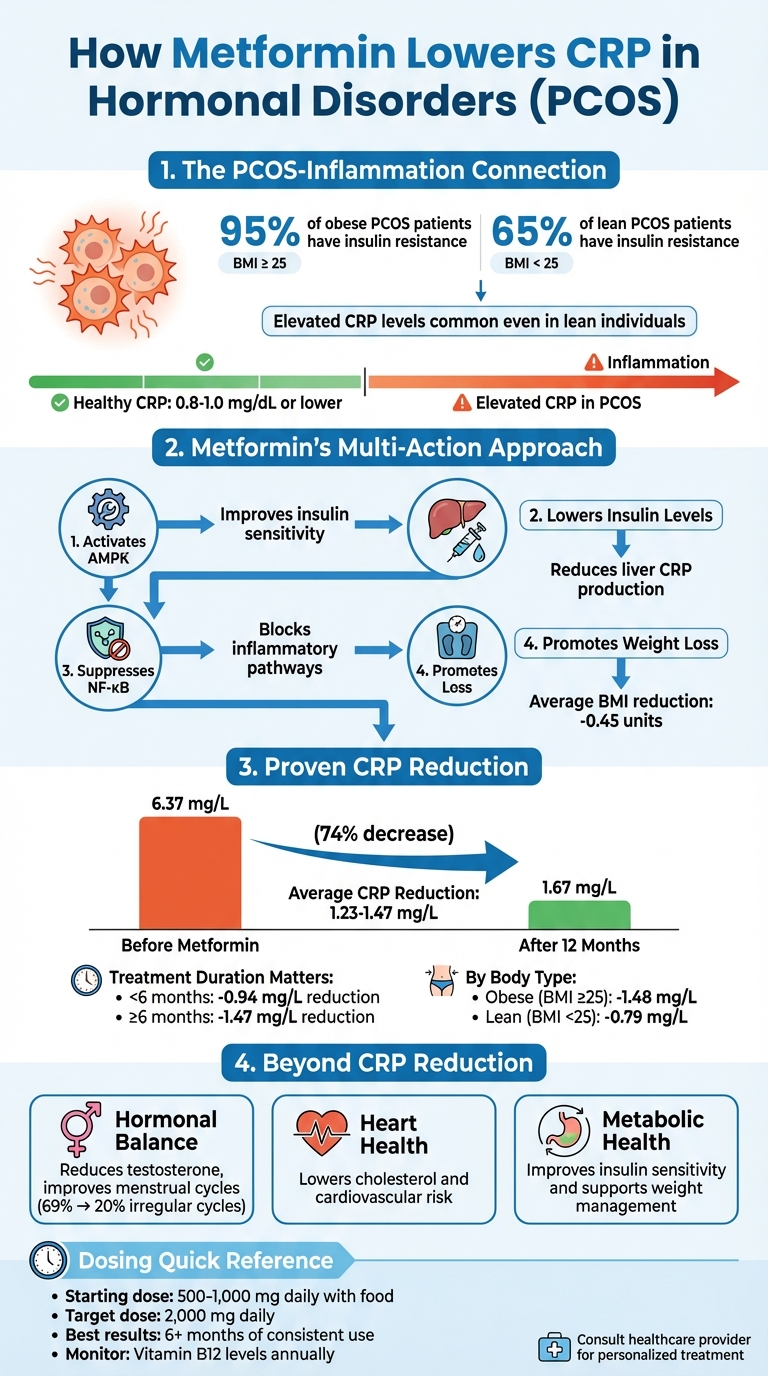
How Metformin Reduces CRP and Inflammation in PCOS: Mechanisms and Clinical Results
What is CRP and Why Does It Matter in Hormonal Disorders?
What is C-Reactive Protein (CRP)?
C-reactive protein (CRP) is a protein that the body releases during acute inflammation. Its levels rise quickly in response to infections or injuries, and they can also provide insights into how well treatments are working.
For most people, a healthy CRP level is considered to be between 0.8 and 1.0 mg/dL or lower. On the other hand, CRP levels above 50 mg/L are often linked to acute bacterial infections, with studies showing this occurs in about 90% of such cases. It's worth noting that there are two types of CRP tests: standard CRP tests, which detect significant inflammation, and high-sensitivity (hs-CRP) tests, which can identify smaller increases in CRP. The hs-CRP test is particularly useful for assessing heart disease risk. This ability to detect subtle inflammation is essential for understanding conditions like polycystic ovary syndrome (PCOS), where low-grade inflammation plays a key role.
Grasping how CRP functions is the first step to seeing its connection to hormonal imbalances.
How CRP Relates to Hormonal Imbalances
In hormonal disorders such as PCOS, CRP serves as a marker for the chronic low-grade inflammation that often drives these conditions. This persistent inflammation can lead to additional health challenges over time.
One major factor is visceral fat - fat stored around internal organs - which releases IL-6, a substance that stimulates CRP production. This connection helps explain why many women with PCOS, especially those who are overweight, tend to have elevated CRP levels. Interestingly, research has also shown that even lean women with PCOS often exhibit higher CRP levels compared to women without the condition.
According to Dr. Zeev Blumenfeld, CRP can act as a predictor for young women with PCOS, identifying those at greater risk for future cardiovascular issues, such as Type 2 diabetes and metabolic syndrome.
sbb-itb-6dba428
How Insulin Resistance Raises CRP Levels
Insulin Resistance Triggers Inflammation
The connection between CRP and hormonal imbalances becomes even clearer when you examine how insulin resistance fuels inflammation.
Insulin resistance doesn't just disrupt blood sugar regulation - it sets off a chain reaction of inflammation that directly elevates CRP levels. When cells become resistant to insulin, the body compensates with higher insulin levels (hyperinsulinemia). This triggers the liver to ramp up CRP production and activates inflammatory pathways.
Here's a striking fact: insulin resistance affects 95% of obese and 65% of lean PCOS patients. Studies also reveal a strong link between fasting insulin and CRP levels, with correlation coefficients ranging from 0.54 to 0.57. Put simply, as insulin levels climb, CRP levels rise in tandem.
"Chronic low-grade inflammation induces insulin resistance both directly and indirectly via activation of serine kinase and mobilization of free fatty acids."
– Jiao Wang, MS, Department of Endocrinology and Metabolism, First Affiliated Hospital of Nanchang University
CRP isn't just a passive marker of inflammation - it actively contributes to it. It stimulates monocytes and endothelial cells, intensifying the inflammatory cycle. CRP also binds to leptin, blocking its normal signaling, which leads to leptin resistance. This leptin disruption impacts energy balance and glucose metabolism, worsening insulin resistance.
Even something as routine as glucose intake can spark immune responses, further fueling this cycle. The result? A feedback loop that makes breaking free from insulin resistance even more challenging.
Why Treating Insulin Resistance Matters
Tackling insulin resistance is critical because it stops the inflammation cycle at its root. As insulin resistance improves, insulin levels drop, which reduces the liver's CRP production. Interrupting this feedback loop helps lower CRP levels, preventing them from perpetuating further insulin resistance.
The stakes are high, especially for cardiovascular health. Elevated CRP levels combined with insulin resistance dramatically increase the risk of type 2 diabetes and heart disease. Dr. Zelija Velija-Ašimi from the University of Sarajevo highlights that CRP linked to hyperinsulinemia is not only a cardiovascular risk factor but also plays a key role in PCOS development.
Addressing insulin resistance also brings hormonal relief. Lower insulin levels mean reduced testosterone production by the ovaries, leading to more regular menstrual cycles and an improvement in PCOS symptoms. By decreasing CRP and stabilizing insulin levels, treatments like metformin can play a crucial role in restoring balance and reducing inflammation.
How Metformin Reduces CRP in Hormonal Disorders
How Metformin Works
Metformin tackles inflammation through two main pathways: improving insulin sensitivity and directly suppressing inflammatory signals.
The drug activates AMPK - a critical energy regulator - which enhances how cells respond to insulin and helps manage blood sugar levels. Lower insulin levels reduce the liver's drive to produce CRP (C-reactive protein), effectively breaking the cycle of inflammation at its core.
Additionally, metformin inhibits NF-κB, a key driver of inflammatory responses. It achieves this through AMPK-related and independent mechanisms. By blocking NF-κB, the drug directly reduces CRP production, complementing earlier findings that link insulin resistance to elevated CRP levels.
"Metformin not only improves chronic inflammation through the improvement of metabolic parameters such as hyperglycemia and insulin resistance but also has a direct anti-inflammatory action."
– Jixiong Xu, MD, PhD, First Affiliated Hospital of Nanchang University
Metformin also promotes weight loss, which further lowers systemic inflammation. Studies show an average BMI reduction with a standardized mean difference of -0.45 units. Since excess body fat contributes to inflammation, this weight loss plays a role in reducing CRP levels.
These cellular mechanisms form the foundation for the clinical evidence discussed below.
Research Evidence on CRP Reduction
Clinical studies consistently back metformin's ability to lower CRP levels. Meta-analyses involving over 400 women with PCOS highlight significant reductions. For instance, a 12-month study of 35 obese women with PCOS taking 850 mg daily showed CRP levels dropping from 6.37 mg/L to 1.67 mg/L - a striking 74% decrease.
Long-term use yields even greater benefits. Women treated for 6 months or more experienced a CRP reduction of -1.47 mg/L, compared to -0.94 mg/L for treatments shorter than 6 months. These effects are observed in both obese and lean patients, though they are more pronounced in those with higher BMI. Obese patients (BMI ≥ 25) showed a -1.48 mg/L CRP reduction, while lean patients (BMI < 25) saw a decrease of -0.79 mg/L. Even in lean individuals, the reduction is meaningful for improving cardiovascular health.
Other Health Benefits of Metformin
Lower Cardiovascular Risk
Metformin does more than just reduce inflammation - it also supports heart health. By lowering CRP levels, a marker tied to chronic inflammation, metformin helps decrease the risk of heart disease. Additionally, it improves lipid profiles by reducing total cholesterol, LDL cholesterol, and triglycerides. Together with its ability to tackle insulin resistance in PCOS, these effects create a well-rounded defense against cardiovascular issues.
"Metformin administration offers new possibilities for preventing CVD in women with PCOS, considering the important role of CRP in CVD." – Yong Chen, Department of Clinical Laboratory, The First Hospital of Changsha City
One noteworthy study from Sarajevo in 2006 examined 30 women with PCOS who took 850 mg/day of metformin. Their CRP levels dropped significantly, from 6.98 ± 1.92 mg/L to 1.98 ± 0.68 mg/L, and fasting insulin levels fell by 38%. These combined reductions in inflammation and insulin resistance provide meaningful protection for cardiovascular health.
Better Hormonal and Metabolic Health
Metformin also plays a key role in improving hormonal and metabolic balance. It reduces androgen levels by increasing sex hormone–binding globulin (SHBG) and directly suppressing ovarian androgen production. In the same Sarajevo study, participants saw their total testosterone levels decrease from 3.52 ± 0.89 to 1.66 ± 0.47, leading to noticeable improvements in symptoms like hirsutism and acne.
Menstrual cycles also become more regular with metformin treatment. In a study of 100 women with PCOS, the percentage of participants with irregular cycles dropped from 69% to 20% over 12 months. During this time, 11 pregnancies (13% of participants) were reported. By lowering insulin and blood sugar levels, metformin supports ovulation and promotes consistent cycles.
"The metformin therapy significantly improved insulin resistance, imbalance of endocrine hormones, hirsutism and menstrual cyclicity in women with PCOS." – Zelija Velija-Ašimi, University Clinical Centre of Sarajevo
Weight loss adds another layer of benefit. Metformin helps reduce body weight, BMI, and waist circumference, breaking the cycle where obesity worsens insulin resistance and androgen excess and inflammation. This interplay between metabolic and hormonal improvements creates a positive feedback loop that enhances overall well-being.
What to Know About Taking Metformin
Dosing and Treatment Timeline
Metformin is widely recognized for its ability to lower CRP (C-reactive protein), but getting the dose right and increasing it gradually is key. Clinical studies suggest doses between 850–2,550 mg daily for CRP reduction. Typically, treatment begins with 1,000 mg daily for the first three months, eventually increasing to a target dose of 2,000 mg per day. To minimize stomach issues, it’s often recommended to start even lower - 500 mg once daily with food - and then increase the dose every 1–2 weeks.
The timeline for results varies. CRP levels usually drop significantly after six months of consistent use. Long-term treatment (six months or more) tends to amplify these benefits. Other symptoms improve on different schedules: acne may show progress within three months, menstrual cycles often stabilize around six months, and conditions like hirsutism or acanthosis nigricans (a symptom of insulin resistance) may take 6–12 months to improve noticeably.
"The degree of decreased CRP levels was not depended on metformin dosage, but more significantly in patients treated beyond 6 months." – Yong Chen et al., Department of Clinical Laboratory, The First Hospital of Changsha City
Interestingly, studies have found that the length of treatment matters more than the dosage when it comes to CRP reduction. Obese individuals often experience a greater decrease in CRP compared to leaner individuals. Beyond lowering CRP, proper dosing can also help with hormonal balance. For those exploring metformin as a treatment for insulin resistance or hormonal issues, Oana Health offers telehealth consultations with licensed providers. They prescribe Oral Metformin ER starting at $22 per month, including free home delivery.
Next, let’s look at how to handle potential side effects.
Managing Side Effects
Managing side effects is crucial to getting the most out of metformin. Common issues include gastrointestinal problems like nausea, diarrhea, gas, bloating, and stomach pain, along with a metallic taste, headaches, and weight loss.
Taking metformin with food can help reduce these side effects. Starting with a low dose and increasing it gradually - commonly referred to as "start low and go slow" - allows your body to adapt. If stomach issues persist, switching to an extended-release version taken once daily may provide relief. It’s also a good idea to avoid sugary foods, as they can worsen bloating and diarrhea.
"If you start off on a higher dose, you're more likely to have these side effects. If you stop taking it for some reason and you go right back to that higher dose, you might also notice more of these side effects." – Diana Isaacs, PharmD, Cleveland Clinic
Long-term use of metformin (over four years) may increase the risk of vitamin B12 deficiency, which can lead to symptoms like numbness, tingling, or memory problems. To prevent this, annual B12 monitoring and supplementation are recommended. Rare but serious risks include lactic acidosis, especially in those with reduced kidney function, and hypoglycemia, which typically occurs when metformin is combined with insulin or sulfonylureas. If you have a history of kidney disease, it’s important to inform your doctor before starting metformin.
Conclusion
Metformin works on two fronts to manage hormonal disorders: it directly reduces inflammation and improves metabolic health. Studies reveal it decreases CRP levels by an average of 1.23 mg/L, with even better results - 1.47 mg/L - when used consistently for six months or more. Beyond inflammation, it addresses insulin resistance, lowers testosterone levels, and aids in weight management, tackling the underlying causes of chronic inflammation in conditions like PCOS.
Clinical evidence repeatedly highlights these benefits across CRP, insulin, and hormonal markers. Dr. Jixiong Xu explains:
"Metformin treatment in women with PCOS was associated with a significant decrease in CRP levels. Therefore, it may be suspected that metformin administration is effective for preventing cardiovascular disease in women with PCOS".
The research underscores the importance of starting treatment early and sticking with it. A six-month regimen, especially when paired with weight management, enhances metformin's anti-inflammatory properties. For example, obese patients see greater CRP reductions (1.48 mg/L) compared to lean patients (0.79 mg/L), emphasizing the need for tailored treatment plans.
For those seeking a personalized approach, Oana Health offers telehealth consultations with licensed providers. They provide Oral Metformin ER starting at $22 per month, including free home delivery.
FAQs
How does metformin help lower CRP levels in women with PCOS?
Metformin can lower CRP (C-reactive protein) levels in women with PCOS by addressing the systemic inflammation commonly tied to hormonal imbalances. It reduces inflammatory markers like CRP and TNF-α, which are often elevated in individuals with PCOS. This reduction in inflammation not only promotes better overall health but also aids in regulating hormones more effectively.
By targeting both inflammation and insulin resistance, metformin becomes an important tool in managing PCOS symptoms. For those seeking tailored solutions for PCOS and other hormonal conditions, Oana Health provides telehealth services grounded in science to meet individual health needs.
How does metformin support hormonal balance and heart health over time?
Metformin offers lasting benefits for hormonal balance and heart health, particularly for women dealing with conditions like polycystic ovary syndrome (PCOS). By boosting insulin sensitivity and reducing insulin resistance, metformin helps tackle hormonal issues such as elevated androgen levels. Over time, this can lead to improved ovulation and better overall hormonal regulation.
On top of that, metformin lowers CRP levels, an inflammation marker tied to heart disease risk. Its anti-inflammatory properties, combined with enhanced metabolic health, contribute to reducing cardiovascular risks in women with hormonal disorders. While metformin is generally safe for extended use, personalized care and consistent monitoring are key to optimizing its benefits.
What should I know about potential side effects or precautions when using metformin to reduce inflammation?
When using metformin to address inflammation, it’s essential to understand the potential side effects and take appropriate precautions. Common side effects like nausea, diarrhea, and stomach upset are typically manageable, especially if you switch to an extended-release version of the medication. While serious side effects are uncommon, they can happen - particularly in people with kidney problems or other underlying health issues.
Metformin can also influence blood sugar levels and how your body responds to insulin. That’s why it’s important to use this medication under the supervision of a healthcare provider. Regular check-ups and monitoring are key to ensuring both safety and effectiveness, especially if you have any pre-existing conditions. Always discuss your treatment plan and dosage with a medical professional to find what works best for your situation.