
Latest Research on HRT Safety and Monitoring
HRT is used to manage menopausal symptoms like hot flashes and prevent long-term health issues such as osteoporosis. Recent studies challenge outdated risk concerns, showing HRT is safer when started early (before age 60 or within 10 years of menopause). Key findings include:
- Heart Health: Early HRT use reduces heart attack risk by 50% and cardiac events by 48%. However, starting HRT after age 70 increases cardiovascular risks.
- Blood Clots: Transdermal HRT (patches, gels) avoids liver-related clot risks seen with oral HRT.
- Breast Cancer: Combined HRT slightly raises breast cancer risk, while estrogen-only therapy has a lower impact. Vaginal estrogen remains the safest for localized symptoms.
- Monitoring Tools: Personalized risk assessments, telehealth, and regular evaluations ensure safer, customized care.
The FDA recently removed broad warnings on HRT, emphasizing individualized treatment. By tailoring therapy to health needs and monitoring closely, women can safely benefit from HRT.
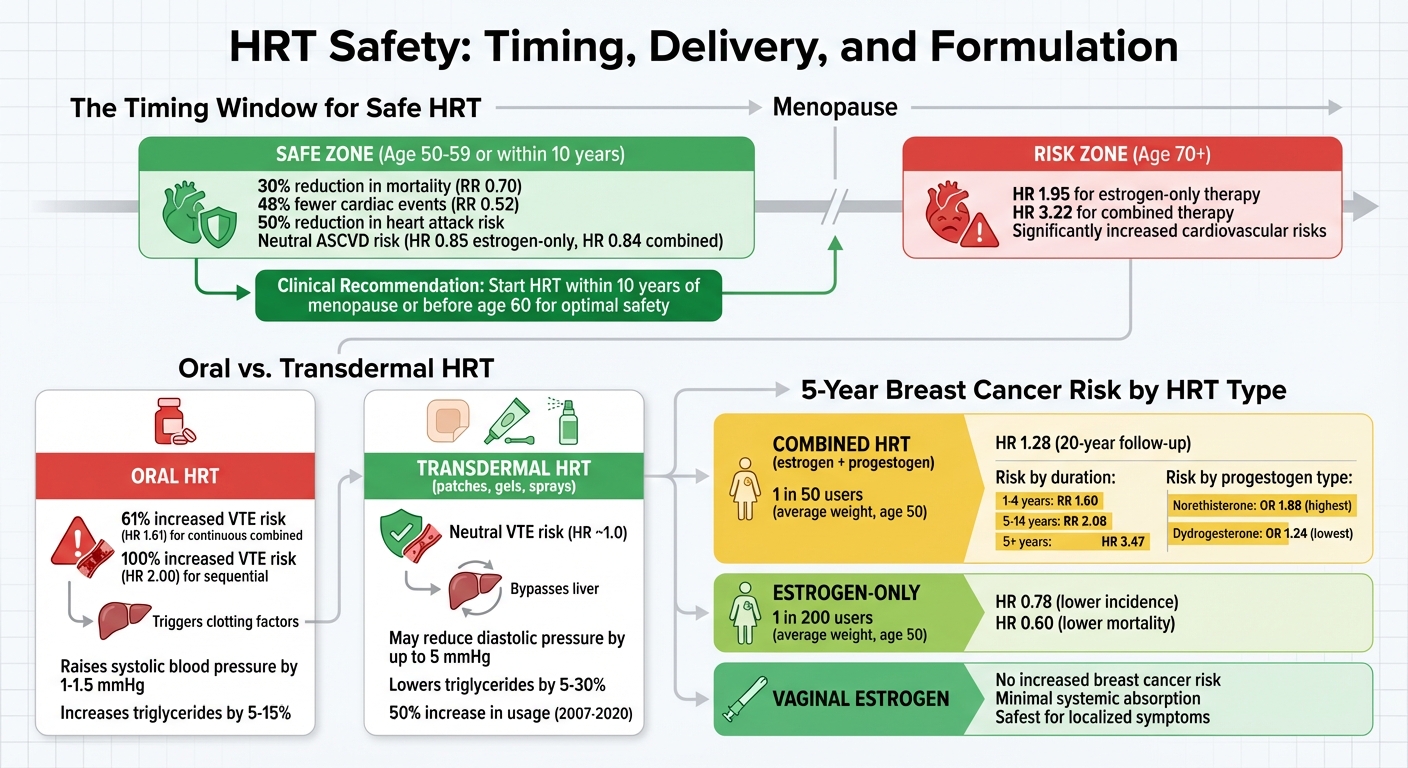
HRT Safety by Age, Delivery Method, and Formulation Type
FDA panel reassesses hormone therapy warnings in menopause treatments
Cardiovascular and Blood Clot Risks: What Recent Studies Show
Understanding the link between hormone replacement therapy (HRT) and heart health has evolved significantly. For years, HRT faced widespread caution due to cardiovascular concerns, but recent research highlights how timing matters when it comes to safety and effectiveness.
How Age and Timing Impact Heart Health
The "timing hypothesis" has reshaped how we view HRT's cardiovascular safety. Women who begin HRT within 10 years of menopause or before age 60 show notably better outcomes. Research indicates that starting treatment during this window can lead to a 30% reduction in mortality rates (RR 0.70) and 48% fewer cardiac events (RR 0.52) compared to those who don’t use HRT.
Data from the Women's Health Initiative adds further nuance. For women aged 50–59, both estrogen-only and combined HRT appear to have a neutral effect on atherosclerotic cardiovascular disease (ASCVD) risks, with hazard ratios of 0.85 and 0.84, respectively. However, starting HRT later in life - at age 70 or older - can significantly increase risks. Hazard ratios jump to 1.95 for estrogen-only therapy and 3.22 for combined therapy in this age group.
"Estrogen may have plaque-destabilizing and other adverse effects in the setting of advanced atherosclerosis, but it provides an appropriate and safe option... when initiated in healthy women <60 years of age or within 10 years of menopause onset." – American College of Cardiology (ACC) Cardiovascular Disease in Women Committee
The science here is compelling. Early HRT use allows estrogen to act on healthier blood vessels, encouraging vasodilation and potentially preventing plaque buildup. On the other hand, starting HRT decades after menopause may destabilize existing plaques, leading to complications.
In addition to timing, how HRT is delivered also plays a crucial role in managing blood clot risks.
Blood Clot Risks and Prevention
Venous thromboembolism (VTE) is one of the most concerning risks associated with HRT, but the delivery method significantly influences this risk. Oral HRT increases VTE risk because it passes through the liver, triggering the production of clotting factors. A 2024 Swedish trial found that oral continuous combined therapy raised VTE risk by 61% (HR 1.61), while sequential oral therapy doubled the risk (HR 2.00).
Transdermal HRT, applied via patches, gels, or sprays, bypasses the liver entirely and has a neutral effect on VTE risk. This has driven a major shift in clinical practice, with transdermal HRT use increasing by over 50% between 2007 and 2020 in some regions.
"The clear winner in this updated review of treatment for vasomotor symptoms in menopause is transdermal formulations of HT." – Deirdre Mattina, MD, Medical Director of Cardio-Obstetrics at Cleveland Clinic Hillcrest Hospital
Monitoring blood pressure is also critical. Even small increases in systolic blood pressure can raise stroke risks. Oral HRT has been shown to raise systolic pressure by 1–1.5 mmHg, while transdermal therapy may actually reduce diastolic pressure by up to 5 mmHg. For women with conditions like obesity, hypertension, or high triglycerides, transdermal options are particularly advantageous, offering a safer route to manage both cardiovascular and clotting risks.
Breast Cancer Risks with HRT
Recent studies shed light on how different HRT formulations and the length of treatment influence breast cancer risk.
Estrogen-Only vs. Combined HRT
Combined HRT carries a greater breast cancer risk compared to estrogen-only therapy. For women of average weight who begin treatment at age 50, using combined HRT (estrogen plus daily progestogen) for five years increases breast cancer cases by about 1 in every 50 users. In contrast, five years of estrogen-only therapy results in an increase of approximately 1 in every 200 users.
The Women's Health Initiative's 20-year follow-up revealed some unexpected results regarding estrogen-only therapy. Women taking conjugated equine estrogen (CEE) alone experienced lower rates of breast cancer (HR 0.78) and lower mortality (HR 0.60) compared to those on a placebo. However, combined HRT in the same study was linked to a higher breast cancer incidence (HR 1.28).
The type of progestogen used also plays a critical role in determining risk. Research from the University of Nottingham found that norethisterone posed the highest risk (OR 1.88), while dydrogesterone had the lowest (OR 1.24). Additionally, daily progestogen use increases risk more than intermittent use - showing a relative risk of 2.30 compared to 1.93 for 5–14 years of treatment.
"Every MHT type, except vaginal oestrogens, was associated with excess breast cancer risks, which increased steadily with duration of use and were greater for oestrogen-progestagen than oestrogen-only preparations." – Collaborative Group on Hormonal Factors in Breast Cancer
Vaginal estrogen preparations remain a safe choice for treating localized urogenital symptoms, as their minimal systemic absorption is not linked to an increased breast cancer risk.
How Treatment Duration Affects Risk
The length of HRT use significantly impacts breast cancer risk, regardless of the formulation. Combined therapy increases relative risk from 1.60 for 1–4 years of use to 2.08 for 5–14 years. A Norwegian study highlighted that the risk rises from 23% (HR 1.23) for less than a year to a 3.5-fold increase (HR 3.47) for five or more years of use.
Using HRT for 10 years roughly doubles the breast cancer risk compared to five years of use. Even after stopping therapy, the elevated risk can persist for more than a decade, with the extent of risk linked to the duration of prior use.
Clinical recommendations generally advise keeping HRT use to five years or less and only using it as long as necessary to manage menopausal symptoms. Women with a lower body mass index (BMI) are at higher relative risk from HRT than those with obesity, as the hormonal effects are stronger in lean women. These findings highlight the importance of tailoring HRT use to balance symptom relief with minimizing breast cancer risk, as newer therapies continue to emerge.
sbb-itb-6dba428
New Monitoring Methods and Safety Protocols
Advances in hormone replacement therapy (HRT) monitoring have moved away from generic approaches, focusing instead on personalized risk assessments and tailored safety measures. These changes help healthcare providers customize HRT for each patient while reducing potential risks.
New Monitoring Approaches
Current guidelines suggest starting HRT within 10 years of menopause or before age 60 to maximize cardiovascular benefits. Early initiation has been shown to lower the risks of heart attacks and Alzheimer's disease.
Before beginning HRT, clinicians now perform detailed screenings to assess individual risk factors. One key tool is the 10-year Atherosclerotic Cardiovascular Disease (ASCVD) risk score - a result below 5% generally signals a low risk for therapy initiation. Routine tests for lipid levels and glucose metabolism are also standard, as estrogen can influence these markers. For instance, oral HRT may raise triglyceride levels by 5% to 15%, while transdermal options can lower them by 5% to 30%.
Liver function monitoring is particularly important for oral HRT due to its potential impact on clotting risks. Transdermal HRT, which bypasses the liver, avoids this issue. For women with an intact uterus, endometrial monitoring is crucial. Vaginal ultrasounds are often used to detect hyperproliferation, especially in those on sequential or continuous combined regimens. Progestogen challenge tests are another tool to ensure endometrial safety.
These advancements are complemented by telehealth technologies, which simplify ongoing monitoring and make treatment adjustments more accessible.
How Telehealth Supports HRT Monitoring
Telehealth platforms have revolutionized how women manage HRT by providing convenient tools for tracking hormone levels and overall health. These digital solutions allow for timely reassessments and therapy adjustments.
Services like Oana Health offer personalized care for patients with moderate risk factors, such as obesity, diabetes, or hypertension. Virtual consultations give licensed medical professionals the ability to monitor symptoms like nausea or breast tenderness, which often signal the need for dosage changes. Additionally, these platforms facilitate tracking of bleeding patterns and enable progestogen challenge tests to maintain endometrial safety.
This digital-first approach fosters collaborative decision-making, helping determine the best formulation, dosage, and delivery method for each patient. By combining home delivery of treatments with regular virtual check-ins, telehealth removes logistical hurdles while maintaining the personalized care necessary for safe and effective HRT management.
How to Reduce HRT Risks
Advancements in monitoring and individualized care have made it easier to minimize the risks associated with hormone replacement therapy (HRT). The key is to align the treatment with each patient’s specific health needs and adjust it over time to ensure safety and effectiveness.
Customizing HRT for Each Patient
HRT should be tailored to individual health profiles. For instance, transdermal options are often better suited for patients with conditions like obesity, diabetes, or high triglycerides, as oral HRT can increase clotting risks due to liver activation. Women with uncontrolled high blood pressure (≥180/110 mm Hg) should avoid HRT until their blood pressure is stabilized.
Progestogen choice is crucial for women with a uterus. Options like micronized progesterone or dydrogesterone are linked to a lower risk of breast cancer compared to synthetic progestins. For women experiencing only urinary or vaginal symptoms, low-dose vaginal estrogen is often a safer choice, as it has minimal systemic absorption and fewer associated risks.
Timing also plays a vital role. Starting HRT within 10 years of menopause can reduce the risk of heart attacks by 50% and cognitive decline by 64%. Additionally, women with an ASCVD risk score below 5% are generally considered low-risk candidates for starting therapy.
Limiting HRT Duration
In November 2025, the FDA updated its guidance, removing the recommendation to use HRT for the "shortest amount of time" and instead emphasizing individualized treatment based on quality of life. This shift doesn’t imply indefinite use but highlights the importance of regular reassessments to ensure the benefits continue to outweigh the risks.
"The FDA is re-considering the benefit/risk balance of these drugs and is requesting... [to] remove the recommendation to use the lowest effective dose for the shortest amount of time." - U.S. Food and Drug Administration
Annual evaluations are essential. These exams help determine whether to continue therapy. Recommendations vary: ACOG advises against routinely stopping HRT at age 65, while AACE typically suggests limiting therapy to five years, with dose reductions for extended use. NAMS supports continued treatment for persistent symptoms or bone loss prevention, as long as regular reassessments are conducted. For women continuing HRT past age 65, lower doses and transdermal options can help reduce the risks of blood clots and strokes.
Getting Support Through Telehealth
Telehealth has become an effective way to manage HRT, offering convenient and continuous care. Despite 41 million American women being in the age group most affected by menopausal symptoms, only about 2 million received systemic HRT prescriptions in 2020.
Platforms like Oana Health provide personalized care through virtual consultations with licensed professionals. These services ensure ongoing monitoring to keep treatment safe and effective. Adjustments to formulation, dosage, and delivery methods are made based on regular risk-benefit assessments. For women with a uterus, telehealth providers also assist with monitoring bleeding patterns and evaluating the endometrium. It’s important to note that any postmenopausal vaginal bleeding should be promptly evaluated by a healthcare provider, regardless of the HRT method used.
Conclusion
New research and advanced monitoring techniques are reshaping the landscape of hormone replacement therapy (HRT), offering a clearer picture of its safety and effectiveness. The FDA's decision in November 2025 to remove broad "black box" warnings is a major step forward, reflecting a shift toward evidence-based medicine. This change addresses past concerns that limited access to treatments many women could benefit from.
Modern monitoring tools are making HRT safer than ever. Transdermal delivery methods and thoughtful progestogen choices have reduced risks, while regular evaluations - such as tracking endometrial health, bleeding patterns, and cardiovascular factors - help ensure treatments remain both safe and effective over time.
Telehealth platforms like Oana Health are playing a key role in simplifying personalized care. Through virtual consultations, licensed professionals can frequently reassess patients, fine-tune dosages, and adjust formulations to ensure treatments continue to meet individual needs as women age.
The future of HRT is all about personalization and data-driven care, tailored to each woman’s unique health profile and life goals. This evolving approach promises to make HRT more accessible and safer, allowing more women to reap the health benefits of modern therapies.
FAQs
What are the advantages of starting hormone replacement therapy (HRT) early during menopause?
Starting hormone replacement therapy (HRT) early during menopause can make a big difference in managing symptoms like hot flashes and night sweats, helping improve daily comfort and well-being. Beginning HRT earlier is also linked to a reduced risk of developing cardiovascular issues compared to starting it later. On top of that, early treatment may play a role in maintaining stronger bones and lowering the chances of osteoporosis, a condition that becomes more frequent after menopause.
Does the way HRT is administered affect the risk of blood clots?
Yes, the way hormone replacement therapy (HRT) is delivered can play a big role in the risk of developing blood clots. Transdermal HRT, which is absorbed through the skin via patches or gels, has been found to carry a 20–30% lower risk of blood clots compared to oral HRT. On the other hand, oral HRT is more likely to increase the chances of venous thromboembolism (VTE) and arterial clots.
The reason for this difference lies in how the body processes each form. Transdermal HRT skips the liver's first-pass metabolism, which helps minimize its effect on clotting factors in the blood. If you're thinking about starting HRT, it's important to talk to a qualified healthcare provider. They can help you choose the safest and most effective option based on your individual needs.
What are the breast cancer risks linked to different types of HRT?
The risk of breast cancer can depend on the specific type of hormone replacement therapy (HRT) you use. Estrogen-only HRT is linked to a slight increase in risk - about 1.5 to 1.6 times higher. However, some research, like the WHI update, didn’t find this increase to be statistically significant. On the other hand, combined estrogen-progestogen HRT tends to carry a somewhat higher risk, ranging from 1.8 to 2 times higher. The level of risk can also vary based on the type of progestogen included. For instance, norethisterone-estradiol is associated with the highest risk, while dydrogesterone-estradiol is linked to the lowest. Tibolone, a different type of HRT, shows a smaller increase in risk, approximately 1.3 times higher.
Talking with your healthcare provider is crucial to finding the HRT option that best matches your health needs. With advancements in personalized care and monitoring, it’s now easier to manage and reduce potential risks effectively.