
PCOS Acne vs. Hormonal Acne: Key Differences
PCOS acne and hormonal acne are both caused by hormonal changes, but they differ in their triggers, symptoms, and treatments. Here's what you need to know:
- PCOS Acne: Caused by polycystic ovary syndrome (PCOS), it often results from high androgen levels and insulin resistance. Symptoms include deep, painful cysts on the jawline, chin, and neck, often accompanied by irregular periods, excess facial hair, or scalp hair thinning. Over-the-counter treatments are usually ineffective, and prescription medications like spironolactone or metformin, along with lifestyle changes, are often required.
- Non-PCOS Hormonal Acne: Tied to temporary hormonal fluctuations, such as menstrual cycles, stress, or life events like pregnancy. It typically appears as mild to moderate breakouts on the lower face or other areas and responds better to topical treatments like retinoids or benzoyl peroxide. Stress management and diet adjustments can also help.
Quick Comparison
| Feature | PCOS Acne | Non-PCOS Hormonal Acne |
|---|---|---|
| Primary Cause | PCOS-related androgen excess | Temporary hormonal fluctuations |
| Appearance | Deep, painful cysts | Mild to moderate breakouts |
| Location | Jawline, chin, upper neck | Broader areas like cheeks, back |
| Associated Symptoms | Irregular periods, facial hair, etc. | None beyond acne |
| Treatment Response | Requires hormonal therapy | Often responds to topical solutions |
Key Takeaway: PCOS acne requires targeted treatment for hormonal imbalances, while non-PCOS hormonal acne often improves with skincare and lifestyle changes. Consult a doctor if your acne persists or if you have symptoms of PCOS.
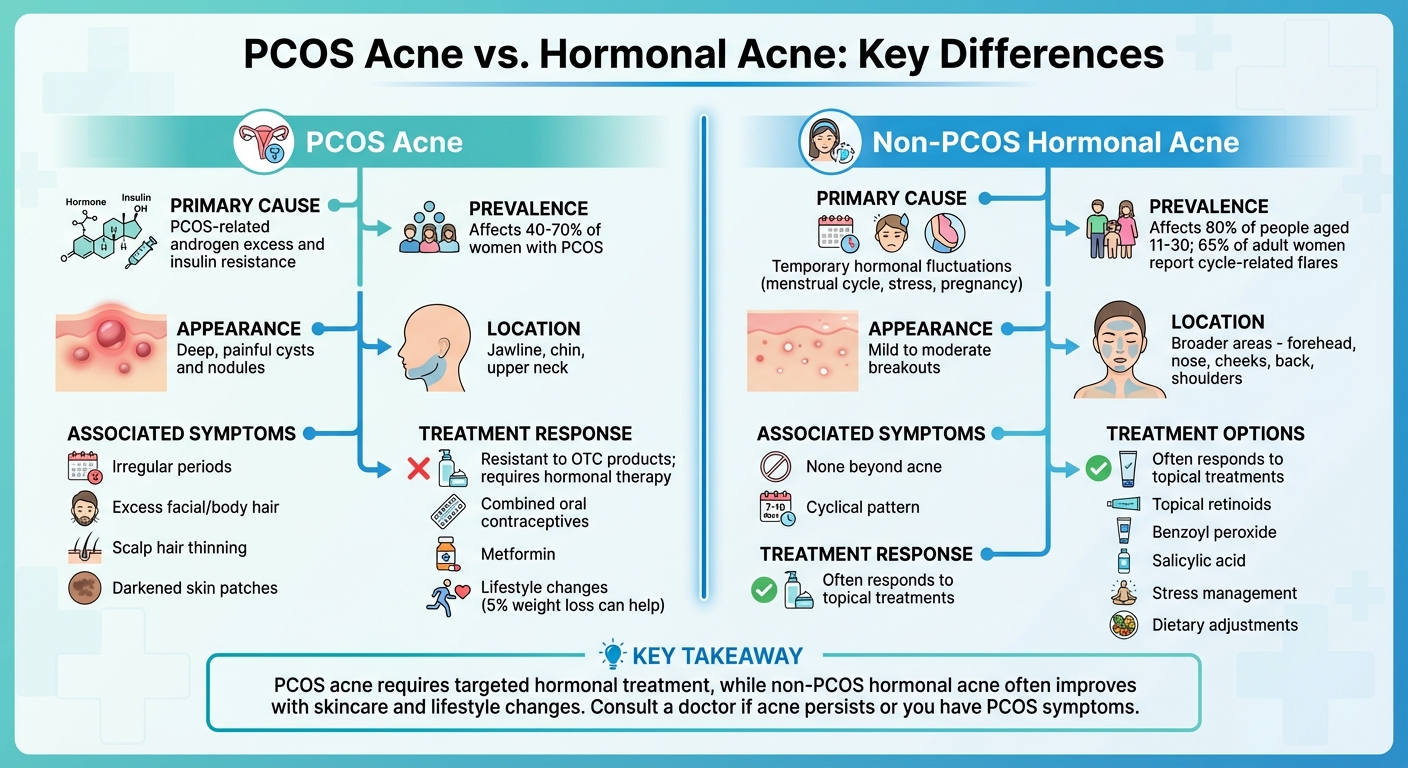
PCOS Acne vs Hormonal Acne Comparison Chart
Stress Acne vs. Hormonal Acne: How to Spot and Treat the Difference
What is PCOS Acne?
PCOS acne is a skin condition linked to polycystic ovary syndrome (PCOS), where the ovaries produce excess male hormones like testosterone and DHEA. Unlike typical acne, this condition stems from a mix of hormonal imbalances, insulin resistance, and inflammation.
It affects between 40% and 70% of women with PCOS, making it one of the syndrome's most common - and challenging - symptoms. Over-the-counter solutions often fall short because they don’t address the hormonal causes behind this type of acne.
Symptoms of PCOS Acne
PCOS acne has unique traits that set it apart from other breakouts. The most common lesions are deep, cystic bumps that form under the skin's surface. These can be painful and may take weeks to heal. The acne typically appears along the lower face, jawline, chin, and upper neck, though about 50% of women also notice breakouts on their chest and back.
Other signs often accompany PCOS acne, pointing to androgen excess. These include facial hair growth, thinning hair on the scalp, irregular menstrual cycles, and skin darkening in certain areas (called acanthosis nigricans). Acne often flares around menstrual periods and remains persistent, even with a consistent skincare routine.
How Hormones Cause PCOS Acne
PCOS acne arises from a chain reaction of hormonal imbalances. Elevated androgens - particularly testosterone and its stronger form, dihydrotestosterone (DHT) - stimulate sebaceous glands to produce excess oil. Dr. Jacqueline Zuponcic from Cleveland Clinic explains:
"Testosterone and DHEA tell your skin's sebaceous glands to produce more oil. These hormones can also slow down your skin's turnover rate, making the oil more likely to clog your pores. Together, these two factors lead to acne."
Insulin resistance, present in 40% to 80% of people with PCOS, adds another layer to the issue. High insulin levels increase the production of insulin-like growth factor 1 (IGF-1), which stimulates androgen production in the ovaries and adrenal glands. This creates a "pro-acneic state", making the skin more prone to breakouts. On top of that, skin enzymes can convert circulating androgens into even more potent forms, intensifying their effects where acne develops.
Understanding these hormonal triggers is key to choosing effective treatments, which are covered in the next section.
What is Non-PCOS Hormonal Acne?
Non-PCOS hormonal acne is caused by temporary hormonal shifts that lead to breakouts. These changes often occur during specific phases of the menstrual cycle, periods of high stress, or major life events like pregnancy and menopause. Unlike PCOS-related acne, which is tied to ongoing androgen overproduction, this type of acne aligns with the body's natural hormonal fluctuations.
This condition affects about 80% of adolescents and young adults aged 11–30 years. Among adult women, 20% to 40% experience acne that starts after puberty rather than continuing from their teenage years. Let's explore its key traits.
Characteristics of Non-PCOS Hormonal Acne
One hallmark of non-PCOS hormonal acne is its cyclical nature. Dr. Jason H. Miller from Schweiger Dermatology Group highlights:
"If your breakouts flare up around your period - usually about a week to 10 days before it starts and then calm down afterward - that's a strong indicator that hormones could be involved".
These breakouts typically appear on the lower face, jawline, chin, and neck - areas where oil glands are especially sensitive to androgens. They often manifest as deep, painful cysts that linger longer than surface-level pimples. Despite this, the severity is usually mild to moderate, and it doesn't come with symptoms like irregular periods or excessive facial hair, which are common with PCOS.
Recognizing these patterns helps identify the factors behind these breakouts.
What Triggers Non-PCOS Hormonal Acne
The most common trigger is menstrual cycle changes. Right before a period, estrogen levels drop, leaving androgens relatively dominant. This stimulates oil glands to produce more sebum, leading to breakouts. In fact, around 65% of adult women report acne flare-ups tied to their menstrual cycle.
Stress is another major factor. Elevated cortisol levels during stressful times can influence androgen hormones, increasing oil production and worsening acne. Lauren Zamborsky, a dermatology expert at Cleveland Clinic, explains:
"Stress can aggravate any skin condition. Adopting healthy stress management habits can help your skin".
Life transitions also play a role. Hormonal shifts during menopause, for example, can create an imbalance as estrogen levels drop, even if androgen levels remain steady. Postpartum changes and starting or stopping hormonal birth control can also disrupt hormonal balance temporarily, leading to breakouts. Additionally, certain medications like steroids, lithium, and anticonvulsants are known to exacerbate acne.
PCOS Acne vs. Non-PCOS Hormonal Acne: Main Differences
While both PCOS acne and non-PCOS hormonal acne share hormonal triggers, their causes, appearance, and treatment responses set them apart. Understanding these differences is crucial for choosing the right approach to manage breakouts effectively. Let’s break down how these two acne types differ in appearance and underlying causes.
Where Acne Appears and How It Looks
PCOS acne often shows up on the lower face, specifically the jawline, chin, and upper neck. Dr. Kristina Liu from Harvard Health Publishing highlights this pattern:
"PCOS-related acne often flares on the lower face, including the jawline, chin, and upper neck. Although not a hard and fast rule, these areas are considered to be a hormonal pattern for acne."
These breakouts are usually severe, appearing as painful cysts or nodules that are red, swollen, and stubborn. Over-the-counter treatments often fall short in addressing this type of acne. Dr. Jacqueline Zuponcic from Cleveland Clinic explains:
"You might try acne creams and take great care of your skin, but the breakouts persist. This resistance to standard treatment can be a sign that the acne products aren't addressing the root cause, which is hormones."
On the other hand, non-PCOS hormonal acne tends to appear more broadly across the face, including the forehead, nose, and cheeks. It can also spread to the back, shoulders, or chest. These breakouts are less severe and usually respond better to topical treatments and lifestyle changes.
| Feature | PCOS Acne | Non-PCOS Hormonal Acne |
|---|---|---|
| Primary Location | Jawline, chin, upper neck | Forehead, nose, cheeks, and sometimes back, shoulders, chest |
| Lesion Type | Painful cysts and nodules | Blackheads, whiteheads, papules, and pustules |
| Treatment Response | Resistant to standard topicals; hormonal therapy often needed | Responds to topical treatments and lifestyle adjustments |
| Associated Signs | May include excess facial/body hair, scalp hair thinning, or darkened skin patches | Typically occurs without other androgen-related symptoms |
These physical differences not only affect how the acne looks but also guide the treatment strategies, which we’ll explore later. For now, let’s dive into the hormonal mechanisms behind each type.
What Causes Each Type
The hormonal causes of PCOS acne and non-PCOS hormonal acne are distinct. In PCOS acne, the primary driver is an excess of androgens, such as testosterone and DHEAS, often paired with insulin resistance . Elevated insulin levels stimulate more androgen production and reduce SHBG (sex hormone-binding globulin), which increases free testosterone. This hormonal imbalance leads to oil overproduction and clogged pores.
Non-PCOS hormonal acne, however, is linked to fluctuations in estrogen and progesterone. For example, the drop in estrogen before menstruation can make androgens more dominant, triggering oil production. Stress-related cortisol also plays a role by influencing oil gland activity. Interestingly, even normal androgen levels can cause breakouts if the skin is particularly sensitive to hormonal changes.
The prevalence of acne in PCOS highlights its hormonal roots. Around 30% to 40% of women with PCOS have acne, a rate about 1.6 times higher than the general female population. In one study, 65.6% of individuals with persistent acne were found to have undiagnosed PCOS.
sbb-itb-6dba428
How to Treat PCOS Acne
Treating PCOS acne goes beyond typical acne remedies. Since the condition is driven by hormonal imbalances, effective treatment requires addressing both elevated androgens and insulin resistance. This means combining prescription medications with lifestyle adjustments to tackle the root causes, not just surface-level symptoms.
Prescription Medications for PCOS Acne
Combined oral contraceptive pills (COCPs) are often the first treatment doctors recommend. These pills help by suppressing luteinizing hormone (LH), which lowers androgen production in the ovaries, while also increasing sex hormone-binding globulin (SHBG) to reduce free testosterone levels. However, patience is key - most people notice improvements after three to six months of consistent use.
If COCPs alone don’t do the trick, spironolactone is a common next step. This medication works by blocking androgen receptors and slowing the conversion of testosterone into dihydrotestosterone (DHT). Dosages typically range between 50 mg and 100 mg daily, but some may need up to 200 mg for the best results. For sexually active women, spironolactone should always be paired with contraceptives to avoid risks during pregnancy.
For those dealing with insulin resistance, metformin helps improve insulin sensitivity, which indirectly reduces androgen levels. Another option is clascoterone, a topical treatment that targets acne directly by blocking androgen receptors in the skin, with minimal impact on the rest of the body.
If you’re looking for personalized treatment options, Oana Health offers telehealth consultations. Their licensed professionals can prescribe medications like spironolactone (starting at $14/month), topical spironolactone ($43/month), and oral metformin ($22/month). Plus, they ship treatments directly to your door for free.
Lifestyle Changes for PCOS Acne
Medications are just one part of the solution - lifestyle changes can make a big difference too. Weight management is especially effective. Even a small reduction in weight, about 5%, can lower insulin resistance and testosterone levels. Dr. Jacqueline Zuponcic from Cleveland Clinic highlights this point:
"Losing just 5% of your body weight can make a difference".
Dietary adjustments also play a key role. A low-glycemic diet packed with whole grains, legumes, leafy greens, and fiber-rich fruits like apples and berries helps keep blood sugar levels steady. Adding healthy fats from sources like avocados, nuts, seeds, and omega-3–rich fish (e.g., salmon) can reduce inflammation. On the flip side, cutting back on dairy and processed foods can help minimize insulin spikes and inflammation.
Don’t overlook the impact of stress management. Chronic stress increases cortisol, which can worsen hormonal imbalances and oil production. Activities like yoga, walking, or swimming can help regulate stress-related hormonal shifts. Quality sleep - seven to nine hours per night - is another critical factor for hormonal balance. Even small changes, like drinking spearmint tea, which may help lower testosterone levels, can complement your overall plan.
Together, these treatments and lifestyle adjustments provide a comprehensive approach to managing PCOS acne.
How to Treat Non-PCOS Hormonal Acne
Non-PCOS hormonal acne is typically triggered by temporary hormone fluctuations, such as those during menstrual cycles, periods of stress, or other shifts. Unlike PCOS-related acne, which is linked to consistently high androgen levels and insulin resistance, this type of acne is more cyclical. Treating it involves a combination of topical solutions and systemic approaches to manage both breakouts and hormonal swings.
Topical Products for Hormonal Acne
Topical retinoids are a go-to treatment for hormonal acne. These vitamin A-based products - like adapalene (Differin), tretinoin (Retin-A), and tazarotene (Tazorac) - help unclog pores and reduce inflammation. Generic adapalene costs approximately $125 per month, while tretinoin is more affordable at around $27 per month. Using retinoids consistently, even after your skin clears, can help prevent future breakouts.
Benzoyl peroxide is an effective over-the-counter option, costing about $5. It works by killing acne-causing bacteria without contributing to antibiotic resistance. Pairing it with topical antibiotics like clindamycin can enhance its effectiveness. Salicylic acid, another budget-friendly choice at around $5, helps unclog pores by breaking down dead skin cells and excess oil.
For a more targeted approach, clascoterone (Winlevi) is a groundbreaking FDA-approved topical anti-androgen. This 1% cream reduces oil production by locally blocking DHT, making it ideal for managing cyclical breakouts. Clinical trials show clascoterone achieves a 19.9% treatment success rate compared to 7.7% for the placebo. It also delivers a 50% improvement in total lesions faster than tretinoin - 43.5 days versus 57 days. Dr. Courtney A. Smith from Emory University highlights its benefits:
"Clascoterone is a safe and effective topical anti-androgen for the treatment of acne in men and women with limited systemic effects on reproductive hormones".
Other effective topical treatments include azelaic acid, which is safe for use during pregnancy, and dapsone (Aczone), a gel designed to reduce inflammation in painful red pimples.
In addition to topical care, addressing hormonal imbalances through systemic treatments and lifestyle adjustments can yield better results.
How to Balance Hormones
Systemic treatments and lifestyle changes are essential for controlling hormonal acne. Combined oral contraceptives (COCs) are a common choice for regulating hormones. These pills work by suppressing ovarian androgen production and increasing sex hormone-binding globulin (SHBG), which binds free testosterone to minimize its effects on the skin. Third-generation progestins like norgestimate, desogestrel, or drospirenone are often preferred because of their lower androgenic activity. Significant improvements typically take three to six months of consistent use.
Spironolactone, an off-label option, is another effective treatment. It blocks androgen receptors and inhibits the conversion of testosterone to DHT, reducing oil production. This medication is particularly helpful for women whose acne hasn't improved with antibiotics. In fact, about 81% of women with adult acne report that antibiotics alone were ineffective.
Beyond medications, managing stress is key. Stress can increase cortisol and corticotrophin-releasing hormone (CRH), which stimulate oil production and worsen acne. Dr. Tobechi L. Ebede explains:
"Since CRH levels change during stress and CRH regulates sebaceous gland function, this may explain the relationship between stress and inflammatory skin disorders such as acne".
Incorporating relaxation techniques like yoga, meditation, or deep breathing exercises can help lower cortisol levels. Aim for seven to eight hours of quality sleep nightly to support natural hormone regulation. Moderate daily exercise (about 30 minutes) also boosts circulation and helps balance hormones.
Dietary adjustments can play a role in managing hormonal acne. A low-glycemic, anti-inflammatory diet paired with adequate hydration helps regulate hormones and reduce inflammation. Focus on whole grains, leafy greens, and avoiding insulin spikes that can trigger androgen production. Cutting back on dairy, processed foods, and refined sugars while adding omega-3-rich foods like salmon or nuts may also help. For some, spearmint tea has been shown to assist in balancing testosterone levels.
Consistency is key with both topical and systemic treatments, as most take four to six weeks of regular use to show visible improvements.
When to See a Doctor
Persistent or severe acne breakouts might signal underlying hormonal issues that require medical attention. Addressing these signs early can make a big difference in managing hormonal acne effectively over the long term.
Signs You Need a Medical Diagnosis
If over-the-counter treatments like benzoyl peroxide or salicylic acid fail to improve your acne after several weeks of consistent use, it’s probably time to consult a doctor. Persistent acne that doesn’t respond to these treatments could point to deeper hormonal imbalances.
Acne that continues past age 25 or suddenly develops in adulthood is another indication of potential hormonal issues, such as polycystic ovary syndrome (PCOS). Dr. Bethanee Schlosser, Director of the Women's Skin Health Program at Northwestern University, explains:
"Any female patient who presents to me with either persistent acne - they had it in their teens and it's continued past the age of 25 - or acne starting after age 25, I'll evaluate for PCOS."
Deep, painful nodules or cysts, especially on the jawline, chin, and lower cheeks, often suggest hormonal causes. Additionally, if your acne is accompanied by irregular or light periods, excessive hair growth on the face or body (hirsutism), thinning hair on the scalp, or unexplained weight gain around the abdomen, these are strong indicators of PCOS. Other symptoms, like dark, velvety patches in body folds or skin tags, may point to insulin resistance .
Acne that negatively affects your self-esteem or mental health - causing depression or significant distress - requires prompt treatment to prevent long-term emotional struggles . Untreated PCOS can also lead to more serious health risks, including type 2 diabetes, high blood pressure, and uterine cancer .
If visiting a doctor in person is difficult, telehealth services provide a convenient way to access professional care for hormonal acne.
Using Telehealth for Hormonal Acne Treatment
Telehealth platforms make it easier to receive specialized care for hormonal acne without needing to leave your home. Through virtual consultations, medical professionals can review high-quality photos of your skin and assess your medical history - especially when breakouts are concentrated on areas like the lower face, jawline, and neck - to identify potential hormonal issues. This approach focuses on treating the root hormonal causes rather than just the surface symptoms.
For instance, Oana Health offers personalized treatments for hormonal acne and PCOS-related symptoms through licensed professionals. If over-the-counter products haven’t worked for you, telehealth can provide access to prescription options like spironolactone or topical spironolactone, which target androgen-driven acne. These treatments are shipped directly to your home for free, eliminating the need for in-person visits. While lab tests like blood work or ultrasounds may still require a trip to a clinic, telehealth simplifies the initial consultation and ongoing care.
Dr. Zuponcic highlights the importance of seeking treatment:
"Safe, effective therapies are available and you deserve a chance to look and feel your best."
Starting treatment early - even through telehealth - can help prevent permanent scarring and reduce the emotional toll that often comes with severe acne .
Conclusion
Both PCOS-related acne and non-PCOS hormonal acne share hormonal roots, but they differ significantly in their causes and treatment approaches. PCOS acne is linked to systemic issues like elevated androgen levels and insulin resistance. It often appears as stubborn cysts along the lower face and jawline, resisting standard topical treatments. On the other hand, non-PCOS hormonal acne arises from natural hormonal fluctuations during the menstrual cycle, pregnancy, or stress, and typically responds better to topical therapies. If your acne is accompanied by symptoms like irregular periods, excess facial or body hair, or unexplained weight gain, PCOS might be the underlying cause.
Dr. Jacqueline Zuponcic highlights the importance of recognizing when standard treatments fall short:
"This resistance to standard treatment can be a sign that the acne products aren't addressing the root cause, which is hormones".
Proper diagnosis is crucial because treating PCOS acne requires targeting internal hormonal imbalances rather than just surface-level symptoms. Prescription options like spironolactone or metformin, paired with lifestyle changes, can be highly effective when topical treatments fail. Understanding these distinctions helps tailor treatment to your specific hormonal profile.
For those struggling with persistent acne that doesn’t respond to standard treatments, seeking professional diagnosis and personalized care is key. Services like Oana Health offer telehealth consultations and deliver prescription treatments such as spironolactone or topical spironolactone directly to your door with free shipping, making effective care more convenient and accessible.
As Dr. Zuponcic reminds us:
"Safe, effective therapies are available and you deserve a chance to look and feel your best".
FAQs
How can I tell if my acne is from PCOS?
PCOS-related acne tends to be deep, cystic, and persistent, commonly appearing on areas like the lower face, jawline, and chin. Unlike typical acne, it often resists standard topical treatments, as it’s closely tied to elevated androgen levels and insulin resistance. Indicators include acne that begins after age 25 or continues from teenage years, particularly when accompanied by irregular periods, excess body hair, or weight gain. If you notice these patterns, it’s important to consult a healthcare professional for proper diagnosis and treatment options.
What tests diagnose PCOS-related acne?
PCOS-related acne is often identified through a combination of ultrasound scans to examine the ovaries and blood tests to measure hormone levels. These diagnostic tools are crucial for confirming PCOS, a condition frequently associated with acne symptoms.
How long do hormonal acne treatments take to work?
Hormonal acne treatments, such as spironolactone, typically require some patience. It can take anywhere from 4 to 12 weeks to start seeing noticeable changes. For many, the most visible improvements happen between 3 to 5 months of consistent use. However, keep in mind that results differ from person to person, depending on factors like individual skin type and adherence to the treatment plan.