
How to Use OPKs While Taking Metformin
If you're using Metformin to manage PCOS or insulin resistance, ovulation prediction can be tricky due to irregular cycles. Ovulation predictor kits (OPKs) are a reliable tool to help identify your fertile window by detecting luteinizing hormone (LH) surges in your urine. Since Metformin doesn’t interfere with LH levels, OPKs provide accurate results, making them an effective option for tracking ovulation during treatment.
Key points:
- Metformin's role: Helps regulate cycles and restore ovulation by improving insulin sensitivity and lowering testosterone.
- When to expect ovulation: Typically within 4–6 months of starting Metformin, though cycle regularity may take up to 12 months.
- Using OPKs: Begin testing based on your cycle length (e.g., Day 10 for a 28-day cycle). If cycles are irregular, use the shortest recent cycle as a guide.
- Accuracy tips: Test daily at the same time (preferably in the afternoon) and limit fluid intake two hours before testing.
For additional confirmation, combine OPKs with methods like basal body temperature (BBT) tracking or consult your doctor for blood tests or ultrasounds. Tools like Oana Health offer personalized Metformin treatments and support for managing PCOS symptoms and tracking ovulation effectively.
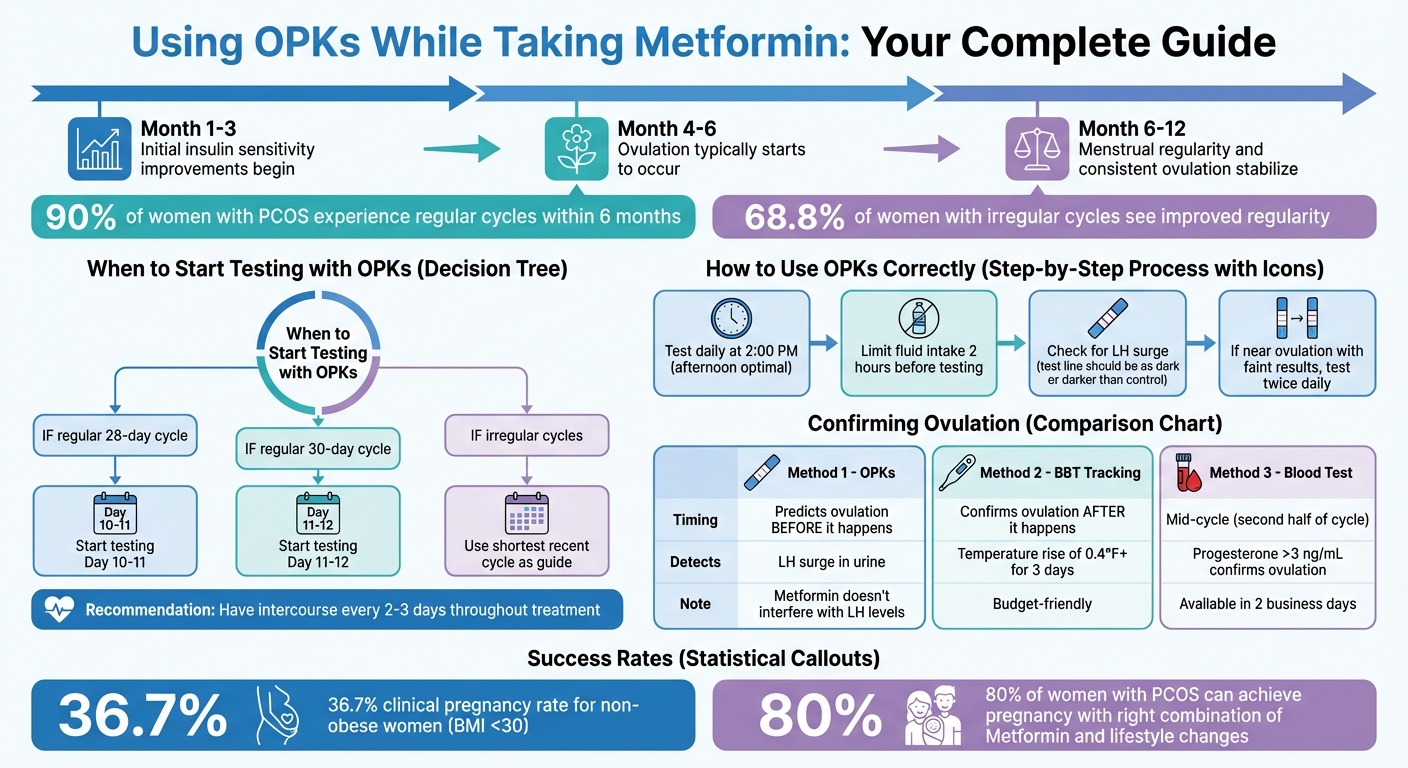
How to Use OPKs While Taking Metformin: Timeline and Testing Guide
How Metformin Affects Ovulation
How Metformin Helps Restore Ovulation
Metformin plays a crucial role in addressing one of the core issues of PCOS: insulin resistance. High insulin levels can prompt the liver to release IGF-1, which, when combined with elevated testosterone, disrupts the normal maturation of follicles. By improving insulin sensitivity, Metformin helps lower both insulin and testosterone levels. This creates a better environment for follicles to mature properly, allowing ovulation to resume. Research supports this, showing that 90% of women with PCOS experience regular menstrual cycles within six months of treatment.
The results can be promising, especially for non-obese women (BMI under 30), where clinical pregnancy rates are reported at 36.7%.
When to Expect Ovulation on Metformin
Ovulation generally begins to occur within 4 to 6 months of starting Metformin. Initial improvements in insulin sensitivity may be noticeable as early as 1 to 3 months, but menstrual regularity and consistent ovulation often stabilize between 6 and 12 months. During the first month of treatment, it’s not unusual for your period to be slightly delayed as your body adjusts to the medication.
Studies show that 68.8% of women with irregular cycles see improved regularity while on Metformin. Once your cycles become more predictable, using ovulation predictor kits (OPKs) can help you pinpoint your fertile window with greater accuracy.
How to Use OPKs While Taking Metformin
When to Start Testing with OPKs
The right time to start using ovulation predictor kits (OPKs) depends on whether your menstrual cycles have stabilized while on Metformin. If your cycle has become regular, you can begin daily OPK testing accordingly. However, if your cycles are still irregular early in treatment, identifying ovulation may be more challenging.
Once your cycles show consistency, you can time your testing based on your typical cycle length. For example, if you have a 28-day cycle, start testing around Day 10 or 11. For a 30-day cycle, testing should begin on Days 11–12. If your cycles are still somewhat unpredictable, use the shortest cycle you’ve had recently as a guide to avoid missing your luteinizing hormone (LH) surge. Because ovulation timing might still vary - even with regular periods - experts recommend having intercourse every 2–3 days throughout your treatment to maximize your chances.
How to Use OPKs Correctly
To get accurate results with OPKs, timing and consistency are key. It’s best to test daily at around 2:00 PM, as LH levels tend to be most detectable in the afternoon. This helps establish a consistent baseline and ensures you don’t miss even brief surges. To improve accuracy, try to limit fluid intake for about two hours before testing, as this will concentrate your urine [13, 14].
If you suspect ovulation is near but are getting faint results, you might consider testing twice a day to catch the LH peak [13, 14]. If the results remain unclear, you may need to explore additional methods for confirming ovulation.
Reading OPK Results on Metformin
One of the benefits of using OPKs while on Metformin is that the medication doesn’t interfere with LH levels. This makes interpreting the results straightforward, unlike other fertility treatments such as Clomid or gonadotropins, which often require a waiting period before testing.
A faint test line on an OPK means some LH is present, but it doesn’t indicate a full surge. For individuals with PCOS, however, elevated baseline LH levels can lead to false positives or make standard OPKs harder to interpret [1, 13]. In such cases, advanced digital monitors that measure specific hormone levels numerically may offer clearer insights compared to traditional line-based strips. If OPK results remain confusing, consult your doctor about a mid-cycle progesterone blood test to confirm whether ovulation has occurred.
PCOS Q&A: OPKS, Letrozole, Miscarriage, and more!
sbb-itb-6dba428
Other Ways to Confirm Ovulation on Metformin
If you're taking Metformin and want to track ovulation, combining different methods can give you a clearer picture of your progress. While ovulation predictor kits (OPKs) are a great tool, adding other approaches can help confirm ovulation more effectively.
Tracking Basal Body Temperature (BBT)
BBT tracking is a simple, budget-friendly way to confirm ovulation and works well alongside OPKs. After ovulation, your body produces more progesterone, which causes a slight rise in your basal body temperature. According to Dr. Sarah Zadek, ND, from Conceive Health, a temperature increase of over 0.4°F sustained for three consecutive days is a strong sign that ovulation has occurred.
The key difference between OPKs and BBT is timing. OPKs predict ovulation before it happens, while BBT confirms it has already occurred. For women on Metformin, this can be a helpful way to see if the medication is effectively restoring ovulation. Typically, the day before your temperature rises is considered the day you ovulated.
To get accurate results, use a digital thermometer first thing in the morning before getting out of bed. Make sure you've had at least 3 to 6 hours of uninterrupted sleep, and avoid alcohol the night before, as it can affect your readings. If your BBT charting seems unclear, medical tests may provide more definitive answers.
Using Ultrasounds or Blood Tests
When at-home methods like BBT or OPKs leave you uncertain, clinical tests can provide more reliable confirmation. A mid-cycle progesterone blood test or a transvaginal ultrasound are two common options.
Cambridge University Hospitals explains, "Ovulation can be confirmed by measuring Progesterone levels in the blood. This should be done in the middle of the second half of the cycle". A progesterone level above 3 ng/mL is an indicator that ovulation has occurred. These tests are typically arranged through your doctor or a fertility clinic, and results are usually available within two business days.
Another option is a transvaginal ultrasound, which allows healthcare providers to directly observe follicle development and confirm ovulation. While ultrasounds offer detailed insights, they are generally reserved for more in-depth fertility evaluations due to their higher cost and logistical requirements.
If a blood test or ultrasound confirms ovulation but your period hasn’t arrived within three weeks, it’s a good idea to take a pregnancy test. These clinical methods can be especially helpful if you're trying to determine the effectiveness of Metformin in regulating your cycle.
Oana Health: Metformin Treatment for PCOS
Oana Health takes the guesswork out of managing PCOS by combining advanced ovulation tracking with personalized care. Through their telehealth platform, women can conveniently address PCOS symptoms and track ovulation without the need for in-person doctor visits. A quick, 5-minute online intake connects you with licensed physicians who craft a treatment plan tailored to your needs.
Metformin Options at Oana Health
Oana Health provides several metformin treatments to suit different needs, all prepared in FDA-regulated compounding pharmacies and delivered to your doorstep for free. Options include:
- Oral Metformin ER: Priced at $22 per month, this extended-release formula helps manage insulin resistance effectively.
- MetSpiro Pack: Starting at $32 per month, this combines Metformin with Spironolactone to address both insulin resistance and androgen-related symptoms like acne or excessive hair growth.
- Topical Metformin Lotion: For those who experience nausea or stomach upset with oral metformin, this lotion offers a gentler alternative. Priced at $89 per month, it provides the same insulin-sensitizing benefits through skin absorption, with noticeable results in 3 to 4 weeks of daily use.
The benefits are clear, as shared by Carrie S.:
"I'm so glad I discovered Oana's metformin lotion! I used to struggle a lot with the side effects for oral metformin and this is a great alternative for me. I get the same benefits but no more upset stomach and nausea." – Carrie S.
Why Choose Oana Health for PCOS Care
Oana Health goes beyond just providing treatment. They offer 24/7 access to licensed medical professionals who can answer your questions about how metformin impacts your cycle and ovulation. This kind of support is especially helpful when using ovulation predictor kits (OPKs) to track progress. The treatments aim to restore regular cycles, making OPKs even more effective.
Margaret K. shares her experience:
"Thanks to Oana, my menstrual cycles are more regular, and my skin has never looked better! I also love the 24/7 accessibility and customer service that always goes the extra mile." – Margaret K.
Oana Health also features a PCOS quiz that generates personalized treatment recommendations based on your symptoms and goals. With tailored metformin options and continuous support, Oana Health ensures your treatment aligns with your fertility and overall health objectives.
Conclusion
Using OPKs alongside Metformin is straightforward because Metformin doesn’t interfere with LH levels, ensuring accurate OPK results. This sets it apart from fertility medications like Clomid or gonadotropins, which directly influence hormone levels and require precise timing.
Consistency is key when taking Metformin, as it works gradually to improve insulin sensitivity and lower androgen levels. These changes typically take a few months to support regular ovulation. To get a fuller understanding of your fertility, you might consider combining OPKs with other tracking methods. These gradual improvements underline the importance of tailoring treatment to individual needs.
Personalized care is crucial for managing PCOS since hormone profiles vary from person to person. With the right combination of Metformin and lifestyle changes, about 80% of women with PCOS can achieve pregnancy.
Oana Health is here to support you every step of the way, offering 24/7 access to licensed professionals, customized Metformin options, and free home delivery. This approach is designed to simplify your treatment plan and help you reach your fertility goals with less stress.
FAQs
How does Metformin support ovulation in women with PCOS?
Metformin plays an important role in helping women with PCOS by improving insulin sensitivity, a critical factor in managing the condition. Many women with PCOS experience insulin resistance, which causes higher insulin levels in the body. These elevated insulin levels can prompt the ovaries to produce excess androgens (male hormones). The result? Disrupted ovulation, irregular menstrual cycles, and symptoms like acne and unwanted hair growth. By reducing insulin levels and restoring hormonal balance, Metformin can help regulate ovulation and support fertility.
Beyond its impact on hormones, Metformin may also assist with weight management and lower the risk of metabolic issues, such as type 2 diabetes, which are often linked to PCOS. While it’s not a guaranteed solution for pregnancy, it can be a helpful part of a broader treatment plan. When combined with healthy lifestyle habits - like maintaining a balanced diet and staying active - Metformin’s ability to tackle insulin resistance makes it a powerful tool for improving ovulation and overall reproductive health.
When is the best time to start using OPKs if my cycles are irregular while on Metformin?
If your menstrual cycles remain irregular while on Metformin, it’s generally a good idea to begin using ovulation predictor kits (OPKs) after about 4 to 6 weeks of treatment. This allows your body some time to adapt to the medication. Since ovulation timing may still vary, keeping a consistent tracking routine is essential. For personalized guidance, reach out to your healthcare provider - they can help you fine-tune your timing and address any related issues.
Can you use ovulation predictor kits (OPKs) with other tracking methods while taking Metformin?
Yes, you can use ovulation predictor kits (OPKs) along with other methods to track ovulation while taking Metformin. That said, some medications, including fertility treatments or hormone therapies, might interfere with OPK results. To minimize the risk of false positives caused by hormone fluctuations, it's best to wait a few days after starting these treatments before using an OPK.
Pairing OPKs with other tracking methods - like monitoring your basal body temperature or observing cervical mucus - can give you a clearer picture of your ovulation patterns. Be sure to consult your healthcare provider for guidance on how to use these tools most effectively.