
Vitamin A and PCOS Acne: What You Need to Know
Struggling with acne that just won’t clear up? For many women with PCOS, hormonal imbalances drive stubborn breakouts, particularly along the jawline, chin, and neck. This happens because PCOS increases androgens like testosterone, which cause excess oil production and clog pores. Insulin resistance, another hallmark of PCOS, worsens the problem by further boosting androgen levels and oil production.
Vitamin A, especially its retinoid forms, can help by addressing these issues at their root. It regulates oil production, speeds up skin cell turnover, reduces inflammation, and even impacts hormone production. Options include topical treatments, oral medications like isotretinoin, and dietary sources. However, oral vitamin A requires careful medical supervision due to risks like liver damage and birth defects.
Here’s what you need to know:
- Topical retinoids (e.g., tretinoin) target clogged pores and reduce oiliness.
- Oral isotretinoin offers systemic benefits but comes with serious risks.
- Dietary vitamin A supports skin health but is less potent.
- Combine vitamin A treatments with hormonal therapies like spironolactone for better results.
Key takeaway: Vitamin A can be a powerful tool for managing PCOS acne, but proper usage and medical guidance are crucial to avoid side effects.
Vitamin A in the Treatment of Acne - What Does the Data Say?
While topical retinoids are common, many wonder if stronger oral versions like Accutane are safe for PCOS patients.
sbb-itb-6dba428
How PCOS Causes Acne
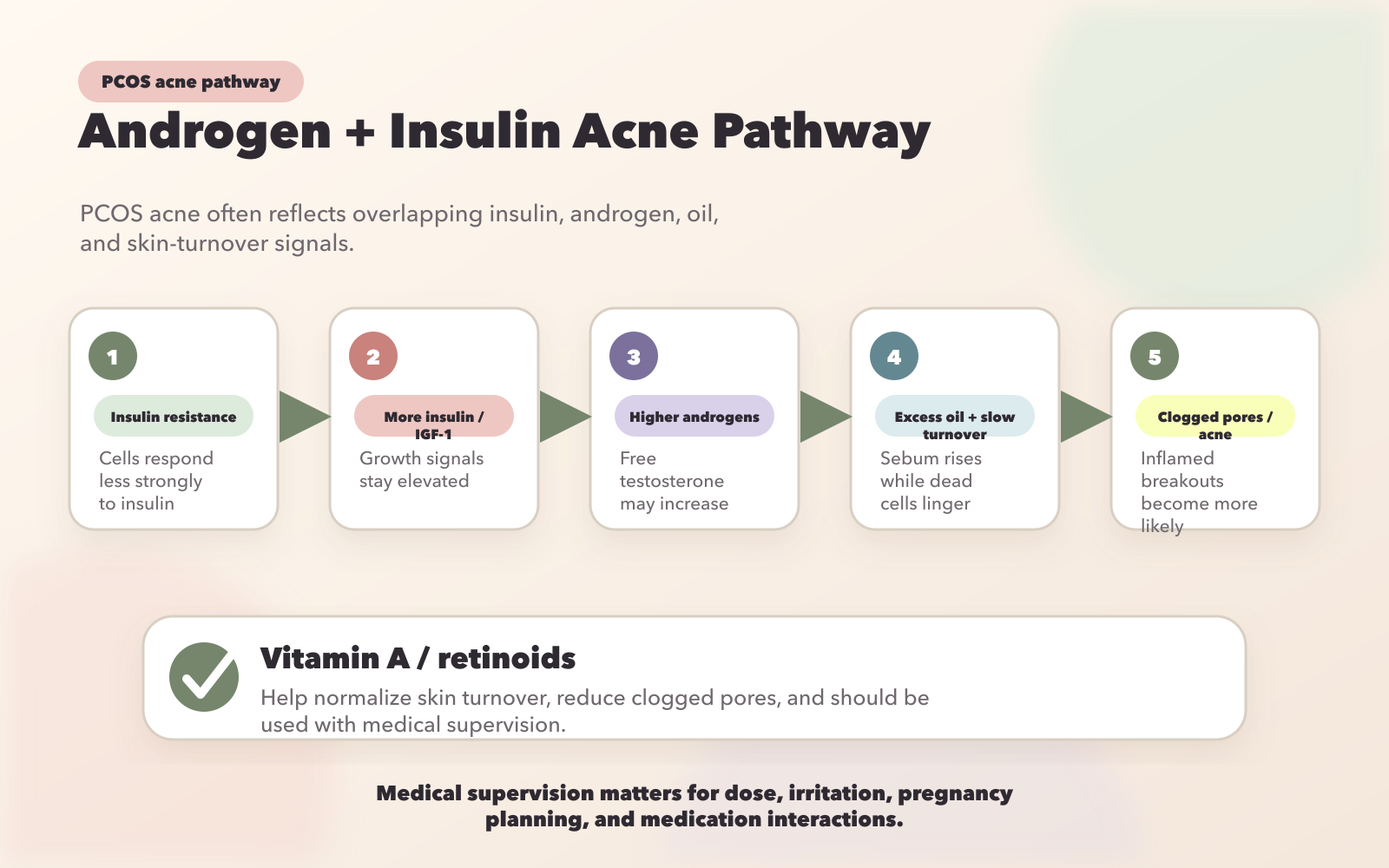
How PCOS Causes Acne: The Androgen and Insulin Resistance Pathway
PCOS throws off your body's hormonal balance in two key ways: androgen excess and insulin resistance. Together, these disruptions create the ideal conditions for persistent, inflamed acne.
Let’s start with the androgen pathway, which is the main driver of excess oil production. Elevated levels of androgens like testosterone and DHEA overstimulate the sebaceous glands, causing them to churn out too much sebum. Adding to the problem, an enzyme called 5α-reductase converts testosterone into dihydrotestosterone (DHT), a more potent form that ramps up oil production even further. Beyond just making your skin oilier, these hormonal shifts also alter the makeup of your sebum, decreasing linoleic acid levels and sparking inflammation. At the same time, high androgens slow down skin cell turnover, leading to a buildup of dead skin that clogs pores instead of shedding naturally.
Now, let’s layer in the effects of insulin resistance, which makes things even worse. When your body becomes resistant to insulin, your pancreas compensates by producing more of it. This extra insulin triggers several acne-promoting effects: it stimulates the ovaries and adrenal glands to produce more androgens, reduces the liver's production of Sex Hormone-Binding Globulin (SHBG) - leaving more free testosterone circulating - and increases Insulin-like Growth Factor 1 (IGF-1), which further drives sebum production and clogs pores.
"Insulin resistance, prevalent in PCOS, augments ovarian/adrenal androgen synthesis and lowers sex hormone-binding globulin levels, increasing free testosterone and sebum production; IGF-1 signaling further amplifies sebogenesis and follicular hyperkeratinization." - Eftichia Damoulaki, Third Department of Obstetrics and Gynecology, Attikon University Hospital
The result? A vicious cycle of blocked pores filled with inflammatory, altered sebum, which creates the perfect environment for Cutibacterium acnes bacteria to thrive. This bacterial overgrowth leads to the deep, red, inflamed cysts that often appear along the jawline, chin, and lower cheeks - areas commonly affected by PCOS acne. In a study involving 305 women with PCOS, 56.4% had acne, with those showing higher markers of insulin resistance experiencing more severe cases.
How Vitamin A Helps Manage PCOS Acne
Vitamin A addresses PCOS acne by tackling the hormonal and cellular issues that fuel breakouts. It works to regulate oil production, speed up skin cell turnover, and reduce inflammation - three major factors behind persistent acne. Here's a closer look at how vitamin A, in its different forms, targets these problems.
How Vitamin A Works as a Retinoid
Retinoids, a form of vitamin A, play a key role in normalizing skin cell behavior. They help unclog pores and speed up skin renewal, preventing the buildup of microcomedones - tiny clogs that form when PCOS-related androgen levels cause excessive accumulation of dead skin cells (a process called follicular hyperkeratinization). This directly counteracts the clogged pores and overactive oil glands driven by elevated testosterone and DHT levels linked to PCOS.
Vitamin A also reduces overactive sebaceous gland activity through a process called apoptosis, regulated by p53, essentially signaling these glands to scale back oil production. Additionally, as an antioxidant, it combats inflammation caused by Cutibacterium acnes bacteria, which thrive in the oily, congested environment often seen with PCOS acne.
Effects on Hormonal Acne in PCOS
Beyond improving the skin's surface, vitamin A tackles the hormonal imbalances behind PCOS acne. Retinoids regulate steroid biosynthesis in ovarian theca cells, which are responsible for producing excess androgens. Oral isotretinoin, a potent retinoid, goes a step further by reducing androgen levels and insulin production systemically, addressing two key acne triggers: androgen excess and insulin resistance.
"Isotretinoin induces expression of apoptosis-promoting factors, such as p53, resulting in a decrease in androgens, therefore also in the downregulation of sebum, testosterone, and insulin production." - Eftichia Damoulaki, Third Department of Obstetrics and Gynecology, Attikon University Hospital
Vitamin A also reduces insulin-like growth factor 1 (IGF-1) signaling, which plays a role in increasing sebum production and pore-clogging cell buildup. Clinical studies have shown that oral vitamin A doses of 100,000 IU daily can improve acne within 7 weeks to 4 months, with 8 out of 9 trials reporting positive outcomes. Considering that acne affects 40% to 70% of women with PCOS - and up to 59% of adolescents with the condition - these effects highlight vitamin A's potential as a valuable treatment option.
Different Forms of Vitamin A for PCOS Acne
Vitamin A can help manage acne through topical applications, oral options, or dietary intake. Knowing these approaches allows for a tailored method to address PCOS-related acne.
Topical Vitamin A (Retinoids)
Topical retinoids are a go-to for addressing clogged pores and excess oil production, common in PCOS hormonal acne. These treatments work by increasing cell turnover and clearing pores, making them effective against inflammatory acne. Popular options include retinol (available over-the-counter), tretinoin (Retin-A), adapalene (Differin), and tazarotene (Tazorac).
Studies show that about 75% of acne patients see improvements with topical tretinoin. To minimize irritation, apply it every other day on dry skin and always use sunscreen during the day. Patience is key - visible results usually take 2 to 3 months.
Now, let’s look at oral vitamin A options for more systemic effects.
Oral Vitamin A (Isotretinoin and Supplements)
For severe or stubborn acne, prescription isotretinoin delivers systemic relief by reducing oil production and inflammation throughout the body. However, it comes with significant risks, such as dry skin, liver issues, and birth defects, requiring careful medical oversight.
"Oral vitamin A could potentially serve as a substitute for isotretinoin in acne management for select patients. However, due to its teratogenicity, potential for toxicity, and long half-life, strict monitoring under the care of a medical provider is prudent." - Madison K. Cook, BS, Center for Dermatology Research
High-dose vitamin A supplements are not advised without medical supervision. Exceeding 10,000 mcg daily (about 33,333 IU) over time can lead to liver damage, bone pain, and hair loss. For context, the recommended daily intake is 900 mcg for men and 700 mcg for women. Historical studies on acne have used much higher doses, ranging from 36,000 IU to 500,000 IU daily, but these levels are unsafe without strict oversight.
Beyond medical treatments, dietary vitamin A offers another avenue to support skin health.
Food Sources of Vitamin A
Dietary vitamin A, while less potent than medical treatments, contributes to healthy skin and complements other acne therapies. It comes in two forms: preformed vitamin A (retinol) from animal products like beef liver and salmon, and provitamin A (beta-carotene) from plant-based foods like sweet potatoes, carrots, and spinach.
For example, a whole baked sweet potato with skin provides 156% of the daily value of vitamin A, while three ounces of pan-fried beef liver offers a staggering 731%. Your body efficiently absorbs 75-100% of retinol from animal sources but only 10-30% of beta-carotene from plants. Since vitamin A is fat-soluble, pairing it with healthy fats enhances absorption. Cooking vegetables like carrots and spinach also boosts beta-carotene absorption.
Benefits and Risks of Vitamin A for PCOS Acne
Proven Benefits for Acne and Skin
Clinical trials have shown that 88% of studies report acne improvement within 7 weeks to 4 months when using oral vitamin A.
But it’s not just about clearing up breakouts. Vitamin A works on a deeper level by addressing the hormonal imbalances linked to PCOS acne. It regulates steroid synthesis in ovarian theca cells, which are often dysfunctional in women with PCOS. Additionally, it helps manage the immune response caused by Propionibacterium acnes, the bacteria responsible for acne-related inflammation. For women who can’t access isotretinoin, high-dose oral vitamin A can serve as an effective alternative, similar to other hormonal acne treatments.
While the benefits are promising, they come with some serious risks that require careful consideration.
Possible Side Effects and Risks
The advantages of vitamin A don’t come without potential drawbacks. Side effects can range from mild to severe, depending on the dosage and form of vitamin A used.
Topical retinoids often cause what’s known as "retinoid dermatitis", which includes redness, scaling, dryness, itching, and a burning sensation. High oral doses can lead to nausea, vomiting, headaches, dizziness, and blurred vision.
Over time, excessive intake of vitamin A may result in toxicity, with symptoms like liver damage, bone and joint pain, hair loss, brittle nails, and fatigue. The most concerning risk is the potential for birth defects. Studies have found that approximately 1 in 57 babies born to women taking more than 10,000 IU of supplemental vitamin A daily during the first trimester had birth defects directly linked to the vitamin.
"Vitamin A, also known as teratogen, is capable of causing severe malformations." - StatPearls
For women of childbearing age, strict precautions are necessary. This includes using reliable birth control and undergoing pregnancy tests before starting oral retinoid treatments. Vitamin A can also interact with certain medications, such as hepatotoxic drugs, other retinoids, and Warfarin, increasing the risk of liver damage and bleeding complications.
Given these risks, sticking to recommended dosages is non-negotiable.
Recommended Dosage Guidelines
Following proper dosage guidelines is essential for both safety and effectiveness. The recommended daily allowance (RDA) is 700 mcg for women and 900 mcg for men. To avoid toxicity, the Tolerable Upper Intake Level (UL) is 3,000 mcg (roughly 10,000 IU) per day.
For topical retinoids, dermatologists often advise starting with low concentrations - typically 0.025% to 0.05% tretinoin - and applying a small, pea-sized amount every two to three days before gradually increasing frequency. Oral isotretinoin is typically dosed at 0.5 to 1.0 mg per kilogram of body weight. In clinical trials, the most common successful dose of oral vitamin A was 100,000 IU daily, but this is far above the safe limits and should only be taken under strict medical supervision.
If you’re using any form of vitamin A, daily sunscreen is a must, as it makes your skin more sensitive to UV damage. Never exceed the RDA through supplements without consulting a doctor, especially if you’re pregnant or planning to become pregnant. Regular lab tests to monitor liver function and lipid levels are also crucial for anyone taking oral retinoids.
Using Vitamin A with Oana Health PCOS Treatments
Pairing Vitamin A with Spironolactone and Metformin
Vitamin A and Oana Health's treatments take different routes to tackle PCOS-related acne. Spironolactone works by blocking androgen receptors, which helps reduce oil production from within and targets hormonal triggers. On the other hand, vitamin A derivatives - used either as topical retinoids or oral isotretinoin - focus on improving skin health and lowering sebum production.
Oana Health offers spironolactone, particularly effective for addressing hormonal acne in areas like the lower face, jawline, and chin. Many patients start to see changes within 8–12 weeks, with more noticeable results after six months. Metformin is also available in combination packs with spironolactone. For cases of severe cystic acne that don’t respond to hormonal treatments alone, oral vitamin A derivatives like Accutane (isotretinoin) may be an option. However, these treatments require careful medical supervision due to their potency and potential side effects.
"Pairing spironolactone with a tailored skincare routine can help optimize results." – Oana Health
This combined approach connects hormonal regulation with direct acne treatment. By combining hormonal therapies with vitamin A, the treatment addresses both the internal and external causes of PCOS-related acne.
Personalized Treatment Plans from Oana Health
Oana Health takes these strategies a step further by offering treatment plans tailored to your unique needs. After completing an online consultation and reviewing your medical history, licensed physicians design a personalized plan and ship treatments directly to you - free of charge.
The platform allows flexibility in managing acne. You might start with oral spironolactone to target hormonal imbalances, incorporate a topical spironolactone cream for localized treatment, or add vitamin A–based products to your skincare routine. Your healthcare provider will monitor how treatments interact and guide you through any initial skin purging phase. With FDA-regulated oversight, your plan is adjusted over time to ensure it meets your needs. If results are slow or minimal after several months, your physician might tweak dosages, switch formulations, or recommend oral vitamin A for a more intensive solution.
This comprehensive approach leverages vitamin A's ability to regulate sebum and promote healthy cell turnover, creating a well-rounded strategy for managing PCOS-related acne.
Conclusion
Vitamin A plays an important role in addressing PCOS-related acne by helping to reduce inflammation, control sebum production, and promote skin cell turnover. Topical retinoids are the most effective option for directly treating acne, while dietary sources offer antioxidant benefits that support overall skin health.
However, oral vitamin A comes with serious risks, such as liver damage and birth defects, and should only be used under strict medical supervision. Experts emphasize that its teratogenic and toxic potential requires careful oversight. When using topical retinoids, it's essential to apply daily sunscreen, as vitamin A can increase sensitivity to UV rays.
Professional guidance is key when incorporating vitamin A into your routine. Oana Health offers personalized treatment plans that combine vitamin A with hormonal therapies to address both the internal and external factors contributing to PCOS acne. Their licensed physicians create tailored approaches, which may include spironolactone to block androgen receptors, metformin to manage insulin resistance, and advice on using vitamin A-based products safely. With treatments delivered to your door and continuous support through their telehealth platform, you receive a holistic approach to managing PCOS-related acne.
Whether you're struggling with stubborn breakouts or looking to enhance your current skincare regimen, combining vitamin A with expert care can lead to clearer, healthier skin.
FAQs
Which vitamin A option is safest for PCOS acne?
When it comes to managing PCOS-related acne, one of the safest approaches is focusing on dietary vitamin A from natural foods. Think leafy greens like spinach and kale, along with vibrant fruits and vegetables like carrots, sweet potatoes, and bell peppers. These options are much better than relying on supplements or oral retinoids, which can sometimes pose risks like toxicity. By prioritizing a well-rounded, nutrient-rich diet, you can help support both your skin and your overall health.
Can vitamin A affect PCOS hormones and insulin?
Vitamin A might affect hormones and insulin sensitivity in women with PCOS. Studies indicate it could support ovarian function and help regulate hormones, which may influence endocrine balance and how the body responds to insulin.
How do I avoid retinoid irritation and purging?
To reduce irritation and purging from retinoids, begin with a low concentration and slowly increase how often you use them to allow your skin to adjust. Start by applying retinoids every other night or just a few times a week. Pair this with a gentle moisturizer to maintain your skin's barrier, steer clear of harsh products, and always apply retinoids to completely dry skin. Don’t skip daily application of a broad-spectrum sunscreen - it helps minimize sensitivity and shields your skin from damage.