
Who Should Avoid Spironolactone for Acne?
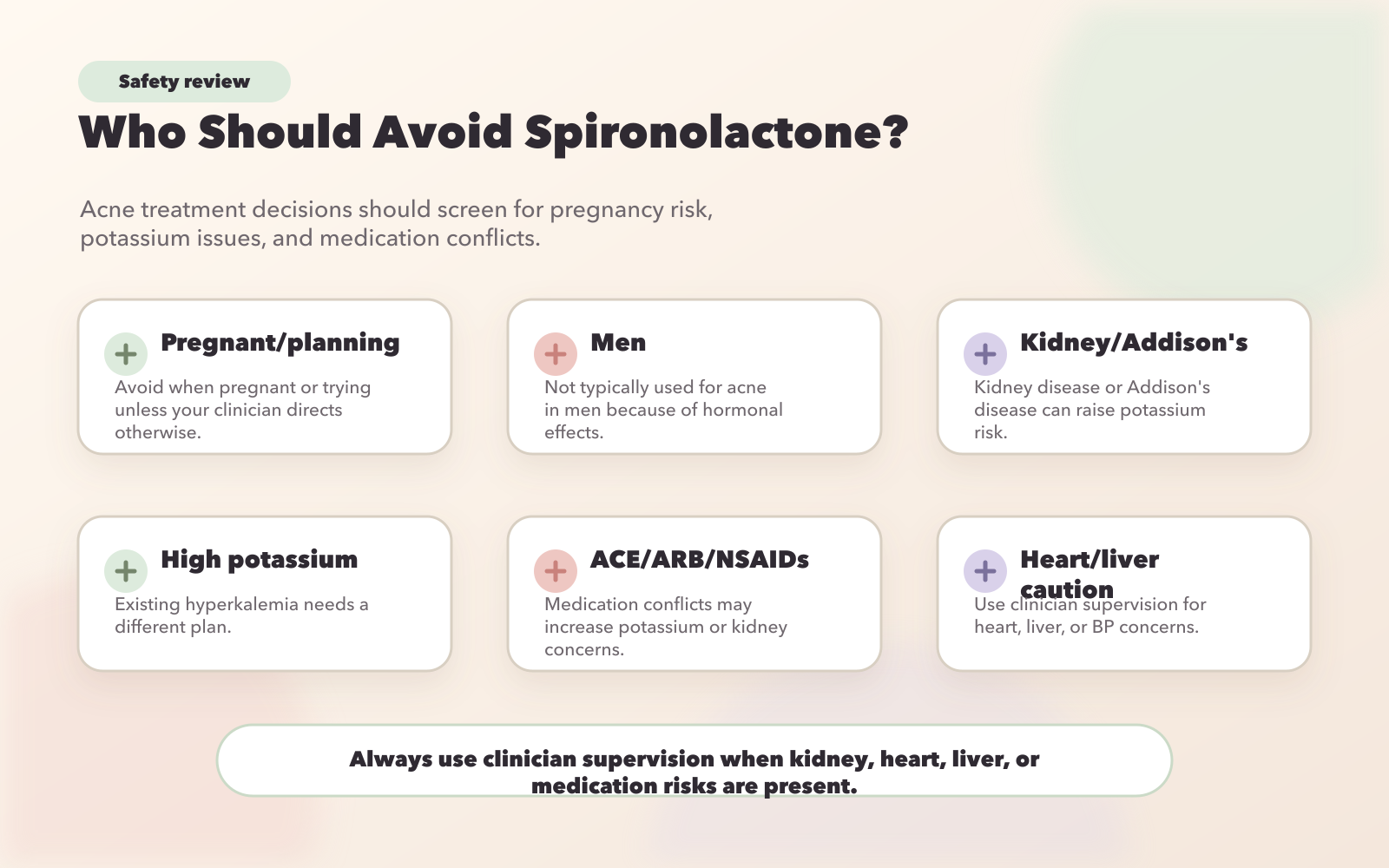
Spironolactone is a popular treatment for hormonal acne, but it’s not suitable for everyone. Here’s a quick summary of who should avoid it:
- Pregnant Women or Those Planning Pregnancy: Spironolactone can harm fetal development, especially in male babies. Effective contraception is necessary while using it.
- Men: Its anti-androgen effects can lead to side effects like gynecomastia, reduced libido, and other hormonal changes.
- Patients with Kidney Disease or Addison’s Disease: The risk of life-threatening potassium imbalances makes spironolactone unsafe for these individuals.
- Those Taking Certain Medications: Combining spironolactone with ACE inhibitors, ARBs, NSAIDs, or potassium supplements increases the risk of hyperkalemia.
- High Potassium Levels: People with already elevated potassium levels should avoid spironolactone.
For those with heart failure, liver issues, or other specific conditions, spironolactone may be used cautiously under medical supervision. Follow a checklist for safe spironolactone use and always consult a healthcare provider for personalized advice before starting treatment.
Who Should Avoid Spironolactone: Complete Contraindications Guide
How to treat hormonal acne with spironolactone in 2026: dermatologist and acne expert explains
Who Must Avoid Spironolactone Completely
Certain individuals face serious health risks when using spironolactone and must avoid it altogether.
Pregnant Women or Those Planning Pregnancy
Spironolactone is classified as an FDA Pregnancy Category C medication, which means it carries risks for developing babies. Its anti-androgenic effects can disrupt fetal development, particularly in male fetuses, as testosterone is crucial for proper sexual differentiation during embryogenesis.
Animal studies have raised concerns. For example, when doses of 200 mg/kg/day were administered during late embryogenesis (gestation days 13–21), male fetuses exhibited signs of feminization. Considering that the baseline risk of major birth defects in the U.S. population is between 2% and 4%, spironolactone introduces an avoidable hazard.
"Because of the potential risk to the male fetus due to anti-androgenic properties of spironolactone and animal data, avoid spironolactone in pregnant women or advise a pregnant woman of the potential risk to a male fetus."
- Pfizer Medical Information
Women planning to conceive should discontinue spironolactone well in advance, as its metabolites can linger in the body for up to 100 hours. Those of childbearing age who take spironolactone must use effective contraception, such as oral contraceptives. If pregnancy occurs while on the medication, stop immediately and consult a healthcare provider.
"While oral contraceptive use is not mandatory, patients must be educated not to become pregnant while on the drug."
- Joshua Zeichner, MD, Director of Cosmetic and Clinical Research, Mount Sinai Medical Center
Men
Due to its anti-androgenic effects, spironolactone is generally unsuitable for men. One of the most common side effects is gynecomastia - the development of breast tissue - which becomes more likely as the dosage increases.
| Dosage of Spironolactone | Incidence of Gynecomastia in Men |
|---|---|
| 25 mg/day | 9.1% |
| 100 mg/day | 30% |
| 200 mg/day | 62.5% |
| 400 mg/day | 66.7% |
In the RALES study, even a low dose of 25 mg/day led to gynecomastia in 9.1% of men, compared to just 1.3% in the control group. Other potential side effects for men include loss of libido, erectile dysfunction, testicular atrophy, and reduced sperm count at high doses.
"Males should not take spironolactone. Male patients who take spironolactone may experience gynecomastia (enlarged breasts), loss of libido, and general feminization."
For men requiring treatment for conditions such as heart failure, eplerenone is a safer alternative that lacks anti-androgenic effects.
Patients with Kidney Disease or Addison's Disease
Certain medical conditions also make spironolactone dangerous, particularly kidney disease and Addison's disease.
Spironolactone is contraindicated in individuals with severe kidney impairment or Addison's disease due to the risk of hyperkalemia - a condition where potassium levels rise dangerously high, potentially causing life-threatening heart rhythm disturbances.
"Spironolactone is substantially excreted by the kidney, and the risk of adverse reactions to this drug may be greater in patients with impaired renal function."
- Aldactone Prescribing Information
In Addison's disease, the adrenal glands already struggle to regulate blood pressure and electrolyte levels. Spironolactone, which blocks aldosterone, can further disrupt potassium excretion, worsening these imbalances. Additionally, patients with anuria (inability to urinate) should avoid spironolactone, as it can lead to excessive fluid loss and further damage to the kidneys.
Health Conditions That Require Caution
Some individuals can use spironolactone safely, but certain health conditions call for careful monitoring and medical supervision.
High Potassium Levels or Use of Potassium-Raising Medications
Spironolactone is a potassium-sparing diuretic, meaning it helps your body retain potassium while flushing out sodium and water. While this can be beneficial in some cases, it becomes risky if potassium levels are already high or when combined with medications that also raise potassium levels.
The incidence of hyperkalemia (high potassium) in patients taking spironolactone is about 17.1%. A study in Ontario revealed a rise in hyperkalemia-related hospitalizations, increasing from 2.4 to 11 per 1,000 patients after spironolactone became more widely prescribed.
Medications that may amplify the risk include:
- ACE inhibitors
- Angiotensin Receptor Blockers (ARBs)
- NSAIDs (like ibuprofen)
- Heparin
- Potassium supplements
Combining spironolactone with ACE inhibitors and ARBs is particularly dangerous.
"The triple combination of ACE inhibitors, ARBs, and aldosterone antagonists cannot be recommended and should be avoided."
- Dr.Oracle Medical Advisory Board
Before starting treatment, potassium levels should be below 5.0 mEq/L, and serum creatinine should not exceed 2.5 mg/dL for men or 2.0 mg/dL for women. If potassium levels rise to 5.5–6.0 mEq/L, the dosage should be reduced, and treatment must be stopped if levels exceed 6.0 mEq/L.
Potassium-rich salt substitutes can also increase the risk of hyperkalemia. If you experience severe diarrhea or vomiting, spironolactone should be temporarily stopped to prevent dehydration and dangerous potassium spikes.
Patients with underlying heart or liver issues are especially vulnerable to complications from electrolyte imbalances.
Heart Failure or Severe Liver Impairment
Spironolactone is FDA-approved for treating heart failure and liver-related fluid retention, but its use in these conditions requires extreme care.
For heart failure patients, about 14.5% experience worsening kidney function while on spironolactone. Combining it with other heart medications can lead to low blood pressure and excessive fluid loss, further straining kidney function.
In cases of severe liver impairment, spironolactone poses additional risks. For patients with cirrhosis, the drug's half-life increases while clearance decreases, heightening the chances of drug buildup and toxicity. Sudden changes in fluid or electrolyte balance can lead to hepatic encephalopathy, a condition that impairs brain function and, in severe cases, can cause coma.
"CAROSPIR can cause sudden alterations of fluid and electrolyte balance which may precipitate impaired neurological function, worsening hepatic encephalopathy and coma in patients with hepatic disease with cirrhosis and ascites."
- FDA Prescribing Information for CAROSPIR
Patients with cirrhosis and ascites should ideally begin spironolactone treatment in a hospital setting, where staff can monitor for neurological changes. Starting doses should be low, with gradual adjustments. Symptoms like jaundice (yellowing of the skin or eyes) or pain in the upper right abdomen require immediate medical attention.
| Condition | Primary Risk with Spironolactone | Monitoring Requirement |
|---|---|---|
| Heart Failure | Severe hyperkalemia (especially with ACE inhibitors/ARBs) | Serum potassium and kidney function (creatinine) |
| Severe Liver Impairment | Hepatic encephalopathy, coma, and reduced drug clearance | Volume status, electrolytes, and neurological function |
| Cirrhosis with Ascites | Sudden fluid/electrolyte shifts and rare liver toxicity | Hospital-based initiation and slow dose titration |
Other conditions requiring caution include diabetes mellitus, as spironolactone can increase the risk of both high potassium and high blood sugar, and a history of gout, since the medication may trigger attacks by raising uric acid levels. Elderly patients are also at higher risk because standard creatinine tests may underestimate kidney dysfunction in those with lower muscle mass.
These considerations highlight the importance of tailored, closely monitored use of spironolactone, especially when managing hormonal acne in patients with pre-existing health conditions. For more information on treatment safety, see our anti-androgen therapy safety rankings.
sbb-itb-6dba428
Drug Interactions and Dietary Considerations
Spironolactone's safety can be influenced by external factors like drug interactions and dietary choices, making it crucial to manage both carefully.
Common Drug Interactions
There are several spironolactone interactions to know that potentially increase the risk of kidney damage and high potassium levels (hyperkalemia). For example, non-steroidal anti-inflammatory drugs (NSAIDs) like ibuprofen (Advil, Motrin) and naproxen (Aleve) can reduce spironolactone's effectiveness while raising the likelihood of kidney issues [34–37]. If pain relief is needed, acetaminophen (Tylenol) is generally a safer option.
Additionally, spironolactone slows the clearance of lithium, which could lead to toxicity [34–37]. It also raises blood levels of digoxin and may interfere with laboratory tests for this medication.
"Spironolactone and its metabolites interfere with radioimmunoassays for digoxin and increase the apparent exposure to digoxin." - Pfizer Medical
Certain blood thinners, such as heparin and enoxaparin, further elevate hyperkalemia risks. The antibiotic trimethoprim (found in Bactrim) can cause dangerous potassium spikes, while cholestyramine, used to lower cholesterol, has been linked to metabolic acidosis when combined with spironolactone.
Always notify healthcare providers - including dentists or emergency room staff - that you are taking spironolactone. This is especially important before starting new medications or undergoing routine blood tests.
Dietary Restrictions
Managing dietary potassium intake is just as critical as monitoring medication interactions. Foods high in potassium - such as bananas, avocados, dried fruits (like apricots, prunes, and raisins), potatoes (with skins), lentils, nuts, and leafy greens - should be consumed in moderation [38–40].
"Some foods especially high in this mineral include dried apricots, prunes, lentils and other pulses (dried seeds from a pod), yams, acorn and butternut squash, and Swiss chard." - Elizabeth Harris, RDN, Registered Dietitian Nutritionist
Be cautious with salt substitutes like Lo-Salt or Nu-Salt, as they often contain potassium chloride. Similarly, some over-the-counter products for indigestion or urinary tract infections may have hidden potassium. Avoid licorice extract, found in certain candies and herbal supplements, as it can interfere with spironolactone's effectiveness.
Both alcohol and caffeine, due to their diuretic effects, can increase the risk of dehydration, dizziness, and fainting when combined with spironolactone. Staying hydrated is essential, especially during physical activity or hot weather. The CDC defines heavy drinking as eight or more drinks per week for women and 15 or more for men, which can worsen spironolactone's side effects.
Herbal supplements with diuretic properties - like fennel, parsley, dandelion, or nettle - should also be approached cautiously. When in doubt, consult your healthcare provider before using any supplements.
Monitoring and When to Seek Medical Advice
Starting spironolactone treatment requires close monitoring to reduce potential risks. Before beginning, healthcare providers usually test blood potassium levels and renal function (creatinine and eGFR) to rule out kidney disease or hyperkalemia. If you show signs of excess androgen - such as irregular periods, unwanted facial hair, or hair thinning - your doctor might also check hormone levels like testosterone, DHEA, FSH, and LH. These tests are typically done during your menstrual cycle or the week before, and it’s important to stop oral contraceptives for at least six weeks beforehand. These initial evaluations set the groundwork for ongoing monitoring throughout your treatment.
Baseline Testing and Ongoing Monitoring
The FDA advises checking serum potassium levels within one week of starting spironolactone or adjusting the dose, followed by regular testing. That said, routine potassium monitoring isn’t usually necessary for healthy young women taking spironolactone for acne, as their risk of hyperkalemia is no higher than the general population.
"Routine potassium monitoring is unnecessary for healthy women taking spironolactone for acne. I tend not to check potassium in these patients unless I head to higher doses due to poor response or I am treating female pattern alopecia." - Adam J. Friedman, MD, Associate Professor of Dermatology, George Washington School of Medicine and Health Sciences
Most dermatologists recommend a follow-up around four weeks after starting treatment to evaluate your response, check for any side effects, and adjust the dosage if needed.
Recognizing Side Effects and Warning Signs
Once baseline tests are done, stay vigilant for symptoms that could indicate adverse effects. Contact your doctor right away if you experience a rapid or irregular heartbeat, muscle weakness, confusion, fainting, numbness or tingling in your hands or feet, or signs of dehydration like extreme thirst or severe dizziness.
Additionally, watch for liver or kidney-related symptoms such as yellowing of the skin or eyes, pain in the upper right abdomen, dark urine, or reduced urination. Seek immediate medical attention if you experience difficulty breathing or swallowing, hives, severe rashes, or swelling of the face, lips, tongue, or throat. Other serious signs, including unusual bruising, bleeding gums, vomiting blood, or black, tarry stools, may suggest internal bleeding and require urgent care.
How Oana Health Supports Safe Spironolactone Use
Oana Health offers telehealth services with licensed professionals who create tailored acne treatment plans. Through their platform at https://spironolactone.oanahealth.com/, you can access professional guidance, along with prescription delivery and free shipping. Their team ensures a thorough initial evaluation to rule out renal issues and interactions with medications like ACE inhibitors or other potassium-sparing diuretics. With spironolactone starting at just $14 per month, Oana Health makes treatment both accessible and affordable. This comprehensive approach highlights the importance of proper patient selection and continuous monitoring for safe spironolactone use.
Conclusion
Selecting the right patients is key to ensuring spironolactone is used safely. While it’s an effective option for hormonal acne, it’s not suitable for everyone. For instance, it’s contraindicated for pregnant women or those planning pregnancy due to risks of fetal feminization. Men are also advised against its use because of testosterone suppression and feminizing effects. Additionally, individuals with kidney disease, Addison's disease, or high potassium levels should avoid this medication. Those with conditions like heart failure or low blood pressure require a thorough evaluation to avoid complications, especially when taking medications like ACE inhibitors, ARBs, or potassium supplements. These factors highlight the importance of close monitoring and expert consultation before starting treatment.
"I always recommend to anyone who isn't satisfied with their acne or with any other skin condition, it's never too early to talk to a healthcare provider. Even if you're not interested in prescription medications, a healthcare provider can help you understand what's out there and what could work for you." - Claudia Ricotti, MD, Dermatology Resident, Cleveland Clinic
Because of these potential risks, working with a healthcare professional is essential to ensure safe and effective treatment. Oana Health offers personalized care through licensed professionals who evaluate hormonal acne and potential contraindications to develop customized treatment plans. Their telehealth platform provides easy access to care, with prescriptions delivered directly and pricing starting at just $14 per month. With expert guidance, you can confidently and safely use spironolactone, knowing you’re supported every step of the way. Explore more at https://spironolactone.oanahealth.com/.
FAQs
How long before trying to get pregnant should I stop spironolactone?
Women are advised to discontinue spironolactone at least 1–2 months before attempting to conceive. This timeframe allows the medication to completely leave the body, minimizing any potential risks it could pose to a male fetus.
What symptoms could mean my potassium is too high?
Signs of high potassium can show up as dizziness, muscle cramps, fatigue, or even irregular heart rhythms. If you’re experiencing any of these symptoms, it’s crucial to reach out to a healthcare provider for proper evaluation and guidance.
Do I need blood tests while taking spironolactone for acne?
Blood tests, like potassium monitoring, are usually not needed for healthy women using spironolactone to treat acne. The likelihood of developing hyperkalemia in this group is extremely low. However, if you have specific health issues or concerns, it's important to talk to your healthcare provider to determine if additional monitoring is necessary.