
Signs Anti-Androgens May Work for You
If you've tried acne treatments without success, hormones might be the issue. Anti-androgens, like spironolactone for acne, block hormones that increase oil production, targeting the root cause of hormonal acne. Here's how to know if they might work for you:
- Acne Location: Breakouts along the jawline, chin, or lower face.
- Menstrual Cycle: Acne worsens before your period.
- Treatment Resistance: Topical treatments or antibiotics haven't helped.
- Other Symptoms: Oily skin, unwanted facial hair, or hair thinning.
- PCOS or Hormonal Imbalance: Diagnosed with PCOS or irregular periods.
Anti-androgens can reduce acne by 50-100% over 3-6 months. Spironolactone is cost-effective and widely used, while other options include combined oral contraceptives and topical treatments. Consult a healthcare provider to explore your options.
How to treat hormonal acne with spironolactone in 2026: dermatologist and acne expert explains
sbb-itb-6dba428
Checklist: Signs Anti-Androgens May Work for You
Wondering if anti-androgens might be the right choice for managing your acne? This checklist can help you identify whether hormonal factors could be contributing to your breakouts. Each of these signs points to androgens potentially playing a role.
Acne Appears in a Hormonal Pattern
If your acne clusters along your jawline, chin, and lower face, hormones might be the culprit. Dr. Sangita Ghosh from the Department of Skin and V.D. at PGIMS highlights:
"Clinically, patients with hormone-related acne can be recognized by the concentration of lesions along the jaw line and chin."
This specific distribution, often referred to as mandibular acne, is a hallmark of hormone-driven breakouts.
Acne Flares with Your Menstrual Cycle
Do your breakouts worsen right before your period? If so, this could indicate a hormonal trigger. These cyclical flares typically occur during the luteal phase, when shifts in estrogen and progesterone levels increase androgen activity. Anti-androgens may help balance these hormonal fluctuations, reducing the excess oil production that often leads to acne. If this menstrual pattern sounds familiar, consider the following additional signs.
Topical Treatments Haven't Worked
Have you tried products like benzoyl peroxide, retinoids, or antibiotics with little success? If so, hormonal therapy might be worth exploring. Dr. Sangita Ghosh explains:
"Hormonal therapies are not strictly indicated for only those patients who have cutaneous or biochemical evidence of hyperandrogenism, but can be used even for therapy-resistant acne, without hyperandrogenemia."
Interestingly, more than half of adult women with persistent acne have at least one abnormal hormonal level.
You Have Other Signs of High Androgens
Look for symptoms of SAHA syndrome - Seborrhea (oily skin), Acne, Hirsutism (unwanted facial hair), and Androgenetic Alopecia (hair thinning). If you notice any of these alongside your acne, they could signal androgen excess. According to Dr. Enrico Carmina from the University of Palermo Medical School:
"Increased androgen production plays a major role in inducing the sebum alterations that participate to the pathogenesis of adult acne."
Anti-androgens work by blocking androgen receptors, which may address these symptoms as well as acne.
You Have PCOS or Other Hormonal Conditions
If you’ve been diagnosed with PCOS (Polycystic Ovary Syndrome), you might benefit from anti-androgen therapy. PCOS is strongly linked to elevated androgen levels and is a common factor in acne. Women with PCOS are 1.6 times more likely to experience acne than those without the condition. In cases where irregular periods, insulin resistance, and high androgen levels are present, anti-androgens can be particularly effective in managing hormone-related acne. You can also compare prescription vs. natural remedies for related symptoms like hirsutism.
These indicators can help you determine whether anti-androgens might be a suitable option for your acne treatment.
How Anti-Androgens Work for Different Acne Severity Levels
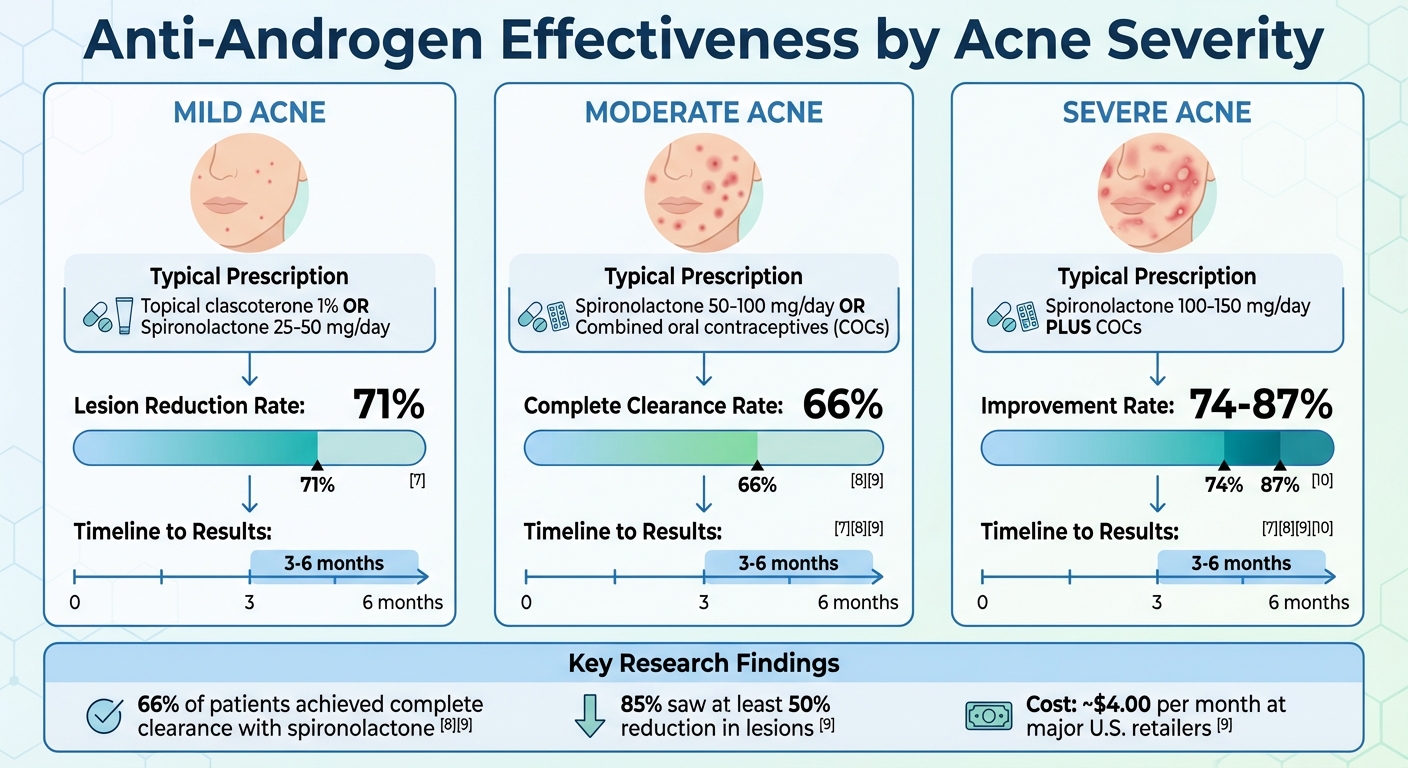
Anti-Androgen Effectiveness by Acne Severity: Treatment Options and Results
Mild vs. Moderate Acne
The dosage of spironolactone can be adjusted based on the severity of acne. For mild to moderate cases, these medications work by reducing comedones (blackheads and whiteheads) and inflammatory papules. Low-dose oral spironolactone (25–50 mg/day) or topical treatments like clascoterone cream are often sufficient as stand-alone options for milder cases.
For moderate acne, higher doses of spironolactone (50–100 mg/day) or combined oral contraceptives (COCs) tend to deliver better results. These therapies block androgen receptors and decrease sebum production. While isotretinoin is generally more effective than spironolactone for severe nodulocystic acne, spironolactone has been shown to produce complete or partial responses in up to 85% of patients.
It’s worth noting that hormonal therapies usually take about 3 to 6 months to show their full effects.
Effectiveness by Acne Severity
The effectiveness of anti-androgens varies depending on acne severity, as shown in the table below:
| Acne Severity | Typical Prescription | Lesion Reduction Rate | Timeline to Results |
|---|---|---|---|
| Mild | Topical clascoterone 1% or spironolactone 25–50 mg/day | 71% reduction in total lesions | 3–6 months |
| Moderate | Spironolactone 50–100 mg/day or combined oral contraceptives (COCs) | 66% complete clearance rate | 3–6 months |
| Severe | Spironolactone 100–150 mg/day plus COCs | 74–87% improvement | 3–6 months |
Research supports these findings. In a retrospective study of 395 patients, 66% achieved complete clearance with spironolactone, and 85% saw at least a 50% reduction in lesions. Another study highlighted that women with severe acne who used 100 mg/day of spironolactone alongside a combined oral contraceptive experienced a 75% or greater reduction in lesions for 74% of participants.
Adding to its appeal, spironolactone is highly cost-effective, priced at approximately $4.00 per month at major U.S. retailers.
Research Supporting Anti-Androgens for Acne
Studies on Spironolactone
The SAFA trial, a phase 3 randomized controlled trial (RCT), provides strong evidence for the use of spironolactone in treating acne in adult women. Led by Professor Miriam Santer from the University of Southampton, this double-blind study ran from June 2019 to August 2021 across 10 centers in England and Wales. It involved 410 women with persistent facial acne - 46% had mild cases, 40% moderate, and 13% severe - with an average age of 29.2 years.
Participants began with a 50 mg dose of spironolactone, increasing to 100 mg by week six. By the 24-week mark, 82% of women taking spironolactone reported improvements in their acne, compared to 63% in the placebo group. At 12 weeks, 19% of the spironolactone group reported treatment success, versus just 6% in the placebo group. The most frequently reported side effect was headaches, affecting 20% of the spironolactone group compared to 12% of those on placebo.
"Spironolactone is a useful alternative to oral antibiotics for women with acne." – Miriam Santer, Professor of Primary Care Research, University of Southampton
A recent meta-analysis further underscored spironolactone’s effectiveness, showing that patients were six times more likely to experience objective improvement compared to those on placebo (OR 6.59). These findings highlight spironolactone’s potential as a strong contender alongside other acne treatments.
How Anti-Androgens Compare to Other Acne Treatments
The SAFA trial results pave the way for a comparison between spironolactone and other common acne treatments. Spironolactone stands out as a safe, long-term alternative to oral antibiotics. While oral antibiotics often show faster results within the first three months - achieving a 48% reduction in lesions compared to 37.3% for oral contraceptives - hormonal treatments like spironolactone match their efficacy by six months, reaching around a 55% reduction. Additionally, spironolactone surpassed doxycycline (100 mg daily) when paired with benzoyl peroxide over a six-month period.
When compared to isotretinoin, which boasts the highest efficacy with a 48.4% lesion reduction, spironolactone offers a gentler option for adult women. Isotretinoin’s intensive side effects and monitoring requirements make spironolactone an appealing alternative for those seeking less invasive treatment. Combined oral contraceptives, while effective for hormonal regulation, show lower efficacy (8.0%–20.8% lesion reduction) and carry a threefold increased risk of venous thromboembolism compared to non-users.
Another anti-androgen option, topical clascoterone, has shown promise in clinical trials, with success rates ranging from 18.8% to 20.8%. This provides an additional choice for patients seeking localized treatment.
Get Personalized Treatment with Oana Health
If you're exploring anti-androgen therapies, tailored treatment plans can help you achieve better outcomes.
Consult with Licensed Medical Professionals
With Oana Health, you can connect directly with licensed professionals who specialize in hormonal acne. The process starts with a short online form where you share details about your medical history, menstrual patterns, PCOS symptoms, current medications, and upload photos of the affected areas. From there, a quick 5-minute virtual consultation allows a licensed provider to assess whether anti-androgens are the right option for you, considering factors like jawline acne and menstrual cycle-related breakouts.
Affordable Anti-Androgen Treatment Options
Oana Health makes treatment more accessible with clear and budget-friendly pricing. Options include Spironolactone at $14/month, the Spironolactone and Metformin comparison combo at $32/month, and Topical Spironolactone for $43/month. These rates can reduce out-of-pocket costs by up to 40% compared to traditional in-person visits.
Treatments Delivered to Your Home
Once your treatment plan is finalized, prescriptions are filled by FDA-regulated pharmacies and shipped directly to your door in discreet, HIPAA-compliant packaging. Free shipping is included, saving you time, travel, and the hassle of pharmacy pickups or multiple office visits.
Conclusion
Certain signs can indicate that anti-androgens might be a suitable option for managing your acne.
If your breakouts tend to cluster along your jawline and chin, worsen around your period, or persist despite topical treatments, anti-androgens could be worth considering. These treatments work by targeting excess androgens, which are responsible for increasing oil production. Research highlights that spironolactone can lead to 50-100% acne reduction and proves effective in about 70% of cases where symptoms like unwanted facial hair or hair thinning are also present.
For those dealing with moderate to severe hormonal acne that doesn’t respond to standard approaches, spironolactone has shown promising results. Studies reveal that combining spironolactone with benzoyl peroxide is more effective than pairing doxycycline with benzoyl peroxide over a 4–6 month period, nearly doubling the chances of success compared to a placebo. For milder cases, prescription topical treatments like clascoterone offer similar benefits but with fewer systemic effects. These findings align with clinical research and can help set realistic expectations for treatment timelines.
You can generally expect to see initial improvements within 8–12 weeks, with full results often appearing by the six-month mark. This gradual progress addresses the hormonal causes of acne rather than just treating surface-level symptoms.
If your acne follows hormonal patterns, flares up with your menstrual cycle, or is accompanied by signs of high androgen levels like PCOS, it’s a good idea to consult a licensed medical professional. They can determine whether anti-androgens are a suitable option for you. Platforms like Oana Health offer personalized consultations with specialists who can create a treatment plan tailored to your specific needs and severity.
FAQs
Do anti-androgens work if my hormone tests are normal?
Yes, anti-androgens can help manage hormonal acne even if your hormone levels seem normal in tests. These medications work by blocking the action of androgens, which can still play a role in acne development, regardless of what lab results show.
What side effects should I watch for on spironolactone?
Watch out for potential side effects, such as dizziness, nausea, menstrual changes, breast tenderness, muscle cramps, fatigue, increased urination, and elevated potassium levels (hyperkalemia). If you experience serious symptoms like an irregular heartbeat, confusion, or yellowing of the skin or eyes, seek medical attention immediately. Although less common, issues related to the kidneys or liver may also occur. If you notice anything unusual or concerning, reach out to your healthcare provider right away.
Can I take spironolactone if I’m trying to get pregnant?
Women are advised to discontinue spironolactone at least three months before attempting to conceive. This precaution helps reduce the risk of potential effects on male fetal development. Always consult your healthcare provider for personalized advice tailored to your circumstances.