
Mechanisms of Anti-Androgens: Steroidal vs. Non-Steroidal
Anti-androgens block testosterone and DHT from binding to receptors, helping manage conditions like PCOS, hirsutism, and acne, and prostate cancer. These drugs fall into two categories:
- Steroidal Anti-Androgens: Examples include cyproterone acetate and spironolactone. They block androgen receptors and reduce testosterone levels but can affect other hormone pathways, leading to side effects like menstrual changes or liver toxicity. They are less specific in targeting androgen receptors.
- Non-Steroidal Anti-Androgens (NSAAs): Examples include bicalutamide and enzalutamide. These are highly selective for androgen receptors, reducing side effects but may cause issues like gynecomastia or increased estrogen levels. Second-generation NSAAs are preferred for prostate cancer due to their effectiveness and specificity.
Quick Comparison:
| Feature | Steroidal Anti-Androgens | Non-Steroidal Anti-Androgens (NSAAs) |
|---|---|---|
| Hormonal Effect | Lowers testosterone & estrogen | Increases testosterone & estrogen |
| Receptor Specificity | Low (affects multiple receptors) | High (targets androgen receptors only) |
| Key Side Effects | Menstrual changes, liver issues | Gynecomastia, potential liver toxicity |
| Prostate Cancer Use | Limited due to partial agonist activity | Standard treatment, especially second-gen NSAAs |
Choosing the right option depends on individual health needs and tolerance. Regular monitoring is essential to minimize risks.
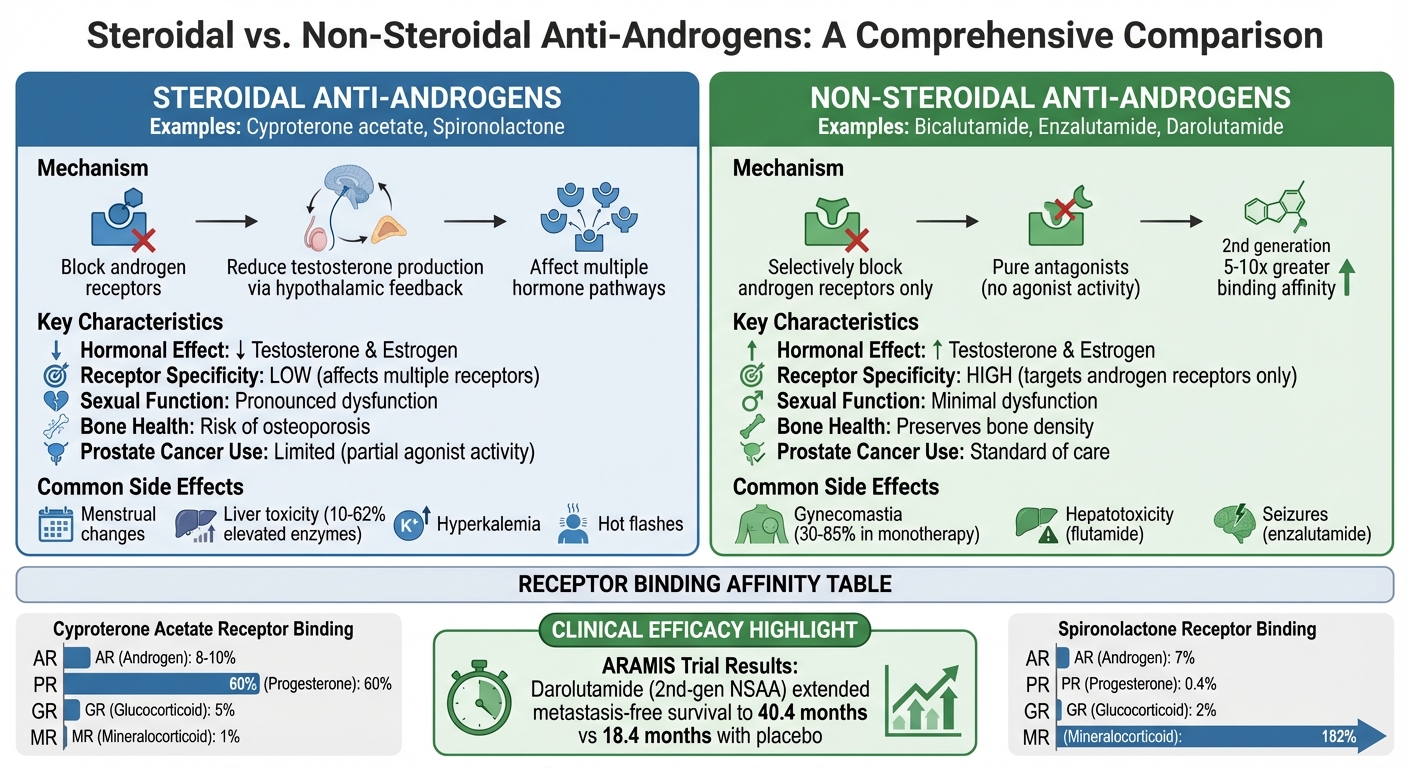
Steroidal vs Non-Steroidal Anti-Androgens: Key Differences and Receptor Binding Affinities
1. Steroidal Anti-Androgens
Mechanism of Action
Steroidal anti-androgens work through two main pathways. First, they compete with testosterone and dihydrotestosterone (DHT) by binding to intracellular androgen receptors, effectively blocking these hormones from attaching. Second, they trigger negative feedback at the hypothalamus and pituitary gland, which reduces luteinizing hormone (LH) secretion and, in turn, lowers plasma testosterone levels. Their steroidal structure also allows them to interact with other hormone receptors, leading to additional hormonal effects. These interactions ripple through broader hormonal pathways, influencing various physiological processes.
Endocrine Effects
Because of their structural resemblance to other steroid hormones, these anti-androgens exhibit progestational and glucocorticoid activity. For example, cyproterone acetate binds to progesterone receptors with a 60% affinity - much higher than its 8–10% affinity for androgen receptors. These additional effects can cause menstrual irregularities, such as amenorrhea, in women. Long-term use may also lead to minor increases in liver enzymes. In one study, 10% to 62% of patients experienced elevated liver enzyme levels, with 25% of women on 200–400 mg/day of cyproterone acetate showing increased ALT levels.
| Antiandrogen | AR Binding Affinity | PR Binding Affinity | GR Binding Affinity | MR Binding Affinity |
|---|---|---|---|---|
| Cyproterone acetate | 8–10 | 60 | 5 | 1 |
| Chlormadinone acetate | 5 | 175 | 38 | 1 |
| Megestrol acetate | 5 | 152 | 50 | 3 |
| Spironolactone | 7 | 0.4 | 2 | 182 |
Reference ligands (100%) were testosterone (AR), progesterone (PR), dexamethasone (GR), and aldosterone (MR).
Clinical Applications
The combined receptor activity and hormonal effects of steroidal anti-androgens make them useful for treating medical causes of hirsutism. For women with polycystic ovary syndrome (PCOS), cyproterone acetate is often prescribed at 25–50 mg/day, typically alongside ethinyl estradiol. Spironolactone, on the other hand, is commonly used at 100–200 mg/day to manage symptoms like moderate hirsutism and acne. While cyproterone acetate is generally more effective for hirsutism, its potential for liver toxicity has prevented FDA approval in the United States. Steroidal anti-androgens are also used in treating prostate cancer, benign prostatic hyperplasia, and as part of feminizing hormone therapy.
For those dealing with androgen excess conditions like PCOS, Oana Health offers telehealth services, including prescription treatments delivered straight to your door.
Efficacy and Selectivity
The broader receptor activity of steroidal anti-androgens can be both helpful and problematic. Unlike non-steroidal options that specifically target androgen receptors, steroidal compounds also interact with progesterone, glucocorticoid, and mineralocorticoid receptors. While this cross-reactivity can help regulate menstrual cycles through progestational effects, it also increases the likelihood of side effects. Additionally, many steroidal anti-androgens act as weak partial agonists, meaning they can activate receptors to a limited degree when stronger androgens are absent. In cases like aggressive prostate cancer, where androgen receptor levels are high, this partial agonist behavior can lead to "agonist switching", potentially promoting tumor growth instead of suppressing it. This is a sharp contrast to non-steroidal agents, which generally act as pure antagonists.
sbb-itb-6dba428
2. Non-Steroidal Anti-Androgens
Mechanism of Action
Non-steroidal anti-androgens (NSAAs) work by selectively targeting androgen receptors. They compete with testosterone and dihydrotestosterone (DHT) for the receptor's binding site, forming inactive complexes that block androgen-driven DNA and protein synthesis. Their structure allows them to interact specifically with androgen receptors without affecting other pathways.
Generational differences play a key role in their function. First-generation NSAAs, like flutamide and bicalutamide, primarily block receptor binding. In contrast, second-generation agents - enzalutamide, apalutamide, and darolutamide - go further by inhibiting receptor translocation, DNA binding, and co-activator recruitment. These newer drugs also bind with 5–10 times greater affinity than their predecessors. Unlike steroidal anti-androgens, which can have weak partial agonist activities, NSAAs act as "pure" antagonists with no androgenic or progestogenic effects.
Endocrine Effects
NSAAs disrupt the feedback loop in the hypothalamus and pituitary by blocking androgen receptors, leading to increased levels of GnRH, LH, testosterone, and estrogen. This rise in estrogen can cause gynecomastia, which occurs in up to 60% of patients using first-generation NSAAs.
Pharmacokinetics also vary significantly among these drugs. For instance, bicalutamide has a long elimination half-life of about six days, making once-daily dosing sufficient. On the other hand, flutamide, with its much shorter half-life of eight hours, requires three daily doses. Flutamide's use is further complicated by its association with severe liver injury, including fatal cases.
Clinical Applications
These pharmacological differences influence how NSAAs are used in practice. Their primary role is in treating advanced or metastatic prostate cancer, but they also have off-label uses for managing androgen-excess conditions in women. For example, flutamide is prescribed for hirsutism in PCOS and acne. Bicalutamide is another option for hirsutism and is also used in feminizing hormone therapy.
In prostate cancer treatment, second-generation NSAAs, such as enzalutamide and darolutamide, are now standard for castration-resistant cases. For instance, the ARAMIS trial demonstrated that darolutamide extended median metastasis-free survival to 40.4 months, compared to 18.4 months with a placebo.
Women dealing with androgen-related conditions like acne or unwanted facial hair can access prescription treatments through telehealth platforms like Oana Health, which deliver medications directly to their homes. Cost is another consideration; as of December 2022, generic bicalutamide was priced at just $0.26 per 50 mg tablet.
Efficacy and Selectivity
NSAAs offer a key advantage over steroidal anti-androgens by reducing unwanted hormonal side effects, thanks to their receptor specificity. Second-generation NSAAs, in particular, can even block mutant androgen receptors, such as the F876L mutation, which causes resistance to other treatments in prostate cancer.
However, selectivity comes with its own considerations. First-generation NSAAs often cross the blood-brain barrier, while darolutamide shows minimal central nervous system penetration, significantly lowering the risk of seizures. For androgen excess disorders, treatment typically lasts at least two years to achieve lasting results. These distinctions underline the importance of tailoring anti-androgen therapy to individual needs and conditions.
Pharmacology of Antiandrogens (Classification, Mechanism of Action, Uses & Side Effects)
Advantages and Disadvantages
When weighing the practical benefits and drawbacks of these treatments, the choice often hinges on the specific condition being addressed and how well the patient tolerates the medication.
Steroidal anti-androgens work by suppressing testosterone through hypothalamic feedback. However, they lack receptor specificity, leading to off-target effects like hypoestrogenism, a potential risk for osteoporosis, and, in the case of spironolactone, issues such as hyperkalemia and low blood pressure. Their partial agonist activity also poses a risk of stimulating cancer cell growth, making them less suitable for prostate cancer treatment.
Non-steroidal anti-androgens (NSAAs), on the other hand, function as pure androgen receptor antagonists, reducing hormonal side effects. Second-generation NSAAs are particularly effective, binding with 5–10 times greater affinity and offering pure antagonism. For instance, the ARAMIS trial demonstrated that darolutamide extended metastasis-free survival to 40.4 months, compared to 18.5 months with a placebo. However, NSAAs don't lower testosterone levels, which means increased estrogen from aromatization can lead to gynecomastia in 30% to 85% of men using them as monotherapy. First-generation NSAAs like flutamide have been linked to serious hepatotoxicity, with reports of at least 46 cases of severe liver injury and 20 fatalities.
| Feature | Steroidal Anti-Androgens | Non-Steroidal Anti-Androgens |
|---|---|---|
| Hormonal Effect | Lowers testosterone and estrogen levels | Increases testosterone and estrogen levels |
| Receptor Specificity | Low; affects multiple steroid receptors | High; targets only androgen receptors |
| Sexual Function | Pronounced sexual dysfunction and loss of libido | Minimal sexual dysfunction with monotherapy |
| Bone Health | Risk of osteoporosis due to estrogen suppression | Generally preserves bone density |
| Prostate Cancer Use | Limited due to partial agonist activity | Standard of care; no agonist activity |
| Key Side Effects | Hyperkalemia, hot flashes | Gynecomastia, hepatotoxicity, seizures (enzalutamide) |
Neither class emerges as a one-size-fits-all solution. For women with PCOS looking to manage acne or unwanted facial hair through services like Oana Health, following PCOS hormonal therapy protocols, the decision often depends on individual tolerance and any contraindications. Regular monitoring is critical to mitigate risks; for example, the rate of clinically apparent liver injury during extended anti-androgen therapy is estimated to range from 0.1% to 1%. These distinctions highlight the importance of tailoring treatment to each patient's unique profile.
Conclusion
Deciding on the right treatment depends on how each option works and how well a patient can tolerate it. Steroidal anti-androgens like cyproterone acetate and spironolactone not only block androgen receptors but also reduce testosterone production through feedback mechanisms in the hypothalamus. This dual action addresses both the symptoms and the root cause of hyperandrogenism in conditions like PCOS.
However, each treatment comes with its own challenges. Steroidal anti-androgens might lead to issues like menstrual changes, bone density reduction, and the need for potassium monitoring. On the other hand, non-steroidal anti-androgens focus solely on blocking androgen receptors, which makes them highly selective and reduces unwanted hormonal effects. That said, some non-steroidal options, such as flutamide, have been associated with liver toxicity, though cases of severe liver damage are rare. These pros and cons highlight the importance of tailoring treatment to the individual.
The best approach depends on patient-specific factors, making personalized therapy and regular monitoring essential. For customized hormonal care, platforms like Oana Health connect patients with licensed professionals to develop treatment plans suited to their needs.
FAQs
What’s the difference between steroidal and non-steroidal anti-androgens?
Steroidal anti-androgens are medications built on a steroid-based structure that work by blocking androgen receptors. They are frequently used to address conditions like prostate cancer and hormonal imbalances, including hyperandrogenism.
Non-steroidal anti-androgens, while also targeting androgen receptors, differ in their chemical makeup - they are not steroid-based. These are another common option for treating prostate cancer.
Both types are important in managing conditions linked to androgens, though their chemical structures and specific uses can differ.
Why are non-steroidal anti-androgens commonly used in prostate cancer treatment?
Non-steroidal anti-androgens are commonly used in prostate cancer treatment because they block androgen receptors without triggering them. This stops male hormones, like testosterone, from promoting cancer growth. Unlike their steroidal counterparts, they don’t show agonist activity, which reduces the risk of resistance developing. Plus, they can trigger cancer cell death (apoptosis), making them a strong option for managing the disease.
What side effects can occur with steroidal anti-androgens?
Steroidal anti-androgens often lead to side effects due to their influence on hormone levels. Commonly reported issues include gynecomastia (enlarged breast tissue in males), reduced libido, erectile dysfunction, and hot flashes. These symptoms stem from the suppression of androgen activity in the body.
Other possible side effects include decreased bone density, loss of muscle mass, and shifts in cholesterol levels - such as a drop in HDL ("good" cholesterol) and an increase in LDL ("bad" cholesterol). Certain medications in this group, like cyproterone acetate, may also impact liver function, making regular monitoring essential. Hormonal fluctuations caused by these drugs can sometimes lead to mood swings, fatigue, and other systemic effects.
The type and intensity of these side effects can vary based on the specific medication, dosage, and individual health factors. It's crucial to work closely with a healthcare provider to ensure proper guidance and monitoring throughout treatment.