
How Androgens Trigger Hormonal Acne
Hormonal acne often appears along the jawline and chin, driven by androgens - hormones like testosterone and DHT. These hormones increase oil production, clog pores, and spark inflammation, creating the perfect environment for acne. Even normal androgen levels can cause acne if your skin is overly sensitive to these hormones.
Key points:
- Androgens (like DHT) stimulate oil production in sebaceous glands.
- Excess oil clogs pores, leading to breakouts.
- Hormonal imbalances, like in PCOS, can worsen acne.
- Stress, diet (high-glycemic foods), and low estrogen levels also contribute.
Treatments include hormonal medications like spironolactone and birth control pills, topical solutions, and lifestyle changes such as a low-GI diet and stress management. For persistent acne, hormonal testing can help identify underlying issues.
Understanding Androgens and Acne
sbb-itb-6dba428
How Androgens Cause Hormonal Acne
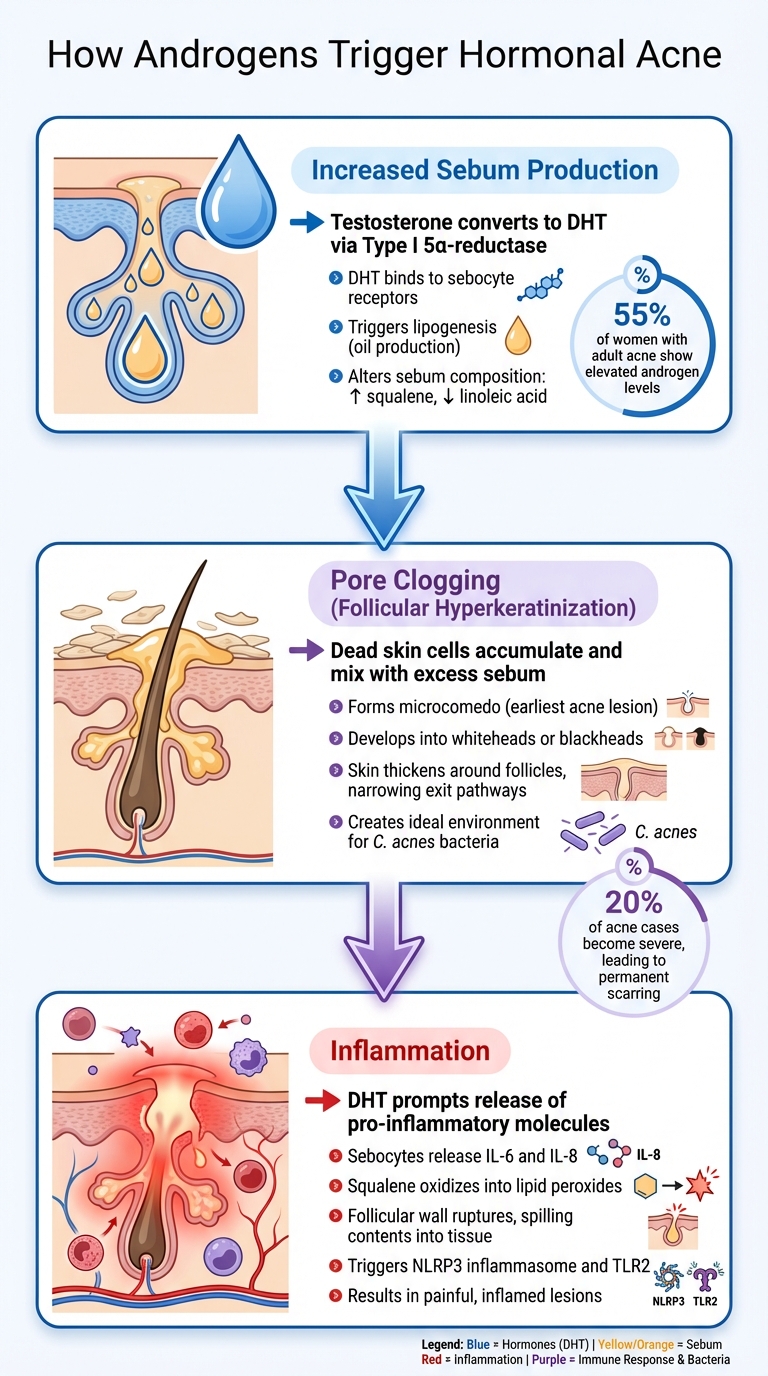
How Androgens Trigger Hormonal Acne: The Three-Stage Process
Androgens play a major role in acne development by setting off a chain reaction that creates the perfect environment for breakouts. This happens through three main processes: ramping up sebum production, clogging pores, and sparking inflammation.
Androgens Increase Sebum Production
In sebaceous-rich areas, testosterone converts to DHT (dihydrotestosterone) with the help of Type I 5α-reductase. DHT binds to receptors on sebocytes (oil-producing cells), triggering lipogenesis - essentially, the production of lipids. This leads to a buildup of oil inside the cells, which eventually burst, releasing sebum into hair follicles. Androgens also alter the makeup of sebum, raising squalene levels while reducing linoleic acid. This change creates a stickier and more irritating substance.
"Increased sebum production correlates with the severity of clinical manifestations of acne."
- Enrico Carmina, Endocrinology Unit, University of Palermo Medical School
This overproduction of sebum is why roughly 55% of women with adult acne show elevated androgen levels. The excess oil sets the stage for clogged pores.
How Androgens Clog Pores
Androgens also interfere with the natural shedding of follicular cells, a process known as follicular hyperkeratinization. Instead of shedding normally, dead skin cells pile up and mix with the extra sebum, forming a microcomedo - the earliest stage of an acne lesion. Over time, these microcomedones grow into visible whiteheads (closed comedones) or blackheads (open comedones). Androgens also thicken the skin around follicular openings, narrowing the pathway for sebum to exit and increasing the chance of blockages. This clogged environment, rich in oil and low in oxygen, becomes an ideal breeding ground for Cutibacterium acnes bacteria.
"The microcomedo serves as the primary lesion and is the precursor for all clinical manifestations of acne vulgaris."
This process explains why around 20% of acne sufferers may experience severe cases that lead to permanent scarring. Once the pores are clogged, inflammation takes hold.
Androgens and Skin Inflammation
After sebum overproduction and pore blockage, DHT drives inflammation by prompting sebocytes to release pro-inflammatory molecules like IL-6 and IL-8. The altered sebum, especially its squalene content, oxidizes into lipid peroxides. These peroxides damage the follicular wall, triggering an immune response. Macrophages and neutrophils release enzymes that cause the follicle to rupture, spilling bacteria, keratin, and inflammatory lipids into nearby tissue. This triggers the NLRP3 inflammasome and Toll-like receptor-2 (TLR2), leading to a surge of inflammatory molecules such as IL-1, IL-8, and IL-12, which turn a simple clogged pore into a painful, inflamed lesion.
"Androgens modulate sebum production and content in sebaceous glands, the proliferation of follicular keratinocytes, and the skin inflammation resulting in the comedo formation and the inflammation of acne."
- Chanat Kumtornrut, Division of Dermatology, Chulalongkorn University
Androgens may also slow the skin's healing process, prolonging lesions and increasing the likelihood of scarring.
Other Hormones That Affect Androgen-Related Acne
Hormones beyond androgens play a role in acne by influencing sebum production and inflammation. These interactions help explain why acne severity varies so much between individuals and at different life stages. Let’s take a closer look at how insulin, estrogen, progesterone, and stress hormones contribute to this process.
Insulin and IGF-1
High-glycemic foods can trigger insulin spikes, which lower SHBG (sex hormone-binding globulin). This leaves more active testosterone available to bind with skin receptors, fueling acne. Insulin also stimulates the ovaries and adrenal glands to produce more androgens.
IGF-1 (insulin-like growth factor 1) amplifies this effect by increasing 5α-reductase activity and making androgen receptors more sensitive. Both insulin and IGF-1 reduce FoxO1, a protein that normally regulates androgen activity and oil production. When FoxO1 levels drop, sebaceous glands produce excess oil.
"Insulin reinforces the entire androgen axis: The pituitary gland, where it acts as a gonadotrophin amplifier; the gonads where it stimulates androgen synthesis; the adrenal glands, where it stimulates the production of androgenic precursors; the liver, where it inhibits the production of sex hormone binding globulin (SHBG)... and the skin."
This explains why individuals with insulin resistance often experience severe acne. Elevated insulin creates a feedback loop, overstimulating sebaceous glands and worsening inflammation.
Estrogen and Progesterone
Estrogen plays a balancing role by increasing SHBG production, which binds free testosterone and reduces oil production. It also shrinks sebaceous glands and counteracts testosterone's effects on skin cells. This is why many women notice improved skin during pregnancy or while using estrogen-containing birth control.
Progesterone, on the other hand, has a more complex relationship with acne. It inhibits 5α-reductase but is also linked to premenstrual acne flares. Around 70% of women with acne report breakouts before their period, when progesterone levels are at their peak. The exact mechanism isn’t fully understood, but progesterone receptors in skin cells likely influence sebum production and composition during the menstrual cycle.
"The fluctuation of sebum production in women during the menstrual cycle has been blamed on progesterone, but this has not been proved experimentally."
Women with lower estrogen levels relative to androgens often experience more persistent acne. This imbalance becomes more pronounced during perimenopause, when estrogen levels naturally decline.
Stress Hormones and Cortisol
Stress hormones also play a major role in acne. Stress triggers the release of CRH (corticotropin-releasing hormone), which directly stimulates sebaceous glands to produce more oil. CRH also increases androgen activity and promotes the conversion of DHEA (a weaker androgen) into testosterone. Meanwhile, elevated cortisol worsens inflammation by increasing cytokine production.
"CRH targets the sebaceous glands and induces lipogenesis by enhancing androgen bioavailability and by stimulating the conversion of DHEA to testosterone."
- Mohamed L Elsaie, Department of Dermatology and Venereology, National Research Centre
This creates a vicious cycle: stress and hormonal changes contribute to acne, increasing oil production and inflammation. In turn, acne can cause psychological stress, further elevating stress hormones and perpetuating breakouts. Breaking this cycle through stress management techniques - like relaxation exercises, quality sleep, and regular physical activity - can help reduce acne flares.
These hormonal dynamics show why focusing solely on androgens may not be enough to address hormonal acne effectively.
Treatment Options for Androgen-Driven Acne
Addressing androgen-driven acne often involves reducing excess androgen activity through hormonal medications, specialized topical treatments, and lifestyle changes. While results vary, most treatments start showing noticeable effects within 3 to 6 months.
Hormonal Medications
Combined Oral Contraceptives (COCs) are a common choice for managing androgen-driven acne. They work by suppressing ovarian androgen production through feedback mechanisms in the pituitary gland and boosting sex hormone–binding globulin (SHBG) levels in the liver. SHBG binds free testosterone, limiting its ability to affect skin cells. FDA-approved options like Ortho Tri-Cyclen, Estrostep, and Yaz have demonstrated effectiveness in treating acne, often matching or surpassing the results of oral antibiotics within six months.
Spironolactone, an oral medication, acts as an androgen receptor blocker. It competes with dihydrotestosterone (DHT) and testosterone for receptor sites in sebaceous glands, reducing oil production and inflammation. In a six-month study, a daily dose of 150 mg spironolactone reduced acne scores by 62%, outperforming doxycycline at 100 mg/day. Additionally, a four-year retrospective study reported clinical improvement in 86% of patients using spironolactone. Oana Health offers this treatment starting at $14/month.
"Spironolactone is an effective acne treatment with clinical trial data to support its use as a first‐line acne treatment for women with acne."
For those seeking alternatives to oral medications, topical treatments provide localized solutions.
Topical and Prescription Treatments
Clascoterone (Winlevi) is a 1% topical cream that blocks DHT from binding to skin receptors. In Phase 3 trials, it achieved a 19.9% success rate compared to 7.7% for the placebo. However, its cost can be a barrier, with a one-month supply typically priced between $300 and $600.
Topical spironolactone offers another option for localized treatment. A 2% solution outperformed a 1.5% clindamycin topical in reducing acne lesions, including comedones, papules, and pustules. Oana Health provides this treatment at $43/month, making it a more affordable alternative to pricier brand-name topicals.
In addition to these treatments, lifestyle adjustments can help regulate hormonal triggers contributing to acne.
Lifestyle and Diet Changes
Dietary changes play a key role in managing androgen-driven acne. High-glycemic foods and dairy products are known to increase insulin and insulin-like growth factor-1 (IGF-1), which stimulate androgen production in the ovaries and adrenal glands. Switching to a low glycemic index (GI) diet - focusing on whole foods, vegetables, lean proteins, and avoiding refined carbs and dairy - can reduce insulin spikes and, in turn, oil production.
Low vitamin D levels are also linked to acne. In one study, 82.3% of female acne patients had vitamin D levels below 20 ng/mL. Since vitamin D deficiency is associated with both insulin resistance and inflammatory acne, supplementation may help improve insulin sensitivity and reduce inflammation.
"A patient with insulin resistance should be counseled about weight loss, exercise, and the consumption of a diet with low glycemic index."
- Sujata Mehta-Ambalal, MD
Regular physical activity and weight management further enhance insulin sensitivity and lower circulating insulin levels, helping to reduce androgen availability. Stress management techniques, such as meditation, quality sleep, and relaxation exercises, can also minimize hormonal surges that exacerbate acne. For patients with PCOS-related acne and insulin resistance, metformin is available through Oana Health starting at $22/month to support metabolic health.
| Treatment Type | Mechanism | Typical Timeline |
|---|---|---|
| Combined Oral Contraceptives | Suppress ovarian androgens; increase SHBG | 3–6 months |
| Oral Spironolactone | Block androgen receptors | 3–6 months |
| Topical Clascoterone | Local androgen receptor inhibition | 3–6 months |
| Topical Spironolactone | Local androgen receptor blockade | 3–6 months |
| Low-GI Diet + Exercise | Reduce insulin and IGF-1 | 2–4 months |
When to See a Healthcare Provider
Signs of High Androgen Levels
If you're dealing with persistent acne that doesn’t respond to typical treatments, it might be more than just a skincare issue - it could point to a hormonal imbalance. Elevated androgen levels often bring other signs along for the ride. These can include hirsutism (excess hair growth on areas like the upper lip, chin, chest, abdomen, or back), irregular or missed menstrual cycles, thinning hair on the scalp in a male-pattern distribution, or chronically oily skin. In more severe cases, symptoms like a deepened voice, increased muscle mass, or clitoral enlargement may appear. These signs are frequently linked to Polycystic Ovary Syndrome (PCOS).
"If these symptoms develop rapidly and suddenly, it's important to see your healthcare provider as soon as possible. In this case, the cause is often an androgen-secreting tumor."
If you notice these symptoms, it’s essential to confirm whether hormonal imbalances are at play through proper testing.
The Role of Hormonal Testing
Hormonal testing is a key step in identifying the root cause of acne and other symptoms. Blood tests typically measure total testosterone, free testosterone, and dehydroepiandrosterone sulfate (DHEAS) to determine whether the androgen excess is coming from the ovaries or adrenal glands. Additional tests might include the LH:FSH ratio (a ratio greater than 2:1 often points to PCOS) or 17-hydroxyprogesterone, which screens for congenital adrenal hyperplasia.
For the most accurate results, these tests are usually done during the early follicular phase of your menstrual cycle. If you're on oral contraceptives, your provider might recommend stopping them for at least a month before testing, as they can mask hormonal imbalances. Certain tests, like androstenedione, may also require fasting in the early morning because of natural hormone fluctuations throughout the day.
"Measurement of serum androgen values (total testosterone, free testosterone, and dehydroepiandrosterone sulfate) by high-quality assays is recommended in all women with adult acne."
- Enrico Carmina, MD, Endocrinology Unit, University of Palermo
For instance, extremely high DHEAS levels (above 8,000 ng/dL) could indicate an adrenal tumor that requires immediate attention. Meanwhile, a high LH:FSH ratio supports a PCOS diagnosis, guiding treatment options like insulin-sensitizing medications or androgen blockers. With these insights, targeted treatments become possible.
How Oana Health Can Help

Once you’ve received your test results, having expert guidance is crucial. Oana Health offers telehealth consultations to help you manage hormonal acne without needing to visit a clinic in person. Licensed healthcare providers will review your medical history, evaluate your symptoms, and arrange for hormonal testing to uncover any imbalances. Based on your results, they’ll recommend personalized, evidence-based treatments tailored to your specific needs.
Treatment options through Oana Health include:
- Oral spironolactone starting at $14 per month
- Topical spironolactone for $43 per month
- Metformin at $22 per month for addressing PCOS-related insulin resistance
Prescriptions are delivered directly to your door with free shipping, making treatment accessible and convenient. This approach is particularly helpful for women dealing with late-onset acne, stubborn breakouts, or acne accompanied by other signs of hormonal imbalance.
Conclusion: Managing Androgen-Related Acne
Hormonal acne stems from androgen-driven oil production and inflammation, requiring a combination of medical treatments and lifestyle changes to manage effectively. Addressing this type of acne involves a multi-faceted strategy: reducing androgen production, blocking androgen activity in the skin, and maintaining a consistent skincare routine [3,25].
Even if blood tests show normal androgen levels, treatment options are available. Many women experiencing persistent or late-onset acne (starting after age 25) find relief with hormonal therapies like spironolactone, combined oral contraceptives, or metformin. These treatments, often paired with topical retinoids, target the hormonal roots of acne and help reduce breakouts. Since most treatments manage symptoms rather than cure the condition, ongoing maintenance is key.
Consistency is crucial - visible improvements typically take 2–3 months of regular treatment [3,25]. During this time, adopting a holistic approach can enhance results. Use non-comedogenic skincare products, limit high-glycemic foods and dairy, and manage stress to help lower cortisol levels.
If stubborn acne is accompanied by symptoms like excess facial hair, irregular periods, or hair thinning, it’s important to seek professional evaluation. Hormonal testing can uncover androgen imbalances and guide targeted treatments. Oana Health provides telehealth consultations with licensed providers who can arrange testing, interpret results, and create personalized treatment plans - all with the convenience of free home delivery.
FAQs
Can you have hormonal acne with normal hormone labs?
Yes, hormonal acne can still develop even if your hormone lab results come back normal. This happens because subtle internal sensitivities or small hormonal fluctuations - often undetectable in standard tests - can trigger acne. These changes may increase sebum production and inflammation, which are key factors in acne formation.
Which blood tests check for androgen-related acne?
Blood tests for acne linked to androgens usually check free and total testosterone, dehydroepiandrosterone sulfate (DHEA-S), and androstenedione. These hormones can influence acne by boosting sebum production and triggering inflammation.
How long do hormonal acne treatments take to work?
Hormonal acne treatments often require 4 to 8 weeks before you start seeing visible changes. For some, it might take a few months to achieve complete improvement. Staying consistent with your treatment plan is essential to get the best results.