
How Nano-Formulations Improve Spironolactone
Spironolactone, widely used for conditions like acne, hair loss, and PCOS, faces significant challenges with poor absorption and systemic side effects. Nano-formulations solve these issues by shrinking particles to the nanometer scale, increasing absorption by up to 7.2 times and enabling targeted delivery to hair follicles and sebaceous glands. This reduces side effects like hyperkalemia and menstrual irregularities while improving effectiveness for localized treatments.
Key benefits of nano-formulated spironolactone include:
- Improved absorption: 5.1–7.2x higher drug release in 2 hours.
- Targeted delivery: Focuses on skin and hair follicles, minimizing systemic exposure.
- Reduced side effects: Limits widespread hormonal impacts.
- Controlled release: Provides quick action and sustained results.
These advancements are particularly promising for PCOS and acne treatments, offering safer, more effective options compared to standard tablets.
Problems with Standard Spironolactone Formulations
Poor Absorption and Low Bioavailability
One of the biggest hurdles with standard spironolactone tablets is their poor absorption. The drug dissolves very slowly in water - only about 28 μg/mL. Because of this, doctors often prescribe higher doses (usually 100–200 mg daily) to treat PCOS-related hirsutism, which unfortunately increases the likelihood of dose-dependent side effects. As Mohammed Maniruzzaman and colleagues explain:
Spironolactone (SP) falls into this group due to its very low aqueous solubility and slow dissolution rate resulting in a variable and poor oral bioavailability.
Another issue is the lack of liquid formulations, which forces pharmacies to create high-sugar suspensions that may not suit all patients. These challenges with absorption not only lead to higher dosing requirements but also amplify the risk of side effects.
Common Side Effects Throughout the Body
Spironolactone's lack of tissue specificity means it causes systemic side effects. For women of childbearing age, there's an added concern - spironolactone can potentially feminize a male embryo, often prompting the simultaneous use of oral contraceptives. These side effects can deter patients from staying on the treatment, particularly since visible improvements in acne may take about 3 months, and hair-related benefits can take up to 6 months. On top of that, regular blood tests to monitor potassium levels make long-term treatment even more challenging. This combination of systemic side effects and prolonged treatment timelines often complicates compliance.
Difficulties with Accurate Dosing
Accurately dosing spironolactone is another significant challenge. Its variable absorption and frequent off-label use mean that doctors often rely on trial and error to find the right dose. Additionally, the drug’s systemic distribution can cause unwanted hormonal effects, even when the goal is to target localized enzyme overexpression. While topical formulations might seem like a solution, they often fail to consistently reach the intended tissues. All these factors make achieving precise dosing a complex task.
How Nano-Formulations Work
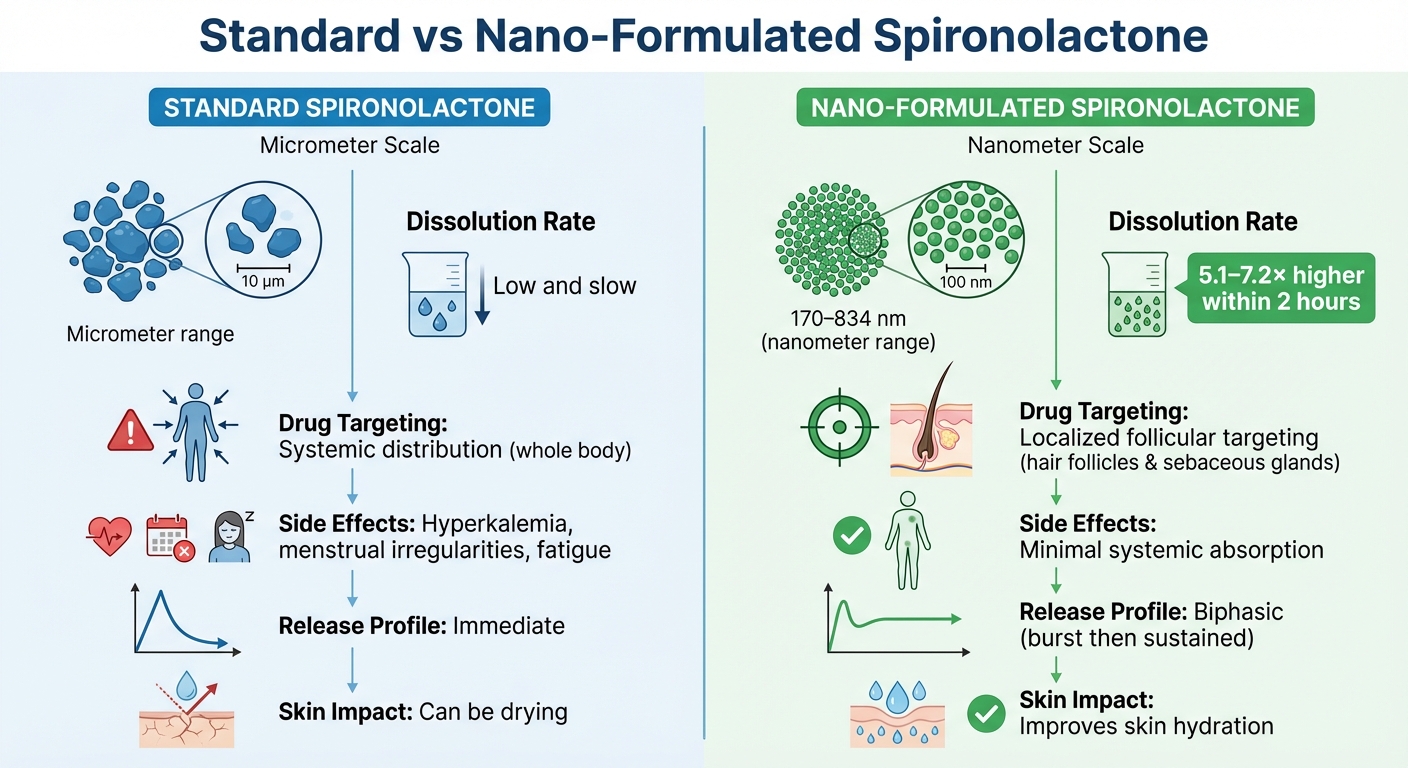
Standard vs Nano-Formulated Spironolactone: Key Differences
What Are Nano-Formulations?
Nano-formulations are advanced drug delivery systems that utilize ultra-small particles, typically ranging from 10 to 1,000 nanometers (nm) in size. These minuscule particles either encapsulate the drug or attach it to their surface. What sets nano-formulations apart from standard spironolactone tablets is their vastly increased surface area. Breaking a drug into nano-sized particles creates significantly more surface area that interacts with bodily fluids, leading to faster dissolution and absorption.
In contrast, standard spironolactone tablets are made with larger crystalline particles that dissolve at a slower rate. Nano-formulations overcome this limitation by converting the drug into an amorphous (non-crystalline) state within specialized carriers. Let’s delve into the specific types of nano-formulations and how they enhance spironolactone delivery.
Types of Nano-Formulations for Spironolactone
Various nano-formulation strategies have been developed to enhance spironolactone's stability and effectiveness. Among these, Nanostructured Lipid Carriers (NLCs) are regarded as the most advanced. These "second-generation" nanoparticles combine solid lipids (like stearic acid) with liquid oils (like oleic acid), forming an imperfect crystal structure. This structure can hold more of the drug and reduces the risk of leakage during storage. Impressively, NLCs can consist of up to 95% solid lipid while still incorporating liquid oils for enhanced stability.
Solid Lipid Nanoparticles (SLNs), the earlier generation of lipid-based nanoparticles, rely solely on solid lipids. While effective at improving solubility, SLNs are more susceptible to drug leakage over time. Another promising option, LeciPlexes, combines phospholipids with cationic surfactants and has demonstrated entrapment efficiencies as high as 93% for spironolactone. Additional systems, such as nanomicelles and vesicular carriers like ethosomes and niosomes, are particularly effective for delivering the drug deep into the skin.
How Nano-Formulations Improve Drug Delivery
These nano-structures revolutionize drug delivery through faster dissolution, targeted application, and controlled release. First, they significantly enhance solubility by reducing particle size into the nanorange, which increases the surface area for dissolution. As H.R. Kelidari and colleagues explain:
The increase in the dissolution is mainly due to a significant reduction in the drug particle size down to the nanorange leading to the higher surface area available for dissolution.
Second, nano-formulations enable targeted delivery to specific areas like hair follicles and sebaceous glands, making them ideal for treating acne and hair loss. This localized delivery minimizes the amount of drug entering the bloodstream, reducing the risk of systemic side effects. Finally, they offer controlled release with a dual-phase pattern: an initial burst for quick action, followed by a sustained release over time. For instance, studies show that while standard spironolactone suspensions release only about 40% of the drug in 24 hours, NLC formulations release approximately 66% in the same timeframe.
Benefits of Nano-Formulated Spironolactone
Nano-formulations of spironolactone tackle the challenges of absorption and dosing seen with traditional versions, offering improved effectiveness and a safer profile.
Improved Solubility and Absorption
One major hurdle with spironolactone is its poor water solubility. Nano-formulations overcome this by reducing particle size to about 170 nanometers, which increases the surface area for dissolution. Additionally, spironolactone is converted into an amorphous form within lipid carriers, boosting drug release rates by 5.1- to 7.2-fold within just two hours.
This enhanced solubility ensures the medication reaches the hair follicles and sebaceous glands more effectively - the key areas for addressing acne and unwanted facial hair associated with PCOS. By improving absorption, nano-formulations not only enhance the drug’s efficacy but also reduce systemic exposure, minimizing potential side effects.
Reduced Side Effects
Oral spironolactone is known for causing systemic side effects like hyperkalemia and menstrual irregularities. Nano-formulated spironolactone, particularly in topical applications, directly targets hair follicles and sebaceous glands while limiting systemic absorption. This targeted delivery significantly reduces the risk of widespread side effects.
As noted by Saedah Dereiah and colleagues:
Topical SP has generally been found to be safer than oral SP for both genders.
For patients with PCOS who often juggle multiple hormonal treatments, this localized delivery method is a game-changer, helping them avoid additional systemic complications.
Consistent Drug Release
Nano-formulations are designed for a biphasic release. Initially, there’s a quick burst to improve skin penetration, followed by a steady release that maintains therapeutic levels over time. Rehab Nabil Shamma and Mona Hassan Aburahma from Cairo University describe this process:
The observed release patterns are interesting for follicular application in the view of that the initial release improves the penetration of drug, while further steady release provides the drug over a prolonged period of time.
For conditions like hirsutism and acne linked to PCOS, this sustained release ensures consistent symptom control with less frequent application. In animal studies, topical spironolactone nano-gels applied over three weeks significantly reduced hair follicle diameter and density. This controlled delivery method allows for more precise and personalized treatment options in managing hormonal imbalances and PCOS symptoms.
sbb-itb-6dba428
Research Evidence for Nano-Formulated Spironolactone
Studies on Nanomicelles and NLCs
Researchers have been exploring nano-formulations of spironolactone, yielding some intriguing findings. Back in 2014, a team from Cairo University developed spironolactone-loaded nanostructured lipid carriers (NLCs) with particle sizes ranging from 215.6 to 834.3 nm. These carriers achieved an entrapment efficiency of over 74%. Using confocal laser scanning microscopy in mice, they confirmed that the formulation achieved deep follicular delivery, highlighting its potential for targeted treatments.
Fast forward to 2021, Amer and colleagues tested spironolactone-NLC hydrogels on rats with letrozole-induced PCOS. After just three weeks, the nano-gel significantly reduced both the diameter and density of hair follicles. This demonstrated its effectiveness in addressing PCOS-related unwanted hair growth.
These early findings are paving the way for clinical trials, especially in applications for acne and PCOS treatment.
Results for Acne and PCOS Treatment
A randomized, double-blind study compared a spironolactone-NLC gel with a standard alcoholic gel for treating mild to moderate acne. Over eight weeks, lesion counts dropped significantly - from 37.66 to 20.31. At the same time, skin hydration improved from 37.44 to 45.69.
H.R. Kelidari commented on the potential of this formulation:
The SP-NLC gel may help in controlling acne vulgaris with skin care benefits.
These results suggest that nano-formulated spironolactone doesn't just address acne effectively - it also improves skin hydration. This dual benefit could be especially appealing to patients dealing with PCOS, where skin issues are often a concern.
Comparison Table: Standard vs. Nano-Formulated Spironolactone
Here’s a quick comparison of standard spironolactone and its nano-formulated counterpart, highlighting the key differences:
| Feature | Standard Spironolactone | Nano-Formulated Spironolactone |
|---|---|---|
| Particle Size | Micrometer range | 170–834 nm |
| Dissolution Rate | Low and slow | 5.1–7.2× higher within 2 hours |
| Drug Targeting | Systemic distribution | Localized follicular targeting |
| Side Effects | Hyperkalemia, menstrual irregularities, fatigue | Minimal systemic absorption |
| Release Profile | Immediate | Biphasic: burst then sustained |
| Skin Impact | Can be drying | Improves skin hydration |
This comparison underscores how nano-formulated spironolactone offers targeted delivery, faster dissolution, and skin-enhancing properties, while minimizing systemic side effects. These advantages make it a promising option for treating acne, PCOS symptoms, and related conditions.
Future Uses in Hormonal and PCOS Treatments
Customized Hormonal Treatments
Nano-formulations offer the ability to fine-tune solid-to-liquid lipid ratios, improving how treatments dissolve and get absorbed in the body. This flexibility makes it possible to tailor therapies for specific conditions like acne, unwanted hair growth, or hair loss.
For those battling hirsutism, adding hyaluronic acid to formulations creates cerosomes, which enhance skin penetration and deliver longer-lasting effects to combat excessive hair growth.
Since 75–90% of PCOS patients deal with elevated androgen levels, nano-carriers can be developed to provide a quick initial release for immediate symptom relief, followed by a steady hormonal regulation over time.
This level of personalization is increasingly accessible through telehealth platforms offering specialized clinical solutions.
Oana Health's Spironolactone Treatment Options
Oana Health has embraced these advancements by offering cutting-edge spironolactone treatments through its telehealth service. Options include topical spironolactone for $43/month and oral spironolactone for $14/month. The topical version uses advanced delivery systems to target androgen receptors directly in the skin, reducing systemic absorption and lowering the risk of side effects.
For patients juggling multiple PCOS symptoms, Oana Health also provides MetSpiro, a custom-compounded medication combining metformin and spironolactone in one prescription. This dual-action solution addresses both insulin resistance and androgen excess, tackling the metabolic and hormonal challenges of PCOS in a single treatment.
Conclusion
Nano-formulations address spironolactone's challenges with poor solubility and absorption, boosting drug release by 5.1–7.2 times. They also ensure the medication reaches hair follicles and sebaceous glands directly. This precise targeting not only enhances effectiveness but also reduces systemic side effects like hyperkalemia, menstrual changes, and fatigue, while offering immediate relief and long-term hormonal balance.
These advancements also simplify access to care. Platforms such as Oana Health bring these treatments to your doorstep, eliminating the need for traditional doctor visits and pharmacy trips. With options like topical spironolactone for $43/month and oral spironolactone for $14/month - both with free delivery - customized hormonal care has never been easier or more convenient.
Real patients highlight the impact of this approach. Virgie S., a satisfied user, shared:
Oana Health provides great service! I love how easy and accessible it is to get my Spiro. Their patient support team and doctors are very eager and quick to help whenever I have questions.
FAQs
How do nano-formulations enhance spironolactone absorption?
Nano-formulations improve how spironolactone works by breaking it down into much smaller particles. This increases the surface area, which helps the medication dissolve faster and more effectively in the body. The result? The drug becomes easier for your body to absorb and use.
These formulations also enhance the drug’s stability, ensuring it performs consistently and addresses issues like poor absorption. On top of that, they may help reduce side effects, making the treatment easier for patients to handle.
How do nano-formulations make spironolactone more effective and reduce side effects?
Nano-formulations of spironolactone enhance the medication's absorption in the body, allowing it to work more efficiently while cutting down on common side effects. By targeting the treatment directly to the affected area, these formulations help reduce problems such as skin irritation and dryness, as well as lower the likelihood of systemic side effects.
This targeted delivery method offers a more refined treatment experience, improving spironolactone's effectiveness for managing conditions like hormonal imbalances and their associated symptoms.
How do nano-formulations improve the effectiveness of spironolactone for skin and hair concerns?
Nano-formulations improve the way spironolactone works by delivering it straight to specific areas like hair follicles and sebaceous glands. With the use of advanced nanostructured lipid carriers, these formulations ensure the medication builds up exactly where it’s needed. This precision enhances local effectiveness while cutting down on unwanted side effects that affect the rest of the body.
By focusing delivery, this method not only strengthens spironolactone’s ability to tackle issues like acne and unwanted hair growth but also addresses common problems like poor absorption and unnecessary systemic effects.