
Efficacy of Topical Estrogen for Hair Regrowth
Female pattern hair loss (FPHL) affects millions of women, especially as they age. While treatments like minoxidil and finasteride are common, topical estrogen - specifically 17α-estradiol - has emerged as another option. Here's what you need to know:
Key Takeaways:
- Topical 17α-estradiol works by reducing DHT levels, a hormone linked to hair thinning, and extending the hair growth phase.
- Studies show moderate regrowth with 17α-estradiol, but topical finasteride consistently outperforms it in effectiveness.
- Combination treatments, like 17α-estradiol with minoxidil, may improve results, but evidence is mixed.
- Side effects are typically mild (scalp irritation, itching) with low systemic risks, making it a safer option for some.
How It Compares:
- Topical Finasteride 0.5%: Stronger results but not suitable for women of childbearing age due to teratogenic risks.
- Topical 17α-Estradiol 0.05%: Slower, moderate regrowth with fewer risks.
- Combination Therapies: Pairing 17α-estradiol with minoxidil or spironolactone can enhance outcomes.
Timeline for Results:
- Initial improvements: 2–4 months
- Noticeable regrowth: 6 months
- Significant changes: 12–18 months
If you're looking for a treatment that's safer with minimal side effects, topical estrogen might be worth considering. However, stronger options like topical finasteride or combination therapies often yield better results. Always consult a healthcare provider to find the best solution for your needs.
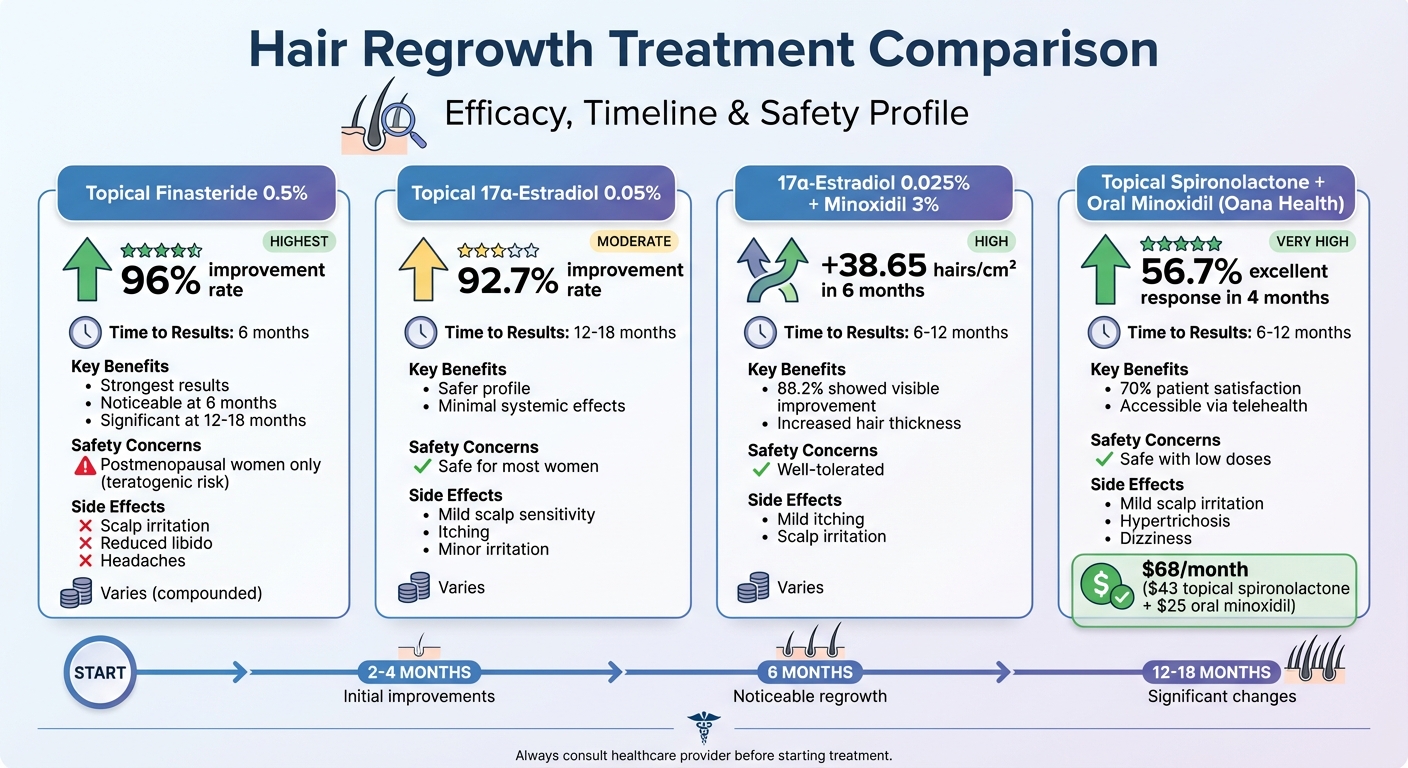
Comparison of Topical Hair Loss Treatments: Efficacy, Timeline, and Costs
1. Topical 17α-Estradiol 0.05%
Efficacy in Hair Regrowth
Topical 17α-estradiol 0.05% works by inhibiting 5α-reductase and increasing aromatase activity in hair follicles. This reduces DHT levels while locally raising estrogen levels in the scalp. A retrospective study conducted by Sapienza University in April 2020 evaluated 50 postmenopausal women using 17α-estradiol 0.05% combined with 2% minoxidil. The results showed noticeable hair regrowth at both the 6-month and 12–18-month marks (P < 0.05). However, another group of 69 women using topical finasteride 0.5% alongside minoxidil demonstrated better results at every checkpoint.
"The efficacy of topical finasteride was significantly greater than that of 17α-estradiol solution, both at the 6‑month (P < 0.05) and at the 12‑ to 18‑month follow‑up (P < 0.005)." – Alfredo Rossi et al., Sapienza University
This highlights the varying effectiveness of hormonal treatments for hair regrowth. One advantage of 17α-estradiol is its lower binding affinity for estrogen receptors compared to 17β-estradiol. This reduces the risk of feminizing effects, making it more suitable for scalp treatments. Often prescribed off-label, it’s commonly used in combination with minoxidil to improve results. These findings help establish clear expectations for patients regarding treatment outcomes.
Timeframe for Visible Results
The timeline for visible regrowth with 17α-estradiol 0.05% is well-defined. Initial signs of regrowth typically appear within 2–4 months, with more substantial improvements becoming evident after 6 months. By 12–18 months, patients often see significant progress. However, it’s important to note that discontinuing treatment can result in the loss of newly regrown hair within a few months.
Side Effects and Tolerability
Tolerability is a key factor when considering any treatment. Topical 17α-estradiol 0.05% is generally well-tolerated due to its localized application and lower potency, which minimizes the risk of systemic estrogenic effects. Most users report only mild side effects, such as scalp sensitivity, itching, or minor irritation. Temporary shedding may also occur as hair transitions from the resting phase to the growth phase. Systemic side effects, including breast tenderness or headaches, are rare, as the low serum levels achieved with topical use avoid the risks associated with systemic hormone therapy.
2. Topical Finasteride 0.5%
Efficacy in Hair Regrowth
Topical finasteride 0.5% has shown better results in promoting hair regrowth compared to 17α-estradiol in addressing postmenopausal female pattern hair loss (FPHL). Finasteride acts as a strong type II 5α-reductase inhibitor, while 17α-estradiol offers only weak inhibition - making finasteride the more effective option, as supported by clinical findings.
A retrospective study conducted between 2016 and 2019 at Sapienza University of Rome, led by Dr. Alfredo Rossi, highlighted this effectiveness. Among 50 postmenopausal women treated with a compounded formulation containing finasteride 0.5%, minoxidil 2%, and hydrocortisone butyrate 0.08%, an impressive 96% (48 out of 50) demonstrated improvement on a 7-point scale. The most noticeable benefits were observed between 12 and 18 months of treatment.
"The efficacy of topical finasteride was significantly greater than that of 17α-estradiol solution, both at the 6‑month (P < 0.05) and at the 12‑ to 18‑month follow‑up (P < 0.005)." – Alfredo Rossi, MD, Sapienza University
Timeframe for Visible Results
Patients can typically expect visible signs of hair regrowth around the 6-month mark, with the most pronounced improvements occurring between 12 and 18 months of consistent application. For optimal results, about 1 mL of the solution should be applied nightly to the affected areas of the scalp, such as the vertex and frontal regions. A minimum treatment period of 6 to 12 months is recommended before assessing its effectiveness.
However, while the results can be promising, it’s essential to weigh these benefits against potential side effects.
Side Effects and Tolerability
Although topical finasteride reduces systemic absorption compared to oral forms, some absorption still occurs. For instance, studies on 0.25% topical finasteride have shown a 68%–75% reduction in plasma dihydrotestosterone (DHT) levels, which is comparable to the 62%–72% reduction seen with 1 mg oral tablets. This reduction underscores the need to monitor for side effects similar to those associated with oral finasteride, such as reduced libido, headaches, and mood changes.
Local side effects might include scalp irritation, redness, or contact dermatitis. Additionally, due to the risk of teratogenicity - specifically the potential feminization of a male fetus - topical finasteride is generally recommended for postmenopausal women and should not be used by women of childbearing age.
Cost and Accessibility
Despite its clinical benefits, accessibility remains a challenge. Topical finasteride 0.5% is not commercially available in many regions, including the United States, and often requires a prescription for a compounded formulation. Lower concentrations, such as 0.25%, have been approved in countries like Italy, Germany, Portugal, Switzerland, Spain, South Korea, and Saudi Arabia. However, in the US and UK, it remains an off-label or compounded option, which can affect both cost and insurance coverage. Prices can vary significantly depending on the compounding pharmacy, adding another layer of complexity for patients seeking this treatment.
3. Topical 17α-Estradiol 0.025% Combined with Minoxidil
Efficacy in Hair Regrowth
When used together, 17α-estradiol and minoxidil appear to amplify the effects of minoxidil combinations for female pattern hair loss (FPHL). The combination of 0.025% 17α-estradiol and 3% minoxidil works by addressing two key factors: 17α-estradiol slows hair loss by inhibiting 5α-reductase, while minoxidil promotes follicle growth and extends the hair growth phase.
A study conducted at Wonju Severance Christian Hospital between March 2010 and December 2015 evaluated 34 women with FPHL using this combination therapy once daily. Led by Dr. Won-Soo Lee, the study showed promising results: total hair count increased by 38.65 hairs/cm² (p < 0.0001), and hair thickness improved from 0.061 µm to 0.074 µm (p < 0.01) over six months. Photographic evidence showed visible improvement in 88.2% of participants.
"A combination therapy consisting of topical 0.025% 17α-estradiol and 3% minoxidil can be tried as an effective treatment for FPHL." – Sung Jay Choe et al., Department of Dermatology and Institute of Hair and Cosmetic Medicine, Yonsei University Wonju College of Medicine
Despite these findings, not all research supports a clear advantage of this combination over minoxidil alone. For instance, a 2024 study comparing 0.01% 17α-ethinylestradiol with 2% minoxidil found no significant difference in outcomes compared to minoxidil monotherapy. Interestingly, the effectiveness of the treatment appears consistent, regardless of family history or the initial severity of hair loss.
Timeframe for Visible Results
As with most topical treatments, results from this combination therapy require patience. Improvements typically become noticeable after six months of daily use. Over a 12-month period, hair density increased from 237.68 to 265.77 hairs/cm².
For best results, it’s recommended to apply 17α-estradiol in the morning and minoxidil in the evening, ensuring optimal absorption.
Side Effects and Tolerability
This combination therapy is generally well-tolerated, with minimal side effects reported. In clinical trials, no major adverse events were observed. A small number of participants experienced mild symptoms like itching (pruritus) or scalp irritation.
"In addition to the satisfactory clinical efficacy observed during this study, no major side effects were observed in any patient." – Sung Jay Choe et al., Department of Dermatology and Institute of Hair and Cosmetic Medicine, Yonsei University
Importantly, the treatment did not cause systemic hormonal side effects, such as menstrual irregularities, further highlighting its favorable safety profile.
4. Oana Health Topical Spironolactone and Oral Minoxidil
Efficacy in Hair Regrowth
The combination of topical spironolactone and oral minoxidil from Oana Health delivers a more effective solution for hair regrowth compared to topical estrogen treatments. While 17α-estradiol offers only weak androgen inhibition, spironolactone works by strongly blocking both androgen production and receptors.
Clinical data highlights the effectiveness of this approach. In one study, 56.7% of patients achieved an "excellent" response within just 4 months, whereas the group using finasteride and minoxidil showed no such results. Additionally, patient satisfaction was significantly higher with spironolactone-minoxidil (70%) compared to finasteride-minoxidil (33.3%). These results underline its strong potential for hair regrowth with a comparable treatment timeline and manageable side effects.
Timeframe for Visible Results
This combination therapy aligns with the typical timelines observed in similar treatments. Initial improvements generally become noticeable around the 6-month mark with consistent use, while the most pronounced results are often seen between 6 and 12–18 months.
Side Effects and Tolerability
The safety profile of this therapy strikes a balance between effectiveness and minimal systemic exposure. Using spironolactone topically reduces the chance of systemic side effects like menstrual irregularities or breast tenderness. However, some localized reactions - such as mild scalp irritation, scaling, or contact dermatitis - may occur.
For oral minoxidil, keeping the dose low (≤5 mg/day) minimizes the impact on blood pressure for most users. Common side effects include hypertrichosis (excessive hair growth), dizziness when standing (postural hypotension), headaches, and mild fluid retention. In one study involving 100 women treated with 25 mg spironolactone and 0.25 mg oral minoxidil, only 2% experienced postural hypotension, and 4% reported facial hypertrichosis.
"Topical spironolactone is safer than oral administration and is suitable for both male and female patients, and is expected to become a common drug for those who do not have a good response to minoxidil." – Weixin Fan, Department of Dermatology, The First Affiliated Hospital of Nanjing Medical University
Cost and Accessibility
In addition to its efficacy, this treatment is designed to be accessible. Oana Health provides the therapy through telehealth services. Topical spironolactone is priced at $43/month, and oral minoxidil costs $25/month. Before prescribing, licensed medical professionals review each patient's health history. Medications are shipped directly to patients' homes from FDA-regulated pharmacies, with free shipping included.
sbb-itb-6dba428
Topical Estrogen for Female Pattern Hair Loss
Pros and Cons
Every treatment option has its own set of strengths and limitations. Let's break them down:
Topical finasteride 0.5% delivers the fastest and most pronounced results, with noticeable improvement in just 6 months, according to clinical studies. However, it’s only safe for postmenopausal women due to the risk of systemic absorption, which could harm male fetuses during pregnancy.
Topical 17α-estradiol 0.05% is a safer option with minimal estrogenic effects, making it a good choice for those who can't tolerate stronger anti-androgens. The catch? It takes longer - about 12 to 18 months - to show similar results. Nevertheless, it’s a reliable option for those who are patient.
A combination of 17α-estradiol 0.025% and minoxidil 3% showed an average increase of 38.65 hairs/cm² after 6 months, along with a boost in hair thickness from 0.061 µm to 0.074 µm. While side effects are generally mild, like scalp irritation, adding estrogen may not significantly enhance results compared to minoxidil alone.
The Oana Health combination of topical spironolactone and oral minoxidil is notable for its effectiveness and affordability. At $68 per month (with topical spironolactone priced at $43/month and oral minoxidil at $25/month), it delivered excellent results in 56.7% of patients. Mild side effects like scalp irritation, hypertrichosis, or fluid retention might occur.
Here’s a quick summary for easy comparison:
| Treatment | Efficacy | Time to Results | Key Safety Concerns | Monthly Cost |
|---|---|---|---|---|
| Topical Finasteride 0.5% | Highest (96% improvement) | 6 months | Postmenopausal use only; teratogenic risk | Varies |
| Topical 17α-Estradiol 0.05% | Moderate (92.7% improvement) | 12–18 months | Minimal; safe profile | Varies |
| 17α-Estradiol 0.025% + Minoxidil 3% | High (+38.65 hairs/cm²) | 6–12 months | Scalp irritation; possible menstrual changes | Varies |
| Oana Health: Topical Spironolactone + Oral Minoxidil | Very high (56.7% excellent response) | 6–12 months | Mild scalp reactions; hypertrichosis | $68/month combined |
This breakdown highlights how topical estrogen fits into the broader range of hormonal therapies for hair regrowth, offering options tailored to different needs and preferences.
Conclusion
Clinical evidence supporting topical estrogen for female pattern hair loss is sparse. In one randomized study, a 0.025% alpha-estradiol formulation failed to show a meaningful improvement in hair regrowth after six months of use. Meanwhile, topical minoxidil continues to be the go-to treatment, demonstrating an average increase of 13.18 hairs per cm² compared to placebo.
Topical estrogen may be most appropriate for postmenopausal women experiencing diffuse hair thinning due to hormonal shifts. However, many patients often require stronger treatments. For those with PCOS or signs of hyperandrogenism, anti-androgen therapies, such as spironolactone, tend to be more effective as they directly counteract excess androgen activity.
While the role of topical estrogen is limited, more potent anti-androgen strategies remain critical. Personalized options, like the Oana Health combination of topical spironolactone ($43/month) and oral minoxidil ($25/month), offer prescription-based treatments that balance effectiveness and affordability.
"Antiandrogen agents or 5α-reductase inhibitors are effective treatments in women with female-pattern hair loss and are useful in combination with minoxidil." - Elise A. Olsen, MD
Most treatments require a period of 6–12 months to achieve optimal results. Clinicians should reassess progress around the 12- to 16-week mark, as this is when many pharmaceutical treatments begin to plateau. Ultimately, selecting the right treatment should be tailored to the individual, considering their hormonal profile, specific hair loss patterns, and overall goals for the best possible outcomes.
FAQs
How effective is topical 17α-estradiol compared to minoxidil for hair regrowth?
Topical 17α-estradiol has gained attention for its potential to address hair loss, particularly in women dealing with hormonal imbalances. While minoxidil is a well-known treatment for stimulating hair regrowth, some studies hint that combining it with 17α-estradiol could enhance outcomes, particularly for female pattern hair loss.
The key difference lies in how these treatments work. Minoxidil directly stimulates hair follicles to promote growth, while 17α-estradiol focuses on the hormonal factors that contribute to thinning hair. That said, research comparing the two treatments head-to-head is still limited, and minoxidil continues to be the go-to option for most people. For those experiencing hormone-related hair loss, adding topical estrogen might be a useful complement to their regimen. However, it’s essential to consult a healthcare provider for tailored guidance.
What side effects can occur with topical estrogen for hair loss?
Using topical estrogen for hair loss can come with some potential side effects. One concern is a slightly higher risk of endometrial cancer, especially with prolonged use in women who still have their uterus. There’s also a small possibility of an increased breast cancer risk, though this remains low when the treatment is short-term or involves low doses.
Before beginning this treatment, it’s essential to talk with a licensed healthcare provider. They can review your medical history and address any concerns to determine if this option is suitable for you.
Is it safe for women of childbearing age to use topical estrogen for hair regrowth?
Topical estrogen can be an option for women of childbearing age, but it requires careful consideration. For those with a uterus, using estrogen without progesterone (known as unopposed estrogen therapy) should be avoided, as it may raise the risk of endometrial cancer.
If you're thinking about using topical estrogen for hair regrowth, it's crucial to speak with a licensed healthcare provider. They can help you assess the potential risks and benefits based on your unique medical history and health needs.