
Tretinoin for Hormonal Acne: Research Insights
Hormonal acne affects millions, particularly women in their 20s and 40s, due to hormonal shifts like menstrual cycles, pregnancy, or stopping birth control. **Androgens**, such as testosterone, drive oil production, clogging pores and causing inflammation. Tretinoin, a prescription vitamin A derivative, addresses this by increasing cell turnover, clearing clogged pores, and reducing inflammation. It’s significantly stronger than over-the-counter retinol and can reduce acne lesions by up to 80% in 12 weeks.
Key Points:
- Tretinoin treats hormonal acne by:
- Preventing clogged pores (microcomedones).
- Reducing inflammation and redness.
- Improving skin texture and pigmentation.
- Clinical studies show effectiveness across concentrations (0.025%-0.1%), though higher doses may lead to irritation.
- Combining tretinoin with hormonal treatments like spironolactone or oral contraceptives enhances results by targeting both surface-level acne and hormonal causes.
Usage Tips:
- Start with a low concentration (0.025%) and gradually increase.
- Apply at night to clean, dry skin.
- Use sunscreen daily, as tretinoin increases sun sensitivity.
- Pair with a gentle cleanser and moisturizer to manage dryness.
Tretinoin is a long-term solution, often showing results after 6-12 weeks. Combining it with hormonal therapies can provide a more comprehensive approach to managing hormonal acne.
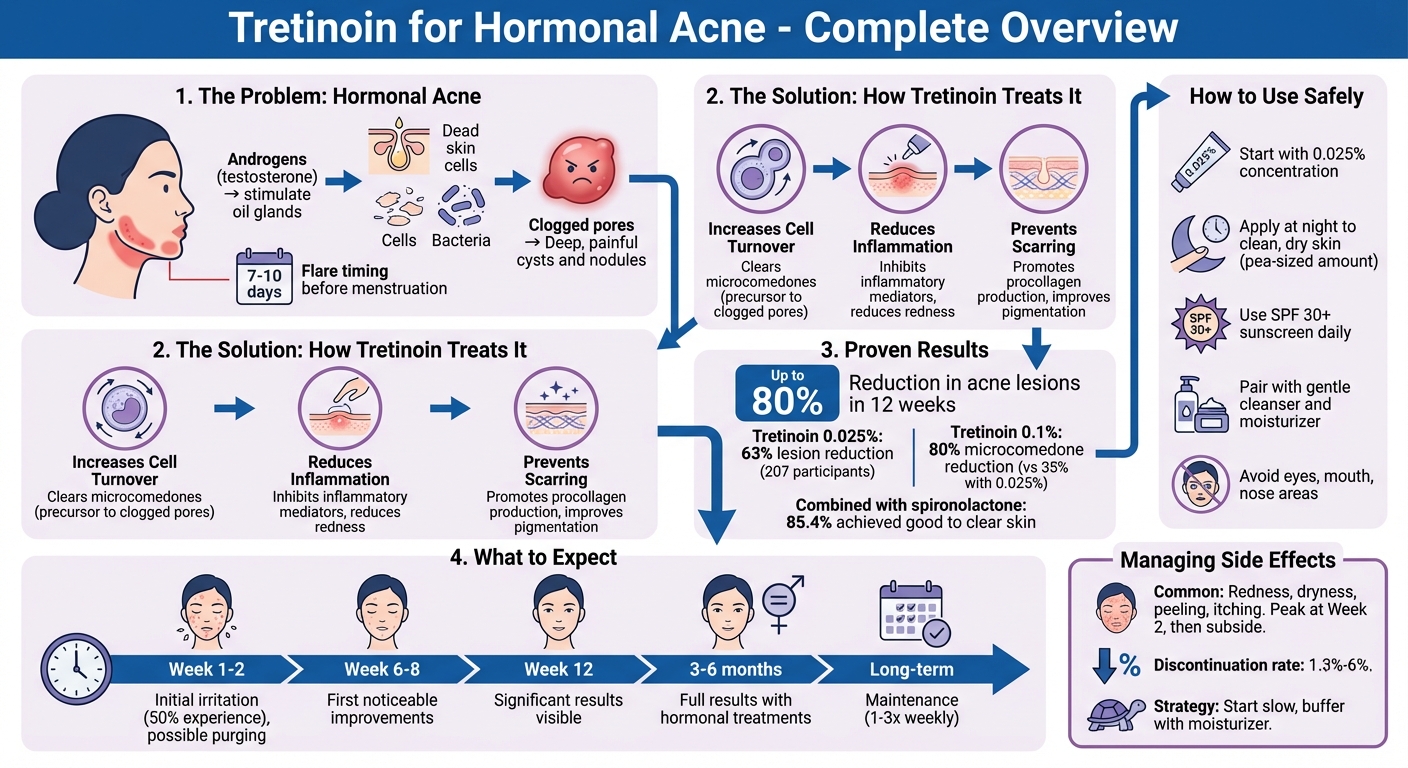
How Tretinoin Works for Hormonal Acne: Mechanisms and Timeline
What Is Hormonal Acne and How Does Tretinoin Work?
Characteristics and Causes of Hormonal Acne
Hormonal acne typically appears around the jawline, chin, and neck - areas with a high concentration of oil glands sensitive to hormonal changes. These breakouts often take the form of deep, painful cysts or nodules that develop beneath the skin rather than surface-level blemishes like whiteheads.
The main culprit? Androgens, including testosterone and dihydrotestosterone (DHT). These hormones stimulate sebaceous glands to produce excessive oil. When this surplus oil combines with dead skin cells and bacteria, it clogs pores and triggers acne. Hormonal acne often flares 7 to 10 days before menstruation, making it a predictable yet frustrating cycle for many. Other contributing factors include stress (which raises cortisol levels and indirectly affects androgens), high-glycemic diets, and hormonal shifts from starting or stopping birth control (or using oral contraceptives for acne).
"Hormonal acne happens when fluctuations in your hormones cause your pores to get clogged and your skin to become inflamed."
– Dr. Jason H. Miller
If you notice acne alongside irregular menstrual cycles, unusual hair growth, or unexpected weight changes, it might be worth consulting a healthcare provider about conditions like polycystic ovary syndrome (PCOS).
Understanding how hormonal changes lead to clogged pores and inflammation sets the groundwork for exploring how tretinoin can help manage these breakouts.
How Tretinoin Treats Acne
Tretinoin, also known as all‑trans retinoic acid, works by binding to retinoic acid receptors in the skin. This action normalizes how skin cells grow and shed, increasing cell turnover to clear out microcomedones (the precursors to clogged pores) and prevent new blockages.
In addition to its exfoliating effects, tretinoin has anti-inflammatory properties. It inhibits inflammatory mediators, which helps reduce redness and swelling. Over time, tretinoin also promotes procollagen production, aiding in the prevention of scarring and dark spots that often follow hormonal breakouts.
"Tretinoin's effectiveness as an acne medication is due to its ability to modify the abnormal follicular formation resulting from excessive keratinization of epithelial cells."
– Athina L. Yoham, University of Miami
To use tretinoin effectively, apply a thin layer to clean skin once daily in the evening. Consistency is key - visible improvement usually takes 6 to 12 weeks. Since tretinoin increases skin sensitivity to sunlight, always pair it with sunscreen during the day.
sbb-itb-6dba428
Research on Tretinoin's Effectiveness for Hormonal Acne
Clinical Studies on Tretinoin 0.025%-0.1%
Tretinoin's impact on hormonal acne has been explored through various clinical studies, showcasing its benefits at different concentrations. For example, a randomized trial with 207 participants found that tretinoin 0.025% gel reduced acne lesions by 63% after 12 weeks, compared to baseline measurements. This concentration effectively targeted both inflammatory lesions (such as papules and pustules) and non-inflammatory ones like comedones.
Higher concentrations, like tretinoin 0.1%, demonstrated even greater efficacy in addressing acne precursors. Over 12 weeks, tretinoin 0.1% reduced microcomedones by 80%, compared to a 35% reduction with the 0.025% concentration. However, the stronger formulation was associated with side effects such as redness and peeling.
Beyond lesion reduction, tretinoin has been shown to improve skin texture and minimize post-inflammatory pigmentation. When combined with clindamycin, its effectiveness further increased - reducing inflammatory and non-inflammatory lesions with ratios of means of 1.48 and 1.87, respectively, compared to placebo.
While these findings are encouraging, they also highlight areas where more research is needed.
Study Limitations and Research Gaps
Although clinical studies underline tretinoin's effectiveness, there are notable gaps in study design and population representation. Many trials focus broadly on "acne vulgaris", with limited research specifically addressing hormonal acne. Adult female acne is often used as a stand-in for hormonal acne, which doesn't fully account for how hormonal fluctuations uniquely respond to tretinoin.
"More data are needed to compare the efficacy of spironolactone and oral antibiotics, as clinical trial data lack generalizability to women of color, patients < 20 years of age, and non-tetracycline-class antibiotics."
– Courtney A. Smith et al., Department of Dermatology, Emory University School of Medicine
Additionally, tretinoin's exact role in modulating epithelial cell differentiation remains unclear. Much of the hormonal acne research stems from contraceptive efficacy studies rather than trials specifically designed for acne. There's also a lack of robust evidence on how hormonal treatments work in combination with topical therapies like tretinoin.
These gaps underscore the need for more targeted research to better understand tretinoin's full potential in treating hormonal acne.
Safety Profile and Managing Side Effects
Common Side Effects in Studies
Tretinoin's side effects are well-documented, with most being temporary and manageable. In clinical studies, around 50% of participants using 0.04% tretinoin gel reported irritation by Week 2. The most common issues include itching (pruritus), skin pain, redness (erythema), and localized irritation.
Nearly all patients experience dermatitis - characterized by redness, localized swelling, and dryness (xerosis) - during the early stages of treatment. For the 0.1% formulation, severe irritation was reported by no more than 3% of participants, while moderate to severe irritation affected fewer than 10% of those using the 0.04% formulation. These side effects usually peak within the first two weeks and then subside as the skin builds tolerance. Additionally, some individuals may go through a temporary "purging" phase as cell turnover increases. Despite these effects, discontinuation rates remain low, ranging from 1.3% for the 0.04% formulation to 6% for the 0.1% formulation.
Strategies to Reduce Side Effects
Managing tretinoin's side effects involves a few key strategies:
- Start slow and low: Begin with a lower concentration and gradually increase as your skin adapts. This approach helps reduce discomfort.
- Apply correctly: Wait 20–30 minutes after washing your face to ensure your skin is completely dry before applying tretinoin. Use only a pea-sized amount to minimize redness and peeling.
- Ease into it: Start by applying tretinoin every 2–3 nights and slowly work up to nightly use. pairing it with combination therapy or a non-comedogenic moisturizer immediately after application (a technique often called "buffering") can further reduce irritation.
- Avoid sensitive areas: Be cautious around the mouth, nose, and eyes, as these areas are more prone to irritation.
Finally, daily use of a broad-spectrum sunscreen with an SPF of 30 or higher is critical, as tretinoin increases your skin's sensitivity to UV rays. Studies have shown that 0.1% tretinoin gel tends to be less irritating than the cream version at the same concentration, a common consideration when comparing natural vs. OTC topical treatments, making it a suitable choice for sensitive skin. While some improvements may be visible within two weeks, consistent results usually take more than seven weeks to appear.
Combining Tretinoin with Hormonal Treatments
Using Tretinoin with Spironolactone or Oral Contraceptives
Tretinoin is already well-known for its effectiveness in treating acne, but combining it with hormonal therapies can amplify the results. While tretinoin works to clear clogged pores and reduce inflammation, hormonal treatments like spironolactone and combined oral contraceptives (COCs) target androgen-driven sebum production, addressing a key cause of acne flare-ups.
In one study involving 41 women using spironolactone (50–200 mg daily) along with topical retinoids like tretinoin or adapalene, 85.4% reported good to clear skin, and 63.4% achieved "excellent or clear" outcomes.
"The addition of spironolactone to topical retinoid treatment suggests a superior response to retinoids alone in clearance of female adult cyclical acne." – Journal of Drugs in Dermatology
This combination is particularly beneficial for women dealing with hormonal acne patterns, such as jawline breakouts, premenstrual flares, or acne that hasn’t responded to other treatments. Another clinical trial demonstrated that women using a formulation of 3 mg drospirenone/20 mcg ethinylestradiol were 4.31 times more likely to achieve clear or almost clear skin compared to those on a placebo. However, hormonal treatments often require patience, as they typically take 3 to 6 months of consistent use to show their full effects.
Thanks to advancements in telehealth, accessing these combined treatments has become easier than ever.
Personalized Treatments Through Telehealth
Telehealth has revolutionized the way acne treatments are delivered, making personalized care more accessible. For example, Oana Health offers customized acne treatment plans that include prescription medications like spironolactone. These plans are designed by licensed professionals who review your medical history, all without requiring an in-office visit. Medications are shipped directly to your door, and shipping is free. Additionally, COCs can now be safely prescribed through telemedicine using dermatology-specific self-screening tools.
For women of childbearing age, it’s essential to use effective contraception while taking anti-androgen treatments like spironolactone, as they can cause pregnancy complications. On the bright side, routine potassium monitoring isn’t necessary for healthy women under 45, as the risk of elevated potassium levels is extremely low - just 0.7%.
Long-Term Results and Practical Considerations
Sustained Results Over Time
Tretinoin works best with consistent use, offering improvements that build over time. Studies show noticeable changes often appear after 6 to 8 weeks of daily application. By the 12-week mark, the results become even more pronounced, and using tretinoin over a year can help maintain clear skin.
Once your skin clears up, you might not need to apply it daily. Many people find that reducing usage to one to three times a week is enough to keep their skin looking good. However, stopping tretinoin altogether often leads to acne and other skin issues gradually returning.
"Retinoids are the core of topical therapy for acne because they are comedolytic, resolve the precursor microcomedone lesion, and are anti-inflammatory; further, they allow for maintenance of clearance." – American Academy of Dermatology
This highlights how tretinoin can be a long-term ally in your skincare routine, which we’ll dive into next.
Adding Tretinoin to Your Skincare Routine
To maintain the benefits, tretinoin needs to be a regular part of your regimen. Apply a pea-sized amount to dry, clean skin at night. Be careful to avoid areas like the eyes, mouth, and nasal creases.
If you’re new to tretinoin, start slowly. Use it every other day for the first 2–4 weeks to help your skin adjust. Beginning with a lower concentration, such as 0.025%, can also make the transition smoother. Over time, you can work up to stronger concentrations like 0.05% or 0.1% as your skin builds tolerance.
Because tretinoin increases sensitivity to the sun, daily sunscreen is a must. Choose a broad-spectrum, non-comedogenic option to protect your skin each morning. Pair this with a gentle cleanser twice a day and a non-comedogenic moisturizer to manage dryness. Also, avoid using benzoyl peroxide simultaneously with tretinoin, as it can reduce its effectiveness.
Consistency is the cornerstone of success. Even after achieving clear skin, continuing tretinoin as part of a maintenance routine can help prevent future breakouts. This is especially helpful for those dealing with recurring hormonal acne.
Is Tretinoin the BEST Treatment For Acne? | Dr Sam Bunting
Conclusion
Tretinoin tackles hormonal acne by regulating cell turnover, clearing clogged pores, and easing inflammation. Studies indicate it can reduce microcomedones by as much as 80% within 12 weeks. Beyond clearing active acne, it also helps improve acne scars and discoloration.
For the best results, consistent use and proper sun protection are critical. Starting with a lower concentration, like 0.025%, and gradually increasing it can help reduce side effects like dryness and peeling. Since tretinoin makes skin more sensitive to the sun, using a daily sunscreen with at least SPF 30 is a must.
When paired with systemic treatments like spironolactone or combined oral contraceptives, tretinoin can address both surface-level symptoms and the androgen-driven causes of acne, enhancing its effectiveness. However, these combinations should always be guided by a healthcare professional to manage risks like drug interactions and ensure safe use.
"Topical retinoids should be introduced as first-line therapy for the treatment of acne and acne sequelae." – Naiem Issa, MD, George Washington University School of Medicine and Health Sciences
If you’re looking for a tailored solution, Oana Health offers telehealth consultations with licensed providers who can prescribe tretinoin, spironolactone, or topical spironolactone. These treatments are delivered straight to your door with free shipping, providing a convenient and personalized way to manage hormonal acne safely and effectively.
FAQs
How does tretinoin work to treat hormonal acne?
Tretinoin works to combat hormonal acne by speeding up skin cell turnover. This process helps clear out dead skin cells and reduces clogged pores, which are common culprits behind breakouts. Additionally, it helps reduce inflammation, easing the redness and swelling that often accompany hormonal acne. By addressing these root causes, tretinoin not only treats current acne but also helps prevent future blemishes.
What side effects can occur when using tretinoin for acne?
Using tretinoin for acne often comes with some mild skin irritation at the beginning. This might include redness, dryness, or peeling. Another thing to watch out for is increased sensitivity to sunlight, which makes daily sun protection a must. In rare instances, some people might notice temporary changes in skin color.
Thankfully, these side effects are usually easy to handle. You can minimize irritation by using a moisturizer, starting with a lower-strength tretinoin, and applying sunscreen every day. If the irritation doesn’t improve or gets worse, it’s a good idea to check in with a healthcare provider for advice.
Can tretinoin be used alongside hormonal treatments to improve hormonal acne?
Yes, you can use tretinoin alongside hormonal treatments to improve the management of hormonal acne. Research indicates that combining topical retinoids like tretinoin with hormonal therapies - such as spironolactone or oral contraceptives - can deliver better outcomes by tackling acne on multiple fronts.
This dual approach helps by addressing surface-level skin issues while also targeting the hormonal imbalances that often trigger breakouts. That said, it’s important to work with a healthcare provider to create a treatment plan that’s suited to your individual needs.